
Shop Loewe — $749
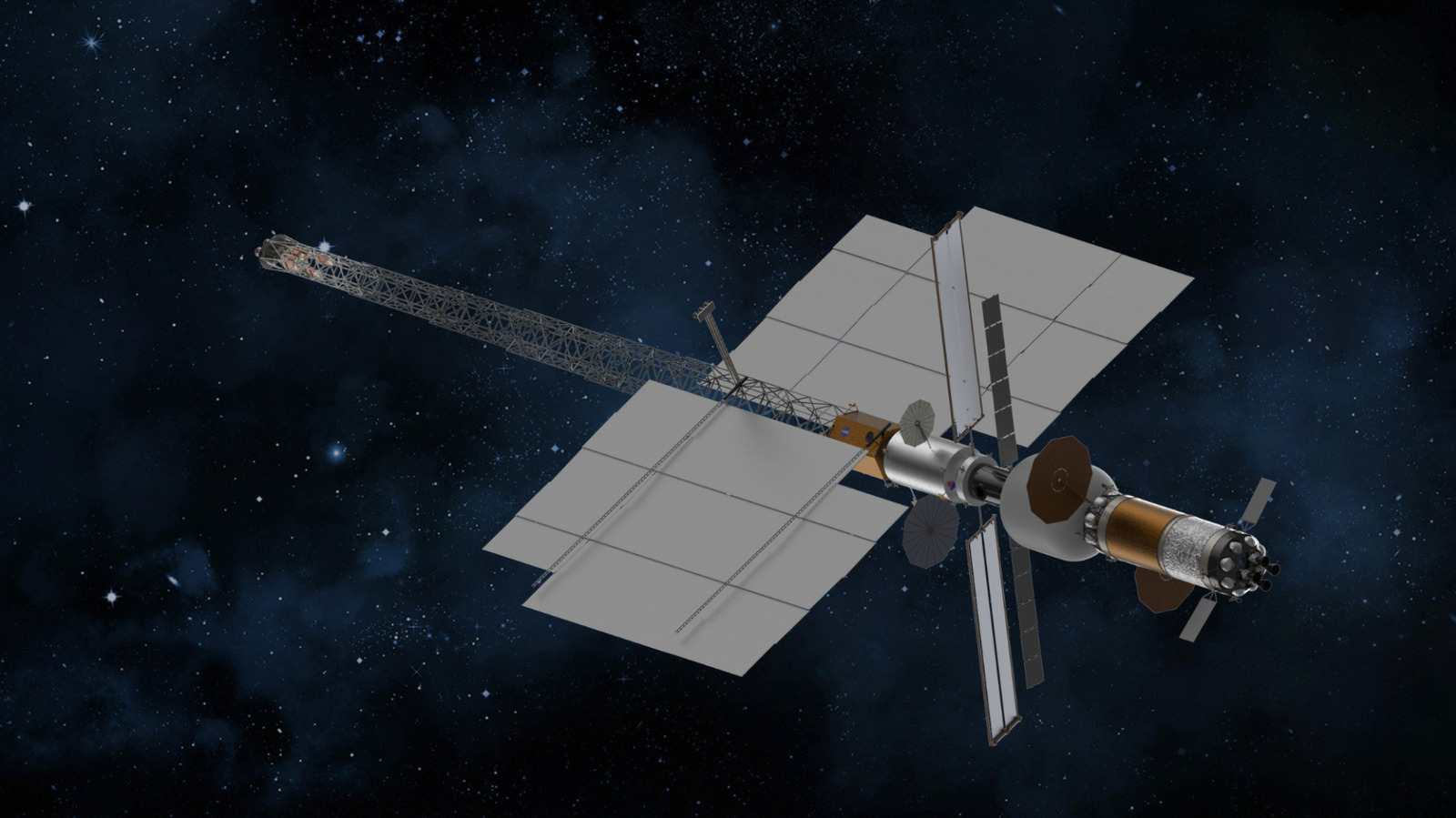
NASA’s next mission sounds more like an Andy Weir space drama than a government project. Debuted at NASA’s March 2026 ‘Ignition’ event, the agency’s first nuclear-powered mission to Mars now has a launch window. The craft tasked with the operation, which boasts the moniker of Space Reactor-1 Freedom, seeks to become the first spacecraft to utilize nuclear electric propulsion in deep space, a potentially revolutionary step in powering man’s exploration of the final frontier.
Conveniently scheduled for the final month of President Trump’s term, NASA administrators are pitching the mission as part of the president’s National Space Policy, which aims to “extend the reach of human discovery, secure the nation’s vital economic and security interests, unleash commercial development, and lay the foundation for a new space age.” These initiatives are part of an accelerated roadmap set on establishing “American leadership in space.” They involve escalating the agency’s moon landing efforts, including a new phased approach to establishing a sustained lunar base, revamping its low-earth orbit strategy in the wake of the impending International Space Station decommissioning, and investing in nuclear electric propulsion. How the administration hopes to achieve these ambitions while slashing NASA’s science budget in half remains a major question.
According to NASA’s announcement, SR-1 Freedom will deliver the agency’s Skyfall mission to the Red Planet. Skyfall, a collaboration between UAV manufacturer AeroVironment and NASA’s Jet Propulsion Laboratory, seeks to probe Mars’ surface with a fleet of three remotely-operated helicopters. If successful, NASA’s delivery mechanism may overshadow its Mars exploration effort, proving a watershed moment for the country’s space exploration efforts. However, experts are dubious of the agency’s professed timeline. Ultimately, NASA hopes this mission will inform its Lunar Reactor-1 program, which seeks to establish the agency’s first permanent nuclear-powered moon base.
How it works
Nuclear propulsion could extend the distance, duration, and speed of space travel. Current rockets are powered by chemical propulsion, in which a mixture of liquefied hydrogen and oxygen ignites to create an explosive reaction. While chemical propulsion provides enough thrust to traverse Earth’s immediate neighborhood, nuclear power is a stronger and more efficient reaction, enabling spacecraft to travel faster and longer than typical propulsion methods. Adding nuclear reactors could also solve NASA’s solar problem. As it stands, most spacecraft rely on solar energy to power their electrical stores, meaning power supplies decrease the farther they move from the Sun. According to NASA, a spaceship’s solar power drops to 4% when it reaches Jupiter. By turning to nuclear space travel, NASA could speed past its current exploration limits.
Nuclear spacecraft mirrors the processes used in earthbound reactors, in which uranium is blitzed with neutrons to generate a massive fission reaction. Gas turbines convert the generated heat into electricity, which ionizes the spacecraft’s gas propellant into a plasma, and the expulsion powers its thrusters. This reaction is much more efficient than conventional chemical fueling methods. Using a different form of uranium than their earthbound counterparts, a nuclear thermal reaction contains roughly 10 times the power density of typical reactors, slashing missions’ fueling needs to a mere fraction of the enormous stores necessitated by chemically-propelled rockets.
Notably, nuclear propellant lacks the initial thrusts necessary to reach orbit, so they’ll likely depend on traditional boosters to launch. However, nuclear fission enables spaceships to steadily accelerate to speeds unachievable by their chemically-propelled forebearers. Future projects utilizing the more powerful nuclear thermal propulsion could cut a visit to Mars by more than two thirds. Some believe astronauts could soon reach the outer solar system in just two years.
Forging ahead
Nuclear space travel isn’t as farfetched as it seems. In the ’50s and ’60s, for instance, both the USSR and U.S. sent nuclear reactors into orbit. Furthermore, radioisotope thermoelectric generators, or RTGs, have been used in dozens of NASA missions. SR-1 Freedom will transition the use of nuclear reactors from generators of the spacecraft’s electrical power supplies to its primary thrust mechanism. Notably, American attempts to harness nuclear propulsion have failed due to cost and safety considerations. The most recent, dubbed DRACO, was a casualty of the administration’s massive 2025 budget cuts to the agency.
NASA will deploy “an American industrial campaign” alongside the Department of Energy to reach its 2028 deadline. Rather than pursuing a more powerful and complicated thermal propulsion system, SR-1 will deploy a simpler electric power-and-propulsion system recycled from NASA’s now-canceled Gateway lunar space station. Reportedly, this electrical system will be rigged to a DOE-designed nuclear reactor, which NASA Administrator Jared Isaacman claimed is “mostly built.”
Although the scientific community is optimistic about its potential, many are skeptical of its timeline. Those interviewed by Science, for instance, noted that a mission like SR-1 would typically take three to five years to design, build, and test. As such, NASA will likely need to move away from its historically careful approach to accomplish this within its truncated timeline, raising safety concerns. Andrew Higgins of McGill University criticized SR-1 Freedom’s “LEGO-like” approach of cobbling together disparate components (via Scientific American). Higgins also noted that its use in the Skyfall mission is likely more a matter of convenience than strategy, as Mars is too near a destination for nuclear propulsion to make an actionable difference. SR-1 may merely prove to be an ambitious test case for more lofty aspirations.






