Posted on

Nokia, Telstra team for network API development

In a project targeting industry use cases for enterprises that use Open Gateway technology, leading comms operator Telstra has forged a collaboration with Nokia to give developers secure access to network application programming interfaces (APIs) to help build smarter applications and integrate them into advanced use cases for enterprises and industries.

The main focus of the Nokia and Telstra collaboration will be on real-world use cases across industries, such as managing network traffic during large events, improving network observability and prioritising critical services.

The partnership will also support Telstra’s network as a product vision of a software-defined, programmable network and explore fixed network use cases, having the developer platform consume APIs from Nokia’s service orchestration software, already deployed in Telstra.

Under the partnership, Telstra’s Muru-D Labs will provide access to a select mix of live and simulated network APIs on Nokia’s Network as Code platform with developer portal, to make it easier for developers to build, test and deploy applications that securely tap into Telstra’s network capabilities.

Muru-D is a development hub for incubating ideas, products and technologies, and is said to have already played a pivotal role in accelerating a portfolio of around 80 startup investments. The hub is currently exploring emerging technologies and prototype services, drawing on expertise in 5G, the internet of things, connectivity, edge computing and applied artificial intelligence (AI).

Through partnerships with industry, experts and universities, Muru-D Labs looks to co-develop real-world solutions to real-world problems. In addition to supporting Telstra’s innovation projects, Muru-D also backs founders driving social and technological impact across AI, virtual and augmented reality, drones, satellites, and robotics. Its process includes prototyping, proof-of-concepts, customer trials, human-centred design workshops and hackathons.

The Nokia and Telstra collaboration will also feature a hackathon later in 2025 for developers to test new ideas and gain hands-on access to live network APIs, looking to open the door for future monetisation opportunities.

Kim Krogh Andersen, group executive of product and technology at Telstra, said the collaboration reflects the company’s recent Connected Future 30 strategy, delivering “increasingly sophisticated and flexible” connectivity capabilities to meet evolving customer needs.

“We’re radically innovating at the core of our business and pushing the boundaries of our network leadership, so that our customers can get the connectivity they need in a changing environment,” he said. “This new collaboration with Nokia is another way we are testing and learning how the power of the network can unlock new value in the tech ecosystem.

“By giving access to advanced capabilities through our network APIs, we’re enabling developers to create smarter, more responsive applications for enterprises. This is about working with our partner ecosystem to demonstrate how developers can securely interact with Telstra’s network and innovate at scale.”

Shkumbin Hamiti, vice-president of network monetisation platform at Nokia, said: “Our collaboration will deepen Telstra’s network integration into developer ecosystems, and provide developers with greater choice, flexibility and security in creating new applications. As more developers explore network APIs, their feedback will shape the next generation of services, and we are excited to work alongside Telstra to drive this.”
Source

Posted on

Pure Enterprise Data Cloud bundles its IP for business outcomes

Pure Storage has launched Enterprise Data Cloud (EDC), which knits together several existing elements in its offering to provide enhanced visibility of data storage and simpler policy-based management-oriented outcomes for the business.

It has also announced new high-performance flash arrays and the availability this year of a 300TB (terabyte) Direct FlashModule, including a solid-state drive (see box).

Also added in EDC – and announced at its Accelerate event in Las Vegas this week – is the capability to build in application and workload-specific orchestration that combines storage, server, networking and application configuration.

Mostly, EDC is a bundling of existing Pure Storage architectural elements. These are the Purity storage OS, which is common to all the company’s arrays; Fusion, which allows discovery and management of storage resources; Pure1, which allows for fleet management in terms of performance and detailed management of resources; and Evergreen, which is the company’s consumption purchasing offer that allows for as-a-service procurement.

But it is a bundling of existing elements that leans into the established mainstream of cloud operating models and builds on common architectural and operating environment elements across the Pure Storage range.

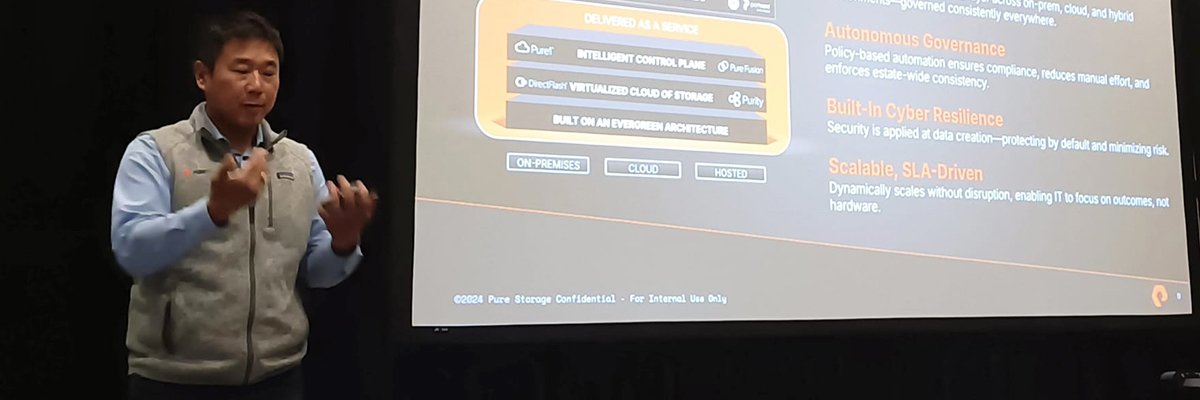
All this combines to provide a cloud-like storage management environment that Pure intends will allow customers to implement “declarative, policy-driven management”, said chief technology officer Rob Lee (pictured above).

The way Pure executives presented EDC is that it provides “higher-level concepts” in storage management that will allow customers to focus on business outcomes rather than managing infrastructure. So, instead of administrators having to manage individual arrays and to provision storage at a very granular level – configuring volumes on a specific array for specific application requirements – that will be superseded by workload-focused outcomes.

“If we look at a lot of the challenges we see customers grappling with today, it boils down to a lot of the elements that really are legacy,” said Lee. “Things like having to do a lot of manual management, driving inefficiency, having to manage tons of individual silos that aren’t making maximal use of the resources that you have on the ground.”

He continued: “We’ve got an opportunity to take some of those lessons from the consumer world, take some of the lessons from the public cloud world, and bring those into the enterprise.”

In other words, customers won’t need to specify storage management activity step-by-step, but will allow the system to decide the details. This, in turn, will allow greater visibility and control over data for the organisation.

“I can transform how I think about, manage, catalogue my datasets, and think about what data I have sitting where, for what purpose, where it came from, how it is secured, what policies are provided for it, etc,” said Lee. “Right now, with too many data footprints, those are questions that can’t even be answered because people don’t have a good handle on what data is sitting where.”

EDC will allow IT organisations to provide storage from on-premise and cloud capacity. It will not be able to directly include storage capacity from third parties, although it will talk to other suppliers’ storage provisions via application workload templates that are another key part of the EDC announcement.

Pure has said it will deliver thousands of orchestrated workflows for specific applications. These connect the Pure environment to third-party applications, such as Cisco, VMware, ServiceNow and Slack. Pure executives term these “recipes” that customers can build for specific applications, with wider collections, or “menus”, possible for multiple applications and workloads. It also expects that customers will write their own or get them from third parties.

Additionally, Pure has partnered with data protection provider Rubrik, where the latter’s cyber monitoring capability triggers Pure snapshots to give the most recent possible snapshot prior to infection by ransomware or the like.

Last year, Pure announced AI Copilot, which allowed customers to interact with their storage at the fleet level and ask questions about it in natural language. That went from beta to general availability at this year’s event.

Also last year, Pure launched Pure Protect, which offers disaster recovery as a service. Then it offered recovery to the Amazon Web Services (AWS) cloud. At this year’s event, it announced that customers would be able to recover VMware environments to a second VMware deployment.

Source

Posted on

Foldable iPad may be delayed, as focus shifts to foldable

Samsung is about to launch the seventh generation of its foldable Galaxy devices, with the Galaxy Z Fold 7 and Flip 7 set to star in an Unpacked press conference next Wednesday. Almost every other big player in the smartphone business has released at least one foldable phone since Samsung’s first Fold device.

Apple is the notable exception, a company known for taking its time before matching the tech offerings of its biggest rivals. But even Apple is now widely expected to launch foldable devices, starting with a foldable iPhone that will be part of the iPhone 18 series next year.

A foldable iPad should follow as early as a year later, unless Apple decides to postpone the release of the larger device. A new report from Asia claims that Apple is doing just that, putting the foldable iPad development on hold while it proceeds with prototyping the foldable iPhone.

Will the foldable iPhone be delayed?

According to Digitimes (via @Jukanlosreve), supply chain sources say the foldable iPhone reached the P1 (Prototype 1) phase this June.

Tech. Entertainment. Science. Your inbox.

Sign up for the most interesting tech & entertainment news out there.

The prototyping period should end by late 2025, when the EVT (Engineering Verification Test) stage begins. Apple would then release the foldable iPhone in the second half of 2026.

The same sources noted that Apple’s original plan included the foldable iPad among the new products in development. The report says it’s “now confirmed” that the foldable iPhone will be released first, with the foldable iPad temporarily on hold.

Digitimes, which isn’t always accurate with Apple rumors, notes that several issues might delay the foldable iPad launch. For example, foldable panels may be more difficult to produce. Also, a higher price tag could impact sales.

Interestingly, analyst Jeff Pu said just a few days ago that the foldable iPhone and foldable iPad might go into production around the same time in late 2026. Pu’s analyses aren’t always accurate. I explained then that his timeline seemed to contradict other reports suggesting the foldable iPhone would launch about a year earlier than the foldable iPad.

Foldable iPhone isn’t a done deal

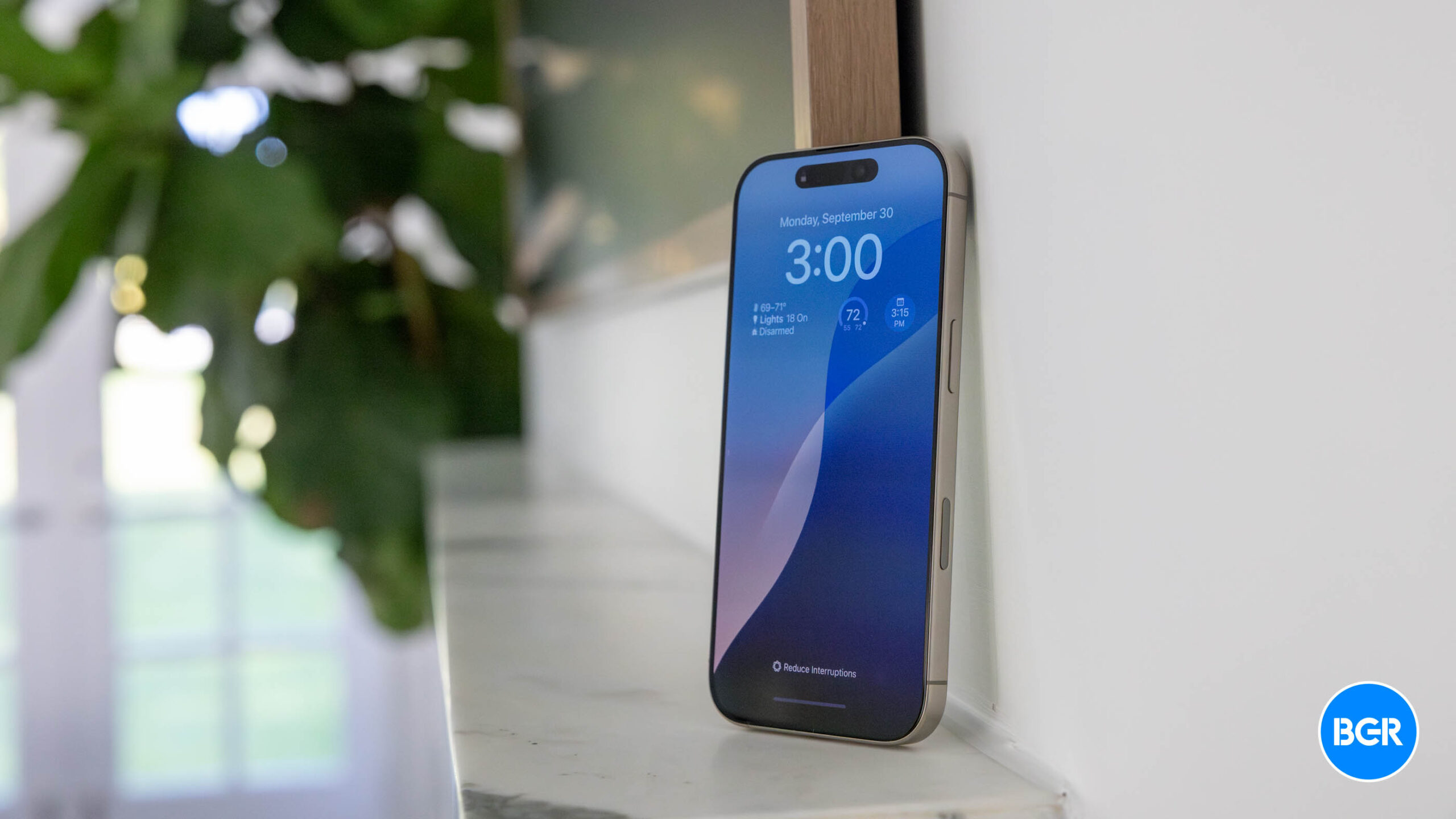
The Galaxy Z Fold 6 features a camera under the foldable display. Image source: Christian de Looper for BGR

While most rumors suggest the foldable iPhone is a certainty for next year, the same Digitimes story explains that Apple suppliers are cautiously optimistic. Apple can always change its mind during prototyping and cancel or delay products.

Some past rumors claimed Apple had abandoned the foldable iPhone. I explained then that Apple is probably just waiting for foldable display makers and hinge suppliers to meet the desired quality standards.

Later rumors claimed Apple is investing significant effort and money to eliminate the crease seen on most foldable phones on the market.

Suppliers tell Digitimes that only once the foldable iPhone reaches the EVT phase will mass production be certain. The handset has been in development for at least five years, and reaching the P1 prototype phase alone doesn’t guarantee Apple will move forward.

An iPhone typically goes through three prototyping stages, each lasting about two months. The foldable iPhone will have to pass through the same P1-to-P3 phases before entering EVT in early 2026.

Suppliers will begin small-volume trial production during the P1 to P3 stages. Apple’s main assemblers will manufacture the first foldable iPhones for inspection. Apple will review the production run and product yield.

The foldable iPhone production schedule mirrors that of the iPhone 17 series launching this year. The report says iPhone 17 models completed EVT early in the second quarter.

There’s no similar schedule for the foldable iPad, or perhaps the same suppliers haven’t leaked that information yet.

If everything goes according to plan, we might see the first schematics for the foldable iPhone leak in late 2025. Dummy models could follow in early 2026. Once that happens, a September 2026 launch would seem likely.

Source

Posted on

Execs shy away from open models and open source AI

A poll of major businesses from the Capgemini Research Institute has found that while using artificial intelligence (AI) for automating repetitive business tasks offers significant savings, the tasks being improved are relatively simple. A significant number of the business leaders surveyed also say they prefer proprietary AI implementations over open source alternatives.

According to the survey of 1,607 executives from organisations with at least $1bn in global revenue, business leaders are seeing a 40% reduction of customer operations costs thanks to AI and generative AI (GenAI). The executives polled also saw a reduction of 26% in people operations costs, and a 24% reduction of finance and accounting costs. Respondents also achieved a 21% reduction of supply chain and procurement costs.

As an illustration of agentic AI potential in the industry, Capgemini highlighted Yum Brands, the parent company of Taco Bell, which operates 60,000 restaurants worldwide. The company introduced an AI-powered restaurant manager to track crew attendance and plan shift patterns, as well as suggest adjusted opening hours to align with market conditions.

While such examples show the potential of AI and GenAI to improve business efficiency, the research found that a significant portion of the gains reported by respondents tend to be associated with automating straightforward, repetitive tasks. According to Capgemini, this suggests the use of AI and GenAI among the executives polled represents early stage efficiencies rather than long-term transformational impact.

Savings need to be balanced against the cost of running the AI system. Capgemini Research Institute noted that the price of querying a trained model is falling dramatically. For instance, OpenAI’s GPT 3.5 experienced a decrease from $20 per million tokens to $0.07 per million tokens, while GPT-4 had a reduction from $15 to $0.12 in a year.

Techniques such as model pruning, quantisation and distillation can be used to reduce the size and complexity of AI models. As Capgemini Research Institute points out, these optimised models require fewer computational resources, which lowers inference costs. Alongside more efficiency algorithms, Capgemini Research Institute said that efficient hardware utilisation, batch processing of inference requests, dynamic scaling to adjust the number of computing resources based on current demand, and energy-efficient algorithms can significantly reduce the power consumption of AI models.

However, although open-source models such as DeepSeek have been shown to achieve an 11x reduction in compute costs without compromising performance and can address the advanced hardware bottleneck many organisations face, the poll showed that business executives are less enthusiastic about open source AI compared with proprietary AI models.

Despite the increasing performance and cost advantages of open-source AI models, Capgemini reported that a significant majority of executives continue to favour proprietary AI implementations. Three-quarters of the executives surveyed prefer proprietary models, with 43% opting for those developed by hyperscalers and another third choosing models from niche providers.

Capgemini found that the preference for proprietary models and AI systems is particularly strong among organisations that have scaled up their investments in AI and GenAI, which, the report’s authors suggest, indicates a clear trend towards trusted, enterprise-grade AI products that offer robust support, security and integration capabilities.

The findings, published in Capgemini Research Institute’s AI in action report, identifies a number of trade-offs that curb enterprise adoption of open-source models due to the trade-offs IT and business leaders need to make. These include the need for greater technical expertise, potential exposure to security vulnerabilities and reliance on community-driven support that can impact update cycles and documentation quality.

Oliver Pfeil, CEO of business services at Capgemini, said: “GenAI and agentic AI can truly transform business services – enabling the shift from traditional cost-focused models towards an AI-enabled, value- and insight-driven business. Those that adopt an integrated approach with data and AI at its core will be set to achieve a truly connected, frictionless enterprise.”

However, he noted that the research suggests organisations face numerous barriers scaling up the deployment of AI agents. “Adopting a pragmatic approach, fostering trust in AI and creating a strong data foundation will go a long way in transforming business services into a strategic powerhouse to fuel any enterprise,” he added.

Source

Posted on

Higgsfield’s amazing viral AI image generator is now free for

Higgsfield Soul is the name of a brand-new AI image generation tool that went viral on social media a few days ago. We’ve seen this happen with other genAI software for creating images and videos from text prompts in the past.

ChatGPT 4o image generation and Google’s Veo 3 are a few examples that stand out. The ChatGPT AI image maker became a massive hit for OpenAI, letting users create images that looked like photos or edit existing pictures with text prompts. Veo 3 introduced audio and dialogue to stunning AI videos a few months later.

Plenty of alternatives are on the market right now, offering creators advanced and affordable tools to generate content with AI. But Higgsfield Soul is something else entirely.

The product lets you create photos using text prompts, and the AI content looks even better than what ChatGPT and Gemini can offer. Users have praised the tool for making the images look like they were captured with real cameras instead of being generated from scratch, avoiding the plasticky feel seen in competitors.

Tech. Entertainment. Science. Your inbox.

Sign up for the most interesting tech & entertainment news out there.

To get the most out of Soul, you’ll need to subscribe to a premium tier, with prices starting at $9/month. But Higgsfield announced that anyone can try Soul for free.

Higgsfield announced on social media that the Soul image generator is free for anyone to try.

Just load this link in your browser or tap the Daily Free Soul Image Generations link at the top of the Higgsfield home page.

Once you log in, you can use Higgsfield for free to generate a few images each day. You’ll need a subscription if you want more credits for Soul AI image generations after that.

What’s so special about Higgsfield Soul?

Like ChatGPT and Gemini, the Soul prompt composer lets you type in the instructions the AI will follow to generate images. You can choose the model, aspect ratio, and desired quality.

What sets it apart is the button that reveals the magic behind it. Tap the button to the right of the prompt composer, and you’ll see over 50 visual styles to choose from, as shown below.

Higgsfield Soul prompt composer lets you select from 50+ visual styles. Image source: Higgsfield

Higgsfield designed these models to help creators generate images that look like they were taken with an iPhone or any real camera.

Instead of describing camera effects in detail, you can start with one of the visual styles in the gallery and go from there. It makes it easier to create an AI image that suits your needs.

You can still describe in detail the kind of AI images you want Soul to generate. The more information you give, the easier it is for the AI to deliver what you want.

Here’s a prompt example from a Soul sample that Higgsfield offers on its website:

A candid urban street photo featuring a duo dressed in futuristic mirrored visors and iridescent parkas, standing casually in front of a heavily graffitied wall. The wall is adorned with prominent large chrome typography split into two lines: “FUTURE” “DECAY” surrounded by intricate swirling graffiti spirals. The reflective chrome paint casts shimmering light reflections onto their iridescent parkas and visors, enhancing the futuristic vibe. Natural daylight mingles with the metallic gleam, creating authentic urban light contrasts and subtle shadows. The textured wall shows realistic graffiti paint drips, slight weathering, and rough concrete imperfections. The composition is casually framed with a slightly tilted angle…

Here’s the resulting image:

The writing on the wall. Image source: Higgsfield

As you can see, the prompt is very detailed, outlining everything the creator wanted to appear in the image. The content creator also selected the “Graffiti” visual style for the image Soul generated.

Other samples on Higgsfield’s website include similarly detailed prompts. But you can include as much or as little detail as you like. The composer will be filled with “surprise me” by default when you load it. That’s a valid prompt, too.

Shorter prompts might not deliver exactly what you’re looking for. The images will still be impressive, but you may need to fine-tune your prompt. If you’re not on a premium plan, you’ll have to wait until the next day for another set of free credits.

It looks like you can generate up to two images for free with Soul every day.

Source

Posted on

Enterprise LAN sector rebounding

After two years of volatility driven largely by the drawdown of backlogged product orders stemming from the Covid-era global supply chain crisis, the enterprise worldwide wireless local area network (WLAN) market grew 10.6% in the first quarter of 2025 to reach $2.3bn in value, according to research from IDC.

The Worldwide quarterly wireless LAN tracker calculated the total market revenue, value and unit shipments of the WLAN arena in a geographic coverage taking in 60 countries in nine major regions, including the US, Canada, Latin America, Japan, China, the rest of the Asia-Pacific region, Western Europe, Central and Eastern Europe, the Middle East, and Africa. The analysis was further segmented by product class, product type, product standard and location.

The study observed that the market’s supply and demand dynamics are stabilising as annualised growth in the first quarter of 2025 built on the momentum in 2024, when market revenues increased in each sequential quarter of the year. This included rising 4.8% between the third and fourth quarters of 2024 and growing 5.8% between the second and third quarters of 2024.

Looking at other growth engines, IDC also pointed to acceptance of the latest Wi-Fi standards driving growth in the enterprise WLAN market. Wi-Fi 6E, which enables Wi-Fi to utilise the 6GHz band of unlicensed spectrum, accounted for 31.9% of dependent access point market segment revenues in Q1 2025, compared with making up 27.7% of the segment’s revenues a year earlier.

The survey also found that Wi-Fi 7 adoption increased in the first quarter, too, making up 11.8% of the dependent AP segment’s revenues in Q1 2025, growing from 10.2% of dependent AP revenues in the fourth quarter of the previous year.

From a geographical perspective, in the Americas, the enterprise WLAN market increased 15.2% year-on-year in Q1 2025, driven by strong growth of 21% in the US. In the Europe, Middle East and Africa region, the market grew 11% on an annual basis, while in the Asia-Pacific region, revenues grew 1%, as market revenues in China declined 4.2% year-on-year.

Looking at the performance of the leading individual enterprise WLAN suppliers, the study revealed that during the quarter, Cisco’s enterprise WLAN revenues rose 4.6% year-on-year in Q1 2025 to reach $904.5m, giving the company market share of 39.5%, more than double that of next-best-ranked rival HPE Aruba Networking (15.9%), for whom revenues grew 10.7% year-on-year in Q1 2025 to reach $363.9m.

Rounding out the top five were Ubiquiti, which generated enterprise WLAN revenues of $267.4m, increasing 50.9% on an annual basis in Q1 2025, leading to a market share of 11.7%; followed by Huawei, whose enterprise WLAN revenues actually fell 10.7% compared with Q1 2024 to total $124.1m, giving the company market share of 5.4%. Finally, Juniper Networks saw enterprise WLAN revenues increase 21.9% year-on-year in Q1 2025 to total $120.9m, leading to a market share of 5.3%.

“The enterprise WLAN market continues to reset after a volatile period of annualised growth rates, driven by complex supply chain disruptions and inventory management issues impacting both vendors and end users,” said Brandon Butler, senior research manager of enterprise networks at IDC.

“The fundamentals of the enterprise WLAN market remain strong, however, with exciting innovations such as 6GHz Wi-Fi and AI-powered management capabilities continuing to power the next generation of wireless connectivity.”

Source

Posted on

How Apple plans to make the next iPad Pro even

The M4 iPad Pro is one of the best products Apple has developed in recent years. The ultra-thin design combined with the M4 chip, a nano-texture option, and a revamped Magic Keyboard makes this tablet one of the best pieces of hardware on the market.

With rumors about Apple planning to release an M5 version as soon this year, it seems one of the new features could be even thinner bezels. According to The Elec, LG Innotek could be responsible for providing Apple its chip-on-film (CoF) for iPad OLED panels.

The publication says Apple is expected to either reject or approve this new panel in June. So far, Apple has exclusively used a display driver IC (DDI) supplied by Samsung System LSI. This new technology could help to shrink the visible bezels on Apple’s best iPad, making it even more compelling for new buyers.

While I don’t think this will be enough to make M4 iPad Pro users upgrade, other rumors reveal that the company wants to add a landscape-oriented Apple logo and its own 5G modem by 2027. In a few years, Apple also wants to update the OLED panel. So far, reports say Apple will be using 8th-generation OLED technology for 2026 MacBook Pro models. The current iPad uses 6th-gen tech, which could later expand to the iPad.

Tech. Entertainment. Science. Your inbox.

Sign up for the most interesting tech & entertainment news out there.

iPadOS 26 bridges the gap between the past and future of the iPad Pro

Image source: Apple Inc.

This rumor indicates that Apple wants to keep improving its state-of-the-art product, even though the M4 iPad Pro is still a compelling upgrade for any tablet user.

While the M5 chip will only make this product better, the company is finally taking on the biggest issue with the iPad Pro: iPadOS. The recently-announced iPadOS 26 adds Mac-like menus, a new windowing system, and improved Files and Preview apps.

These changes alone are enough to make the iPad look more like a Mac, while still being a touchscreen-first device. That said, users will finally be able to take advantage of the iPad’s best capabilities with the features this upcoming software update unlocks.

Source

Posted on

iPhone users angry after receiving Apple Wallet notification for upcoming

With Brad Pitt’s F1 movie set to hit theaters this week, Apple thought it might be a good idea to provide iPhone users with a little bit of an incentive to see the film in theaters. In theory, the plan made sense. In practice, it generated furious backlash from users.

Here’s what went down. On Tuesday afternoon, some iPhone users noticed a push notification from their Wallet app. The notification was, in essence, a promotion whereby users purchasing two tickets to the film on Fandango would be able to do so with a $10 discount. As to why this promotion even exists, recall that Apple is one of the film’s distributors. In turn, the film will ultimately end up as an offering on Apple TV+ following its theatrical run.

U2 all over again – iPhone users aren’t happy

Predictably, Apple’s strategy here generated a lot of backlash. And while it’s possible that we’re only hearing from a very vocal minority, the drama surrounding the incident is large enough that the move seems to have backfired.

Here’s how the promotion appeared on user devices:

Tech. Entertainment. Science. Your inbox.

Sign up for the most interesting tech & entertainment news out there.

Remember, iPhone users don’t appreciate when promotions they didn’t ask for magically appear on their devices. Even when it’s free, it can still be distasteful. As a prime example, remember the uproar when Apple automatically downloaded U2’s Songs of Innocence album to millions of iPhones?

Users felt violated, arguing that Apple’s move reeked of corporate overreach. Keep in mind that this was before streaming became commonplace, and iPhone users, at the time, took their music libraries very seriously. In short, many users were dismayed, if not furious, that an album was added to their iTunes library without their permission.

Responding to the controversy, U2 front man Bono said that the intention behind the partnership was pure, albeit misguided. Bono articulated that the band simply wanted to make its album accessible to swaths of people who might not otherwise be exposed to it.

“We wanted to deliver a pint of milk to people’s front porches, but in a few cases it ended up in their fridge, on their cereal. People were like, ‘I’m dairy-free.’”

Response to the F1 Wallet app notification

Similar to the U2 fiasco, users aren’t happy with the F1 push notification, which is essentially an advertisement. Some iPhone users lamented that avoiding this type of chicanery is precisely why they left Android, only to see it emerge on Apple’s platform. One user on the iOS subreddit sums things up nicely: “I did not pay over $1000 for an iPhone to get advertised at.”

Perusing what people are saying on X reveals more of the same: People blasting Apple for putting ads in their notifications.

To wit, one user on X wrote the following: “I love living in the future where the manufacturer of my phone makes a movie and sends me advertisement push notifications via my wallet.”

Another user writes: “Not a lot of notifications have access to give me notifications. Apple broke that trust so now the wallet app notifications have been disabled.”

How to turn off Wallet app notifications

Indeed, Apple’s move here is particularly frustrating because notifications from the Wallet app are typically useful. I’d personally recommend keeping them on as I imagine Apple won’t try a stunt like this again anytime soon. But if the F1 ordeal left a bad taste in your mouth, here’s how to turn off notifications to ensure you’re not bombarded with another promotional stunt.

Open up the Settings app and then select the Notifications pane. From there, scroll down until you see the Wallet listing. From there, turn the “Allow Notifications” toggle to Off.

Notably, Apple allows more granularity with Wallet app notifications in iOS 26. Specifically, if you go to the Wallet app settings pane in iOS 26, you’ll see an option to toggle off notifications pertaining to “Offers & Promotions.”

Image source: Apple

We imagine that once iOS 26 ships, this toggle will be turned on by default. What’s more, the fact that this toggle even exists suggests that iPhone users can expect more promotions in the future.

The bigger picture – F1 looks great

Putting the saga surrounding Apple’s questionable marketing tactics aside, F1 looks to be a great movie. If you’re not yet familiar, it’s a sports drama about a Formula One driver – played by Brad Pitt – who’s forced into an early retirement following a brutal crash. Ultimately, he comes back to the sport he loves to help mentor a hotshot new driver.

The movie comes from the same team as Top Gun: Maverick, which is evident from the trailer below.

As we highlighted earlier this month, the early feedback about the movie has been overwhelmingly positive. Of course, nothing is a guarantee until release day comes. But the film, buoyed by Pitt’s star power and Apple’s bank account, might be on track to be the film of the summer.

Source

Posted on

Brazil’s defence, public safety agencies unify comms with federal network

The Brazilian Telecommunications Agency (Anatel) is to deploy a federal mission-critical communications service based on technology from Motorola Solutions.

Brazil’s defence and public safety agencies have in the past struggled with real-time coordination, with the bodies’ use of separate communication systems causing delays that undermined response efforts.

To address these challenges, the Band Administration Entity (EAF), an organisation created by Anatel, has selected Motorola Solutions to implement a federal mission-critical communications offering that will enable Brazil’s defence and public safety organisations to seamlessly collaborate during joint missions.

Rolling out from the capital, Brasilia, the product will enable agencies to coherently share information, coordinate responses and make better-informed decisions for the protection and service of Brazil’s communities.

As a combined nationwide service, organisations such as the Brazilian Army, the Federal Highway Patrol and the Distrito Federal Military Police will be equipped with the trusted reliability and resiliency of land mobile radio (LMR) voice communications together with advanced broadband capabilities, including video streaming, and the ability to share rich data and multimedia.

“Efficiently addressing drug trafficking, organised crime and natural disasters demands highly coordinated multi-agency responses,” said Geraldo Segatto, head of government private network project at EAF.

“In the past, defence and public safety agencies, each using separate communication systems, struggled with real-time coordination, causing delays that undermined response efforts. The new solution eliminates these communication barriers, enabling reliable connectivity for federal agencies and, in its next phase, state military and civil police, to significantly improve response times and mission success.”

Motorola Solutions will integrate multiple existing LMR systems and add mission-critical Push-to-X (MCX) broadband services to enhance interagency interoperability and access to data applications to better protect Brazil’s communities.

In addition, EAF will implement Wave PTX, a 3GPP standards-compliant communications platform that will run on the government’s private 4G network, and Critical Connect, a service that will enable interoperability between the 4G network and P25, Tetra and DMR land mobile radio systems.

“Motorola Solutions is proud to support Brazil’s vision for public safety modernisation by delivering a communications platform that bridges the proven reliability of land mobile radio technology with the media-rich capabilities of MCX broadband services,” added Edison Ambrosio, sales director of defence and federal markets at Motorola Solutions.

“This integration provides Brazil’s defence and public safety agencies with resilience, enhanced situational awareness and seamless interoperability for faster and more effective emergency response across the nation.”

The deployment in Brazil comes after Motorola Solutions ended 2024 by expanding its emergency communications offer in Europe, in particular furthering its control and command centre portfolio with the acquisition of 3tc, a provider of control room software services for Fire and Rescue Services and Police.

3tc’s flagship computer-aided dispatch software is designed to maximise 999 call-taker speed and efficiency in high-stress environments. The single-screen software gathers and synthesises critical data that enables call takers to display the real-time location of the caller and the closest emergency responders to dispatch help more quickly.

Source

Posted on

Here’s what Apple’s new iPhone 18 Pro design might look

An increasing number of reports claim Apple is planning two major display updates for the iPhone in the coming years.

First, Apple will move the Face ID sensors under the display, shrinking the top cutout to a hole-punch camera. After that, the selfie camera will also go under the screen. The result would be an iPhone with a flawless display and no visible cutouts.

But a few key insiders disagree on the timeline. Mark Gurman recently said the iPhone 18 will have a smaller Dynamic Island, while the iPhone 20 will debut an all-screen design with no cutouts.

Ross Young responded on X that Apple will use a three-phase approach spanning up to five years. A smaller cutout is expected with the iPhone 18 series, but Face ID components will still be located in that area. Two years later, those cameras will move under the display, leaving only a hole-punch for the selfie camera. By 2030, if Young’s info is right, the selfie camera will also be placed under the screen.

Tech. Entertainment. Science. Your inbox.

Sign up for the most interesting tech & entertainment news out there.

A developer looked at these display rumors and created two iPhone 18 Pro concepts that align with some of the predictions.

Hole-punch selfie camera on the left

Gurman and Young aren’t the only ones talking about the screen changes coming to future iPhones. The Information reported last month that the iPhone 18 Pro and 18 Pro Max will feature a small hole cutout in the top-left corner for the front-facing camera.

Gurman’s latest report didn’t specify the location of the selfie camera. He only mentioned a smaller Dynamic Island.

Developer Filip Vabroušek shared the following concept on X:

iPhone 18 Pro concept with hole-punch camera on the left. Image source: X

This render was created before Apple revealed the new Liquid Glass design for iOS 26 and its other platforms. But for this concept, the look of iOS doesn’t really matter.

I mentioned a few weeks ago that placing the selfie camera on the left could give the iPhone 18 Pro models a unique look. Most Android phones with hole-punch cameras center them.

The iPhone 18 Pro wouldn’t be the first phone with a selfie camera near a corner. The left side is the only viable spot. The rear camera is on the right side when viewing the screen, so there’s no room there for a front camera.

In this setup, the Dynamic Island would either be integrated with the hole-punch or placed in the middle of the screen. Apple won’t ditch Live Activities, which is a software feature. This is just speculation on my part.

A smaller Dynamic Island

This concept assumes Apple is confident that under-display Face ID won’t hurt speed or accuracy.

Young had this to say about the 2026 iPhone design: “2026 – smaller notch as some under-panel Face ID elements remain in the notch rather than transparent under the panel.” That suggests Apple may take a gradual approach, or the screen section covering the Face ID hardware won’t have active pixels.

The same developer adjusted the iPhone 18 Pro concept based on Young’s comments:

iPhone 18 Pro concept with smaller Dynamic Island cutout. Image source: X

The Dynamic Island cutout still looks like a pill here, but it’s smaller than what we’ve seen since the iPhone 14 Pro models.

In this version, the Dynamic Island would function just like it does now, wrapping around a smaller cutout.

This design would mirror what Apple did with the iPhone X notch. Before switching to a pill-shaped cutout, Apple reduced the notch size.

Source