Posted on

‘Sensitive’ data stolen in Westminster City Council cyber attack

Westminster City Council has said that “potentially sensitive and personal” data was stolen by hackers during the cyber attack that hit three neighbouring London authorities last month.

Westminster is part of a shared IT services operation with the London Borough of Hammersmith and Fulham, and the Royal Borough of Kensington and Chelsea (RBKC), with all three affected by the attack, which was first detected on 24 November.

RBKC said four days later that it had experienced a data breach during the attack, but Westminster has now confirmed that, following further examination, its data was copied and taken by a third party that infiltrated IT systems operated by RBKC.

“The council has established that the Westminster breach involves some limited data, hosted in the Royal Borough of Kensington and Chelsea’s shared IT environment, which is likely to contain some potentially sensitive and personal information,” said Westminster council in a statement published on its website.

“Work is underway to establish what exactly the data entails and how it relates to individuals, as part of a comprehensive process in line with the Information Commissioner’s Office recommendations, which will take some time to complete. The data is not lost or deleted, and there is no indication at this stage that it has been published online.”

RBKC added in a separate statement: “Following extensive investigation with cyber security specialists from NCC Group and independent forensic experts, we can confirm that this was a cyber attack with criminal intent, with data copied and taken away.”

The councils said the attack was detected quickly and they believe it was stopped before it could spread to other systems. “There is no evidence of any lateral movement,” said RBKC.

The Metropolitan Police, the National Crime Agency, and the National Cyber Security Centre are also involved in the investigation.

Westminster councillor David Boothroyd, cabinet member for finance and council reform, reassured residents that the council is doing everything possible to respond to the incident and to keep delivering services.

“Our priority is to support and protect the most vulnerable in our community, despite the disruption that is being caused. We acted quickly to secure our systems, and we are working towards restoring council services as safely and swiftly as possible, but this will take time. We remain committed to transparency and will continue to provide updates as our recovery progresses,” he said.

RBKC said it will “take months” to fully check for any further data exfiltrated from its systems. The borough said it has written to more than 100,000 households with advice on what to do if they are worried about the data breach.

“We’re working to restore all systems securely, but this will take time. Essential services, including those supporting vulnerable residents, are being prioritised,” said RBKC. “Our investigation is ongoing and will take several months, due to the complex nature of the attack and the data involved, and the need to restart many of our systems.”

Public services were affected at all three councils affected. In Hammersmith and Fulham, multiple services were affected, with most of its online offerings unavailable, including council tax accounts; business rates payments; benefits accounts; housing, including repairs; parking permits, fines and on-street bay suspensions; freedom pass applications; and property licensing.

In Westminster, the disruption also extended across multiple services, including rent and service charge payments; council tax and business rates; housing repairs; local support payment applications; community hall bookings; birth, death and marriage certificates; children’s services referrals; complaints; licensing; and online waste and recycling services, including bulky item collections and requests for more recycling bags.

The UK government also admitted today that IT systems at the Foreign, Commonwealth and Development Office were hacked in October, but insisted the attack had a “low risk” of personal data being compromised.

Source

Posted on

European Commission renews UK data adequacy agreement, ensuring continued free

The European Commission has renewed its data adequacy agreement with the UK, guaranteeing free flow of data with the European Union (EU) for a further six years.

The agreement assures that the UK’s data protection framework is considered to have equivalent safeguards to the EU, based on two European regulations – the General Data Protection Regulation (GDPR) and the Law Enforcement Directive (LED). The existing adequacy arrangement was due to expire on 27 December but will now continue until the same date in 2031.

Minister for digital government and data Ian Murray said in a post on X (formerly Twitter) that he was “thrilled” at the decision.

“I’m thrilled to welcome the EU’s renewal of its two adequacy decisions for the UK. We remain committed to enabling secure, trusted data flows between the UK and EU to support growth, innovation and security,” he wrote.

Henna Virkkunen, executive vice-president for tech sovereignty, security and democracy at the European Commission, said the renewal of data adequacy benefits businesses and citizens on both sides of the Channel.

“It ensures the free flow of personal data between the European Economic Area and the UK in full compliance with data protection rules while reducing costs and administrative burdens. This continuity allows European companies to keep sharing data seamlessly with their UK partners, supporting innovation, competitiveness and trusted digital cooperation.”

Data adequacy with the EU became a critical issue after the UK left the bloc, and the original 2021 agreement was based on the measures introduced by the Data Protection Act 2018 (DPA).

In June this year, the government amended parts of the UK’s data protection regime through the Data (Use and Access) Act, which aimed to make it easier for businesses and the public sector to share data, which the government claimed would ease bureaucracy and improve efficiency.

Several civil society groups wrote in June to Michael McGrath, European commissioner for democracy, justice, the rule of law and consumer protection, calling for the EU to rescind the UK’s data adequacy status, citing major concerns around the erosion of privacy and data rights and warning of “a substantive risk” that fresh UK adequacy decisions could be struck down by the European Court of Justice.

“Allowing third countries such as the UK to benefit from unrestricted personal data flows with the EU while simultaneously weakening legal safeguards at home does not only endanger the rights of people in the EU, it also undermines the credibility of the EU’s data protection framework, exposes EU businesses to unfair competition, and devalues the Union’s regulatory leadership on the global stage,” they wrote.

“The UK government’s proposed reforms and recent actions threaten to imperil the UK’s data and privacy protections. This status of affairs will fuel uncertainty and threaten individuals and businesses alike.”

There were also warnings in Parliament that police use of US-based hyperscale cloud providers for processing sensitive law enforcement data could put adequacy with the Law Enforcement Directive at risk.

In June 2024, Computer Weekly revealed that UK policing data uploaded to Microsoft cloud services is routinely sent offshore for some forms of processing, in an apparent breach of the LED.

During a debate in the House of Lords in March, Liberal Democrat peer Tim Clement-Jones highlighted how cloud service providers routinely processed data outside the UK, and were unable to provide contractual guarantees to policing bodies as required by Part Three of the DPA, which implements measures in the LED: “As a result, their use for law enforcement data processing is, on the face of it, not lawful,” he said.

To circumvent the lack of compliance with these transfer requirements, the government simply dropped them from the new data act.

“The government’s attempts to change the law highlight the issue and suggest that past processing on cloud service providers has not been in conformity with the UK GDPR and the DPA,” said Clement-Jones, at the time.

Commenting on the renewal of data adequacy, European commissioner McGrath said, “The UK is an important strategic partner for the European Union and the adequacy decisions form a central pillar of this partnership.

“By enabling the free flow of personal data, they underpin both commercial exchanges and cooperation in the fields of justice and law enforcement. Their renewal reflects the Commission’s assessment that the UK’s legal framework continues to provide robust safeguards for personal data that remain closely aligned with EU standards, including in the context of recent legislative developments.”

Source

Posted on

4 Cheap Smart TVs To Avoid, According To Users

Giuliano Benzin/Getty Images

We may receive a commission on purchases made from links.

Buying a cheap smart TV can definitely be a frugal financial move. Otherwise, if you want the best of the best, you should be willing to splurge north of $2,000 for a high-end model from top brands like Samsung, Sony, and LG. Although you won’t get the bells and whistles offered by high-end smart TVs — or even the best possible picture quality — with most cheap TVs, these sets can still be a worthwhile buy. However, before you spend your hard-earned money, you should understand that buying an inexpensive TV can mean a compromise in quality. 

There are great, cheap smart TVs that you can buy, of course, but if you’re not informed, it’s easy to make an expensive mistake by selecting models that have given previous buyers trouble. Regardless of the sticker price, you shouldn’t buy a TV now and have to repair it in the next year, or be forced to get a new model because the one you bought failed. 

In fact, cheap TVs can last for years. This is more likely to be the case if you avoid models that have poor ratings, and those that previous buyers discourage anyone else from purchasing. We’ve scoured the internet to find cheap smart TVs that you should definitely steer clear of, based on user reviews, weighting quality concerns and longevity in particular.

Panasonic W70 Series

Panasonic was a giant in the plasma TV market, and at one point, it was a leader in the category in the U.S. market. Despite exiting the U.S. market for about a decade, it bounced back and has been releasing new TVs stateside since 2024. If you want a cheap model from the company, the W70 series might seem like the perfect fit, as it comes in various screen sizes, starting at 43 inches. The 43-, 50-, and 55-inch variants are pretty affordable, going for under $400 without any discount applied. 

All variants have a 4K LED panel with HDR10+, HDR10, and HLG support, four HDMI ports, including one HDMI 2.1 port for higher bandwidth, and AirPlay for playing content from your iPhone. These specs make the W70 series quite tempting if you’re shopping for a TV on a budget, but don’t be fooled. The W70 series hasn’t exactly impressed some who purchased the model. The 43-inch variant is marked as a frequently returned item on Amazon, which is a clear sign it may not live up to expectations.

Several users reported problems with the display, some right out of the box, including dark spots, glitching, flickering, and the screen turning green. Some also ran into issues with the TV’s sound after a few weeks of use. One user noted that the W70 series isn’t like Panasonic TVs of the past, and had to return it. The W70 series has a 3.9-star rating out of 5 on Amazon.

Vizio 24-inch V Series

Vizio sells some of the cheapest smart TVs on the market and is one of the recommended brands if you want a TV on a tight budget. However, while the company does sell solid TVs for the price, don’t assume that all of its products are excellent — case in point: the 24-inch Vizio V series TV. For transparency, we’ve featured the 43-inch and 55-inch Vizio V series TVs in our roundup of the best cheap smart TVs under $400.

But this 24-inch model is not worth your money, according to users on Amazon. This model features a 24-inch LED screen with 720p resolution, which is certainly lower than many TV models on the market in 2025, even the cheapest ones. The 24-inch screen may be too small for today’s TV viewer, and one user noted that it’s “very small” and “very hard to see.” 

Another user complained about their horrible experience using the TV as it constantly freezes and, to add insult to injury, takes its time to boot, prompting multiple restarts. This TV costs $79.99 without any discount, which could be tempting if you’re looking for the cheapest TV you can get. However, its quality can be summarized by its 3.6-star rating on Amazon.

FPD 43-inch CG43-P3 smart TV

Flat Panel Display (FPD) is a Chinese electronics manufacturer that makes a handful of TVs. It isn’t as well-known as major TV brands like Samsung and LG, and its products target the budget-conscious shopper who needs a brand-new set for less. If you’re shopping for a cheap 43-inch TV, the company’s CG43-P3 model might seem like a perfect fit.

It costs just $186 on Amazon and includes a FHD (1080p resolution) LED display, HDR10 support, a nearly bezel-less design, two HDMI 1.4 ports, two USB ports, an optical port, an Ethernet port, and Dolby Atmos for better audio. It runs on the Google TV operating system, which is great as it gives you access to a wide range of apps. However, it’s not all sunshine and rainbows for this smart TV. According to user reviews, this model has numerous issues. Several users highlighted that the TV has poor sound quality, with one comparing the built-in speakers to those of an iPhone 4. 

You’ll also have a hard time mounting this model to the wall, because, as one reviewer suggested, it doesn’t use standard mounting holes. Quality is another issue, one said it’s “cheaply made”, while others spoke of its sluggish performance. Reliability seemed to be an issue for several users as well, which is a telltale sign that you shouldn’t get this TV if you want something that’ll last.

15.6-inch Supersonic SC-1520V LED TV

This is another TV from Supersonic that’s been poorly received by users. Unlike the model above, it’s a smart TV that’s powered by Hisense’s VIDAA operating system. It has a small 15.6-inch screen boasting 1080p resolution and will cost you $159.99. It may seem like the perfect TV for anyone with a small space — for example, an RV, boat, or truck. However, there’s a reason why this model is marked as frequently returned by Amazon.

One problem with this TV that users on Amazon highlighted is poor sound quality — though most mentioned its larger 19-inch counterpart in this regard – which means it’s likely hard to enjoy viewing without an external speaker. Another common complaint from several users who bought the TV is the lack of certain apps in the VIDAA app store, including DirecTV, Hulu, and Paramount+. Some also said their units stopped working after a few weeks or months of use.

How we selected these TVs

Andreypopov/Getty Images

While compiling this list of the worst cheap smart TVs to avoid, we only considered models that cost less than $400 without any discount applied. We also looked at those holding low ratings from users on Amazon or Walmart. To make our selection more precise, we focused on TVs that have a rating of 4.0 or less out of 5 based on at least 30 reviews.

We also looked at the issues users highlighted in their reviews and gave priority to those that affect the longevity and watching experience, such as build quality, sound quality, picture quality, and reliability.

Source

Posted on

Will Quantum Computing Kill Bitcoin?

For years, the conversation around quantum computing and cryptocurrency has been dominated by a single, breathless question: Will a quantum breakthrough kill Bitcoin?

 The fear is simple enough. Bitcoin relies on cryptographic assumptions that could, one day, be broken by a sufficiently powerful quantum computer. If that happens, the thinking goes, the entire system collapses. Wallets could be drained. Property rights could be violated. Trust, the foundation of the protocol, evaporates.

 As someone who has spent decades working at the intersection of cryptography, maths, and blockchain systems, I understand the anxiety. I’ve had this conversation with researchers like Professor Scott Aronson, one of the foremost experts on quantum computation. And while quantum computing will transform many fields, we need to separate real risks from science-fiction panic.

Quantum computers, if scaled dramatically beyond what exists today, could run Shor’s algorithm — a quantum technique designed to crack the hard mathematical problems that protect modern encryption — to break the elliptic-curve signatures that secure Bitcoin wallets. This is a genuine risk, but a very specific and narrowly defined one.

 Here’s the truth: Quantum computing won’t kill Bitcoin. But it will force it to evolve and that evolution has already begun. Quantum computers cannot magically rewrite the entire Bitcoin ledger. They cannot counterfeit coins out of thin air. And they cannot bypass consensus or control the network.

 What they could theoretically do is target addresses whose public keys have already been revealed, such as during a transaction. That means the threat is surgical, not systemic.

 The biggest misconception in this debate is that Bitcoin is frozen in time. It isn’t. Bitcoin has adopted major upgrades before. And it will evolve again. If and when the quantum threat becomes real rather than theoretical, the network can transition to quantum-resistant signature schemes, which  already exist today.

 Post-quantum security isn’t an add-on in this ecosystem; it’s baked into its mathematical foundations. In other words, the tools for a quantum-safe future are not theoretical.

Every transformational technology forces legacy systems to improve. Quantum computing will do the same, accelerating the move to more secure constructions, better cryptography, and next-generation scaling architectures. Far from killing Bitcoin, quantum technology could trigger its most important upgrade cycle yet.

  The only scenario in which Bitcoin faces existential risk is one where the ecosystem waits too long, assuming quantum computing is always “ten years away.” Cryptographers, researchers, and developers must treat the quantum shift as inevitable and prepare accordingly.

 Quantum computing will reshape the world’s technological landscape. It will disrupt encryption standards, national security models, scientific research, drug discovery, and yes–the blockchain ecosystem.

 But it won’t kill Bitcoin. What it will do is force us to adopt cryptography that is more robust, more transparent, more elegant, and more future-proof. And in that future, blockchains that embrace post-quantum security, including STARK-based systems, an advanced mathematical approach to blockchain, will not only survive, but thrive.

 The future of cryptography is not fear. It’s evolution.

 Eli Ben-Sasson, CEO and Co-Founder of StarkWare and Zcash, is a pioneering mathematician best known as the co-inventor of STARKs.


Source

Posted on

12 Common Windows Apps You Should Uninstall Immediately, According To

Nwz/Shutterstock

Windows gets a lot of flak from users for having more bloat than macOS or Linux, and rightfully so. The term “bloatware” is synonymous with a fresh Windows install, to the point that there are custom user-created PowerShell scripts, such as Win11Debloat, for removing pre-installed apps. For people setting up a new PC, whether it runs Windows 11 Home or Pro, the amount of preloaded software is a legitimate concern.

These unwanted programs go beyond being generally useless for many people. Many of these apps run quietly in the background, consume system resources, and slow down startup times. All of these issues negatively impact performance, especially if you’re using older or less powerful hardware. Moreover, many bundled applications send telemetry data back to Microsoft. While a lot of the data is used for debugging and improving the software experience, some privacy-minded users have expressed concerns regarding this telemetry. Finally, many of these apps are redundant (offering functionality already present elsewhere), riddled with ads, or simply outdated when compared to modern alternatives.

Since some Windows apps have hidden and useful features, we’ll be leaving those alone. Our ultimate goal is to help you optimize your Windows experience and lower resource allocation, so the list below will only focus on apps that experts widely agree are safe to uninstall.

Microsoft Solitaire Collection

Microsoft Solitaire Collection is a sort of gaming hub that includes games such as Mahjong, Sudoku, Minesweeper, and, of course, Solitaire. This app comes pre-installed on many Windows devices, and despite the dated design, it still offers a fun collection of games to pass the time. Unfortunately, the app is heavily monetized. On the current version of Windows 11, whenever you launch a game inside the Solitaire collection, you’re greeted by an ad below and to the side of the game window.

Furthermore, games are limited to a windowed resolution. If you try to click the full-screen button in the top-right corner, the app hits you with a “Get Premium” button. Yes, to go into full-screen mode, you have to pay for a subscription that costs about $20 per year (depending on the region). This monetization model is a shame, especially when classic games like “3D Pinball” and “Purble Place” were completely free on older versions of Windows.

ZDNet’s Ed Bott admitted that he enjoys the games, but he also confirmed that the ads are too intrusive. The ads that are on the side or at the bottom of the screen are tolerable, but the fact that users are bombarded with a full-screen ad in the middle of a game is quite bad. There are many free games out there that are less intrusive, such as “2048.”

Microsoft News and Weather

Asad Khan/BGR

Microsoft News and Weather are two separate pre-installed Windows apps, but we’re bundling them together here because they have the same issues. First off, News and Weather are now directly integrated into the Windows 11 taskbar and Start menu, which already makes both apps a bit redundant.

To make matters worse, both apps are slow to launch, and I found them to be surprisingly sluggish when checking them before writing this article. The weather widget is much quicker, as it always displays the current temperature in the taskbar, and clicking it provides a more detailed breakdown of both the weather and news.

Both Microsoft News and Weather serve very little functionality as separate apps, and they’re actually simple web wrappers for the MSN/Microsoft Start service. This means they run a browser engine in the background to pull data, which consumes unnecessary resources. Tom’s Hardware reported that after an update back in 2024, Microsoft added more ads to the Weather app. All the more reason to uninstall it.

Outlook

Rather than being a native Windows application, the new Outlook app is effectively a web wrapper for the Outlook website. This new app replaces the classic Mail and Calendar apps, and Microsoft heavily pushed this change on users. Unfortunately, most people don’t find it a very welcome change. Since the new Outlook is built on web technology (WebView2 Runtime), it consumes much more memory than the older, native Mail app, as confirmed by Windows Central.

This indirectly leads to performance issues, including delays I noticed when clicking between menus. Beyond performance, the app has sneaky, difficult-to-spot ads that look like legitimate emails. How-To Geek highlighted this action in its analysis of the app. Of course, the only way to get rid of these apps is to pay for a Microsoft 365 subscription, which starts at $9.99/month for the Personal plan.

Finally, the fundamental design choices here make it functionally inferior to the old Mail app. The modern Outlook lacks a proper unified inbox; push notifications are often unreliable; and the Settings menu is strangely hidden away. The Outlook app also exists on Mac and is free to use, but the reviews on the App Store aren’t favorable there either.

Microsoft 365 Copilot

Azulblue/Shutterstock

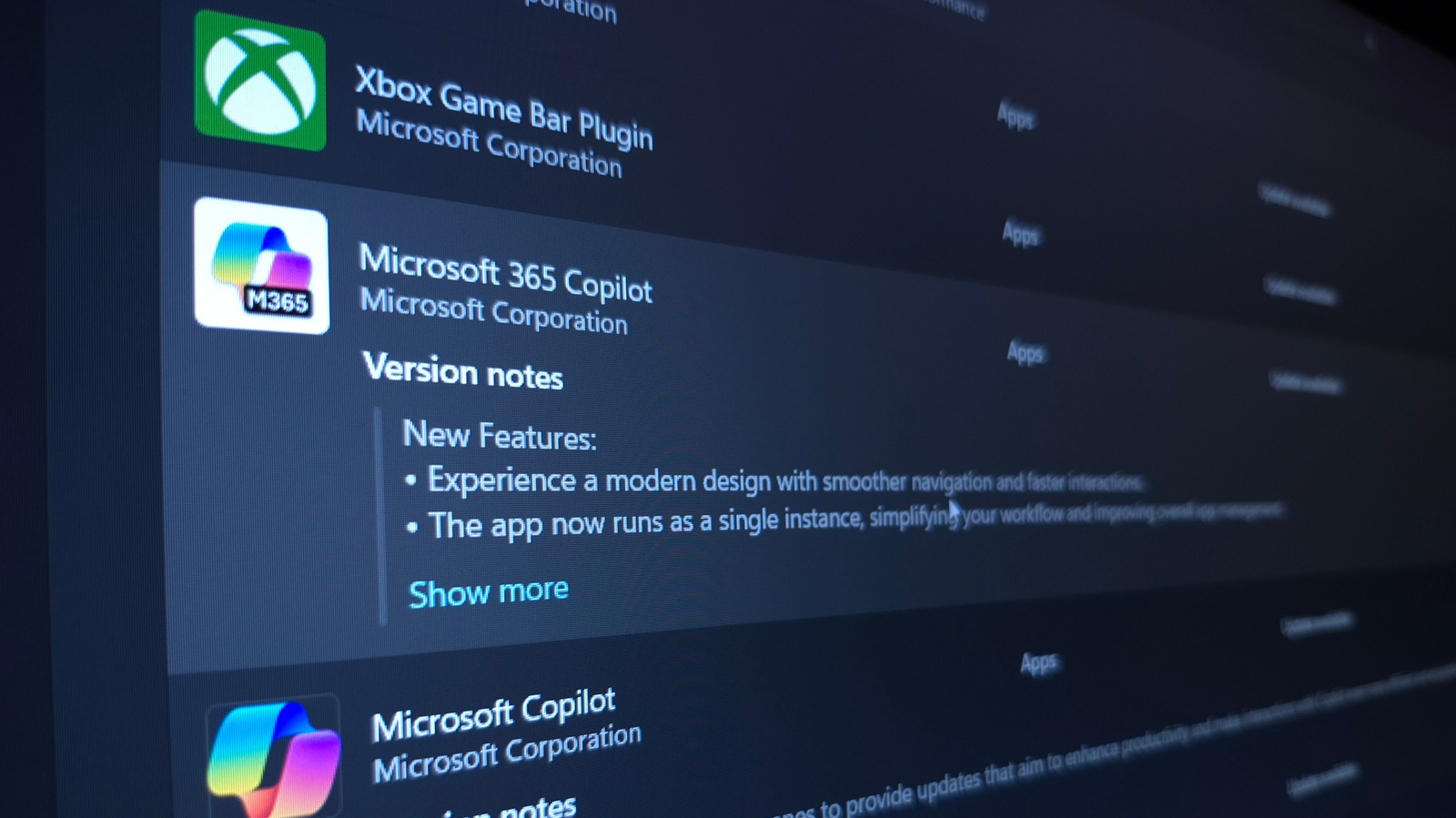
We have said in the past that Microsoft 365 is a great value for Windows users, and that is still true. Unfortunately, if you don’t use Microsoft’s 365 services (Copilot, Word, Excel, Outlook) and don’t pay for the subscription, the Copilot app itself is a mess. For the purpose of writing this post, I used this app for a couple of days to test it out. Since then, Microsoft decided that I must really like the app and now forcefully launches it during startup every time.

The name itself is also very confusing. It’s not just the Copilot app; It’s a rebranded version of the Microsoft Office app, which has nothing to do with the separate Copilot app (which is also pre-installed). As a standalone program, there’s very little functionality due to it being a basic web wrapper that requires an internet connection. Clicking on the built-in shortcuts, such as Word or Excel, takes you to their respective websites. You can just bookmark those sites or use Google Workspace instead.

ZDNet’s scathing write-up detailed even more flaws: increased subscription prices, unreliable Copilot AI functionality, and unnecessary RAM usage. Microsoft’s strategy of pushing the Copilot brand everywhere is poorly executed and creates unnecessary confusion in the process.

Xbox App and Game Bar

Nwz/Shutterstock

For anyone who is not an active PC gamer, the entire suite of Xbox-related programs is unnecessary system bloat. This includes the main Xbox App and the Game Bar. The former is actually a decent game launcher for those who use Xbox Game Pass, but it’s a redundant pre-installed app for everyone else. If you’re one of the many who cancelled their Game Pass subscription after the price hike, you’re better off uninstalling it.

The bigger offender here is the Xbox Game Bar. Now, this isn’t necessarily an app that you can uninstall but a feature you have to disable within Windows settings. Game Bar offers real-time FPS monitoring, game recording, and social features, which are, once again, useless features for anyone who’s not a gamer. The pain here is if you accidentally launch it with the Win+G shortcut, Xbox Game Bar will start running useless background processes.

Even if you are a gamer who uses Game Bar, XDA’s findings showed how far behind it is in terms of functionality. It doesn’t hold a candle to apps such as OBS Studio, MSI Afterburner, and the Nvidia GeForce app in terms of features and customization.

Media Player

BGR/Asad Khan

On the surface, there’s nothing functionally wrong with the built-in Media Player; It plays your songs or videos, organizes your library, and supports basic playlist creation. However, compared to free, modern alternatives, Media Player is severely lacking in terms of features. The app’s most critical flaw is its limited codec and file format support. XDA compared the Media Player and VLC and highlighted how Windows’ built-in player doesn’t support the AV1 codec. For those who don’t know, AV1 is a modern file format that enables higher video quality at smaller file sizes.

VLC is a much better open-source alternative with newer features that are always under active development. The program will soon incorporate on-device AI for offline subtitles and translation, which is a feature you won’t find on Media Player. Media Monkey is another strong alternative that offers advantages such as auto-tagging, CD ripping, and file conversion. So, while the Media Player is not an egregious or intrusive app, its lack of modern features makes it incomplete for power users. You’re better off replacing it now than waiting until you run into an unsupported file format.

Third-party Antivirus Software

Glegorly/Getty Images

Third-party antivirus programs such Norton and McAfee still come pre-installed on many Windows machines, and they are less useful than you think. PCWorld unveiled McAfee’s deceptive marketing tricks to lure you into paying more, touching on the intrusive ads and pop-ups. Protecting your PC is important, but you don’t need to pay upwards of $100 per year to do so.

According to CNET, the Windows Security suite included with Windows 11 is highly reliable on its own. Microsoft Defender, included in Windows Security, is free, customizable, and robust. You get real-time protection, ransomware defense with Controlled Folder Access, and a negligible impact on system performance.

In stark contrast, third-party antivirus software can often prove intrusive and hog unnecessary system memory. As long as you keep your PC updated, don’t disable Windows security, and incorporate good practices (use 2FA, avoid sketchy emails, update OS regularly), you don’t need to drown yourself in antivirus subscription fees.

Microsoft Clipchamp

Microsoft Clipchamp is admittedly a decent app for editing short clips and getting started with video editing. It’s included with Windows, comes with plenty of templates, and offers a good number of usable filters. However, Clipchamp is closer to Apple’s iMovie than it is to a full-fledged editor like Premiere Pro or DaVinci Resolve.

While Clipchamp is free to use, the free version limits export resolution to 1080p, lacks any support for cloud backups, and forces ads on you to buy the premium version or Microsoft 365. PCMag’s review of Clipchamp highlighted the slow export speeds and lack of advanced features like keyframe effect editing. Again, the app is perfectly serviceable as a basic video editor, but not one you should pay for when the free version of DaVinci Resolve is much more powerful. 

Then there’s also the fact that a lot of people just don’t edit videos as a part of their daily workflow. If that includes you, Clipchamp is perfectly safe to uninstall.

Microsoft To Do

A lot of people use Microsoft To Do for work, simply because their workplaces rely on it. The app integrates nicely with Outlook and Microsoft Teams, and it lets you flag emails and messages automatically as tasks. Microsoft To Do comes pre-installed on Windows 11 and offers a clean interface, but it’s less robust than alternatives such as Todoist or TickTick.

PCMag criticized To Do’s lack of advanced search capabilities, natural language input, and the fact that you can’t add details to subtasks. In an app like TickTick, you can just type “Meeting with John on Wednesday at 5 p.m.,” and the app will automatically set the date and time for the task. Microsoft To Do lacks this functionality, so you have to do it manually. Search results aren’t great either, since you can’t perform an advanced search like “tasks due next week.” Microsoft To Do is simply missing essential features that competitors offer by default, and unless your company uses Microsoft To Do, you should go with a better alternative like Todoist, TickTick, or Asana.

Movies & TV

Asad Khan/BGR

Movies & TV is one of those pre-installed Windows apps that exist while offering little to no functionality. Originally, the app served as a digital storefront and media player where you could buy content to watch. Back in July 2025, Microsoft disabled this service, meaning you can’t actually buy or rent any new movies or shows. The program now only exists so you can watch the stuff you already own on the platform.

Now, if you have content that you purchased through the Movies & TV app, you’ll likely want to keep the app installed. According to Microsoft, movies and TV shows are ineligible for refunds, which is a shame for people who made recent purchases expecting the service to stick around. You now essentially have to move to a different service to expand your library of content. As for those of you who don’t have any pre-existing stakes in this platform, you can safely uninstall the app.

Maps

Asad Khan/BGR

Many people never bothered with Microsoft Maps, and a large portion of users likely never even launched it. Even if you do want to use it today for some reason, launching the Maps app will just tell you that the service has reached the end of support. That’s right, this is yet another pre-installed Windows app that serves no real purpose. Even launching the app gives you an uninstall button then and there.

If you have a Windows PC that was originally updated to version 24H2, you won’t find this app. However, anyone who bought a Windows desktop or laptop before October 2024 likely still has this relic sitting around for no reason. Fun fact: The Maps app dates back to the Windows Phone era, and it never quite managed to compete with its major alternative, Google Maps. Shutting down Microsoft Maps also causes an unintentional issue: The default Windows Photos app can no longer render functional, interactive maps of where photos were taken.

Sound Recorder

Asad Khan/BGR

Sound Recorder isn’t a particularly bad Windows app; it’s just very basic and offers limited functionality. As the name suggests, you can use Sound Recorder to record voice notes, but that’s pretty much it. There are no speech-to-text transcription or translation features, which you’ll find in the Recorder app on Google Pixel phones or the Voice Memos app on iPhone.

The Sound Recorder app (formerly known as Voice Recorder) does let you share recordings with other apps, such as WhatsApp, Outlook, or directly to your phone through Nearby Share. However, it’s much easier to just directly record a voice note with WhatsApp or Outlook and send it using the app. It’s also easier to use your phone for such tasks in the first place. Admittedly, I occasionally use this app to check if my mic is working, but even that doesn’t matter much when dedicated apps and websites exist for that exact purpose.

Source

Posted on

‘Albiriox’ Attack Lets Hackers Control Your Android Phone And Bank

Kenstocker/Getty Images

A new piece of Android malware is making the rounds and it has some pretty dire implications for smartphone owners. This is by no means the first scary malware release Android users have seen, though it is certainly up there. The malware threat is called Albiriox, and when installed on a smartphone, it has the potential to take complete control of the device.

Analysis by security researchers at Cleafy shows that the malware is likely backed by Russian-speaking cybercriminals — a discovery they made after finding language clues and forum chat logs. Cleafy’s breakdown of the new threat also shows that it is not just targeting banking apps, either. It also goes for crypto apps and is designed for on-device fraud, which utilizes Android’s built-in accessibility features to let attackers remotely control the devices it is installed upon.

What is especially bad about this malware is that Albiriox is being sold as a “malware-as-a-service” subscription. Basically, this allows anyone to subscribe to gain access to the malware, allowing them to spread it however they want. This makes it especially dangerous, as different threat actors may try to distribute it in a variety of ways.

How to stay safe from Albiriox

Cokada/Getty Images

Ultimately, the only way to stay safe from malware like this is to try your best to avoid fake apps, social engineering attempts, and smishing or phishing links. The latter will often mimic trusted brands or app store developers, and Cleafy notes that there was even one campaign that tricked users into downloading a fake “Penny Market” application that looked to direct users to a real Google Play Store page.

While Google has done a lot to improve safety and security on Android devices with Play Protect, the best defense is staying in the know and being mindful of what you interact with. Even if you never download a fake app, you could fall prey to SMS campaigns or other social engineering attempts.

Because Albiriox is so advanced, if it is installed on your device, it gives the bad actor full remote control of your device, allowing them to navigate to banking, crypto, and other apps. They can then start transferring funds using your own session, which makes it more difficult to contain.

Additionally, the malware is also equipped with “black-screen masking” features that help hide all of this activity behind a faked black screen — so they can drain your accounts without you even knowing until it is too late. Keep an eye open for vaguely named apps that might appear on your phone, and if you do find any, it’s highly recommended to scan your phone with a trusted Android malware app to check for any exposure. Then, you should proceed to remove spyware or malware as quickly as possible.

Source

Posted on

Top 10 IT leadership interviews of 2025

Artificial intelligence (AI) has been the biggest talking point for IT leaders in 2025 – both the emerging capabilities and opportunities from the technology, and the challenges of implementing it at scale and in a way that delivers measurable benefits.

For the digital, data and technology leaders that Computer Weekly is privileged to talk to every week, building AI into their wider strategies and managing often over-hyped expectations just adds to the difficulties of one of the most important roles in any modern organisation.

All of that is taking place while they need to keep a tight rein on costs in a still difficult economy, and juggle skills shortages, talent development and ensuring cyber security. So, how well are they doing?

Computer Weekly gets access to some of the top technology leaders in the world – and the details they share make fascinating reading for anyone looking to develop and implement an IT strategy to improve their business, support employees and enhance their careers.

Here are Computer Weekly’s top 10 interviews with IT leaders in 2025:

The BBC’s research and development (R&D) arm serves a public purpose, which, according to director Jatin Aythora, is to make some of the technologies and inventions it creates available for free or at a really low cost. Aythora sees his job as helping to achieve technical breakthroughs that the news and media industry can benefit from, which he says BBC R&D has done for many years. Computer Weekly talks to him about self-belief and learning from different industries

The UK mapping service has moved on a long way from paper maps as it now looks to use AI to understand, interpret and derive insights from geographical data. CTO Manish Jethwa has a career-long passion for turning geographical data into useful insight, and he’s leading the organisation’s development of next-generation geospatial technologies.

As a technologist who also runs corporate operations, Thomson Reuters’ CTO believes her tech background gives her a unique edge as the business information group looks to transform its products with AI. That’s why she’s on a mission to use digital systems to transform internal processes and customer services.

Richard Masters, vice-president of data and AI at Virgin Atlantic, is an expert in enterprise data, but his career began somewhere different – space. Before moving into analytics, Masters completed a PhD in astrophysics at the University of Oxford. He is now applying his expertise in astrophysics to the nitty-gritty details of using AI to improve customer experience.

The vehicle recovery specialist is looking to AI and connected vehicle technology to enhance customer experience and get motorists back on the road in the shortest possible time. Group CIO Antony Hausdoerfer is driving the plan for digital transformation.

Digital media is core to engaging nearly two billion fans of Premier League football around the world, with data analytics and AI playing an ever-more important role. For Alexandra Willis, director of digital media and audience development at the organisation that runs top-level club football in England, the priority is to establish data-enabled experiences that keep fans just as engaged and entertained off the pitch.

Among the questions a head of technology may ponder are: what does it mean to be innovative, and, perhaps, what technology can be used to drive an innovation strategy? Given the main way people tend to place bets with Bet365 is via its mobile app, Alan Reed, head of platform innovation at Bet365’s Hillside Technology platform, talks to Computer Weekly about how generative AI changes the way people interact with computers.

Kate Balingit has been leading the digital health initiative at Mars Pet Nutrition, reporting to the company’s pet care CIO, where she is focused on commercialising and deploying artificial intelligence through well-known pet food brands such as Pedigree, Iams, Sheba and Whiskas. She talks to Computer Weekly about making AI relevant across its brands to support pet health.

Dan Keyworth, director of business technology at McLaren Racing, says his role involves running the tech at the sharp end of Formula One, all the IT infrastructure that must be deployed to Grand Prix races, and the IT that keeps the business of McLaren Racing on track.

The world of performing arts is in a completely different universe compared to the bits, bytes and IT infrastructure that Keith Nolan and the IT team at Royal Ballet and Opera spend their work time in. He talks about how IT lowers costs and helps power stage innovations for world-class performances. 

Source

Posted on

Top 10 end user computing stories of 2025

The biggest event of 2025 in the PC market has been the end of support for Windows 10. It was positioned as the last major release of the Windows operating system, which would be kept updated by over-the-air Windows updates. But when Windows 11 was launched in 2021, Microsoft set the date for the end of  support for Windows 10 – October 5, 2025.

It was not much of an industry shock that Microsoft decided to release a new version of Windows. A new operating system install allows IT departments to clean up their PC estates and ensure devices are running a core set of applications. Some may use the upgrade to purchase new PCs, but Windows is only certified to run on any PC with a TPM 2 (trusted platform module), that enables its Secure Boot functionality.

While the Windows OS offers backwards compatibility, Microsoft’s security stance means that as PCs get older, there comes a point when the device driver software needed to keep these PCs functional offers too large an attack surface to continue supporting them. 

Microsoft is unwilling to coordinate the effort required to support device drivers indefinitely, which means that perfectly good peripherals will lose support eventually; they may still run using the older (legacy) device driver, but there will not be any newer versions.

To prevent older PCs from running Windows, Microsoft enforces signed device-drivers, which means that only certified driver software is allowed to be installed on Windows when it boots up securely. There will always be workaround to get devices working, but these break the Microsoft security model and potentially expose corporate IT to cyber security attacks.

While the migration to Windows 11 eventually got going, many corporate IT departments have found it harder to migrate to the latest version of Windows, which is why there is an extended support option available. Home users have until October 26, after Microsoft recognised that there were plenty of consumers still on Windows 10. Consumers who register for extended support and back up their PCs in the Microsoft cloud will be able to get free security updates until October 2026. Corporate PCs and devices connected to Active Directory will only receive Windows 10 security updates if they are covered by an Extended Security Updates (ESU) subscription. 

A potential enticement to migrate is new PCs with neural processing units (NPU), aimed at running artificial intelligence (AI) workloads locally, rather than relying on cloud-based AI acceleration. Among the interesting developments in AI PCs is that Microsoft initially only certified ARM-powered devices based on Qualcomm chips, but Intel and AMD -based PCs are now supported.

Running AI inference workloads locally offers application developers and hardware providers the ability to use the built-in NPU to provide smart capabilities in their products, with noise-cancelling webcam microphones among the early use cases. It can also help improve the rendering of backgrounds in video conference calls. However, these do not appear to offer a compelling enough reason to upgrade to an AI PC.

The annual Build 2025 conference was Microsoft’s chance to convince developers that creating AI functionality in their applications is the direction of travel for Windows software. Without compelling use cases, there is no reason for IT departments to pay the current premium being commanded for NPU-enabled PCs that offer local AI acceleration.

Microsoft offers an AI inference engine, Windows ML, in Windows 11, which can be accessed via an application programming interface (API), and, significantly, can be trained on custom data. It is unclear how this will evolve, but the capabilities are now built into Windows 11, which means it is highly likely more AI-infused PC applications will be coming online during 2026.

Here are Computer Weekly’s top 10 AI stories of 2025.

While the end of support has driven PC purchases, there also appears to have been an increase in PC refreshes in preparation for the new US tariffs. In April, analyst Canalys reported that PC shipments experienced a surge in first quarter of 2025 (Q1 2025), driven by manufacturers accelerating deliveries to the US in anticipation of initial tariff announcements.

Google Gemma, Meta Llama, Mistral and DeepSeek can all be downloaded free of charge for use on a personal machine without paying for online services or exposing your data to the cloud. In this article, we assess the technical feasibility of doing this on a personal machine and the quality of the output with the resources available. 

With Windows 10 no longer supported, IT leaders need to consider how to manage the devices that haven’t yet been upgraded to Windows 11. This is because stranded Windows 10 boxes and legacy applications will become a tempting target for hackers. This requires mitigations, such as uninstalling as much end-of-life software as possible or segregating devices that can’t be upgraded.

Before the web allowed businesses such as Facebook and Google to flourish, there was traditional computing. Until the late 1970s with the era of homebrew computer devices, computers were seen as complex, expensive machines that ran in specialised facilities. But on 4 April 1975, Paul Allen and Bill Gates formed Microsoft, a company that defined the PC era and opened up computing for all.

The traditional way of handling IT issues through helpdesk tickets generally delivers an unsatisfactory user experience – something Toyota is looking to rectify. Instead of waiting for IT issues to be manually triaged, Toyota’s 100,000 staff members now benefit from the IT department using Nexthink’s DEX technology to proactively detect, diagnose and remedy IT issues across endpoints, leading to an improvement in digital employee experience.

Widespread warranty fraud is not only costing companies billions but also creating a breeding ground for advanced hardware exploits, warned hardware hacker and researcher Bunnie Huang at Black Hat Asia 2025.

In Shenzhen, China, there is a bustling market of hardware tinkerers, repairing and repurposing old devices, enabling them to build a deep understanding of hardware vulnerabilities. According to Huang, these technicians are perfectly positioned to identify and exploit manufacturing defects.

When Windows 10 reaches end-of-life on 14 October, organisations will need to purchase an Extended Support (ESU) contract to receive Microsoft patches.

“There will be no more bug fixes or performance enhancements,” said Gartner analyst Ranjit Atwal.

Businesses can buy an ESU, but Atwal expects that only a small number of organisations will pay for this, to provide a “support” bridge enabling them to continue to receive support from Microsoft when they complete the migration away from Windows 10. 

A range of AMD, Intel and ARM-powered PCs with neural processing units are aiming to boost office productivity. DellLeading PC makers, HP and Lenovo all demoed their latest AI-enabled PC offerings. These devices pack vats amounts of memory for running local AI inference workloaads, along with powerful AI acceleration hardware. 

Gartner explains how IT leaders can manage their migration from Windows 10 to Windows 11 using the Microsoft ESU programme. However, customers experiencing technical issues with Windows 10 that are unrelated to the ESU updates are advised to upgrade to Windows 11 because ESU does not provide complete patching. Vulnerabilities rated as “moderate” or “low” will not be addressed.

Businesses and consumers alike may not feel the need to upgrade to Windows 11 as its predecessor approaches end-of-life, but they are putting their own security at risk, said the NCSC.

The NCSC released updated recommended configuration packs for Windows 10 – part of a set of recommended configurations it maintains for the main operating systems to help organisations rapidly deploy recommended baselines.

Source

Posted on

Top 10 telecoms stories of 2025

Generally, reviews and analyses of the telecoms market have been very grounded and focused on gigabit fibre networks and 5G mobile. But any look at 2025 would not be complete if it didn’t show just how much service providers and the industry in general are now increasingly and literally reaching for the stars – to be more precise, the looking at the burgeoning satellite communications sector.

The upshot is that in 2025 non-terrestrial networks (NTN) and satellite connectivity moved very markedly from niche to mainstream, whether in rural broadband or direct-to-cell use cases. In terms of those driving the provider landscape, it was no surprise to see Starlink as having gained the highest orbit sealing with 44 partnerships, followed by AST SpaceMobile and Lynk.

Looking at use cases and geography, rural and enterprise broadband remained the dominant application, with the leading providers players enabling unmodified smartphones to connect in remote areas. Yet in-flight connectivity was perhaps one one of the most interesting applications.

In July 2025, Virgin Atlantic announced plans to introduce Starlink in-flight connectivity across its entire fleet by creating a digitally connected cabin. Months later, arch rival International Airlines Group (IAG) announced a partnership to implement Starlink connectivity for more than 500 aircraft across its fleet, which includes Aer Lingus, British Airways (BA), Iberia, Level and Vueling. Not to be outdone, Qatar and Emirates also inked deals with Starlink to equip widebody aircraft with connectivity.

After a previous year which marked its fifth birthday and the arrival of Advanced versions of the basic network, the 5G industry concentrated on deployment. And one of the most interesting developing market was in-stadium connectivity. Simply offering Wi-Fi in stadiums is not enough: providing an advanced connectivity experience is now what fans – both in music and sports – expect. Game-changing connectivity for stadiums includes integrating existing stadium infrastructure with 5G, cloud-based private telecom networks.

The year was rather quiet on the 6G front, but 2025 did end with research establishments in Europe, in particular Finland, setting out plans for what the next generation of mobile will look like.

For fixed broadband access in the UK, the year saw continued rapid pace of gigabit access. A report from regulator Ofcom in November revealed that 78% of UK homes (23.7 million) had full-fibre broadband access, up from 20.7 million (69%) a year ago. Yet Ofcom also noted that less than half of those with access sign up. Alternative providers were also facing increased business headwinds that are expected to continue into the new year.

Here are Computer Weekly’s top 10 telecoms stories of 2025.

GSA study shows Starlink leading the satellite landscape with 44 partnerships, followed by AST SpaceMobile and Lynk, while in spectrum Ka-band remains most widely used frequency range, supporting both feeder and service links.

The findings point to an evolving landscape where satellite services are moving from niche to mainstream, with strong growth expected in broadband and direct-to-cell offerings, and slower but steady expansion in IoT applications

Satellite communications firm launches its next-generation internet of things connectivity service, which it says is set to revolutionise global IoT capabilities with two-way messaging connectivity.

The IoT Nano service is designed to address a growing demand for cost-effective, low-data, low-power IOT services, enabling businesses across sectors such as agriculture, transport, utilities and mining to effectively monitor and control fixed and mobile assets with what is claimed as “ultra-reliable” satellite coverage.

As part of its mission to build the first and only space-based cellular broadband network accessible directly by everyday smartphones for commercial and government applications, AST SpaceMobile reveals plans to expand its satellite fleet by almost 10 times over the next 18 months.

Specifically, the space-based cellular broadband network provider as part of a programme to send 45 to 60 satellites into orbit by 2026 to support continuous service in the US, Europe, Japan and other strategic markets.

MENA airline accelerates programme to equip widebody aircraft with Starlink-based connectivity and now operates up to 200 daily such connected flights to key destinations.

Qatar Airways claims to be the operator of the largest number of Starlink-equipped widebody aircraft and the only carrier in the MENA region currently offering Starlink in-flight connectivity. It has described the expansion as “reaffirming its position as the world’s leading airline for innovation, reliability and unmatched passenger experience

Preliminary design review revealed for Astrum Mobile’s Neastar-1, said to be the first geostationary satellite-to-device mission in the region designed to change how mobile networks reach people across Asia Pacific.

Neastar-1 is being developed on Swissto12’s HummingSat new geostationary small satellites that are seen as offering new economics for the geostationary satellite market, being around five times smaller than traditional satellites and so unlocking faster builds, lower costs and ride-share launches. The range is also said to offer a telecoms-grade service backbone that plugs directly into the 3GPP non-terrestrial networks (NTN) standard, designed for mass-market adoption.

As the country’s mobile comms operators increase the reach and roll-out of 5G standalone networks, the UK has become a mobile data-hungry nation, with mobile users consuming nearly a fifth (18%) more mobile data than a year ago, according to research from communications regulator Ofcom.

The research found UK mobile data use climbs to over 1.2 billion gigabytes each month, as networks deliver 5G SA to 83% of the UK to meet rising demand.

The city of Oulu in Finland has received a further boost to its prestige in the field of mobile communications research, design and manufacturing, with Nokia’s opening of what it calls the new home of radio, in the form of a research and development hub for the entire lifecycle of 5G and 6G radio innovation that will design, test and deliver next-generation networks built for artificial intelligence (AI).

The new campus is claimed to contain some of the world’s most advanced radio network laboratory and manufacturing technology, and will provide both simulated and real-world field verification environments to accelerate network evolution, ensuring that secure 5G and 6G networks are designed, tested and built in Europe.

The UK’s broadband sector has quietly witnessed a tipping point as fibre-based connections direct to premises superseded kerb-side connectivity for the first time, according to analyst Point Topic, while two of the country’s leading independent broadband service providers (altnets) have geared up fibre offerings for businesses.

The Point Topic survey found that the UK broadband market overall regained momentum in the third quarter of 2025, adding 64,000 subscribers and returning to growth across a total base of 28.94 million lines. Most significantly, full-fibre (FTTP) adoption surged ahead at its fastest rate since nationwide roll-outs began, reaching 11.56 million connections and overtaking fibre to the cabinet (FTTC) for the first time, with the latter decreasing to 10.6 million.

Mobility Report shows 33 CSPs currently offer differentiated connectivity services based on network slicing, with a combined total of 65 offerings with around 1.4 billion people expected to be served by fixed wireless access.

Even though the footprint of the UK’s alternative broadband providers (altnets) has doubled in less than two years, the sector is now moving from expansion to survival, with several operators facing commercial pressure that could trigger an expected consolidation wave, a study from Intelligens Consulting has found.

The State of the UK fibre market 2025 report revealed that the UK broadband market is on the brink of its biggest shakeout yet, as the industry shifts from rapid expansion to targeted, commercially grounded fibre investment.

Source

Posted on

Here’s What Might Happen When The AI Bubble Pops

patpitchaya/Shutterstock

“When [the bubble] breaks, it’s going to be really bad, and not just for people in AI,” entrepreneur and AI expert Jerry Kaplan said at a Silicon Valley panel recorded by the BBC. “It’s going to drag down the rest of the economy.” This warning comes at a time when economists, investors, business owners, and the public at large are questioning whether all the money being poured into artificial intelligence (AI) is going to be worth it. Will it all pay off in a speculative future where AI might lead to a better and thriving society, or will the bubble burst and impact the global economy with it?

A bubble forms when excitement drives valuations beyond what the technology or business fundamentals can justify. With AI, huge amounts of money are being funneled into companies, and investors are betting heavily on the promise of AI reshaping society. This boom, however, may not be sustainable.

OpenAI, creator of ChatGPT, still hasn’t turned a profit despite massive investment. Nvidia has also seen a surge in money because of the demand for its computational products to meet AI needs –- and this AI-driven chip shortage could make the products you buy more expensive. However, much of that demand is driven by circular investments. Companies funded by Nvidia then spend that money to buy its products. As these patterns intensify, the question becomes that if we are in a bubble, and how bad it will be if it bursts?

Signs that the AI bubble is forming

Jusun/Getty Images

It seems we are currently seeing the rise in AI and the collapse of everything else. One of the strongest signs of a forming bubble is the imbalance between how much money is being poured into AI and how little financial return is being generated. Major AI companies continue to operate without substantial profits, yet investors keep putting more capital into them. This brings to mind the dot-com bubble, where companies with unproven business models received massive funding simply for being part of a trendy new technology. AI today appears to be following a similar path.

Nvidia’s situation is another red flag. Its explosive growth is tied to demand for the hardware needed for AI, but much of that demand is circular. Nvidia invests in AI startups that then use those funds to buy Nvidia chips, inflating the company’s success without reflecting real market stability. This kind of investment loop artificially boosts valuations, creating the illusion of sustainable demand. If the loops break, though, the value it props up could collapse with it.

The large amounts of debt in the tech sector add even more pressure. Much like the 2008 housing crisis, where easy borrowing fueled an unstable boom, many AI companies are taking on massive loans to grow quickly. Billions of dollars in tech borrowing this year alone indicate an ecosystem dependent on constant investment rather than proven profitability.

What happens when the bubble pops?

JessicaGirvan/Shutterstock

The boom in AI has created a demand to build more and more data centers. In fact, the energy needs of AI are so high that it might make your power bill go up even if you don’t use AI. These facilities have a limited lifespan and can’t be repurposed the way traditional infrastructure, like roads, can. If AI investments collapse, many of these data centers could quickly become abandoned industrial husks. As Kaplan told the BBC, “We’re creating a new man-made ecological disaster.”

The economic fallout could also be severe. Tech-related stocks make up roughly a third of the U.S. stock market, and Nvidia alone is valued higher than the entire country of Japan. A sudden collapse in the AI sector would therefore ripple through financial markets globally. Businesses dependent on AI-driven growth could struggle and the stock market could take a massive hit. Struggling businesses often lead to layoffs, and unemployed people spend less money, which impacts the economy, as well.

Finally, the interconnected borrowing among tech companies creates a dangerous level of shared financial risk. With no single company holding all the debt or responsibility, a collapse would be chaotic and difficult to contain. Similar to the dot-com bust or the end of the Gold Rush, the structures built to support the AI boom could be left behind as empty shells. Once the bubble pops, recovery may take years.

Source