Posted on

UK broadband hits 2025 target with strong first quarter

The steady progress of the UK’s gigabit broadband market over the past five years has culminated in the market hitting one of its key objectives, with data released by Ofcom in its latest Connected nations report showing that by the end of January 2025, the number of homes able to get gigabit-capable broadband increased to 25.9 million (86% of the UK’s 30.2 million homes), up from 25 million (83%) in July 2024.

In the early months of its days in power, the previous UK government set the target that gigabit-capable broadband was to be available to a minimum of 85% of UK premises by 2025, and nationwide by 2030.

The interim update to the Connected nations 2024 report from the UK’s communications regulator noted that gigabit-capable coverage for all properties, i.e. combining both residential and business, now stands at 84%.

Just four years ago, less than a quarter of UK homes and offices had access to full-fibre broadband. This now stands at 73% of premises – 23.686 million. Some 21.134 million of these are to be found in urban locations (76% of premises) and 2.552 in rural areas (55%) – an indication there is still work to be done in so-called hard-to-reach locations. Over the six-month period under review, the number of full-fibre broadband connections has increased by 1.5 million to nine million.

Premises having access to connections offering broadband speeds greater than 300 Mbps – regarded by Ofcom as providing ultrafast broadband – totalled 27.396 million at the end of January 2025. Of these, 24.775 million were in urban environments and 2.62 million in rural locations (57%) for a grand total of 90% coverage.

In the constituent parts of the UK, Northern Ireland was the most connected nation, with 94% of all premises having access to broadband speeds in excess of 300 Mbps. This compared with 86% in England, 78% in Scotland and 77% in Wales, respectively.

One of the key aspects of the UK broadband market is the existence of the so-called digital divide, that is the still relatively large number of premises without access to decent broadband (at least 10 Mbps download and 1 Mbps upload speed) from a fixed line or fixed wireless access network. However, this figure has dropped from 58,000 to 48,000 premises from July 2024 to January 2025. Ofcom estimated around 41,000 of these premises not to be covered by the roll-out of publicly funded schemes in the next 12 months.

In March 2025, Ofcom published its view on the final steps needed to give the UK almost total access – 96% of homes and businesses – to full-fibre connectivity. In its Telecoms access review 2026-31, the regulator firmly believes full-fibre broadband is on course to become universally available in the next two years, given the necessary levels of competition and investment.

Also in its investigation, Ofcom looked at the world of wireless connectivity. It found 4G mobile coverage has remained stable since September 2024, with around 96% of the UK landmass predicted to have good outdoor 4G coverage from at least one mobile network operator. Mobile network operators were found to have maintained coverage of at least 99% outside of UK premises.

In addition, 5G coverage has also remained stable over the previous four months, with the report predicting around 62% of UK landmass will have 5G coverage from at least one mobile network operator.

Mobile network operator coverage outside premises ranges between 62% and 85%, figures that the regulator rates at its High Confidence level.

Source

Posted on

Gemini AI is coming to your car, watch, TV, and

Google on Tuesday hosted a special Android Show: I/O Edition event streamed on YouTube a week before I/O 2025. This is the event Google needed to go over the big Android 16 redesign and new security features ahead of Google I/O, likely because the developers conference will focus on Gemini and other AI innovations. There probably won’t be time for in-depth Android presentations.

While Google’s AI events don’t need to discuss Android, any Android event has to feature at least some Gemini news since Gemini is now at the heart of Android.

Google’s Tuesday event did have its own Gemini segment, with Google confirming that Gemini AI will become the default assistant across devices. After the phone, Gemini will be available in the car (Android Auto and cars with Google built-in), Wear OS smartwatches, Android TVs, and future Android XR devices.

This evolution makes sense for Google. The company wants its AI products to integrate with as many apps as possible and run on as much hardware as possible. Fans of AI tools like Gemini and Gemini Live will want the same thing. Gemini will be much more useful if it can pull data from various Google apps and be accessible across multiple devices.

Tech. Entertainment. Science. Your inbox.

Sign up for the most interesting tech & entertainment news out there.

By signing up, I agree to the Terms of Use and have reviewed the Privacy Notice.

Telling Gemini to always remember a language setting for texting a contact. Image source: Google

Gemini should boost your productivity while you drive, as long as you connect your Android phone to your car (Android Auto) or use a car with Google built-in. You’ll be able to speak naturally and ask the AI to handle specific tasks.

For example, you can tell Gemini to send messages to your contacts and even ask it to always send texts to a specific person in a different language.

Gemini can extract review information from Google Maps. Image source: Google

You can also ask Gemini to recommend places nearby, like restaurants and charging stations. In those cases, Gemini will use Google Maps to find the information.

Gemini can also pull information from Gmail, like a location from an email, and help you find content on YouTube Music and Spotify.

Gemini Live conversation inside the car. Image source: Google

Then there’s Gemini Live, which lets you have real-time voice conversations with the AI about any topic. It can help pass the time on your commute, keep you updated on the news, and help you prep for meetings or events.

Gemini AI on Wear OS devices will need an internet connection through your phone or the watch’s cellular service, but some features will also work on-device.

Just like in cars, Gemini AI on wearables can tap into data from other Google apps. You can talk to your wrist instead of pulling out your phone. Gemini can also save reminders, like your gym locker number or where you parked.

Gemini AI works on wearables. Image source: Google

Gemini will also be on Google TV devices to help with show recommendations. The AI can answer questions by pulling relevant YouTube clips.

Google is also bringing Gemini AI to Android XR devices, starting with Samsung’s first XR model set to launch later this year.

Gemini AI taking questions on a Google TV. Image source: Google

Gemini will be central to Android XR. That was already clear back in December when Google first announced the platform, but the company confirmed it again during a press briefing BGR attended before Tuesday’s event. Gemini AI will serve as the main user interface layer for Android XR devices.

It will use its multimodal vision and audio capabilities to respond to what you see and hear. The AI will deliver a different kind of experience compared to other devices. For instance, Gemini can help you plan a trip by “surrounding you with videos, maps, and local tips, creating an entire itinerary in minutes while providing a more realistic feel for the place you’re researching.”

Gemmini AI on Android XR. Image source: Google

That’s a compelling scenario, and I say that as someone already using ChatGPT to make travel plans in a simple, written format.

Gemini AI will roll out to all these devices later this year, so you’ll have to wait before using Google’s AI on gadgets beyond phones and tablets.

Source

Posted on

Threats versus potential benefits: Weighing up the enterprise risk of

Throwing artificial intelligence (AI) tools at a wall and seeing what sticks will most probably deliver mixed results. Therefore, to realise the opportunities, it should pay to scope and minimise potential risks in advance.

After all, even well-resourced companies are still struggling to figure out their approach to AI, as Dael Williamson, EMEA chief technology officer at data analytics and AI software provider Databricks, confirms. 

“For instance, copying and pasting from one proprietary thing to another, and then another, comes with an inherent ‘tax’ on data integrity. You need all the checks and balances. And all companies can experience this, because all companies have siloes,” Williamson observes.

If your data is problematic or just plain wrong, inferencing will suffer, and you probably won’t get the return on investment (ROI). Then there’s the risk of choosing the wrong language model for your needs.

“You have to train the models. But the inference is the meat and potatoes [of] what you’re actually going for,” Williamson notes. “AI can be incredibly useful. But it’s also tricky.”

Securing AI also presents risk, and not just from AI-enabled attacks, such as more sophisticated social engineering, prompt injections or slop-squatting.

Richard Cassidy, EMEA chief information security officer at cloud data management company Rubrik, says if you do not lean in on the “how” of AI goals, you can introduce security concerns of different kinds.

For instance, AI can become a “noise generator” that distracts users – including from real incidents – and increases waste and costs. In addition, carefully devised security controls might not carry across to the AI workflow.

On top of that, the relevant digital skills can be lacking, and workflows often are not yet sufficiently digitised, he says.

If the underlying processes are flawed, AI cannot fix that. It will just amplify chaos Richard Cassidy, Rubrik

Risk assessment and prioritisation

“People don’t ask what AI adoption looks like in practice,” he says. “CISOs can build data lakes of epic proportions, with multifactor authentication, user attribution, secure access, and so on. Then AI comes along and maps a numerical representation into its workflow, embedding models, and then vector databases, getting the outputs through retrieval augmented generation (RAG) workflows and so on, and the security controls are lost.”

This matches Office of National Statistics (ONS) figures that suggest the most common barriers to AI adoption are difficulty identifying activities or business use cases (39%) and cost (21%). Some 16% of firms cited a lack of AI expertise and skills.

“If the underlying processes are flawed, AI cannot fix that. It will just amplify chaos,” says Cassidy.

“As always, start with the problem, not the hype, and don’t adopt AI just because you think you should. Ensure you pinpoint specific business challenges – customer service bottlenecks or slow cycles – and build from there.”

Reduce risk with clear usage policies and guardrails for single-workflow pilots – perhaps summarising reports, assisting queries, or automating invoice generation – then measure the impact.

Did it work? Did it reduce cost or increase value? Learn from that and build a roadmap from evidence, not enthusiasm, Cassidy advises.

Further mitigation strategies

Regardless, you likely do not want to jump into AI straight away, and you do not want to plug all your sensitive or regulated data into an off-the-shelf model to train it either, adds Tony Lock, distinguished analyst at IT market watcher Freeform Dynamics.

“Once you put data into the language model, you can’t take it out again. It’s just subsumed into the pattern,” says Lock. “That’s why RAG is around, so instead of feeding information into an LLM, you cleanse everything.”

And what if your model is pulled from the market? While open source, parallel developments and application programming interface (API) gateways can help protect organisations, Lock suggests we also cannot know exactly how risks will play out when it comes to, say, OpenAI losing an in-progress lawsuit about its rights to use others’ intellectual property.

Once you put data into the language model, you can’t take it out again. It’s just subsumed into the pattern. That’s why RAG is around, so instead of feeding information into an LLM, you cleanse everything Tony Lock, Freeform Dynamics

“If you’re told by a judge that you need to take all that information out, that you’re not allowed to use it for training purposes, you’re likely going to have the entire language model start again with properly secured data that you’ve acquired,” says Lock.

Penalties could ensue. How will the AI suppliers then respond? Will they pass on related costs to customers? Will customers themselves be penalised? These are unanswered questions that might require specific legal advice.

Before you bet on using specific data in a particular model, it might be wise to remember that there are multiple AI-related lawsuits in the pipeline.

National regulations are complicating the environment. For example, the UK government currently favours some yet-to-be-devised sort of “opt out” of AI process for intellectual property (IP) owners.

Yet in the European Union, for instance, that will not work, because everything typically has to be “opt in”, notes Lock. And to opt in, users have to be told exactly how their IP is going to be used.

“Maybe the US courts will not enforce action. But then again, all those companies have European, UK, Japanese subsidiaries that could become liable, maybe even the local CEO,” he says.

At the same time, it can pay to wait. After all, there can be only one “first mover”; later entrants may benefit from a relative lack of obstacles that early adopters had to tackle.

The top recommendation

Databricks’ Williamson recommends enterprises get their data house in order first, even if that delays adoption. “Data processing and organising is hard, even for companies with money and a huge in-house team,” he says.

Usually, data is just not ready for AI. That means a need to inventory, audit and map all structured and unstructured data. A cleaner, deduplicated, standardised, accurate and relevant data foundation may require silo consolidation too, well before adding AI on top, he points out.

The good news is that fixing data “in the broader sense” will buy time for enterprises to consider their approach and generate benefits – including cost savings, storage efficiencies and the removal of legacy or shadow IT – for the whole business.

Rubrik’s Cassidy believes opportunities are typically about “smart delegation” of tasks and the democratisation of data-based intelligence across the business. “And AI offers SMEs a genuine levelling-up capability.”

Implementation plan and timelines

Robbie Jerrom, senior principal technologist for AI at Red Hat, says enterprises should focus on working out what they should do with AI, and take as much time as they need to do that.

“First, understand your need, then narrow the use case. Don’t try to boil the ocean,” says Jerrom.

One thing organisations can do is calculate the tokens required for a given AI enablement, although it is not always easy.

First, understand your need, then narrow the use case. Don’t try to boil the ocean Robbie Jerrom, Red Hat

“Writing some small bits of Python code, maybe 10 minutes’ work, might use 45,000 tokens. Map it back to cost, and it’s maybe a couple of cents. But if you scale that up, and have 10 developers doing it all day long, how much is it? Every time an AI agent goes out and talks to something, for example, it uses tokens.”

Pick something small, get some experience running something trackable, and build something from which the business will learn.

Sandboxing can reduce risk, especially when considering more autonomous systems such as agents. Examine whether it can be trained in the company’s static policies, for example.

Perhaps ask a model to review a contract, compare it with previous contracts, and show the differences, confusions or irregularities. You might notice two irregularities, but the model might highlight something different to think about in addition. Changes over years, for instance, might signal a possible challenge in the customer relationship that had not been previously picked up.

AI can help discipline your thinking and apply method. Afterwards, double-check results and re-evaluate. Can you tune the model to better align with need, or try an alternative?

“Some of the boring use cases are where you’ll start to see value,” says Jerrom, noting that while generative AI (GenAI) makes mistakes, so do humans.

Education and training for workers are equally crucial. Most will need help learning how best to use their AI services.

“This can get you into a lot of hot water,” warns Jerrom. “AI is already everywhere.”

Next steps for enterprise AI adoption

Sue Daley, director of technology and innovation at TechUK, says all AI has “huge potential” for businesses. Regardless of shape, size or sector, it is key to understand exactly how AI can drive efficiencies and effectiveness. “What do you want it to do and what are you looking to achieve?”

As with any other technology, is AI the appropriate tool? Sometimes benefits might be agentic, while others might require a small language model or very specific approach.

“Small language models may be more appropriate for a specific business need or issue in their supply chain, logistics or operations. Context will be so important,” says Daley.

Play “mindfully” in a sandbox or safe environment to learn what AI can do. Examine compliance, security policies and practice, and ethics around responsible innovation. Consider upskilling needs. Acquire perspective from people and build cross-functional teams across the business.

“Start with education and awareness. Consider your organisation at all levels, from board level to middle management and individual workers,” says Daley. “Find ways to bring people on the journey with you. It’s a change management process, affecting a lot of people’s jobs.”

Even if enterprises think of GenAI tools as just another chatbot, many chatbots have not satisfied customers. Benefiting from AI requires serious thought, including on how the next version or product is evolving. Again, the top tip is that outputs can only be as good as your data inputs, she says.

Freeform Dynamics’ Lock adds: “Understand how to get AI working so your people say it actually helps them, rather than it being just something else to ‘get around’. When they’re picking AI up on their own, remember some might be doing advantageous things you hadn’t thought of – or  something they shouldn’t. User effectiveness and happiness are crucial.”

Finally, don’t forget there are different classes of AI – some of which the business may already have experience with.

Source

Posted on

8 new Android 16 security features that will make your

Google hosted its Android Show: I/O Edition on Tuesday to deliver all the Android 16 news that it won’t have time to discuss next week when I/O 2025 starts. That keynote will probably contain so much Gemini and AI talk that Android will only come up in passing.

Tuesday’s event had three big themes: Android 16 design, Gemini AI, and security. Security is of special interest lately, as hackers and scammers are now using AI to steal personal data and money from users. Thieves steal phones to sell them, and some try to extract user data from the devices beforehand. Also, some nation-states hack mobile devices to spy on high-value targets, from politicians to journalists to activists.

Google announced on Tuesday several big upgrades to Android that will keep you, your data, and your valuables safer than before. Some of these features are coming to Android 16 devices, while others will also beef up the security of older Android operating systems.

Advanced Protection

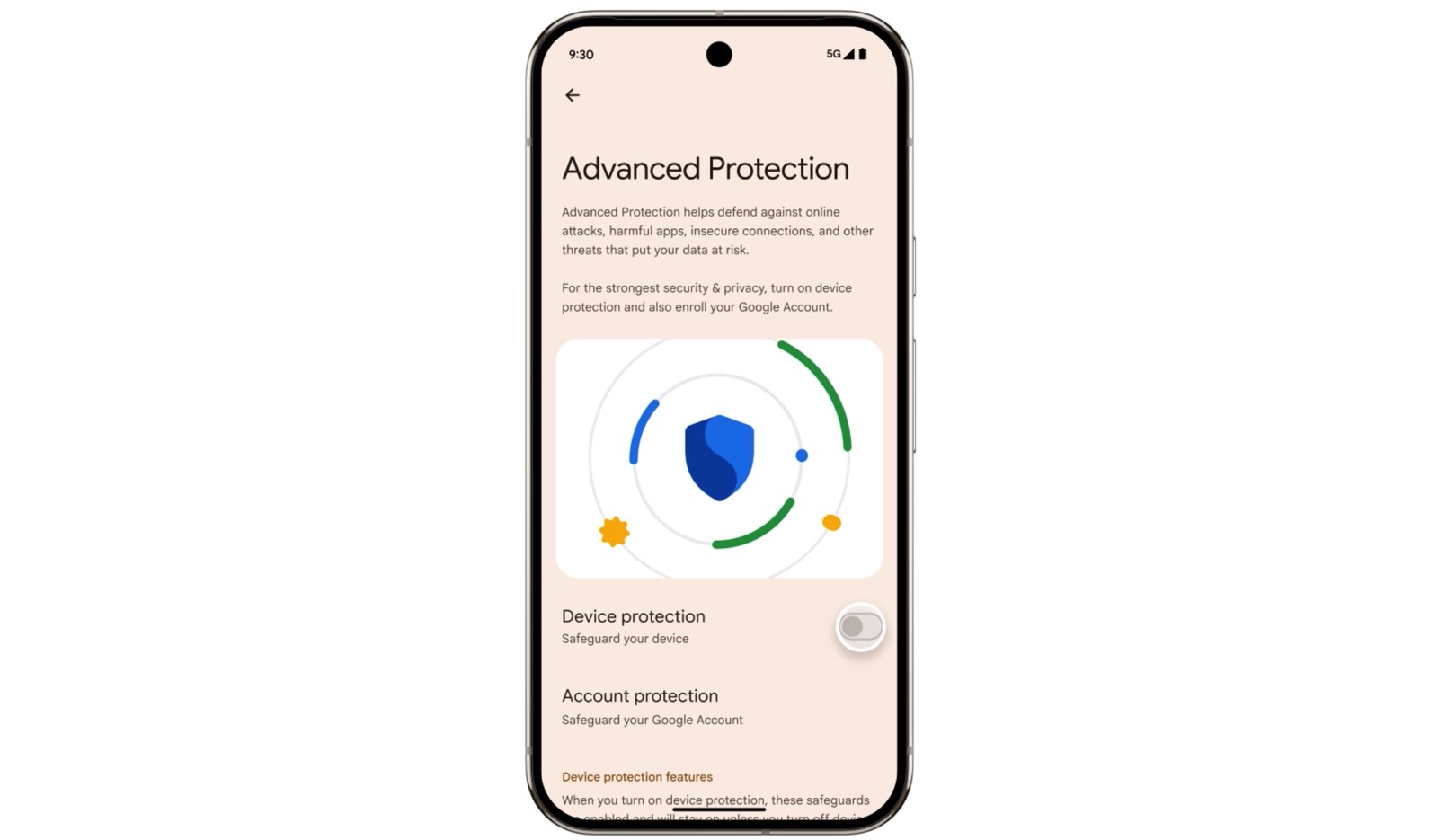
This is easily one of the most important security features coming to Android 16 devices. Google will let people who are at risk of being targeted by hackers and spies enable this powerful new security tool. Advanced Protection will lock a device’s critical settings so that attackers cannot access them.

Tech. Entertainment. Science. Your inbox.

Sign up for the most interesting tech & entertainment news out there.

By signing up, I agree to the Terms of Use and have reviewed the Privacy Notice.

Advanced Protection will also log potential intrusions, prevent USB connections, and automatically disable joining insecure Wi-Fi networks.

Advanced Protection features. Image source: Google

Advanced Protection ensures that all Google apps respect the stronger security settings, including Chrome, Google Messages, and the Phone app. The feature will work with third-party apps in the future.

The list above gives you an idea of everything Advanced Protection can do for you on an Android 16 device.

Improved anti-theft features

Android 16 will also improve the anti-theft features Google has already built into Android. Google said that Remote Lock and Theft Detection Lock were used to protect data on hundreds of thousands of devices that may have been stolen.

Setting a security question for Remote Lock. Image source: Google

More recently, Google launched an Identity Check feature on Pixel and Samsung One UI 7 phones, offering additional safety if your phone’s PIN or password is compromised. The feature will be rolling out to more devices once Android 16 arrives.

Later this year, Factory Reset protections will restrict functionalities on devices that reset without authorization from the owner. Remote Lock will let you add a security challenge question to prevent unauthorized access.

Factory reset warning. Image source: Google

One-time passwords will no longer show up on the lock screen on devices that have not been recently unlocked or that were not connected to a Wi-Fi network.

One time codes will not show up in certain conditions. Image source: Google

The Find Hub

Previously known as Find My Device, the Find Hub is the app that lets you locate the belongings you’re tracking with all sorts of trackers, and track friends and family.

The new app will be available on devices running Android 8 or later. It’ll work with Bluetooth and UWB taggers from various partners. The Find Hub also lets you track lost bags with airline partners and provides satellite location services.

The latter should be a handy feature for tracking friends and family even when there’s no cellular or Wi-Fi connectivity available.

Scam Detection in Google Messages

Google recently launched the AI-powered Scam Detection feature in Google Messages and the Phone app to prevent malicious actors from extracting data or stealing money from users after initiating chats and calls.

Scam detection warning in a text message. Image source: Google

Google is now improving Scam Detection in Google Messages to detect suspicious conversation patterns that might lead to scams. The feature works on-device, warning users about all sorts of potential scams.

Until now, Scam Detection has focused on detecting package delivery and job-seeking scams. Google is upgrading it to detect toll road and billing fee scams, crypto scams, financial impersonation scams, gift card and prize scams, and tech support scams.

Preventing risky actions in phone call scams

Some scammers will ask you to give them some sort of access to your device or perform some settings tweaks yourself to attempt to extract data or install malicious apps. Android 16 will deliver a new type of protection for such calls that should prevent such initiatives.

Android will prevent you from disabling Google Play Protect, sideloading an app from a browser or other source, and granting accessibility permissions to a newly downloaded app while you’re on a call.

Android warning a call might be a scam. Image source: Google

If you share your screen during a call, Android will tell you to stop once the call ends.

Older devices that run Android 6 or later will also get one of these features, the one that prevents you from disabling Google Play Protect while you’re on the phone.

Android will block certain apps during a potentially scammy call. Image source: Google

In-call protection for banking apps

Some hackers want to steal money from you directly, and they might try to convince you to use mobile banking apps to transfer cash to them during malicious calls. These attackers will impersonate trusted institutions or people; that’s how they might convince victims to comply.

Google is launching a pilot program in the UK where the phone will warn you to end a call and stop sharing your screen when you’re about to launch a banking app. The feature will work with three banks initially (Monzo, NatWest, and Revolut) and support Android 11+ devices.

If the pilot is successful, Google might give the security feature a wider rollout.

Key Verifier

Another way to ensure your safety on mobile phones is to be certain that the people you’re texting are who they say they are. That’s where Key Verifier comes in, a feature rolling out this summer to Android 10+ devices. You’ll be able to verify the contact keys in your Google Contacts app via a QR code or a number comparison.

The Key Verifier features in Android 16. Image source: Google

If the secret key matches, it means both people engaged in the text are who they say they are. This feature will prevent scams that involve attackers stealing someone’s SIMs and then attacking their contacts. If that were the case, the secret key would not match, as the attacker is using a SIM card on a different device.

Google Play Protect Life Threat

Finally, Google is improving Google Play Protect to allow the security feature to detect threats on devices in real time. For example, some hackers will try to change the icon of their malicious app or hide it to prevent detection by the user.

Google Play Protect will now catch this behavior and make it easier for users to remove malicious apps. The feature will be available on Pixel 6 and newer devices, as well as new phones from other vendors.

Google Play Protect has new on-device scanning abilities that allow it to identify more malicious apps even faster than before. The app contains a new set of on-device rules that look for text or binary patterns consistent with malicious activity. If an app shows malware-like patterns, Google Play Protect will warn you before you install it. This feature is available to all Android devices that use Google Play Protect right now.

Source

Posted on

University will ‘pull the plug’ to test Nutanix disaster recovery

The University of Reading’s IT team plans to “pull the plug” on its Nutanix-based infrastructure to test disaster recovery (DR) readiness after a move to the supplier’s NC2 cloud services.

That’s according to head of operations Kevin Mortimer, who spoke to Computer Weekly at Nutanix’s .Next 2025 event in the US last week.

The University of Reading has been a Nutanix customer since 2017. It has more than 50 research centres in areas that include agricultural, biological and physical sciences, as well as meteorology. The university has around 5,000 faculty members and 20,000 students.

It runs Nutanix Enterprise Cloud Software on Dell EMC XC Series hyper-converged systems, with the Nutanix AHV hypervisor. 

The plan now is to use Nutanix’s NC2 cloud provision as failover for on-site activity. 

When it’s up and running, Mortimer plans to pull a plug to test it – literally.

The university already uses Rubrik for backup, but it wanted a way to fail over in a DR scenario. The question for Mortimer was: “If we lost our main datacentre on campus, then what do we do? We have a few IaaS [infrastructure as a service] workloads in Azure, and things like domain controllers that are really critical.” 

But to put all those into Azure was going to cost up to five or six times more than it would if it was on-premise, according to Mortimer.

“So if on-premise was £100,000, public cloud would be £1m,” he said. “But NC2 is kind of in the middle of that, so you’re getting the benefit of some cloud and it does cost you more, because cloud is generally more expensive.”

Nutanix Cloud Clusters (NC2) is a hybrid cloud platform that provides a consistent user interface to all environments. 

“It’s a step up from colo, but you get the benefit of public cloud networking and the management piece,” said Mortimer. 

Disaster recovery test

Mortimer’s team is still working through the details of NC2 deployment, but one benefit he’s looking forward to is to be able to do a full DR test.

“That’s something that is always quite scary to an organisation, but it’s something I’m really keen to do,” he said.  “We can turn it off. We know the processes. We’ll let it run from the cloud for a week beforehand so it’s not all last-minute, and we can fail it back.

“I’ve threatened my team,” said Mortimer. “I said … ‘I’m going to walk into the datacentre, and get a cable and pull it’. Because in a real-life scenario, that’s what could happen. If it doesn’t work, at least you can know it isn’t working.”

That’s likely to happen this summer or next Christmas, to avoid periods of heavy user activity. 

According to Mortimer, it will involve about 60TB of data that will be closely synchronised in terms of RPO. 

Key steps

What are the key steps for Mortimer in the run up to that kind of test?

“Once the platform’s all stood up and connected, we need to make sure we can move workloads between the two clusters,” he said. “That’s validating the networking, which is going to be the trickiest part. It’s things like making sure DNS is available, and tier-zero services like Active Directory.

“But once we’re confident that networking works for those test cases, and if everything’s been rebuilt out from scratch against those principles, then it should be just a case of pull the plug and fail over,” said Mortimer.

The university migrated from VMware to AHV when it moved to Nutanix, and later deployed Enterprise Cloud to build a self-service portal to allow academics to provision their own resources where they can manage virtual machines (VMs) and storage directly, similarly to a public cloud platform.

In total, it now has around 600 VMs that run across eight nodes in its datacentre, and something like 60 applications. 

It also uses Nutanix Files, manages things with the Nutanix Prism user interface, and has added Self-Service portal and the Nutanix Calm management framework for hybrid clouds.

Source

Posted on

Virgin Media O2, Daisy Group merge to form B2B comms

Virgin Media O2 (VMO2) has announced a merger of its business to business (B2B) operations with the complementary assets of Daisy Group.

Founded by Matthew Riley in 2001, Daisy Group describes itself as an independent, specialist communications businesses delivering a range of cloud, communications and IT services to companies across the UK. The business has expanded organically and through a series of acquisitions over the past two decades.

The deal will be structured through the contribution of an approximately £425m secured intercompany loan by VMO2 and approximately £835m of debt by Daisy Group. The new entity is calculated to have annual pro forma revenues of around £1.4bn, and will be consolidated by VMO2 with a 70% holding, with Daisy Group making up the remaining 30%.

The company will be supported by fixed and mobile connectivity wholesale agreements with VMO2, and supplier arrangements with Telefónica and Liberty Global to offer high-growth products and services from across the portfolio of those wider shareholder groups.

The dedicated new company will look to serve the communications and IT needs of hundreds of thousands of UK businesses from small offices, small and medium-sized enterprises (SMEs), large enterprises, and public sector organisations, as well as indirect partners. VMO2 and Daisy Group are confident the company will have greater scale, expertise and focus as a combined entity, benefitting from VMO2’s fibre and mobile infrastructure, combined with Daisy’s end-to-end IT and sales management platforms and customer service.

Digital-first connectivity offerings and managed services for new and existing customers will include cloud-based communications tools, 5G private networks, internet of things connectivity, security services and artificial intelligence-powered products such as O2 Motion. VMO2’s fixed and mobile wholesale operations, which include smart metering and connectivity to mobile virtual network operator customers, will remain fully owned at VMO2.

The firm will be led and chaired by Daisy founder Riley, and Jo Bertram, managing director of Virgin Media O2 Business, as CEO. At the outset, both businesses will operate under their separate brands from their current office bases.

Virgin Media O2 CEO Lutz Schüler said: “Combining Virgin Media O2 Business with Daisy Group is the perfect pairing, and creates a new British business connectivity powerhouse and greater competition in the market. Following completion, the new company will have the scale, talent, focus and infrastructure needed to drive digital transformation and provide business customers with an innovative one-stop shop for all their communications and IT needs. We can’t wait to get started on this next chapter in partnership with Daisy.”

Riley added: “This transformational transaction will revolutionise the telecommunications and IT landscape and create the most comprehensive offering for businesses of all sizes across the UK.

“Growth is top of the political and business agenda – inextricably linked to this is access to world-class IT and communications infrastructure that is integrated and can scale,” he said.

“Our new entity, which brings together two highly successful companies, will deliver a comprehensive solution for the fast-changing needs of UK organisations supported by specialist teams that have a relentless focus on customer service. It will be driven by the entrepreneurial spirit for which we are known and will catalyse the next phase of our ambitious growth plans.”

Source

Posted on

Apple’s brilliant new shortcut helps you capture ideas before you

With the first iOS 19 features announced, Apple has prepared us for a big WWDC 2025 keynote next month. Alongside exciting new accessibility features, the company also released a brilliant shortcut that helps you capture ideas before you forget them.

While Apple created this shortcut especially for neurodivergent minds, it’s also great for those constantly interrupted during a task, which might affect their productivity.

Apple explains that users have two options when using the Hold That Thought shortcut: to capture the information displayed on the screen or to recall it later. Here’s how it works:

“Run the shortcut and select Capture to capture a screenshot of what you’re doing, any calendar events in the next hour, the current open webpage in Safari (Mac only), and Clipboard contents. You’ll then be prompted to write short notes about what you are doing and what you’re about to do. Run the shortcut again and select Recall to find the last created note with all the captured information. All notes will be saved with the title ‘Hold That Thought’ and the date and time saved.”

Tech. Entertainment. Science. Your inbox.

Sign up for the most interesting tech & entertainment news out there.

By signing up, I agree to the Terms of Use and have reviewed the Privacy Notice.

What I like most about this Apple shortcut is how thoughtful it is. Using shortcuts is one of the best ways to make your Apple device more powerful, and this one is especially useful on the Mac. Of course, you can also enjoy it on iPhone and iPad, but the Mac is Apple’s true powerhouse and is so handy.

Apple’s Hold That Thought shortcut is available for free here. You can say, “Hey Siri, Hold That Thought.” Another option, if you have an iPhone 15 Pro or newer, you can set it on the Action Button, especially if you’re often interrupted while brainstorming.

Below, you can learn more about Apple’s upcoming iOS 19 update, including the latest rumors, features, and compatible devices.

Source

Posted on

Wi-Fi 7 trials show ‘significant’ performance gains in enterprise environments

The latest version of the wireless standard, Wi-Fi 7, promises faster speeds, enhanced security, and improved performance and user experience, but to date, adoption across enterprises has been sluggish, and in what may boost business deployment of Wi-Fi 7, the Wireless Broadband Alliance (WBA) has revealed the results of Wi-Fi 7 industry trials in enterprise scenarios that are said to have demonstrated significant improvements in throughput, efficiency and latency.

The trials were conducted in live enterprise environments by the global industry body dedicated to driving the service experience of Wi-Fi across the global wireless ecosystem, in collaboration with AT&T, CommScope (Ruckus Networks) and Intel. At its heart, it set out to evaluate Wi-Fi 7’s real-world performance, highlighting the standard’s ability to support mission-critical enterprise applications such as extended reality (XR), artificial intelligence (AI), cloud computing and industrial internet of things (IIoT).

In deeper detail, the trials also focused on assessing rate versus range performance in enterprise settings, comparing Wi-Fi 7 with Wi-Fi 6E across the 5 GHz and coveted 6 GHz bands.

The WBA says that fundamentally, the tests revealed that Wi-Fi 7 delivers nearly double the throughput of Wi-Fi 6E at 5 GHz using 40 MHz channels; sustained throughput of over 1 Gbps up to 40 feet away from the access point (AP) in the 6 GHz band with 160 MHz channels; lower latency and improved efficiency, supporting next-gen applications such as augmented and virtual reality (AR and VR), video conferencing and automation; and greater network reliability, helping enterprises manage high-density environments with thousands of connected devices.

In addition, the trial highlighted downlink speeds of 2 Gbps and reduced congestion with multi-link operation (MLO). It assessed Wi-Fi 7’s capabilities in both controlled and real-world enterprise environments, focusing on throughput, latency and signal range across different frequencies and channel widths.

At 6 GHz with 160 MHz channels, Wi-Fi 7 achieved nearly 2 Gbps downlink throughput at close range, maintaining over 1 Gbps up to 40 feet away. In high-density enterprise settings, where APs must support thousands of simultaneous connections, Wi-Fi 7’s enhanced spectral efficiency and MLO was said to have provided more stable, reliable connectivity, mitigating network congestion even in heavily loaded conditions.

Another key challenge the trial set out to address concerned connectivity of new and legacy devices, in particular demonstrating Wi-Fi 7’s ability to address key connectivity challenges in smart offices, manufacturing, healthcare and immersive digital environments. This trial focused on 160 MHz channels in the 6 GHz band that the WBA said would be typical for high-density commercial Wi-Fi 7 network deployments requiring many access points. However, it emphasises that most current Wi-Fi 7 devices also support 320 MHz channels that would be more common for smaller networks and enable higher levels of performance for hybrid work and consumer experiences.

The WBA believes enterprises that rely on real-time collaboration, video conferencing, AI-driven automation and AR/VR applications will benefit from Wi-Fi 7’s lower latency and higher throughput, ensuring what it called “seamless” user experiences without performance bottlenecks.

The WBA added that the trials confirmed Wi-Fi 7 delivers significant improvements in 5 GHz networks, where many legacy devices still operate, ensuring backward compatibility and an easier transition for enterprises upgrading their infrastructure.

Following the trials, the WBA said it would continue to collaborate with industry leaders to accelerate Wi-Fi 7 adoption, refine implementation strategies and support enterprises in bringing about Wi-Fi 7’s full potential.

“Wi-Fi 7 is not just an evolution: it’s a game changer for enterprise connectivity,” said Tiago Rodrigues, president and CEO of the Wireless Broadband Alliance.

“As adoption accelerates, enterprises will see tangible benefits in everything from hybrid work and immersive experiences to AI-driven automation. The WBA is committed to ensuring the industry has the data and insights needed to maximise Wi-Fi 7’s potential.”

Source

Posted on

This Chinese breakthrough could change microprocessors forever

China may have just taken a significant step forward in the global chip race. A team of researchers from Peking University says it has developed a silicon-free transistor that could dramatically improve processor speed and efficiency—and reshape how silicon-free chips are built in the future.

In a study published in Nature Materials, the team describes a next-generation chip architecture that replaces traditional silicon with a two-dimensional material called bismuth oxyselenide. Not only is this material thinner and more flexible than silicon, but it also enables faster electron movement and better control of electrical currents.

The transistor design wraps the gate around all sides of the source, unlike conventional designs that cover only three. This complete wrapping boosts current control and cuts down on energy loss—two key improvements that lead to faster performance and lower power use.

According to the researchers, chips built using this new silicon-free transistor could run up to 40 percent faster than top-tier silicon chips made by companies like Intel. Even more impressive, they could do so while using 10 percent less energy.

Tech. Entertainment. Science. Your inbox.

Sign up for the most interesting tech & entertainment news out there.

By signing up, I agree to the Terms of Use and have reviewed the Privacy Notice.

That combination of speed and efficiency is largely due to the unique properties of bismuth oxyselenide. The material allows for higher carrier mobility, which means electrons can move faster, giving it a high dielectric constant, which helps it store electrical energy more effectively.

Lead researcher Hailin Peng described the breakthrough as more than just an upgrade to existing silicon tech. “If chip innovations based on existing materials are considered a ‘shortcut’, then our development of 2D material-based transistors is akin to ‘changing lanes,’” he told the South China Morning Post.

Beyond its technical promise, the new transistor could also have global implications. As China faces ongoing restrictions on advanced U.S. chips, a move toward silicon-free transistors could offer a path to more independent chip development—and a new advantage in semiconductor innovation.

For now, the transistor remains at the research stage. But if it scales successfully, this breakthrough may not only challenge the dominance of silicon, but it could completely rewrite the roadmap for the next generation of chips.

Source

Posted on

Nokia looks to light up in-building enterprise connectivity with Aurelis

Looking to meet the evolving demands of local area enterprise connectivity, with improved cost of ownership and performance upgrades, Nokia has launched Aurelis Optical LAN, a “next-generation” fibre-based local-area networking (LAN) solution.

Designed and marketed as “a future-ready solution”, it is attributed with bringing fibre’s unmatched longevity, performance and efficiency to in-building and campus environments. The comms tech provider said that optical LAN offers a significant leap forward, requiring up to 70% less cabling and 40% less power compared with traditional copper-based LAN networks. With a lifespan of more than 50 years, Optical LAN can potentially deliver up to 50% reduction in total cost of ownership (TCO).

“With a 50+ year lifespan, fibre infrastructure ensures you’re ready for whatever comes next – without the disruption and cost of constant upgrades. Optical LAN gives enterprises a future-proof foundation for connectivity, at a dramatically lower total cost,” said Geert Heyninck, general manager of broadband networks at Nokia.

The Aurelis Optical LAN is said to be built for simplicity, reliability and long-term performance. Supporting current speeds of 1Gbps, 10Gbps and 25Gbps with an upgrade path to 50Gbps and 100Gbps, Aurelis Optical LAN is, said Nokia, built to ensure enterprises are ready for what’s next.

Open APIs allow seamless integration with existing enterprise environments while advanced automation features help to simplify and streamline operations. Six-nines availability and robust security ensure it can deliver fast and seamless LAN connectivity, essential for Wi-Fi 7 and other high-bandwidth applications.

Explaining how the tech has been deployed to some effect in its organisation, Daniel Schach, head of OT infrastructure at German electricity utility company FairNetz, said: “Deploying Optical LAN across our campus was a strategic move to modernise connectivity across multiple buildings. It gives us a reliable, high-performance backbone for Wi-Fi, printers and all our office endpoints, while significantly lowering power and cabling needs. The fibre-based infrastructure supports our long-term vision for a more efficient, future-ready network.”

As it was making its optical LAN announcement, Nokia also revealed that Australian operator Optus has deployed its technology to bolster its 5G network with improved capacity and coverage and modernised sites across regional parts of the country.

In the deployment, Nokia is installing its latest generation of Habrok Massive MIMO radios and its Levante baseband solutions from its AirScale portfolio to enhance network performance. This strategic upgrade follows Optus’s Multi-Operator Core Network (MOCN) RAN-sharing agreement with TPG Telecom in 2024, reinforcing a commitment to providing broader coverage, faster data speeds and a superior customer experience.

Powered by ReefShark System-on-Chip (SoC) technology, the Habrok 32 massive MIMO radios are said to offer a 33% boost in output power, helping Optus deliver coverage and capacity while significantly reducing power consumption. The solutions are said to be ideal for new deployments and site modernisation. Use of Habrok 32 also enables Optus to maximise the use of shared spectrum assets in the RAN-sharing areas, allowing higher data rates and enhanced coverage.

Kent Wu, Optus vice-president of access network strategy, planning and quality, added: “We know connectivity is vital for our customers so they can stream their favourite content, download TV shows and movies, or upload pictures and videos onto their favourite social media platforms.

“The Habrok 32 massive MIMO radios bring the right balance of performance and cost efficiency for upgrading our 5G network to elevate consumer experiences and drive business productivity. Through this partnership, we are expanding our reach for customers and bringing them high-speed, reliable connectivity to more customers, communities and enterprises.”

Source