Posted on

The hidden security risks of open source AI

Open source AI is gaining momentum across major players. DeepSeek recently announced plans to share parts of its model architecture and code with the community. Alibaba followed suit with the release of a new open source multimodal model aimed at enabling cost-effective AI agents. Meta’s Llama 4 models, described as “semi-open,” are among the most powerful publicly available AI systems.

The growing openness of AI models fosters transparency, collaboration, and faster iteration across the AI community. But those benefits come with familiar risks. AI models are still software – often bundled with extensive codebases, dependencies, and data pipelines. Like any open source project, they can harbour vulnerabilities, outdated components, or even hidden backdoors that scale with adoption.

AI models are, at their core, still code – just with additional layers of complexity. Validating traditional components is like reviewing a blueprint: intricate, but knowable. AI models are black boxes built from massive, opaque datasets and hard-to-trace training processes. Even when datasets or tuning parameters are available, they’re often too large to audit. Malicious behaviours can be trained in, intentionally or not, and the non-deterministic nature of AI makes exhaustive testing impossible. What makes AI powerful also makes it unpredictable, and risky.

Bias is one of the most subtle and dangerous risks. Skewed or incomplete training data bakes in systemic flaws. Opaque models make bias hard to detect – and nearly impossible to fix. If a biased model is used in hiring, lending, or healthcare, it can quietly reinforce harmful patterns under the guise of objectivity. This is where the black-box nature of AI becomes a liability. Enterprises are deploying powerful models without fully understanding how they work or how their outputs could impact real people.

These aren’t just theoretical risks. You can’t inspect every line of training data or test every possible output. Unlike traditional software, there’s no definitive way to prove that an AI model is safe, reliable, or free from unintended consequences.

Since you can’t fully test AI models or easily mitigate the downstream impacts of their behaviour, the only thing left is trust. But trust doesn’t come from hope; it comes from governance. Organisations implement clear oversight to ensure models are vetted, provenance tracked, and behaviour monitored over time. This isn’t just technical; it’s strategic. Until businesses treat open source AI with the same scrutiny and discipline as any other part of the software supply chain, they’ll be exposed to risks they can’t see with consequences they can’t control.

  1. Securing open source AI: A call to action

Businesses should treat open source AI with the same rigour as software supply chain security, and more. These models introduce new risks that can’t be fully tested or inspected, so proactive oversight is essential.

  1. Establish visibility into AI usage:

Many organisations don’t yet have the tools or processes to detect where AI models are being used in their software. Without visibility into model adoption, whether embedded in applications, pipelines, or APIs – governance is impossible. You can’t manage what you can’t see.

  1. Adopt software supply chain best practices:

Treat AI models like any other critical software component. That means scanning for known vulnerabilities, validating training data sources, and carefully managing updates to prevent regressions or new risks.

  1. Implement governance and oversight:

Many organisations have mature policies for traditional open source use, and AI models deserve the same scrutiny. Establish governance frameworks that include model approval processes, dependency tracking, and internal standards for safe and compliant AI usage.

  1. Push for transparency:

AI doesn’t have to be a black box. Businesses should demand transparency around model lineage: who built it, what data it was trained on, how it’s been modified, and where it came from. Documentation should be the norm, not the exception.

  1. Invest in continuous monitoring:

AI risk doesn’t end at deployment. Threat actors are already experimenting with prompt injection, model manipulation, and adversarial exploits. Real-time monitoring and anomaly detection can help surface issues before they cascade into broader failures.

DeepSeek’s decision to share elements of its model code reflects a broader trend: major players are starting to engage more with the open source AI community, even if full transparency remains elusive. For enterprises consuming these models, this growing accessibility is an opportunity and a responsibility. The fact that a model is available doesn’t mean it’s trustworthy by default. Security, oversight, and governance must be applied downstream to ensure these tools are safe, compliant, and aligned with business objectives.

In the race to deploy AI, trust is the foundation. And trust requires visibility, accountability, and governance every step of the way.

Brian Fox is co-founder and chief technology officer at Sonatype, a software supply chain security company.


Source

Posted on

US cyber agency CISA faces stiff budget cuts

The United States’ Cybersecurity and Infrastructure Security Agency (CISA) is likely to have its funding cut by approximately $495m and may have to lay off around 1,000 employees later this year, according to budget proposals unveiled by President Trump’s administration.

In a written statement, the White House said Trump was “laser-focused on eliminating … weaponised rot” in the American government as he laid out a series of cuts to multiple agencies.

“The Budget eliminates CISA’s disinformation offices and programmes that functioned as a hub in the censorship industrial complex, conspiring against the First Amendment rights of President Trump and his supporters,” the statement reads.

The First Amendment to the Constitution, which dates back to 1791, guarantees freedom of assembly, the press, religion and speech in the US.

“CISA was more focused on cooperating with big tech to target free speech than our nation’s critical systems,” said the White House. “Even CISA’s own systems have fallen prey to attacks. Under President Trump’s leadership, CISA will protect our critical infrastructure instead of censoring Americans. The budget refocuses CISA on its core mission – federal network defence and coordinating with critical infrastructure partners – while eliminating weaponisation and waste. The budget also streamlines the agency by consolidating redundant security advisors and programmes.”

Besides the elimination of its work countering “disinformation”, the budget cuts money from CISA’s government network and critical infrastructure protection operations, and its provision of support and services to companies and local government bodies in America. CISA will also have to take an axe to divisions that work to analyse and predict future threats, among other things.

Other planned cuts potentially affecting the US’ cyber security mission include proposals to trim the budget allocated to the FBI, which deals with cyber crime in the US, and a unit at the Department of Energy that deals with threats to CNI.

A globally recognised force

Officially established during Trump’s first administration, with origins dating back to 2007 when the US established the National Protections and Programs Directorate within the Department of Homeland Security (DHS), CISA has grown into one of the leading western cyber security agencies working alongside the likes of the UK’s National Cyber Security Centre (NCSC) and counterparts in Australia, Canada, Europe and New Zealand.

It frequently leads on multilateral advisories and alerts on cyber matters including cyber crime and ransomware and nation state threats, and its Known Exploited Vulnerabilities (KEV) catalogue is a globally recognised resource.

However, leadership had clashed with Trump in the past – CISA’s founding director Chris Krebs was given his marching orders after the 2020 Presidential Election.

Gabrielle Hempel, security operations strategist and threat intelligence researcher at the Exabeam TEN18 unit, described a “strategic deprecation” of America’s cyber defence capabilities at a time when threat actors were only widening the scope of their activities.

“Gutting critical programmes …  doesn’t ‘refocus’ the mission – it hollows it out. These teams drive cross-sector collaboration, provide threat modeling to CNI operators and build resilience in a space where private-sector entities own the vast majority of the target surface,” said Hempel.

“If the intent of these cuts is to ‘focus on core mission’, the question is: whose definition of core? Threat visibility, regional coordination, intelligence sharing, and vulnerability analysis are core to a functional national cyber strategy.

“The reality is, we don’t get to pick when or where the next attack happens – but we do decide whether we’ll be ready. Bluntly, this plan is guaranteeing that we won’t be,” she said.

Hempel also lamented the proposed elimination of election security funding at a time when threat actors both within and without the US are actively working to undermine democratic processes.

Source

Posted on

Analysis of job vacancies shows earnings boost for AI skills

UK workers with skills in artificial intelligence (AI) appear to earn 11% more on average, even in sectors where AI is automating parts of their existing job functions.

Workers in sectors exposed to AI, where the technology can be deployed for some tasks, are more productive and command higher salaries, according to PwC’s 2025 Global AI Jobs Barometer. The study, which was based on an analysis of almost one billion job adverts, found that wages are rising twice as fast in industries most exposed to AI.

From a skills perspective, PwC reported that AI is changing the skills required of job applicants. According to PwC, to succeed in the workplace, candidates are more likely to need experience in using AI tools and the ability to demonstrate critical thinking and collaboration.

Phillippa O’Connor, chief people officer at PwC UK, noted that while degrees are still important for many jobs, a reduction in degree requirements suggests employers are looking at a broader range of measures to assess skills and potential.

In occupations most exposed to AI, PwC noted that the skills sought by employers are changing 59% faster than in occupations least exposed to AI. “AI is reshaping the jobs market – lowering barriers to entry in some areas, while raising the bar on the skills required in others,” O’Connor added.

Those with the right AI skills are being rewarded with higher salaries. In fact, PwC found that wages are growing twice as fast in AI-exposed industries. This includes jobs that are classed as “automatable”, which means they contain some tasks that can readily be automated. The highest premiums are attached to occupations requiring AI skills, with an average premium in 2024 of 11% for UK workers in these roles.  

AI is reshaping the jobs market – lowering barriers to entry in some areas, while raising the bar on the skills required in others Phillippa O’Connor PwC UK

PwC’s analysis shows that sectors exposed to AI experience three times higher growth in the revenue generated by each employee. It also reported that growth in revenue per employee for AI-exposed industries surged when large language models (LLMs) such as generative AI (GenAI) became mainstream.

Revenue growth per employee has nearly quadrupled in industries most exposed to AI, such as software, rising from 7% between 2018 and 2022, to 27% between 2018 and 2024. In contrast, revenue growth per employee in industries least exposed to AI, such as mining and hospitality, fell slightly, from 10% between 2018 and 2022, to 9% between 2018 and 2024.

However, since 2018, job postings for occupations with greater exposure to AI have grown at a slower pace than those with lower exposure – and this gap is widening.

Umang Paw, chief technology officer (CTO) at PwC UK, said: “There are still many unknowns about AI’s potential. AI can provide stardust to those ready to adapt, but risks leaving others behind.”

Paw believes there needs to be a concerted effort to expand access to technology and training to ensure the benefits of AI are widely shared.

“In the intelligence age, the fusion of AI with technologies like real-time data analytics – and businesses broadening their products and services – will create new industries and fresh job opportunities,” Paw added.

Source

Posted on

ChatGPT just got a lot more personal, but not for

OpenAI CEO Sam Altman said on X earlier this week that ChatGPT o3-pro will launch this summer for ChatGPT Pro users paying $200/month. While o3-pro isn’t ready yet, OpenAI has rolled out other updates for ChatGPT users. The company introduced a few new ChatGPT features aimed at delivering a more personal chatbot experience.

That’s not surprising since OpenAI wants to turn ChatGPT into a super-assistant this year. It’s also working on the first ChatGPT io device, expected to launch next year. That kind of hardware will require a much more personal ChatGPT experience.

After bringing chat memory support to ChatGPT Free users on Tuesday, OpenAI shifted focus to enterprise users with new ChatGPT features. That might not mean much to those not using Team or Enterprise tiers, but these updates mark early steps toward making ChatGPT a more personal assistant.

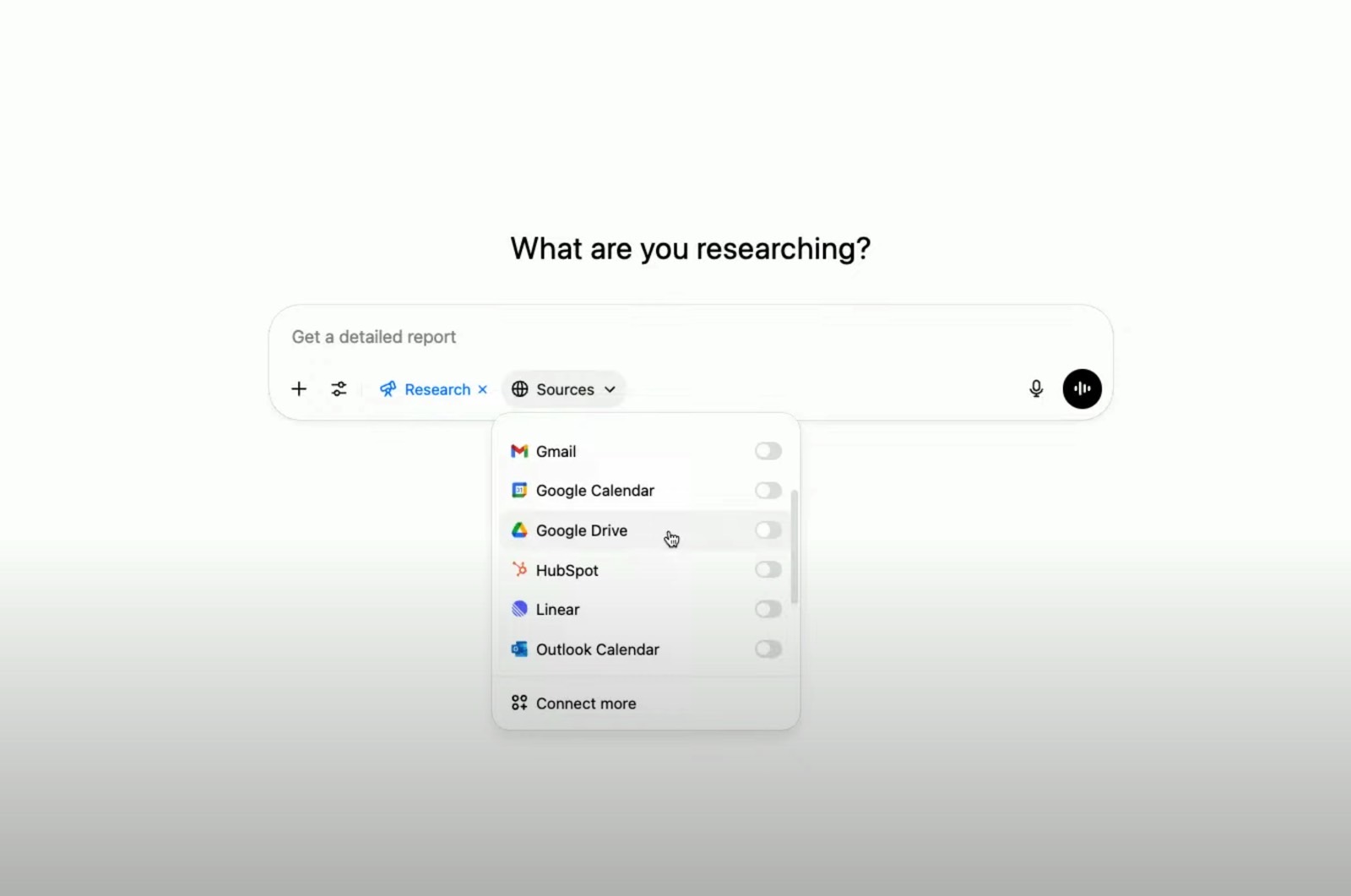
OpenAI introduced a new Connectors feature that lets businesses link ChatGPT to specific data sources. This includes Google apps like Gmail and Calendar, Microsoft apps like Outlook and Teams, and cloud storage services such as Box, Dropbox, and Google Drive.

Tech. Entertainment. Science. Your inbox.

Sign up for the most interesting tech & entertainment news out there.

By signing up, I agree to the Terms of Use and have reviewed the Privacy Notice.

More interestingly, organizations can add custom Connectors to ChatGPT using that MCP AI feature we mentioned a few days ago. MCP allows AIs like ChatGPT to connect to external sources for information.

As I said, this might sound dull if you’re not using ChatGPT at work, but it’s a key move by OpenAI to solve one of its bigger challenges. Unlike Google and Microsoft, OpenAI doesn’t have its own suite of beloved apps. ChatGPT can’t access first-party apps the way Gemini can. That’s a hurdle if you’re building a super-assistant AI. But if it can link to third-party data sources, that hurdle disappears.

Think of it this way: You could ask ChatGPT to check your Gmail for emails from family and summarize plans for your next get-together. Right now, ChatGPT can’t do that.

But if you’re on an enterprise plan, you’ll be able to let ChatGPT access your work Gmail and extract the info you need.

OpenAI hosted a livestream about 22 minutes long to demo the new Connectors feature. They created a fictional company with generated emails and cloud data to show how ChatGPT can easily connect to external sources.

The clip shows a Deep Research run where the AI pulls data from internal sources like HubSpot, Outlook, SharePoint, and Teams. The final report includes citations so you can check the documents ChatGPT referenced before summarizing.

Another demo involved asking ChatGPT a question about the company’s plans. The AI pulled info from internal documents stored in Google Drive and elsewhere, providing links to files the user could access. ChatGPT will only use data that the user is authorized to see.

The new record button is available in the Composer window. Image source: OpenAI

OpenAI also released a new Record Mode for the Mac ChatGPT app that lets the AI record meetings in real time. It will transcribe the meetings and provide summaries with timestamps, so you can jump back to specific parts of the transcription.

The demos targeted enterprise customers, but this is just the beginning. ChatGPT is likely to get more Connectors down the line, eventually opening them up to personal users as well.

OpenAI said on X that Connectors are “available in deep research for Plus & Pro users (excl. EEA, CH, UK) and Team, Enterprise & Edu users.” So, like usual, I can’t use them yet. Still, this means ChatGPT Plus and Pro users are also getting access.

ChatGPT can record audio via the Mac app. Image source: OpenAI

I’ll also note that the recent ChatGPT redesign makes a lot more sense now. OpenAI was clearly setting up the new Composer window to support Connectors.

It won’t be long before ChatGPT becomes a reliable assistant. With memory support and access to personal data sources, it’s getting close.

While we wait, OpenAI’s full demo video is below:

Source

Posted on

Humanoid AI robots may soon jump out of Amazon vans

One of the great things about Amazon is its fast delivery options, especially if you’re an Amazon Prime subscriber. That speed is made possible by a massive logistics operation. Amazon stocks products in huge warehouses around the world, and those fulfillment centers can quickly ship goods to nearby customers once an order is placed.

Amazon has also come up with new ideas to improve delivery times, like using drones in certain regions or shipping goods directly to your home or car.

It’s no surprise that the next big idea to enhance Amazon deliveries (and reduce costs) involves artificial intelligence. Amazon is reportedly considering using humanoid robots powered by generative AI programs to deliver packages to your door.

That kind of test makes sense, given the AI boom we’re living through. Most of us interact with AI through apps on our phones or desktops, but we’ve also seen impressive advances in genAI for robotics in recent years. Soon enough, humanoid robots will use AI software to understand their surroundings and carry out instructions.

Tech. Entertainment. Science. Your inbox.

Sign up for the most interesting tech & entertainment news out there.

By signing up, I agree to the Terms of Use and have reviewed the Privacy Notice.

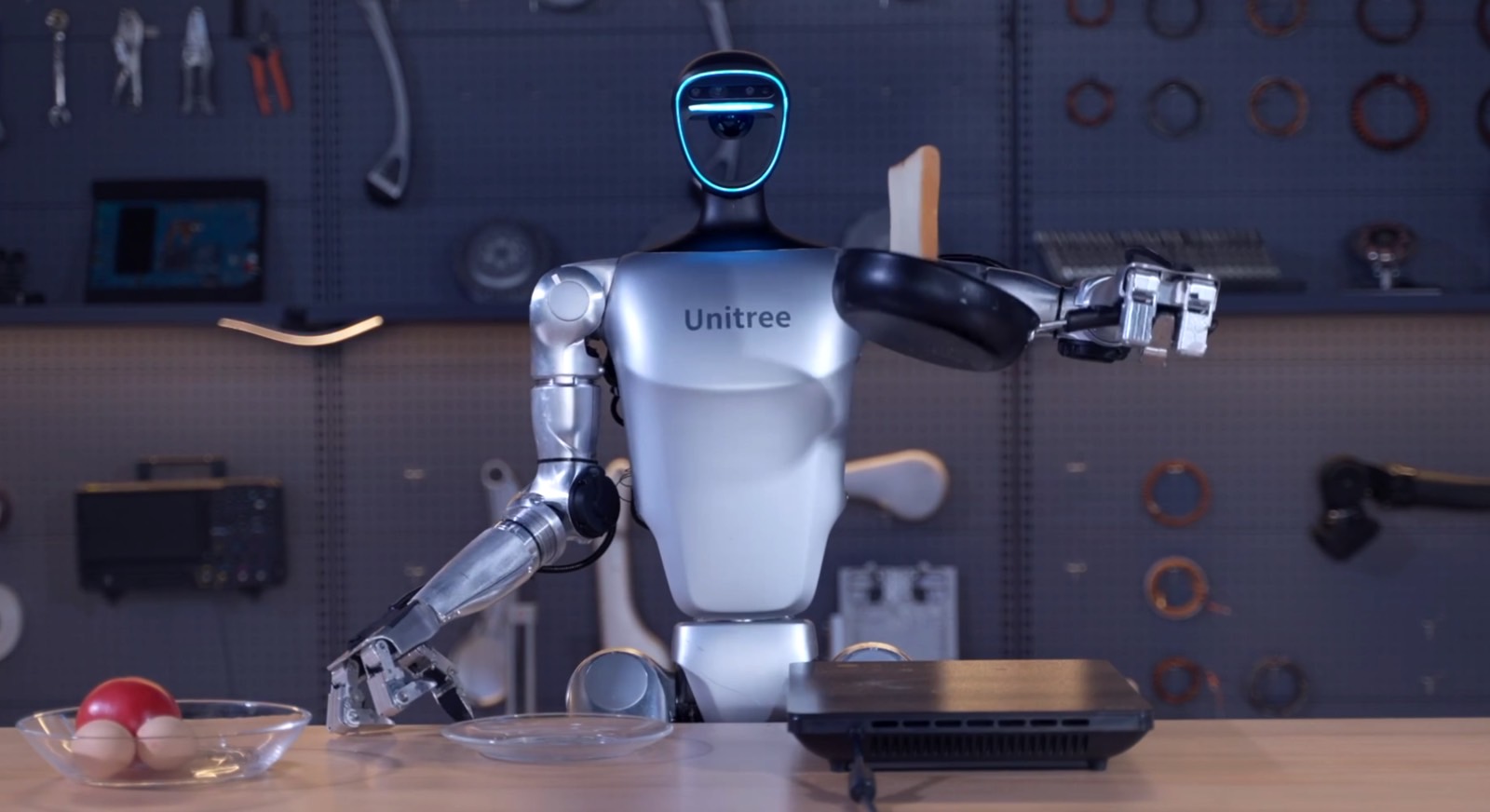
Those instructions might involve telling a Unitree G1 robot (above) to hop out of a Rivian car when it reaches your neighborhood, grab the correct package from the back, and deliver it to your door. This is no longer science fiction, and Amazon is reportedly testing just such scenarios.

According to The Information (via The Verge), Amazon is conducting tests at one of its San Francisco facilities.

Amazon has reportedly built an indoor humanoid park about the size of a coffee shop. The obstacle course includes a Rivian van so the robots can practice the full package delivery process.

The company is testing various humanoid robots for this task, including the $16,000 Unitree G1 robot we covered a few months ago. I said then that I’d eventually want one of these for help around the house. If Amazon’s tests go well, G1-style robots could be delivering orders before that day comes.

The Digit robot in an Amazon warehouse. Image source: Amazon

A few years ago, Amazon confirmed it was testing a humanoid robot called Digit from Agility Robotics. Those tests focused on warehouse work.

The current delivery tests haven’t been officially confirmed, but The Information has a strong track record when it comes to inside scoops on tech companies.

Amazon also made a few AI-related announcements this week about its shipping logistics that seem to back up The Information’s report.

According to Reuters, Amazon has created a new group at its Lab126 device unit focused on developing more capable warehouse robots. These machines will be able to handle more tasks than Amazon’s current robots.

“We’re creating systems that can hear, understand, and act on natural language commands, turning warehouse robots into flexible, multi-talented assistants,” Amazon said in a statement.

The new robots will feature agentic AI that enables them to unload trailers and retrieve parts for repairs. That, in turn, should speed up delivery times for customers, according to Lab126 leader Yesh Dattatreya.

Separately, Amazon plans to use generative AI for improved mapping tools that will help drivers deliver packages more efficiently. The AI will provide more accurate building details than standard mapping apps, including shapes, obstacles, and tricky layouts.

Reuters suggests the tech might be paired with AR glasses Amazon is developing for drivers.

I’d add that this kind of AI software would also benefit humanoid robots making doorstep deliveries.

We don’t yet know when AI-powered robots will start delivering packages or where they’ll be deployed first. But given the pace of development in AI robotics, it probably won’t be long, whether Amazon leads the way or someone else does.

There’s one obvious issue that hasn’t been addressed. Humanoid AI robots will eventually replace human workers, marking another way AI could take over human jobs. It’ll be interesting to see how Amazon handles that messaging, especially considering its less-than-stellar history with employee relations.

You can check out the following video to see what a Unitree G1 robot is capable of right now. For more on AI robotics, here’s what Figure and Google are working on.

Source

Posted on

National Grid starts building large-scale substation to support growth of

The National Grid has confirmed that it is in the process of building its largest new electrical substation in response to the growing demand for datacentres in West London.

The facility will be sited just outside of Greater London in Buckinghamshire and will, according to the National Grid, enable a dozen new datacentres to be connected to its electricity transmission network.

“The new site forms part of National Grid’s upgrade to its transmission network to meet growing demand for electricity, ensuring it can continue to support the growth of new sectors, such as datacentres, and the economic and employment benefits they can bring,” the National Grid said in a statement. 

Dubbed Uxbridge Moor, the substation is being built next door to another 400kV substation in Iver, Buckinghamshire, that is at full capacity and cannot be expanded further. It will be comprised of two substations, including one 400kV facility and another with 132kV of capacity.

“The requests from datacentres to connect at Uxbridge Moor will require around 1.8GW of new capacity, equivalent to adding a mid-sized city to the grid on the outskirts of London,” said the National Grid. “When built, it will be the largest new substation on National Grid’s network by gigawatt capacity.”

The work is part of a planned five-year investment push, valued at £35bn, by the National Grid that is geared towards increasing the UK’s electricity generation capacity and making it easier for datacentres and gigafactories to connect to the grid.

The part of the country where the substation will be built has seen a influx of datacentres over the course of the past decade, prompting concerns about whether there is sufficient supply and grid capacity to service them all.

This matter came to a head in 2022 when a briefing note from the Greater London Authority’s Development Service began to circulate that claimed an influx of datacentres meant the electricity and transmission networks in West London were struggling to cope with the demand being placed on them.

Energy minister Michael Shanks said that projects such as this are essential to the government’s ability to deliver on initiatives, such as its push to lower the barriers to datacentre developments in the UK.

“Upgrades to the electricity network like this are at the heart of building the industries of our future and support our Plan for Change to deliver economic growth and skilled jobs across the UK,” said Shanks.

“It comes as we progress our reforms to the grid connections queue that will speed up the time it takes to get high-growth firms, like datacentres and AI hubs, plugged into the grid – while also fast-tracking projects that will scale up clean, homegrown power by 2030.”

Laura Mulcahy, project director at National Grid Electricity Transmission, said the substation’s creation will generate a wide range of economic benefits. 

“Our new Uxbridge Moor substation will provide vital access to power for datacentres that are at the heart of Britain’s innovation and economic growth,” she said. “It will enable new jobs and investment in Buckinghamshire, and will support the UK’s digital future.”

Source

Posted on

Vodafone, Three UK complete UK merger

After almost exactly two years of regulatory wrangling, Vodafone Group and CK Hutchison Group Telecom (CKHGT) Holdings have at last announced the successful merger of their respective UK mobile firms, Vodafone and Three UK.

The combined business will operate under the VodafoneThree brand, and is 51% owned by Vodafone and 49% by CKHGT. Vodafone will fully consolidate VodafoneThree in its financial results, and the company’s CEO will be Max Taylor, who currently leads Vodafone UK. Three UK’s Darren Purkis has been appointed chief financial officer.

VodafoneThree says it will invest £11bn over the next 10 years, creating one of Europe’s most advanced 5G networks, giving businesses up and down the country a vastly superior mobile experience. In its first year, VodafoneThree plans to invest £1.3bn in capex to enable the company to accelerate its network deployment. It added that significant investment in a 5G Standalone network will propel the UK’s mobile infrastructure to the forefront of European connectivity.

Vodafone and Three first announced plans to merge in June 2023, creating a joint entity with 27 million mobile subscribers in the UK and providing a response to BT’s 2016 purchase of EE, as well as the 2021 merger of Virgin Media and O2 to form VMO2. Vodafone and Three justified the combination by saying it would boost the roll-out of 5G infrastructure and allow greater scale to compete with the larger, converged telecoms and mobile players in BT/EE and VMO2.

Yet after it launched an investigation into the merger in October 2023, the UK’s Competition and Markets Authority (CMA) found that “tens of millions” of mobile customers could see the cost of their mobile packages go up or services such as data allowances reduced. While it acknowledged that the merger could improve the quality of mobile networks and bring forward the deployment of next-generation 5G networks and services, the CMA added that it considers these claims to be “overstated”, and that the merged entity would “not necessarily have the incentive to follow through on its proposed investment programme”.

The CMA also found that the wholesale market where virtual operators – such as Sky Mobile, Tesco Mobile, Lebara, Lyca Mobile and iD Mobile – resell airtime from the four network operators could see worse deals on offer through the reduction in competition from four to three suppliers.

After the CMA outlined ways in which Vodafone and Three could address its concerns, the deal was given a regulatory green light in December 2024 subject to a number of caveats – namely, Vodafone and Three delivering a joint network plan that sets out the network upgrade, integration and improvements they will make to their combined network across the UK over the next eight years; caps in selected mobile tariffs and data plans for three years to protect large numbers of customers from short-term price rises in the early years of the network plan; and offering pre-set prices and contract terms for wholesale services for three years.

Commenting on the completion of the deal, Vodafone Group chief executive Margherita Della Valle said: “The merger will create a new force in UK mobile, transform the country’s digital infrastructure and propel the UK to the forefront of European connectivity. We are now eager to kick off our network build and rapidly bring customers greater coverage and superior network quality. The transaction completes the reshaping of Vodafone in Europe, and following this period of transition, we are now well-positioned for growth ahead.”

Assessing the deal’s wider significance, technology, media and telecoms analyst Paolo Pescatore described the announcement as a big day for the UK telecoms industry as a whole, regarding the new multi-brand approach as catering for specific market segments, providing plentiful opportunities for customer growth and selling more services.

“With a larger base, I would argue that the [combined] entity should focus on retaining its existing base in the short-term and seek to cross or upsell additional services to this larger group,” he said. “An attack on the fixed line market represents a significant opportunity for customer acquisition. This will consist of both fixed wireless access and fibre broadband.

“Three has demonstrated customer success with its home broadband FWA service,” said Pescatore. “We should expect to see this more broadly marketed and most likely at a slightly higher premium than the current offering … there should be a greater focus on the enterprise market given the promise of network leadership combined with its overall spectrum position. It will not be easy to integrate networks and ensure any stripping out does not impact disruption for customers. Make no mistake, the arduous work starts now.”

Source

Posted on

CEO change for AccelerComm as it closes $15m funding round

5G satellite communications products and technology provider AccelerComm has announced it has closed a funding round totalling $15m and appointed David Helfgott as its CEO.

Experts in specialised radio access network (RAN) applications, AccelerComm says its core mission is to transform the next generation of wireless communications with “innovative, world-leading” IP that delivers ultra-high performance and error-resilient 5G to meet the unique demands of satellite-based 5G networks. The company’s portfolio ranges from physical layer services to customisable signal processing components, implemented on next-generation silicon, artificial intelligence (AI) engines, field-programmable gate array and application-specific integrated circuit-ready intellectual property cores including space-hardened platforms.

The £15m round was led by IP Group – including its Parkwalk and Hostplus managed funds – with support from IQ Capital, Swisscom Ventures’ digital transformation fund and Bloc Ventures.

“Having supported AccelerComm since inception, we’re delighted to see the company attract an experienced CEO and close a new funding round, supported by additional blue-chip investors,” said Lee Thornton, deeptech partner at IP Group. “AccelerComm has one of the world’s leading technologies for fast and efficient communications in the nascent low-earth orbit satellite market. The company is well-positioned for growth, with a market that is projected to be worth $100bn within a decade, and we look forward to future progress.”

AccelerComm says the new capital will be used to further develop and accelerate deployments of its 5G satellite communications products and technology that enable direct-to-device communications between phone handsets and space-based satellite networks. It will also support ongoing implementations with operator and satellite network customers, and partners such as Lockheed Martin, which is using AccelerComm’s services in its advanced regenerative 5G NR NTN base station, set to be the first regenerative 5G NTN payload in orbit.

Assessing what AccelerComm’s cash injection means for both the company and the space comms industry, Henny Sands, head of telecommunications at the UK Space Agency, said the non-terrestrial network convergence of satellite and mobile technology was reshaping the future of connectivity, and that companies like AccelerComm were helping to drive that transformation.

“This investment marks a significant step towards achieving universal mobile coverage through space-based 5G,” he said. “The UK Space Agency is proud to support pioneering businesses developing world-class and unique capabilities, and we welcome AccelerComm’s continued innovation in this critical sector.”

David Helfgott will be at the forefront of driving such innovation, and will also be responsible for accelerating customer and partner traction in the US and globally for AccelerComm’s technology.

Boasting more than 20 years of leadership experience across the wireless and satellite communications markets, he also most recently held the position of CEO at inflight comms firm SmartSky Networks, which majored in air-to-ground (ATG) 4G LTE/5G networks for aviation.

“There is growing momentum in the mobile communications industry towards using 5G enabled satellites to augment existing coverage and capacity delivered by terrestrial networks,” he said.

“AccelerComm’s unique technology and acumen position us at the centre of this shift, delivering a critical building block required to provide best-in-class 5G services from space. The recent announcement of our 5G NTN solution has led to great interest from mobile operators and satellite networks from around the world.”

Source

Posted on

If the iPhone’s Mail app is giving you issues, you’re

The Mail app has long been one of Apple’s most popular and important first-party iPhone apps, but at the moment, it appears to be broken. As spotted by MacRumors on Thursday, there have been multiple reports from around the internet about iPhone owners encountering a completely blank screen when they try to open the Mail app.

What’s up with the Mail app?

“My [Mail] app no longer works after the [iOS 18.5] update,” said one frustrated iPhone owner in a thread on Apple’s Support Community forums. “I uninstalled and re-installed and it attempts to open (blank white screen) and crashes every time.”

Hundreds of comments on a Reddit thread show that this is not an isolated or uncommon issue, either. A wide range of iPhone models are affected, stretching back to at least the iPhone 12, so it’s probably safe to assume it’s a software issue.

In fact, I experienced this issue myself on an iPhone 14 Pro when I woke up this morning. I tapped on the Mail app, and after hanging for a few seconds, the last email I’d opened appeared on the screen. Then, the buttons on the top of the app vanished, the app froze, and I had to swipe up to return to the Home screen. After force-closing the app, I attempted to reopen it, but I either saw a blank screen or had the same freezing issue as before.

Tech. Entertainment. Science. Your inbox.

Sign up for the most interesting tech & entertainment news out there.

By signing up, I agree to the Terms of Use and have reviewed the Privacy Notice.

Is there a fix?

I wasn’t sure what else to do, so I tried turning my iPhone off and back on again. For whatever reason, that worked, and I’m able to use the Mail app normally now. That solution also seemed to work for some of the other users who encountered the bug.

Another user claims that they were able to fix the app by going to Settings > General > Keyboard and disabling features like Auto-Correction and Smart Punctuation. Unfortunately, none of these appear to fix the problem permanently.

As MacRumors notes, Apple has yet to acknowledge the issue. There is no indication on Apple’s System Status page that the app is experiencing any problems on Apple’s end. We’ll be keeping an eye out for any updates on the matter.

Source

Posted on

South Korea grants regulatory licence for LEO services

Satellite connectivity solutions provider Intellian Technologies and geographic and low Earth orbit (GEO, LEO) communications provider Eutelsat Group are hailing the decision by the Ministry of Science and ICT (MSIT) in South Korea to approve a cross-border supply agreement for satellite internet services and in particular granting a regulatory licence for the deployment of Eutelsat OneWeb’s LEO satellite across the country’s maritime, military and government and enterprise markets.

Eutelsat OneWeb claims that its LEO satellite network is designed to provide secure, low-latency, high-speed broadband with global coverage. It is already operational across multiple regions, designed to deliver connectivity in areas where terrestrial infrastructure is limited or unavailable. The service looks to address connectivity demands across applications including maritime, aviation, enterprise and government networks.

For its part, Intellian, headquartered in Pyeongtaek with global operations across 11 countries and four research and development centres, boasts over 20 years of operation in satellite communications.

The company, which says it has evolved from a global antenna manufacturer to a strategic enabler of next-generation connectivity, is the largest supplier of OneWeb user terminals globally, offering a range of flat-panel and parabolic solutions tailored for land mobility, maritime and fixed installations. Its portfolio includes the OW10Hx, a compact flat-panel terminal based on phased array technology, and the OW11Fx, an enterprise-grade terminal capable of delivering download speeds of up to 196Mbps. These are both co-developed and deployed in partnership with Eutelsat OneWeb.

The two parties describe MSIT’s decision as a first of its kind, potentially providing a spur to the rapidly growing space-based communications market, marking a “ground-breaking regulatory precedent” in the country and opening the door to a new era of next-generation satellite broadband access.

In addition, Eutelsat and Intellian see strong growth potential in Korea’s LEO satellite market and say they are committed to deepening their collaboration for domestic and international deployments. With OneWeb’s global network fully in place and Intellian’s manufacturing and engineering capability, the partners say they are positioned to support digital transformation across industries and geographies.

Commenting on the announcement, Neha Idnani, regional vice-president for APAC at Eutelsat OneWeb, said: “Eutelsat’s OneWeb LEO service will connect Korean businesses and government with reliable, high-speed connectivity. From secure defence networks and maritime operations to blue light services and cellular backhaul, our SLAs and committed information rates are tailored for the most mission-critical use cases. We’re proud to partner with Intellian Technologies – one of our closest technology partners – to deliver Korean-made user terminals for the Korean market, reinforcing our global commitment to local enablement.”

Intellian Technologies CEO Eric Sung said Korea’s regulatory approval for LEO services was a major inflection point for the region, reflecting the government’s forward-looking commitment to next-gen connectivity and positioning Korea to lead in LEO-based innovation.

“Intellian is proud to play a key role in enabling this vision through close collaboration with OneWeb,” added Sung. “The performance of our terminals – already deployed globally – proves that LEO is no longer experimental. It’s fully operational, scalable and commercially impactful. With this launch, Korean customers now have access to high-speed satellite broadband that was previously unavailable or unviable, especially in sectors where fibre or terrestrial networks fall short.”

Source