Shop Loewe — $749
 Tim Boyle/Getty Images
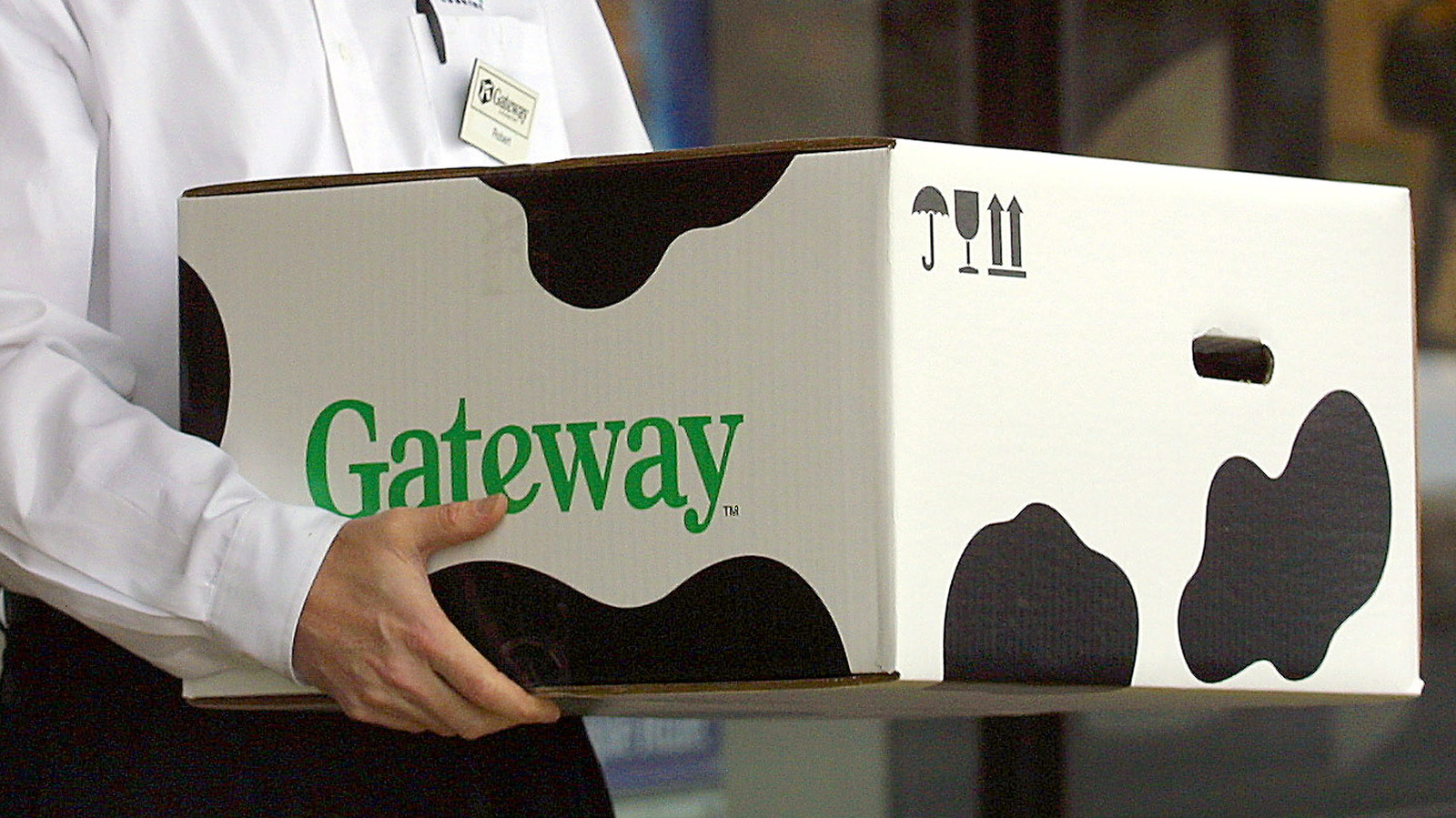
Gateway, the company that competed against the likes of Dell and Packard Bell in the ’80s and ’90s, fell from grace and shut down production of its PCs rather rapidly. Originally based in Iowa, the company was founded in 1985, just a year after Michael Dell set up his PC reselling business. With the rise of the PC, Gateway quickly adapted, becoming a “white box” computer company, selling cheap PCs that it made in-house.
After a fairly successful first few years, Gateway started to make certain mistakes that began to mount up. One user on Reddit, who claims to have worked with Gateway PCs back in the day, noted that the cheap prices owed to the sourcing of parts. They say that machines under the same name could have different parts, depending on when they were made. This led to the PCs having problems if they needed updating or repairing.
David L. Farquhar, an IT professional who worked on Gateway PCs at his various jobs, attributed part of the company’s undoing to the fact that it had lackluster customer support in the enterprise field. Despite two blogs talking about how friendly the consumer customer support was, often guiding him and a colleague through setups, it never managed to fit into the enterprise market. Without this foothold, similar to HP, Dell, or IBM, it couldn’t survive the oncoming storm. This might explain why it never makes favorite tech brand lists.
Gateway 2000 couldn’t hack it in the 2000s
 Jeff Christensen/retired/Getty Images
Gateway began to struggle after the dot-com bubble popped (which will pale in comparison to the inevitable AI bubble bursting), in line with a slump in the PC industry as a whole in the early 2000s. Without the steady stream of income, when a price war cropped up between it and Dell, it saw a fourth-quarter loss of $94.3 million in 2000. Profits also fell, and its stock dropped to $18.75 from a high of over $80. In 2001, it also reported more losses — now $1.03 billion — and more revenue falls, with mass layoffs (24,600 to 14,000) and worldwide factories closed.
These losses proved particularly hard to overcome since Gateway wasn’t in a position to make up for them through diversification, considering it had little foothold in the enterprise and laptop markets. Its TouchPad product was canned, and its decision to launch physical stores started to become a burden, with overhead costs resulting in the closure of nearly 100 stores (19 at the start of 2002, then another 76 in 2003) out of 268. It did begin to diversify its portfolio in 2003, however, launching home theater PCs, PDAs, and MP3 players.
Management, despite the firm being on its back foot, opted to purchase eMachines, a lightweight computer company that sold budget systems. The 2004 purchase wound up costing $234 million in total, which was paid out as $30 million in cash along with 50 million shares in Gateway. With a quick boost from eMachines’ budget-PC momentum, Gateway peaked as the third-largest PC seller in the U.S. when the deal was finalized. The CEO of eMachines briefly became Gateway’s, but left in 2006 after the brand suffered further fallout from its pricing and management woes.
Sold to Acer, now a budget Walmart brand
 Marlon Trottmann/Shutterstock
By the time 2007 rolled around, Gateway was now down to just 1,800 people. With the PC industry rapidly changing underneath it, Gateway was effectively left behind, as it had failed to make a significant mark in the portable or enterprise market. As August hit, the company was sold to Acer for $710 million.
Acer, now owning the Gateway and eMachines brands, didn’t do too much with its purchase. What was there for its professional business was sold to MPC Corporation, which also went bust in 2008, blaming problems with integrating Gateway into its company. Acer eventually retired both the Gateway and eMachines branding.
However, in 2020, the company brought back Gateway. The brand is now used to rebadge Walmart’s EVOO-branded laptops, working with THX on the sound. Gateway currently provides incredibly basic laptops, ranging from offerings powered by the ultra-budget Intel N100 processor to some featuring older AMD Ryzen mobile processors, like the 5700U. Unfortunately, the story ends with the brand languishing in obscurity — it didn’t even make the cut in our list of laptop brands to avoid.