Posted on

Dell AI server revenues leap but storage waits on Project

Dell’s quarterly results show a huge growth in server sales, driven by artificial intelligence (AI) projects, but a relative lag in storage. Key reasons behind that might be that Dell’s current storage lags a little behind the curve in AI performance, while its massive parallel network-attached storage (NAS) that aims to plug that gap, Project Lightning, is in gestation.

Dell’s PC division usually massively outsells its datacentre products, but that’s not the case in its latest (second) quarterly results, which show 69% growth in sales of servers and networking equipment year-on-year. That equated to a revenue of $16.8bn for the infrastructure division that put the client services – i.e. personal equipment – into the shade with $12.5bn of sales.

Dell has benefited here from being the first to the AI market, with servers, the latest Nvidia graphics processing unit (GPUs), and switches compatible with high throughput Nvidia Spectrum-X networking and Ultra-Ethernet cards.

“In the last six months we have delivered $10bn worth of servers for AI,” said Jeff Clarke, vice-chairman and chief operating officer for Dell Technologies. “That’s more than was attained in the whole previous year. Demand is strong and sales of the new AI hardware has totalled $20bn for the year.”

Overall, Dell’s Q2 results showed record revenue of $29.8bn, which was up 19% on the previous year. Of the $16.8bn of revenue contributed by the infrastructure group – growth of 44% in a year – servers and network equipment contributed $12.9bn.

Meanwhile, however, storage arrays – flash and disk – saw revenues lower by 3% over the year at $3.9bn in the quarter.

Meanwhile, the client services group’s revenue growth was a mere 1% year-on-year, with enterprise PCs reporting $10.8bn revenue (+2%) and consumer products $1.7bn (-7%).

Storage the poor relation in infrastructure sales

A salient feature of these results is that the demands of AI seem to favour compute hardware more than storage.

That might be confirmed by the latest results from NetApp, which is number one in flash storage arrays, according to IDC. Here, the array maker posted quarterly results of $1.56bn in August, which equated to annual growth of 1%.

Meanwhile, Pure Storage announced revenue of $861m, and that was an increase of 13% on sales in a year – but there’s a catch. That set of figures included its delivery – unprecedented – of SSD DirectFlash Modules (DFM) to hyperscaler Meta.

Pure’s DFMs are a proprietary format in which the vendor has packed a much higher density of storage onto SSD cards. That’s because it offloads a lot of on-board cache to the array and handles data there instead.

HPE’s third quarter results showed revenue growth for servers at $4.9bn, up 16% year-on-year, but doesn’t appear to break out storage revenue. 

Towards evolution in storage

Why have we seen a boost in revenue for servers for AI, but not really with storage?

There’s no doubt from a technical point of view that storage is an essential support for compute for AI; it’s possible that enterprises have staged their budget spend and focused first on processing power.

At the same time, it’s true that storage products have lagged behind in terms of performance compared with compute. For example, servers that feed GPUs are able to move data at a rate of 400Gbps or even 800Gbps. Current storage products offer around 100Gbps.

Storage suppliers have, however, centred efforts to develop AI storage around parallel file system storage for AI.

Vast Data led the way here, with massive parallel access to storage, while Hammerspace and Weka also followed.

Dell responded with Project Lightning – which comprises Powerscale, the rebranded Isilon scale-out NAS – but that doesn’t seem to have a release date yet. Meanwhile, NetApp has Ontap Data Platform for AI, while Pure has FlashBlade//Exa.

Source

Posted on

Did Will Smith Use AI To Fake Concert Crowds? It’s

Will Smith came under fire this week after he uploaded a short video to Instagram and YouTube Shorts showing the crowds at some of his recent concerts. Some fans quickly noticed inconsistencies in the clip that suggested Will Smith’s team might have used generative AI to make a fake video. TechCrunch and blogger Andy Baio have pointed out that the clip Will Smith uploaded does feature signs of a video created or altered with AI. However, the crowds depicted in the clip are real, as are many of the AI-altered signs and individuals depicted within.

The explanation seems to be even more complicated than Will Smith resorting to AI to create videos showing fake crowds. Baio conducted a detailed analysis that suggests Will Smith’s team might have used AI to turn photos from his recent concerts into videos. Such products are readily available to the public. In fact, Google recently announced a new Veo 3 photo-to-video capability that allows users to turn any static image into a video.

However, there’s another element that might work against Will Smith in this AI controversy. Google recently ran an experiment for YouTube Shorts in which it used AI (machine learning) to improve the quality of Shorts without asking the creator for permission. People complained the videos looked like they were AI generated. It seems that Will Smith’s YouTube Shorts clip that attracted criticism from fans this week might have been a victim of this experiment.

Why people believe Will Smith’s concert video is AI generated

“My favorite part of the tour is seeing you all up close,” Will Smith says in the clip’s caption. “Thank you for seeing me too.” The video is just one minute long, showing the artist singing during his European tour in front of large crowds. The clip focuses on the fans and some of the signs they displayed. One of those signs shows a man saying that Will Smith’s music helped him survive cancer. But the man’s face looks plasticky on YouTube, and one of his hands seems to merge with the hand of a woman in front of him. A different sign shows illegible words that seem to be generated with AI. Another sign saying “Lov U Fresh Prince” turns into “Lov U Fr6sh Crince” later in the clip.

These details prompted backlash. Fans thought Will Smith faked the crowds at his shows, including the signs they displayed. However, Andy Baio did a great job analyzing Will Smith’s social media content and attempted to explain what happened. The signs are real. The man who claimed Will Smith’s song helped him cure cancer was there. The woman in front of him was holding the sign with him. The “Lov U” sign appeared in photos the singer posted on his social media channels before the clip was shared.

Is YouTube Shorts to blame?

Baio speculates that Will Smith’s team used AI to transform some of these photos into videos and then merged them into a longer clip. This led to unwanted visual effects that are telltale signs of AI use. However, Baio says that the YouTube Shorts AI experiment might also be at fault here, as Google automatically enhanced the clip uploaded to Shorts, making it look like even more like a fully AI-generated video. 

The same clip uploaded to Instagram looks more natural, as machine learning wasn’t used to enhance details and smooth out faces. Baio posted a side-by-side comparison on YouTube that makes it easier to see the differences on Instagram and YouTube Shorts:

Plausible excuses aside, the backlash is understandable, considering the increasing amount of AI-generated content posted online. Will Smith has not denied the use of AI in these promotional clips. As a reminder, not all generative AI tools feature visible watermarks to let viewers know that the content was created with AI. Google did not disclose the YouTube experiment until people complained. Even Netflix used AI in a TV show without disclosing the practice beforehand.

Source

Posted on

Insider Says The iPhone 20 Won’t Have A Curved Display,

Mattgush/Getty Images

After a series of reports claimed that Apple is developing an all-screen “iPhone 20” smartphone for 2027 featuring a design mostly made of glass curving around the phone’s four edges, well-known insider UniverseIce said on X that Apple won’t make an iPhone with a curved display to celebrate the iPhone’s 20th anniversary. Instead, Apple would give the iPhone’s edges a softer curvature effect similar to the Apple Watch, which appears to be curving on the sides. The actual OLED panel under the glass will not curve; only the glass cover on top of it will get a curving effect towards the sides.

UniverseIce has been leaking Samsung and Apple secrets on Chinese social media and X for years. His newest take on X comes in response to a report from another well-known Apple insider. Bloomberg’s Mark Gurman detailed a few days ago Apple’s purported iPhone design plans for the next three years. The iPhone 17 series will introduce the ultra-thin “Air” model; the iPhone 18 series will feature Apple’s first foldable handset; and a 20th anniversary iPhone redesign will come in 2027.

“Then comes 2027, when Apple celebrates its smartphone’s 20th birthday with a curved-glass ‘iPhone 20.’ This design will finally break from the squared-off slab we’ve lived with since 2020 and move to an approach with curved glass edges all around,” Gurman said, via MacRumors. “It should fit nicely with the new Liquid Glass-based interface for iOS and other operating systems due to be released next month.”

Gurman made similar claims in mid-May, saying that the iPhone 20 will offer a “mostly glass, curved” design. The Information said in early May that Apple will release an iPhone model in 2027 featuring an edge-to-edge display. The phone’s Face ID system and selfie camera would go under the screen.

What the iPhone 20’s curved screen might look like

Cheng Xin/Getty Images

“The iPhone can’t be designed with a curved screen. Don’t believe such rumors,” UniverseIce warned on X, explaining what sort of curvature the 20th anniversary iPhone might deliver. “Apple has explicitly informed its suppliers that it will not adopt curved screens. At most, it may feature a ‘visual curve’ effect—similar to the edges of an Apple Watch display, where the panel remains flat with the signature softly squared-off borders, while the glass subtly curves downward at the edges. The curvature will be minimal, achieving an edge-to-edge visual experience.”

The leaker also detailed the manufacturing concerns Apple might be dealing with during what could be a very early stage of prototyping. The iPhone 20 might be two years away, but Apple is probably working on the technology advancements required to support a massive redesign.

“The current challenge lies in thinning the TFE (thin-film encapsulation) and optimizing the side OCA (optical clear adhesive) application,” UniverseIce said. “If not executed properly, it could create a ‘magnifying glass’ effect when viewed from the side, causing distorted visuals. This is the general direction Apple is pursuing—absolutely no quad-curved screens. A unibody quad-curved glass design might be possible, but only the glass would bend; the display itself would remain entirely flat, with zero curvature.”

Apple has never made iPhones with curved edges, even though various Android handset makers used curved screen designs in previous years. Samsung is the best example, but even Samsung retired the curved displays in favor of the flat screens seen on handsets launched in recent years. Apple did offer curved-edge glass effects on the 2014 iPhone 6 designs, which it kept in place until the 2022 iPhone SE 3.

One more thing

Adrianhancu/Getty Images

The sources above have always provided accurate details about Apple’s plans for the iPhone in the past, but these early iPhone 20 reports will need more time to be confirmed. While they seem to be contradictory, they could be telling the same iPhone 20 design story, as learned from different sources. Both Gurman and UniverseIce might be correct. Apple could employ an all-screen iPhone 20 design in 2027, but only the display’s glass cover might curve slightly at the edges before seamlessly merging with the phone’s chassis.

Interestingly, a report from Korean site ETNews from mid-May said that Apple might employ a “four-edge bending” technology for the 2027 iPhone, somewhat supporting Gurman’s May report. Such a screen would wrap around the iPhone’s four sides to offer users a display experience that would eliminate borders, or the bezels seen around current iPhone displays. A leak from Korea said in mid-June that Apple is considering an all-glass design for the iPhone 20. The glass would surround the display, edges, and rear, showing no gaps. Apple published patents in previous years showing iPhone concepts with wraparound displays. While tech shown in patents doesn’t always make it into commercial products, it proves Apple’s interest in pursuing such iPhone display innovations.

While this is all speculation, we’ll see an increase in iPhone 20 rumors in about a year, around the iPhone 18’s September 2026 launch event. The iPhone 20 will then appear in more reports in early 2027, as Apple finalizes the design and approaches the mass-production stage.

Source

Posted on

Northern Ireland police kept inspectors in dark over surveillance of

Northern Ireland police failed to disclose two covert surveillance operations against journalists to the UK’s independent surveillance watchdog, in breach of their statutory obligations.

The Police Service of Northern Ireland (PSNI) kept inspectors from the Investigatory Powers Commissioner’s Office (IPCO) in the dark about two covert operations against journalists in 2018 and 2023, it has been disclosed.

Brian Leveson, the investigatory powers commissioner, confirmed in a letter to the Northern Ireland Policing Board that the PSNI only informed IPCO about the covert operations in 2025, after they had become public.

The disclosure, in letters published in the Northern Ireland Policing Board’s annual human rights report – first reported by The Detail – comes as the PSNI is preparing to publish a review by barrister Angus McCullough KC into police surveillance of journalists and lawyers in Northern Ireland.

Covert surveillance in 2018

In August 2018, the PSNI authorised an unlawful surveillance operation in a failed attempt to identify a confidential journalistic source suspected of supplying information to journalists Barry McCaffrey and Trevor Birney.

The then chief constable of the PSNI issued a directed surveillance authorisation (DSA) to allow the PSNI to monitor an individual suspected of leaking information to the two journalists.

But according to Leveson, the PSNI failed to disclose the existence of the surveillance operation against the journalists to IPCO inspectors during the watchdog’s annual inspection in spring 2019, in breach of its statutory obligations.

“There is no indication in the 2019 inspection report for PSNI that my inspectors were notified of any covert activity conducted against journalists, or with the intention of identifying a journalistic source,” he wrote in a letter to the policing board.

Leveson said he had received no explanation for the PSNI’s omission. “The question remains why the DSA was not specifically brought to my inspectors’ attention in 2019, given its stated objective of identifying a journalistic source,” he said.

It’s quite clear that the PSNI is incapable of acting honestly with any of these oversight bodies. They don’t take it seriously at all, or they show them complete disrespect by failing to properly and honestly interact with them Barry McCaffrey, journalist

The PSNI did not inform IPCO of the surveillance operation until after the Investigatory Powers Tribunal (IPT) disclosed it publicly in its judgment in favour of the two journalists in 2024, awarding them costs.

Independent inquiry

Journalists McCaffrey and Birney told Computer Weekly that the PSNI had consistently failed to take oversight seriously during their legal battle with the PSNI.

“It’s quite clear that the PSNI is incapable of acting honestly with any of these oversight bodies. They don’t take it seriously at all, or they show them complete disrespect by failing to properly and honestly interact with them,” said McCaffrey.

He said the only way of getting to the truth was to hold an independent public inquiry. 

“We now see with Brian Leveson that they have withheld evidence even when IPCO was asking for it, and we fear that there are going to be more incidents of this when the McCullough Review comes out,” he added.

2023 operation spied on Twitter

The PSNI also failed to disclose a surveillance operation against another unnamed journalist in 2023 to IPCO inspectors.

The operation targeted the covert monitoring of social media posts on X by investigative journalist Dónal MacIntyre.

In a letter to the policing board, Leveson said the PSNI had failed to alert inspectors to the operation, despite being asked to do so.

“This authorisation was not brought to my inspectors’ attention, despite their specific enquiry regarding any operations involving confidential journalistic or legally privileged material,” he added.

The inspection was led by judicial commissioner Declan Morgan, the retired former Lord Chief Justice of Northern Ireland, who sought specific assurances from IPCO on surveillance authorisations issued against journalists. He reported that he identified no issues with non-compliance with the management of confidential information.

As Lord Chief Justice, Morgan ruled in 2019 that Durham Police, which was assisting the PSNI, had unlawfully used search warrants in an attempt to identify Birney and McCaffrey’s sources.

Boutcher: Journalistic risk not identified

PSNI chief constable Jon Boutcher told the policing board that he had no explanation for why the PSNI had not disclosed the 2018 surveillance operation to IPCO inspectors.

“No reason or record can be located to explain why this was not highlighted to IPCO as intended,” he said.

Boutcher said the PSNI had not reported the later 2023 surveillance operation to IPCO as it had not identified that it related to journalistic material.

“As this application had not been highlighted correctly in conjunction with journalistic material, it was not identified when preparing for the 2024 inspection, and not highlighted to the IPCO inspectors,” he added.

He said the material sought was limited to “public tweets” and did not seek private communications.

Barry McCaffrey (left) and Trevor Birney (right)

Up to 16 BBC journalists targeted

Following the IPT’s ruling in favour of Birney and McCaffrey, other journalists have made complaints that they were unlawfully spied on.

Former BBC journalist Vincent Kearney has filed a complaint against the PSNI, and up to 16 more BBC journalists have also raised concerns about unlawful surveillance by the PSNI or MI5, according to the policing board.

Computer Weekly reported in July that the PSNI engaged in sustained surveillance of BBC journalists in Northern Ireland from at least 2006 to 2022.

Surveillance against BBC journalists allegedly took place during multiple PSNI operations, codenamed Operation Oxbow in 2009, Operation Settat in 2011, Operation Basanti in 2014 and Operation Grimmicaeie in 2022.

Data published by the policing board shows that the number of complaints to the Investigatory Powers Tribunal relating to the PSNI’s use of surveillance powers rose from nine in 2022 to 16 in 2023 and 33 in 2025.

The PSNI received “notifications to disclose” information in three cases in 2022, rising to six cases in 2023 and 19 in 2024, which, according to the policing board, “might indicate that these are not hopeless cases”.

Oversight mechanism ‘not working’

Amnesty International said the admission that the PSNI’s covert surveillance operations targeting journalists, including one later ruled unlawful, were withheld from the UK’s surveillance watchdog is “deeply concerning”.

There must be an overhaul of the mechanisms designed to provide oversight of police surveillance activities across the UK Patrick Corrigan, Amnesty International

“The PSNI not only authorised covert surveillance designed to identify journalists’ confidential sources, in flagrant violation of press freedom, but then withheld details of those operations from the very watchdog charged with holding them to account,” said Patrick Corrigan, Amnesty International’s Northern Ireland director.

“There must now be an overhaul of the mechanisms designed to provide oversight of police surveillance activities across the UK,” he said. 

Daniel Holder, director of Belfast-based human rights group the Committee on the Administration of Justice (CAJ), called for the government to implement the 1999 Patten Commission’s recommendation for a dedicated “commissioner for covert law enforcement” in Northern Ireland.

“We cannot continue with an oversight system that is dependent on the PSNI and other bodies here exercising such covert powers voluntarily telling the oversight body what they are doing, or hope that such matters are turned up in limited dip-sampling,” he said.

IPCO ‘not dependent on voluntary disclosures’

A spokesperson for IPCO said the investigatory powers commissioner, Leveson, will personally raise the issues with the PSNI chief constable, Boutcher.

In response to the failures, the PSNI had enhanced its central record of surveillance authorisations and would implement training on the “acquisition and management of information relating to journalists”, the spokesperson added.

IPCO said its oversight regime is not dependent on voluntary disclosures.

“Inspectors use proactive techniques, including ‘dip sampling’ of authorisations, to identify compliance issues and verify responses to requests for information,” the spokesperson said.

“The requirement for PSNI to highlight journalist-related authorisations provides an additional layer of assurance in the oversight process,” the spokesperson added.

Policing board ‘open to all courses of action’

The chair of the Northern Ireland Policing Board, Mukesh Sharma, saidthe board has expressed serious concerns regarding the use of covert surveillance.

“The board awaits the findings of the McCullough Review and remains open to all courses of action to ensure proper accountability,” he said.

The Police Service of Northern Ireland’s deputy chief constable, Bobby Singleton, said the PSNI welcomed the policing board’s human rights report.

“We will continue to work closely with the policing board’s independent human rights adviser as we consider and respond to the content and recommendations of this wide-ranging report,” he said.

Source

Posted on

How Much Battery Life Does iOS 26’s Adaptive Power Feature

José Adorno for BGR

It won’t be long before iPhone users can download iOS 26. With iOS 26 beta 8 and IOS 26 public beta 5 now available to testers, Apple likely only has the Release Candidate (RC) version to ship before the final build launches in September.

That said, it’s very unlikely that Apple between now and September 15, which is when we expect iOS 26 to be officially released. While we have tested several of the new features coming in Apple’s new software updates, one that stood out and deserved a more thorough examination was Adaptive Power Mode, which rumors suggest could be a vital addition for the iPhone 17 Air.

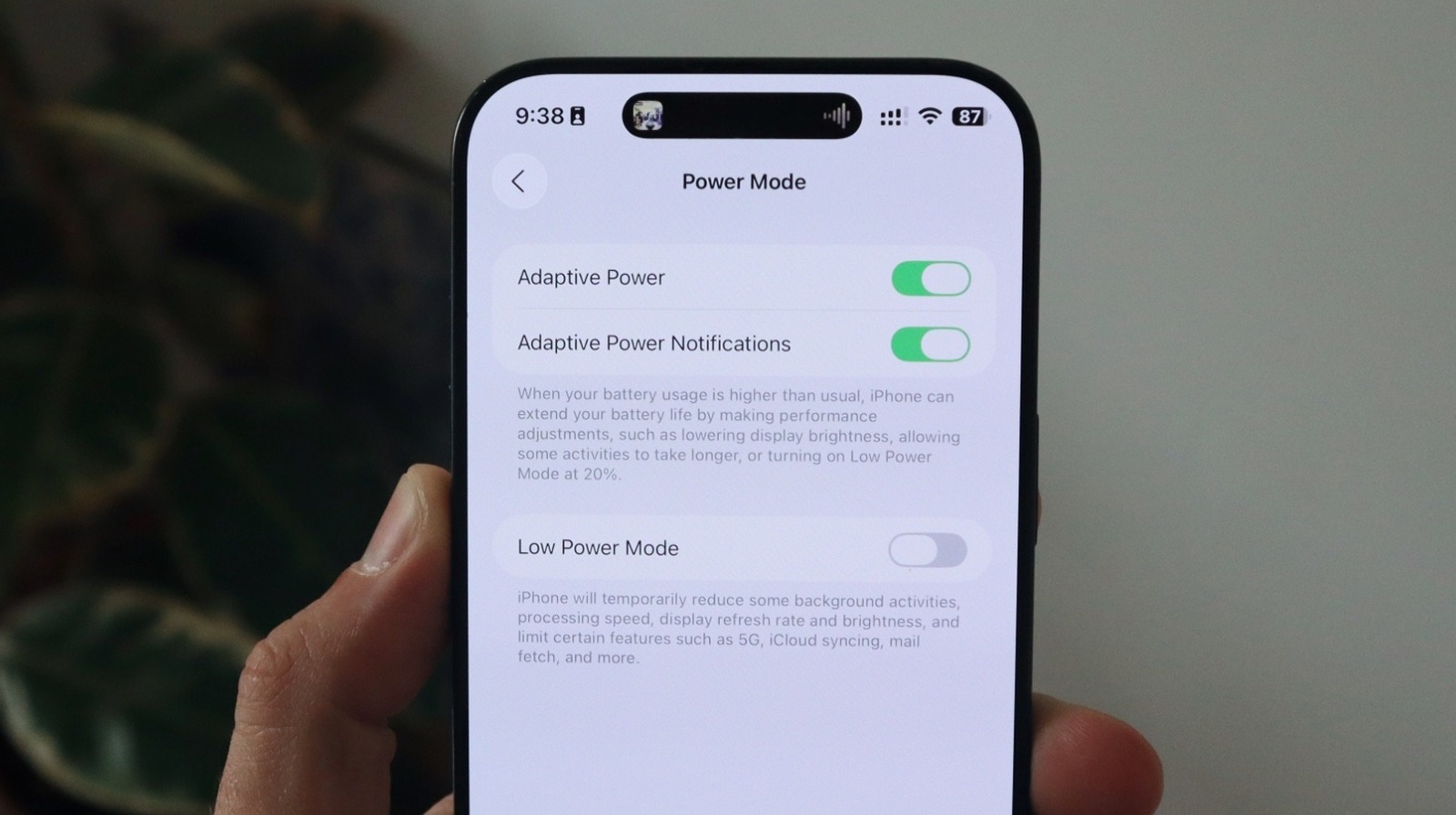
Apple says that with Adaptive Power Mode activated, the iPhone can extend battery life by making performance adjustments when the battery usage is higher than normal, such as lowering the display brightness, slowing down certain activities, or turning on Low Power Mode at 20%. However, after a few weeks of testing, Adaptive Power Mode made little to no difference on the battery life of an iPhone 16 Pro Max.

Will iOS 26’s Adaptive Power Mode make a difference on your iPhone?

José Adorno for BGR

The tricky thing about testing iOS 26’s Adaptive Power Mode is that the operating system is still in beta testing. While Apple has improved the overall experience significantly in recent beta releases, test builds are expected to have battery draining issues. As such, there’s always a chance that the feature will have a more noticeable impact in the final version of iOS 26.

While we can’t promise iOS 26 will deliver better battery life than iOS 18, there’s also no evidence so far that it has a negative impact on the battery. What we did notice, however, is that apart from the occasional notification confirming that Adaptive Power Mode was active, triggered by what was happening on the iPhone’s display, we still had to charge the device at least twice a day just to make it to bedtime.

In general, we’ve seen the display dimming in outdoor environments with a combination of Apple Maps usage, music streaming, and warm weather. However, this already happened whenever the iPhone started to overheat. Long story short, the only real benefit of the Adaptive Power Mode feature has been the automatic Low Power Mode activation at 20%.

There might be salvation to Apple’s newest battery feature

José Adorno for BGR

Adaptive Power Mode is likely to be a key feature for the ultra-thin iPhone 17 Air, which is rumored to feature a smaller battery than the other iPhone 17 models. That said, there are only two notable features beyond battery size that differentiate an iPhone 16 Pro Max from the upcoming iPhone 17 Air: A more efficient processor and Apple’s C1 5G modem.

Cellular connectivity is known to be one of the greatest causes of excessive battery life drain. With a more power efficient chip and better control of the 5G modem, the Adaptive Power Mode functionality might work better on an iPhone 17 Air than on the iPhone 16 Pro Max, which has a bigger battery but a third-party 5G modem and an older processor.

While we’ll have to wait until after the “Awe Dropping” event on September 9 to see how the iPhone 17 Air interacts with the final version of the feature, Adaptive Power Mode hasn’t made the greatest first impression on iOS 26 beta testers.

Source

Posted on

Splunk.conf: Splunk and Cisco showcase unified platform

Having spent the best part of a year and a half working to unify its products and tools with those of its new owners Cisco, Splunk is using its annual Splunk.conf event in Boston, Massachusetts, to showcase a number of future developments, beginning with the introduction of the new Cisco Data Fabric platform.

Following the closure of the multibillion dollar purchase in 2024, Splunk and Cisco moved quickly to start to integrate their technology offerings. By last September, as Computer Weekly reported at the time, the duo already had multiple tools, such as Splunk’s Observability Cloud, working well with Cisco AppDynamics, Talos Threat Intelligence and ThousandEyes, and were eyeing closer integration in other areas.

Speaking to reporters in advance of the show’s opening keynote on Monday 8 September, Splunk senior vice president and general manager for EMEA, Petra Jenner, reflected on a busy year and said there were a lot of positive aspects to the deal.

“While we still have our own identity we are working more closely together to achieve better customer experiences,” she said. “One of the key priorities for us is to ensure that customers are really supportive. They see that we are collaborating from a technical point of view.”

Jenner said that prior to Splunk’s acquisition by Cisco, while it had had a strong and growing presence in markets such as the UK, France and Germany, there had been a recognition that it needed to invest in growth.

Cisco’s money has been a catalyst for this investment, not only in the UK but also helping open up more business in countries such as Saudi Arabia and the United Arab Emirates (UAE), said Jenner.

“The impact the acquisition had for the Splunk EMEA team has been extremely good. We have joint customer engagements and there are core initiatives going on so that customers can really leverage the joint Splunk and Cisco, not only the product but also the overall convergence,” said Jenner.

“It also suits very well the technology trends [that are] happening,” she added. “In regard to AI the platform approach is getting more important.”

Jenner also reaffirmed Splunk’s commitment to its IT channel partners both in the security and observability fields, saying it has doubled the numbers on its books. She added that drawing on the strength of Cisco partners – with all the myriad possible networking certifications available – that may not have previously considered Splunk, may help make the platform concept an easier sell to customers looking to do more.

Data Fabric turns machine data into actionable intel

Splunk.conf kicked off on Monday evening with the launch of Cisco Data Fabric, which promises to “transform machine data into AI-ready actionable intelligence”.

On the basis that AI has led to a surge in machine data, but that said data is still largely siloed, fragmented, and hardly ever used, Splunk said Cisco Data Fabric to enable customers to make better decisions, reduce their operational risk, and innovate around AI, for example by helping train custom models, powering agentic workflows, or correlating various streams of machine and business data.

Among some of Data Fabric’s features are the Time Series Foundation Model, which will power pattern analysis and temporal reasoning on time series data to enable anomaly detection, forecasting and root cause analysis, driving proactive operations and easing incident response.

Meanwhile, Cisco AI Canvas, also integrating with Splunk Cloud Platform, will provide an AI agent to orchestrate analysis workflows and workspaces for team collaboration. Splunk described this as a “virtual war room experience” that will let teams glean more in-depth insight, work together in real-time, and make decisions better.

These capabilities will be coming on stream over the next few months, with a few slated for 2026.

Kamal Hathi, Splunk senior vice president and general manager of Splunk, said machine data was now the heartbeat of digital organisations and characterised Splunk as a “heart rate monitor”.

“Our goal is to give customers the fastest, most secure path from data to action,” said Hathi.

“By embedding AI across the platform and embracing open standards, we’re not just helping organisations analyze information faster – we’re enabling them to anticipate change, scale innovation without unnecessary complexity, and deliver digital services that are more resilient, adaptive, and responsive to the needs of their users.”

IDC senior research director of cloud data management, Archana Venkatraman, said Data Fabric addressed a critical pain point – the need to quickly and safely unify vast streams of machine data in the service of resilience.

“By enabling a federated approach that eliminates data movement, it provides a pragmatic solution for organisations operationalising AI at scale,” she said.

“Its focus on real-time search, coupled with a repository for AI-ready data, provides tangible value by reducing complexity and time to insights. This unified architecture is a strong step toward helping customers build more resilient and trustworthy AI systems.”

Searching for Snowflakes

Also on the docket is the launch of Splunk Federated Search for Snowflake, a new platform integration empowering users to connect, query and combine operational and business data across Splunk and Snowflake environments.

Some of its key capabilities include unlimited onboarding of Snowflake data in Splunk; federated queries whereby users can write SPL-like queries to search Snowflake data direct from Splunk; next-gen federation capabilities to combine datasets for more impactful context and insight; and more efficient querying, letting users leverage Snowflake analytics for partial queries before performing final data joins in Splunk.

These capabilities, and others, are slated for a July 2026 release.

Source

Posted on

iPhones Will Give A Boost To The Entire Smartphone Market

Wongsakorn 2468/Shutterstock

Apple’s iPhone lineup is about to do something fairly interesting this year: Carry the entire smartphone market on its shoulders. Worldwide smartphone shipments, according to new data from IDC, are expected to grow by something on the order of 1% in 2025 (which is practically flat), reaching 1.24 billion units overall. Obviously, that doesn’t sound like a lot, but here’s the kicker — based on IDC’s data, smartphone shipments this year would have actually declined worldwide were it not for a pickup in Apple’s iPhone shipments.

The entire market is forecast to end up in positive territory this year thanks to an estimated 3.9% rise in iOS sales, a reminder of how much importance continues to be attached to Apple and its iPhone line even in a tough global economy with uneven demand. Apple, for its part, is also no doubt pleased with these numbers, especially right now, just days before the company’s annual fall iPhone reveal event — with the iPhone 17 launch just around the corner.

The iPhone effect on the smartphone industry

Justin Sullivan/Getty Images

Overall, IDC’s forecast presents a rather mixed picture for the year. On one hand, the global market is being dragged down by weaker demand in China, where shipments are expected to decline by 1% as government subsidies roll away and consumers hold back on spending. At the same time, iPhone shipments remain a bright spot, with softness in some parts of the world offset by consumers’ interest in replacing their devices in markets like the U.S., Middle East, and Africa — this Apple-driven trend apparently being what’s lifting the smartphone market 1% in 2025 all by itself in an otherwise challenging period.

For Apple, this is welcome data to see ahead of its “Awe Dropping” event on September 9, at which time we’ll get our first look at the iPhone 17 family of devices — with the rumors about them pointing to what just might be Apple’s slimmest handset yet. Rumors indicate an ultra-thin iPhone 17 Air, for example, will feature updated design elements like a camera bar across the back panel.

Looking further ahead, IDC’s new report says smartphone makers are focusing less on unit growth and more on value, thanks to innovations like foldables and on-device generative AI. But in 2025, it’s Apple’s iPhone that’s doing the heavy lifting — and reminding us all once again why the September iPhone event remains one of if not the most important moments on the smartphone calendar.

Source

Posted on

UK equality watchdog: Met Police facial recognition unlawful

The Metropolitan Police’s use of live facial-recognition (LFR) technology is unlawful, according to UK equality watchdog, citing the need for deployments of the technology to be necessary, proportionate and respectful of human rights.

John Kirkpatrick, chief executive of the Equality and Human Rights Commission (EHRC), acknowledged that while the tech could be used help to combat serious crime and keep people safe, the force is currently failing meet key legal standards with its deployments.

“The law is clear: everyone has the right to privacy, to freedom of expression and to freedom of assembly. These rights are vital for any democratic society,” he said.

“As such, there must be clear rules which guarantee that live facial-recognition technology is used only where necessary, proportionate and constrained by appropriate safeguards. We believe that the Metropolitan Police’s current policy falls short of this standard.”

The EHRC added that the Met’s current approach to LFR is incompatible with the European Convention on Human Rights, specifically Articles 8 (right to privacy), 10 (freedom of expression) and 11 (freedom of assembly and association).

It further highlighted how, when used on a large scale, even low error rates can affect a significant number of people by brining unnecessary and unwanted police attention, and warned that its use at protests could have a “chilling effect” on people’s freedom of expression and assembly.

Senior police officers from both the Met and South Wales Police have previously argued that a major benefit of facial-recognition technology is its “deterrence effect.”

The EHRC added that the “high risk” nature of LFR means it should only be used when strictly necessary and subject to safeguards.

The regulators’ comments follow it being granted permission to intervene in an upcoming judicial review of the Met’s LFR use, which was launched by anti-knife crime campaigner Shaun Thompson after he was wrongly identified as a suspect by the Met’s system.

Thompson, who was returning home from a volunteer shift in Croydon with the Street Fathers youth outreach group when he was wrongly stopped in February 2025, previously described the system as “stop and search on steroids,” and said it felt like he was being treated as “guilty until proven innocent”.

The EHRC said that data shows that the number of Black men triggering an “alert” by the technology is higher than would be expected proportionally when compared with the population of London.

According to data gathered by Green Party London Assembly member Zoë Garbett, more than half of the Met’s 180 LFR deployments that took place during 2024 were in areas where the proportion of Black residents is higher than the city’s average, including Lewisham and Haringey.

While Black people comprise 13.5% of London’s total population, the proportion is much higher in the Met’s deployment areas, with Black people making up 36% of the Haringey population, 34% of the Lewisham population, and 40.1% of the Croydon population, where the Met is also planning to deploy permanent LFR cameras.

While the review will not take place until January 2026, the EHRC will now be able to submit evidence on the “intrusive ways” the force has been using the technology in recent years.

Responding to the EHRC’s claims, a Met Police spokesperson said: “The Met is committed to making London safer, using data and technology to locate offenders that pose the greatest risk to our communities. It helped us to take hundreds of dangerous offenders off London’s streets, including those wanted for rape and domestic abuse.

“We continue to engage with our communities to build understanding about how this technology works, providing reassurances that there are rigorous checks and balances in place to protect people’s rights and privacy.

“A judicial review hearing is scheduled for January 2026, and we are fully engaged in this process. We are confident that our use of live facial recognition is lawful and follows the policy which is published online.”

At the start of August 2025, the Met said it will more than double its number of LFR deployments to cover the loss of 1,400 officers and 300 staff, amid a £260m budget shortfall for the coming year.

The Met also said in July this year that since the start of 2024, more than 1,000 arrests have been made using LFR – 773 of which led to the individual being charged or cautioned.

In the same month, home secretary Yvette Cooper confirmed for the first time that the UK government will seek to regulate police facial recognition by creating “a proper, clear governance framework”, citing police reticence to deploy systems without adequate rules in place. However, she declined to say if any new framework will be statutory.

While there have been repeated calls from both Parliament and civil society over many years for the police’s use of the technology to be regulated, the Home Office has consistently maintained that there is already a “comprehensive” framework in place.

Such calls include three separate inquiries by the JHAC into shoplifting, police algorithms and police facial recognition; two of the UK’s former biometrics commissioners, Paul Wiles and Fraser Sampson; an independent legal review by Matthew Ryder QC; the UK’s Equalities and Human Rights Commission; and the House of Commons Science and Technology Committee, which called for a moratorium on LFR as far back as July 2019.

More recently, the Ada Lovelace Institute published a report in May that noted the UK’s patchwork approach to regulating biometric surveillance technologies is “inadequate”, placing fundamental rights at risk and ultimately undermining public trust.

Source

Posted on

YouTube Music Is Stealing A Much-Needed Design Change From Spotify

Leona Octavii/Shutterstock

YouTube looks to be gearing up for a major design change on Android — at least in its Spotify competitor, YouTube Music. The change is relatively minor, but it’s a nice quality-of-life feature that should be a welcome sight for most YouTube Music users.

Previously, YouTube Music required users to tap on a search icon — a little magnifying glass — located near the top of the app window in order to search for music. This wasn’t difficult by any means, but for such an important button, it was a bit out of the way, especially for users sporting a larger device, like the Galaxy S25 Ultra or the Pixel 10 Pro XL.

Now, though, 9to5Google reports that some users have discovered they are able to operate the app’s search functionality using a new Search icon right in the middle of the main toolbar at the bottom of the app. That’s basically the same spot you’ll find the Search tab in the Spotify app, but that isn’t a bad thing, as you should now be able to reach it while using your phone with one hand.

YouTube Music’s new search icon might not be permanent

Robert Way/Getty Images

This feature isn’t widely available yet, and there’s no official word from Google and YouTube about whether it intends to launch it wide or not. For now, it seems only some users have been given access to the design update, though based on what we’ve seen so far from the screenshots shared by 9to5Google, it does look like it could make searching for new music just a little easier.

Instead of requiring you to tap on the search icon at the top, the new design lets you search for new songs while also looking at the Explore page all in one go. The Explore icon, which looked like a compass, has now been replaced with a little magnifying glass, and when tapped on, it opens up the Explore page with a search bar at the top. Previously, these two pages were separated, which made it a bit more difficult to engage with the different content that YouTube was pushing while also letting you easily search for others artists and songs.

It’s unclear when or if this update will roll out to more users. YouTube Music hasn’t always been the most welcoming app, and back when it first released, it was hard to justify using it over something more established like Spotify or even Apple Music. Now, though, with YouTube Premium offering access to ad-free content, and YouTube Music now featuring podcasts, too, it’s come a long way.

Source

Posted on

‘Historic’ shift in broadband usage heralds expansion phase

At the end of 2024, OpenVault predicted ongoing monitoring and network adaptability would be crucial to maintain a high quality of experience amid rising demand. with upstream data usage now growing at more than twice the rate of downstream usage.

In its latest quarterly analysis of broadband consumption for the second quarter of 2025, the company has now said that the current acceleration marks a small yet historic shift in growth rates.

The Q2 2025 OVBI report analysed data from millions of broadband subscribers, aggregated through OpenVault’s data collection solutions, to uncover usage patterns that effect network performance, operator revenue and customer satisfaction. It detailed shifting consumption trends in the quarter, including distinct growth patterns within specific tiers of service, as well as the continued impact of growing upstream usage.

The Q2 2025 edition of the report introduced new network health metrics that quantify how proactive network management (PNM) and profile management application (PMA) technologies can support broadband providers’ technology and business objectives.

The key standout finding for the quarter was that after several years of post-pandemic uncertainty, broadband growth was showing strong signs of a comeback, with average per-subscriber data usage increased for the second consecutive quarter in 2025. Moreover, the year-on-year (YoY) growth rate in Q2 2025 was higher than any seen in a second quarter in the past three years.

Data collected by OpenVault’s software-as-a-service (SaaS) network management and monitoring solutions found a rise in average per-subscriber usage to 664.2 GB. While this represented a small increase of 1.0 GB over the 663.2 GB recorded in the previous quarter, OpenVault said that it also marked a significant metric given historical seasonal declines in average usage from the first quarter to the second.

The increase in average usage over Q2 2024’s 585.8 GB was 13.4%, which is the largest since a 14.0% rate of growth in 2021. OpenVault attributed the increase largely to what it called “vigorous” downstream traffic – up 13% YoY in Q2 to 615.3 GB – as well as by a rise in upstream usage of 17.9%. The upstream growth was the fastest second-quarter metric on record, with the exception of the pandemic-fuelled 55.8% increase in 2020.

Other key findings included the percentage of super power users – those consuming 2 TB of data or more per month – rose to 5% in Q2 2025, up from 3.7% at the end of 2024. Subscribers with speeds of 1Gbps or higher continued to close in on 1TB of data in Q2 2025, and their 955.0 GB average was up 14.4% over the 834.8 GB registered during the same period in 2024.

BY contrast, the relevance of lower speed tiers was seen to be fast eroding. Average monthly usage for those consumers on sub-50Mbps plans was only 117.4 GB, a YoY decline of 55.0%.

PMA technology was seen to be improving network resource optimisation and more efficient DOCSIS 3.1 utilisation. The percentage of total channels reporting more than half of their modems in partial-service mode was 3.4% after the implementation of PMA, compared with 11.6% prior to PMA deployment.

The report noted: “The unprecedented increase in usage from Q1 to Q2, the resurgence of downstream consumption and the continued growth of upstream traffic all signal that broadband is entering a new phase in expansion. In this evolving environment, agility is essential – providers must leverage detailed insights and advanced tools like PMA to build resilient networks capable of supporting rising and increasingly dynamic consumer usage.”

Source