Posted on

Soracom unveils Connectivity Hypervisor to expand IoT flexibility 

Advanced internet of things (IoT) connectivity systems provider Soracom has unveiled Connectivity Hypervisor, a platform capability designed to boost IoT deployments’ flexibility and control over cellular connectivity.

The company said that Connectivity Hypervisor came about due to the widening and increasingly complex scope and form of IoT devices and deployments, as well as the arrival of new technology standards creating the need to prepare for global scale and regulatory compliance.

Soracom said that in an increasingly connected world, where devices from vehicles and industrial equipment to consumer electronics and payment terminals are expected to work across borders and networks, it intends to act as a hypervisor for IoT connectivity. By unifying profile management across operators, Soracom believes that it can support a more open, flexible and resilient global IoT ecosystem.

“For globally deployed products, the ability to dynamically control connectivity is no longer a luxury, it’s a strategic necessity,” said Kenta Yasukawa, CTO and co-founder of Soracom. “Connectivity Hypervisor marks an evolution in Soracom’s role, from simply providing connections to enabling intelligent connectivity management that adapts to each customer’s unique operational needs.”

The Connectivity Hypervisor platform feature is designed to enable orchestration of multiple connectivity profiles, including third-party profiles, on a single IoT subscriber identity module (SIM). This capability, said the company, should allow dynamic remote management and switching of multiple connectivity profiles on a single eSIM, including those issued by third-party mobile network operators.

From a functional basis, the Connectivity Hypervisor enables devices to automatically connect to the network using a pre-installed Soracom profile upon activation, then to switch to the most appropriate local or use-case-specific profile based on deployment region or application requirements.

This capability supports multi-profile orchestration, including Soracom and third-party MNO profiles; single-SKU global deployment, with reduced logistical complexity and cost; compliance with permanent roaming regulations via dynamic profile switching to local carriers; connectivity optimisation, including high-volume data or voice-enabled profiles; and built-in redundancy, with fallback to Soracom’s profile for uninterrupted service.

Showing how the system has been deployed in real-world collaboration, Soracom revealed that it has been working with Toyota Motor Corporation under the auspices of the Automotive Edge Computing Consortium (AECC) on a demonstration project called Irigate, which explores stable, flexible connectivity for connected vehicles.

AECC works across industries to drive the evolution of edge network architectures and computing infrastructures, aiming to enable high-volume data services to deliver smarter, more efficient connected vehicle services. The association has a mission statement whereby all connected vehicle services can deliver the full benefits of big data, enabling intelligent driving, improved safety, increased efficiency and greater reliability.

This initiative includes validation of dynamic profile provisioning using the Connectivity Hypervisor based on the SGP.32 standard. Soracom said that SGP.32 is rapidly becoming a requirement in automotive RFPs, and it is already conducting live testing in environments using embedded universal integrated circuit card (eUICC), eIM and SM-DP+ infrastructure. The platform is being positioned as a foundational technology for scalable, regulatory-compliant and operationally efficient IoT connectivity.

The Connectivity Hypervisor is planned for release by the end of Soracom’s 2025 fiscal year and will be compatible with Soracom’s eUICC-compliant IoT SIMs supporting GSMA SGP.32, the next-generation standard for remote SIM provisioning in IoT.
Source

Posted on

Google Search just got powerful new AI tools, but only

AI Mode was one of the highlights of Google I/O 2025, with Google showing off a few exciting AI capabilities coming to Google Search that are entirely optional. As a reminder, AI Mode is a separate tab in Google Search that you can choose to use, unlike the AI Overviews that appear at the top of Search whether you like it or not.

AI Mode is also a lot more sophisticated than AI Overviews, and probably more reliable. It’s the kind of AI experience in search some users might appreciate. Google showed off advanced Gemini support for AI Mode, a new Deep Search feature, and shopping-centric tools at I/O 2025.

Some of these features are starting to roll out to Google Search users in the US, but not all of them are free. It might sound strange to hear that you have to pay for certain Search functionality, but if you want the full AI Mode experience, you’ll need a premium Gemini subscription.

Gemini 2.5 Pro in AI Mode

Gemini 2.5 Pro is Google’s best AI model. You can use it in the standalone Gemini app for all kinds of tasks. Starting this week, it’s also available in AI Mode.

Tech. Entertainment. Science. Your inbox.

Sign up for the most interesting tech & entertainment news out there.

Tap the AI Mode tab in Google Search, and you’ll find a dropdown menu that lets you select Google’s top model. Gemini in Search can help with questions similar to those you might ask in the standalone app. That said, the app might still be better for advanced reasoning, math, and coding tasks.

Still, there may be complex questions you ask through Search that benefit from a better AI model.

Gemini AI Pro and Ultra subscribers can access Gemini 2.5 Pro in AI Mode, as long as they’ve opted into the AI Mode experiment in Labs.

Deep Search in AI Mode

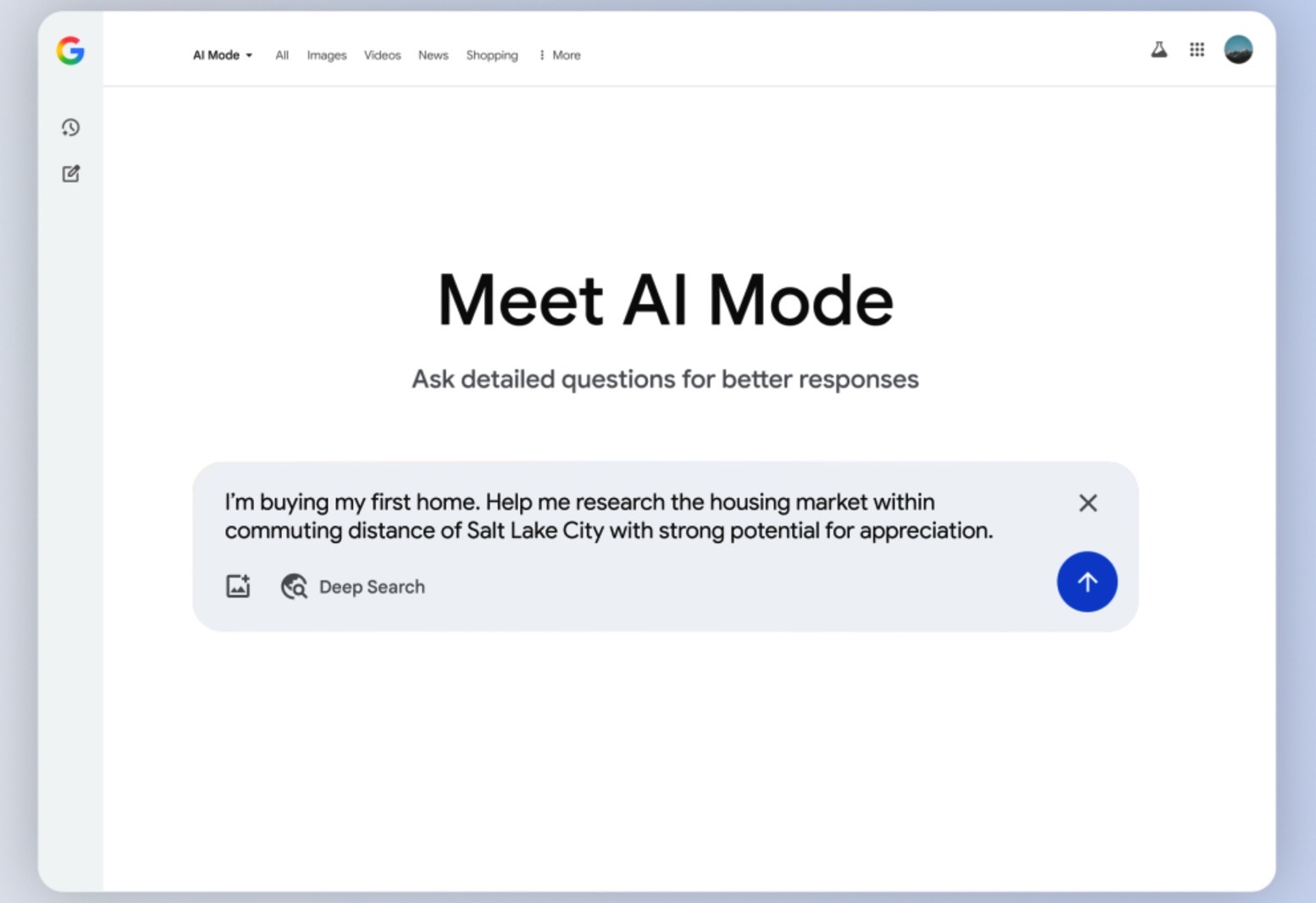
We’re used to seeing deep research features in AI models like ChatGPT and Gemini, so Google is bringing a similar tool to AI Mode in Search. It’s called Deep Search, and it’s powered by Gemini 2.5 Pro.

With Deep Search, you can assign Google complex tasks, and the AI will respond after running hundreds of searches at once. It reasons through them to deliver a more detailed report than a typical search result would offer.

An example of a Deep Search analysis in Google Search. Image source: Google

Deep Search is also available to paying Gemini AI Pro and Ultra users.

Calling businesses with AI Mode

Even before the days of ChatGPT and Gemini, Google let Assistant call businesses for you. In the AI era, that kind of task feels even more fitting for tools with agent-like capabilities, including Google Search.

That means the AI can act on your behalf, like calling businesses to ask questions.

Google Search will call any business you want and ask questions for you, no phone call required. In its blog post, Google used a search for pet groomers as an example.

A summary of an AI call Google Search made for you. Image source: Google

The AI finds local businesses and offers a “Have AI check pricing” button. Tap it, and the AI will place a call. It then returns a summary and an email with everything you need to know.

It’s unclear whether businesses will enjoy talking to AI or if they’ll start using their own bots to handle a surge in calls. But Google gives businesses a way to opt out, so they aren’t overwhelmed by calls from Search (here’s the support document for that).

AI calling results will be emailed to you after the call. Image source: Google

The AI calling feature is rolling out now to Google Search users in the US. Unlike some of the other features, AI calling is free to use, though AI Pro and Ultra subscribers will get higher usage limits.

Source

Posted on

iPhone 17 Pro renders highlight stunning new orange color

A new report from Majin Bu provides us with our first credible look at the potential color options for Apple’s iPhone 17 Pro. Bu sourced his report from accessory manufacturers who, historically speaking, have a strong track record when it comes to relaying iPhone colorways. Because there’s a business advantage to launching accessories early, manufacturers typically make a concerted effort to obtain iPhone color and size details from Apple’s supply chain months in advance. Put simply, rumors from accessory manufacturers are, more often than not, reliable.

All that said, let’s dive in. According to the report, Apple’s iPhone 17 Pro will be available in four distinct colors: black, dark blue, silver, and a brand new orange color.

iPhone 17 Pro color options Image source: Majin Bu

Based on the mockup provided by Bu above, the shade of orange is loud and vibrant, and is somewhat reminiscent of the Action button on the Apple Watch Ultra. It’s worth noting that a separate report claims that we might see a titanium gray as a fifth iPhone 17 Pro color option.

Not surprisingly, the iPhone 17 Pro color options are bolder than what we’ll likely see on the entry-level iPhone 17 lineup. As we covered earlier this week, the entry-level iPhone 17 will be available in black, white, steel gray, green, purple, and blue. Note that the green, purple, and blue hues will likely be on the lighter side.

Tech. Entertainment. Science. Your inbox.

Sign up for the most interesting tech & entertainment news out there.

Incidentally, Apple historically uses its iPhone Pro lineup to introduce a completely unique color. With the iPhone 11 Pro, for example, Apple introduced a Midnight Green option which, in my personal opinion, would be nice to see Apple bring back. With the iPhone 17 Pro, that unique color is orange.

iPhone 17 Air colors

Of course, Apple’s iPhone lineup this year will be unique insofar as we’ll reportedly see a brand new model — the iPhone 17 Air. As we’ve reported over the past few weeks, the iPhone 17 Air is poised to be the thinnest iPhone to date, with a thickness of just 5.5mm. To give you a sense of how thin that is, note that the thinnest iPhone to date is the iPhone 6, which measured in at just 6.9mm thick. At the same time, it’s worth pointing out that the iPhone 17 Air will be thicker around the camera bump.

Weight aside, the iPhone 17 Air will naturally be impressively light as well. Rumor has it that it will weigh just 145 grams. To give you a sense of how light that is, the iPhone SE 2 weighs just 145 grams. All told, the iPhone 17 Air will be positioned as a device for users who want the processing power of an iPhone Pro without the heft or bulk. In a way, the iPhone 17 Air will fill a gap that’s been open ever since Apple opted to do away with its iPhone mini line.

Specs wise, the iPhone 17 Air will reportedly ship with Apple’s next-gen A19 processor, and will boast a 6.6-inch 120Hz ProMotion display with 12GB of RAM. As for the colors, we’re hearing Apple will offer black, white, light blue, and light gold colorways.

iPhone 17 release window

Apple hasn’t yet officially announced when it’s going to unveil its iPhone 17 lineup. Still, there’s a growing consensus that the company’s iPhone event will take place during the week of September 8. And seeing as how most iPhone keynotes are either on Tuesday or Wednesday, it’s a safe bet Apple will introduce its iPhone 17 lineup on either September 9 or 10.

From there, it’s somewhat trivial to figure out when the iPhone will arrive in stores. Historically, Apple announces its new iPhone lineup early in the week, with pre-sales opening up on the following Friday. The official release then typically happens one week after that. In other words, there’s a strong chance that Apple’s iPhone 17 lineup will hit stores on Friday, September 19.

Lastly, as a quick recap, Apple’s anticipated iPhone 17 lineup will reportedly feature four distinct models. You’ll have the regular iPhone 17, the aforementioned iPhone 17 Air, the iPhone 17 Pro, and the iPhone 17 Pro Max. The entry-level iPhone 17 and iPhone 17 Pro will reportedly both boast a display of 6.3 inches. The iPhone 17 Air will boast a 6.6-inch display while the gargantuan iPhone 17 Pro Max will feature a 6.9-inch display.

Source

Posted on

Meta used AI to make faster-curing, lower-carbon concrete

Using AI as a companion to browse the web or generate lifelike images and videos are a few of the features some people are starting to take for granted. Lately, I almost always search the web with AI chatbots like ChatGPT or Gemini in tow. I even use AI chatbots for information when watching certain shows or visiting museums.

But AI can do so much more than providing relatively reliable assistance (remember, AI can make mistakes); it can actually help make breakthrough discoveries.

We have seen plenty of examples over the past few months. Some researchers used AI to find a potential cure for blindness. Others used AI to develop rare-earth-free magnets that might be used in electric cars in the future.

The latest innovation in which AI played a major role concerns concrete. An AI model helped researchers create recipes for lower-carbon, faster-curing concrete, and they’ve actually started using it in a real-life project.

Tech. Entertainment. Science. Your inbox.

Sign up for the most interesting tech & entertainment news out there.

The best part is that the breakthrough doesn’t come from a construction company or a university studying, though such groups were also involved. It’s Meta, the giant social media company which is speeding towards AI superintelligence and throwing mountains of cash at AI researchers, that made the faster-curing, more eco-friendly concrete.

Components for concrete mixes. Image source: Meta

I wouldn’t blame you for not trusting Meta AI. The years of Facebook toxicity can’t be forgotten despite the name change. Trusting Meta with personal data in the age of AI is something I’m not ready for, and we’ve seen several examples of Meta AI mishaps already.

But Meta is marching forward with its AI plans, and that involves building massive data centers for Meta AI. It also means worrying about energy use and the carbon footprint associated with Meta AI and its social media apps. Taking Meta’s net-zero emissions for 2030 into account, along with the fact that concrete is responsible for about 8% of global CO2 emissions, and the idea of a software company working on lower-carbon, faster-curing concrete doesn’t sound quite as odd.

If anything, using AI to make faster-curing concrete that’s more friendly to the environment than traditional methods might be the best marketing tool for promoting Meta AI. And Meta isn’t keeping the AI tech to make lower-carbon, faster-curing concrete a secret. Anyone can use it to come up with similar recipes for other types of construction work.

The AI tech used to create faster-curing, lower-carbon concrete. Image source: Meta

Meta developed an open-source AI tool that uses multi-objective Bayesian optimization algorithms running on Meta’s BoTorch and Ax frameworks to create concrete recipes. The AI is capable of creating a recipe for a concrete mix and predicting its strength.

Lab tests then follow to see whether the cement mix cures as predicted. The AI uses the data to refine its recipe for concrete that should perform even better. Rinse and repeat, and you can obtain a new type of concrete that uses more low-carbon supplementary cementitious materials (SCMs) without impacting its strength.

A recipe for concrete. Image source: Meta

The use of AI speeds up the development process. Humans could always come up with similar recipes, but testing would take much longer. Meta worked with Amrize, one of the world’s largest cement manufacturers and concrete suppliers, on the project. Researchers from the University of Illinois Urbana-Champaign (U of I) were also involved.

Real-life applications

Concrete strength comparison for existing mixes and the AI recipes. Image source: Meta

After coming up with a recipe for lower-carbon, faster-curing concrete that met its needs, Meta went on to use it for the concrete slab in one of the data center buildings at Meta’s Rosemount, MN, data center project.

“Formal tests show that the team exceeded all the technical requirements while achieving good workability and finish performance required for the application,” Meta writes in the blog post, which is easily one of the most exciting things Meta has ever shared on its blog. The post also contains links to the open-source AI model used for developing sustainable concrete and more support literature. Check out the video about the project below:

Source

Posted on

NCSC exposes Fancy Bear’s Authentic Antics malware attacks

The UK’s National Cyber Security Centre (NCSC) has issued a formal notice attributing a series of hostile cyber attacks using a variety of malware dubbed Authentic Antics to Russian-state operated advanced persistent threat (APT) group Fancy Bear.

Authentic Antics is designed to steal login credentials and tokens for its victims email accounts, allowing Russian cyber spies to establish long-term access to their surveillance targets.

Fancy Bear, which goes by APT28 in some threat matrices, is operated as part of the 85th Main Special Service Centre, Military Unit 26165, and ultimately answers to the GRU, a successor intelligence agency to the KGB of Cold War legend.

“The use of Authentic Antics malware demonstrates the persistence and sophistication of the cyber threat posed by Russia’s GRU,” said NCSC operations director Paul Chichester.

“NCSC investigations of GRU activities over many years show that network defenders should not take this threat for granted and that monitoring and protective action is essential for defending systems. 

“We will continue to call out Russian malicious cyber activity and strongly encourage network defenders to follow advice available on the NCSC website,” said Chichester.

Working with NCC Group, which provided samples of Authentic Antics, the NCSC’s experts have conducted a lengthy analysis of the malware – this can be read in full here – which blends in with everyday, legitimate activity to enable Fancy Bear to maintain persistent endpoint access to Microsoft cloud accounts.

The malware has been widely used since about 2023, and runs within Microsoft Outlook processes where it displays malicious login prompts to its target in order to get them to enter their credentials, which are then intercepted along with OAuth 2.0 authentication tokens for various applications, likely including Exchange Online, SharePoint and OneDrive.

The NCSC said it had been cleverly designed to exploit growing familiarity among end-users with genuine Microsoft authentication prompts, including generating prompts from within Outlook processes, and ensuring they do not display too frequently.

Authentic Antics does not communicate with any command and control (C2) infrastructure and cannot receive additional tasking. It talks only to legitimate services, meaning that when it is active it is much harder to pick out – for example it exfiltrates its victims’ data by sending emails from the compromised account to an email address controlled by Fancy Bear – these sent emails do not show up in the victim’s sent items folder.

The agency said that “significant thought” had gone into Authentic Antics’ design to ensure it blends in with normal activity. Among other things, its presence on disk is limited, it stores data in Outlook-specific registry locations, and its codebase includes genuine Microsoft authentication library code as an obfuscation method.

“It is clear the intention of the malware is to gain persistent access to victim email accounts. This highlights the benefit of monitoring your tenant for suspicious logins,” said the NCSC’s analysts.

Sanctions

The attribution comes alongside the announcement of wider sanctions against three GRU Units – including Unit 26165 – and 18 officers and agents who allegedly run cyber and information interference operations in support of Russia’s geopolitical and military objectives.

Among those sanctioned are GRU military intelligence officers who targeted and surveilled the device of Yulia Skripal, daughter of double agent Sergei Skripal, prior to the infamously botched Novichok poisoning attempt against them in 2018 that claimed the life of a British national, Dawn Sturgess.

“GRU spies are running a campaign to destabilise Europe, undermine Ukraine’s sovereignty and threaten the safety of British citizens,” said foreign secretary David Lammy.

“The Kremlin should be in no doubt: we see what they are trying to do in the shadows and we won’t tolerate it. That’s why we’re taking decisive action with sanctions against Russian spies.

Speaking in support of the UK’s actions, a Nato spokesperson condemned Russia’s ongoing malicious cyber activities, noting other attributions made to Fancy Bear, which earlier this year was called out for targeting Western logistics and technology organisations involved in supporting the defence of Ukraine.

“We call on Russia to stop its destabilising cyber and hybrid activities. These activities demonstrate Russia’s disregard for the United Nations framework for responsible state behaviour in cyberspace, which Russia claims to uphold,” a spokesperson said.

“Russia’s actions will not deter Allies’ support to Ukraine, including cyber assistance through the Tallinn Mechanism and IT capability coalition. We will continue to use the lessons learned from the war against Ukraine in countering Russian malicious cyber activity.”

Source

Posted on

The best iPhone 17 display feature is still coming, despite

As excited as we are about the upcoming iPhone 17 colors, there’s something far more important we should be watching out for: Whether Apple is finally going to improve the display on its next generation of smartphones. Don’t get me wrong, Apple offers one of the best screens available on any device. However, while it has become more fall-resistant over the years, it has also continued to struggle with abrasions and scratches.

That’s why a report suggesting Apple was working on a new scratch-resistant anti-reflective display layer for the upcoming iPhone 17 models had me so excited. Unfortunately, this rumor was later debunked as Apple wasn’t satisfied with the results it achieved.

Fortunately, MacRumors says Apple suppliers were actually able to achieve a “high enough yield on the anti-reflective glass to support mass production.” According to sources familiar with the matter, Apple plans to add this scratch-resistant anti-reflective display to the iPhone 17 Pro and iPhone 17 Pro Max models.

Image source: José Adorno for BGR

With that, we could see a less reflective and yet scratch-resistant display coming to Apple’s best phones, something Samsung did with the new S25 generation. While it doesn’t look like Apple will use the Gorilla Glass Armor technology, it seems the company was able to get something similar. In Gorilla Glass’s case, it’s able to cut down on reflection by up to 75% while improving contrast in bright lighting conditions.

Tech. Entertainment. Science. Your inbox.

Sign up for the most interesting tech & entertainment news out there.

While this feature isn’t coming to the iPhone 17 and iPhone 17 Air models, Apple might finally add ProMotion and Always-On Display technologies to these devices, even though some rumors suggest Apple might offer a fixed higher refresh rate for these models.

That said, the company has several new improvements expected for the iPhone 17 display, with even more coming in the following years, including a smaller Dynamic Island and, eventually, an all-display design with the Face ID and camera sensors underneath the panel.

Source

Posted on

Openreach adds 21 locations in broadband upgrade footprint

As part of its stated mission to reach up to five million more homes and businesses with its broadband network during the year to March 2026, Openreach, the UK’s leading wholesale broadband provider, has announced that 19 million premises across the UK can now order its gigabit broadband technology.

Seven million UK premises already take services based on the full-fibre network of the BT-owned company, 37% of the growing footprint, and the further 21 locations added to the full-fibre roll-out will cover as many as 80,000 rural and urban premises across the country, including Belmont, in Lancashire; Cheriton Bishop, in Devon; Didcot, in Oxfordshire; Innsworth, in Gloucestershire; Silverdale, in Lancashire; and Woburn Sands, in Buckinghamshire.

“This is a UK infrastructure success story, so it makes sense for us, and the country, to push hard on the accelerator pedal,” said Openreach CEO Clive Selley.

“Our new network is helping to drive economic growth, create jobs, and will be the backbone of a prosperous, globally connected and competitive UK. Last year was our biggest year of build ever – reaching well over four million homes with this life-changing technology. No other build across Europe has achieved that kind of rate, and this year will be our biggest ever.”

In May 2024, while reporting a financial year of flat revenues and a significant fall in profits, BT announced it had reached a peak for its significant investments in full-fibre broadband, and BT Group chief executive Allison Kirkby stated that the company had reached an inflection point in its long-term strategy.

However, a year later, the comms giant told the industry it had turned the capital spending taps back on and given the green light to Openreach to dig further and faster.

Openreach claims to be building its new network to connect customers faster and further than any other provider in the UK – reaching an average of 85,000 new premises every week. In total, more than 3,500 UK towns, cities, boroughs, villages and hamlets have so far been included in Openreach’s build programme, with many more being reached through publicly funded partnerships.

In the year from April 2024, Openreach extended its network to another 4.3 million premises, which it said represented its biggest ever year of build, and that it was actively increasing the pace of the build to reach up to five million more in 12 months.

With the caveat of “a supportive economic and regulatory environment”, Openreach ultimately expects to make full-fibre available to 30 million premises in all corners of the UK by 2030.

In its yearly financial results, published in May 2025, BT said it had passed peak capital expenditure on its full-fibre broadband roll-out and achieved a £3bn cost and service transformation programme a year ahead of schedule.

Remarking on the telco’s performance, Kirkby described BT’s full-fibre deployment as a “UK infrastructure success story”, adding that it now made sense for the company, and the UK in general, to push on the accelerator pedal.

“The more full-fibre we build, the more customers choose to connect,” she said. “In a highly competitive market, and despite a challenging economic landscape, Openreach is building and connecting customers faster, and at a lower cost than anyone.”

Source

Posted on

The road to quantum datacentres goes beyond logical qubits

One of the questions everyone involved in quantum computing is asked is, “When will the technology become commercially viable?”

This very question was posed to a panel of experts at the inaugural Quantum Datacenter Alliance Forum in London by Austin Li, who is working on quantum computing standards at Google and serves as chair and head of the United States Delegation to the IEC/ISO Joint Technical Committee on Quantum Technologies Standards. 

Although there tends to be a lot of industry noise around logical qubits and error correction, which are needed to make quantum computers that are capable of performing useful tasks, numerous pieces of the jigsaw required for a fully working and scalable quantum computing system are missing. 

Esoteric hardware 

Speaking at the forum, Alexander Keesling, chief technology officer at QuEra, discussed the limits of lasers, which are being optimised for completely different application areas. “You can find very high-powered lasers, but these lasers do not have any kind of coherence,” he said, which makes them unsuitable for use in quantum computers. 

Another challenge the industry needs to resolve, according to Keesling, is scalability. Realistically, a system with twice the number of qubits should not require a machine that is twice the size, he said, adding that the infrastructure required by a quantum computer must be kept in check as the number of qubits increases.

“If we just build another system next to a quantum computer and then figure out how to connect it, I would say that it is extensible. It’s not scalable,” he said. 

Owen Arnold, vice-president of product development at Oxford Quantum Circuits, discussed the challenges in working with suppliers of dilution refrigerators, which are needed to achieve a superconductive environment, as required by some quantum computer systems. “These are very impressive, but they have largely been built for an academic market,” he said.

In Arnold’s experience, the manufacturers of dilution refrigerators need to consider how such specialised equipment can be scaled to operate in a datacentre environment. “If you need a dilution fridge, then you will need the expertise to run that dilution fridge,” he added. 

Another consideration is that quantum computers tend to be built for experimentation. “The experiment goes down; it fails, which is largely acceptable. A small number of people are affected by that,” he said. 

But when you consider the ambitions of the quantum computing industry to deploy such machines in datacentres, it is no longer just an experiment that can fail with limited disruption. Instead, five-nines (99.999%) uptime is required. “We want to have much better diagnostics for these units. We want to control the maintenance cycle, and we want to make sure the redundant power is there,” Arnold added. 

Even if the science behind quantum computing can progress to the point where it can perform with a high degree of reliability, and the industry can make datacentre-ready quantum computing systems, ease of programmability will need to be addressed to achieve datacentre-scale adoption. 

Ease of programming and hybrid complexity 

Josh Savory, director of offering management at Quantinuum, discussed the company’s 2029 roadmap at the forum, and the challenges it will need to overcome to deliver something commercially viable by then. He believes there needs to be industry alignment around standards.

Savory said QIR, the community-wide effort to design and implement the necessary compiler technology to accelerate advances in quantum programming language design, and CQASM, a programming language for quantum computing that provides a way of expressing quantum circuits as code, are needed to provide a uniform programming interface for application developers. 

The panel of experts also discussed how quantum computers would fit alongside classical high-performance computing (HPC) as a kind of coprocessor. While this approach could be the direction of travel for many quantum computing companies in deploying their machines in datacentres, such an architecture is hugely complex. 

“How the types of problems that we are trying to solve today can be accelerated with a quantum computer is still unknown,” said QuEra’s Keesling.

Factors like considering the application code that can be sent to a quantum computer with code that is best run on HPC architecture, and orchestrating between these different classes of compute resources, are questions the industry will need to answer if a hybrid approach is adopted.

There has been plenty of research into quantum computing that suggests the goals of the industry are achievable, at least from a technology perspective. But the message from the panel of experts at the Quantum Datacenter Alliance Forum was that a heck of a lot more work needs to be done before these machines can truly scale in a commercial datacentre setup.

Source

Posted on

Check out the 8 new emoji coming to your iPhone

There are plenty of reasons to look forward to iOS 26 — the debut of Apple’s new Liquid Glass design language, custom backgrounds for text conversations, and CarPlay upgrades — but we are here to give you eight more. This week, the Unicode Consortium unveiled the emoji that will arrive as part of the Unicode 17.0 release this fall. It is a fairly eclectic crew, featuring a treasure chest, an apple core, and even Bigfoot. Sadly, they won’t join your iPhone’s emoji keyboard on day one, but a future iOS 26 update will include all eight.

New emoji coming in iOS 26

First, let’s take a look at the standard versions of all eight emoji characters that are being added to the Unicode Standard in Unicode 17.0:

New emoji coming in the Unicode 17.0 release. Image source: Unicode

Here’s a full list of the official names of all the new emoji, in case you’re curious:

  • Trombone
  • Treasure Chest
  • Distorted Face
  • Apple Core
  • Fight Cloud
  • Ballet Dancers
  • Hairy Creature 
  • Orca

Apple always creates its own variations of the emoji before rolling them out to its software. As a result, iPhone owners often have to wait a few months to get their hands on the new characters. The emoji that arrived in Unicode 16.0 didn’t hit iPhones until iOS 18.4 launched in March 2025. That was a full six months after Unicode 16.0 was released.

Tech. Entertainment. Science. Your inbox.

Sign up for the most interesting tech & entertainment news out there.

Thankfully, this is a much more entertaining set than what we got in Unicode 16.0. I’m not sure when or where I’ll use half of them, but I could see “Fight Cloud” becoming a mainstay in group chats with family members. And that “Distorted Face” sure is something.

Source

Posted on

Cloudflare to let customers block AI web crawlers

From today, Cloudflare users will be able to block artificial intelligence (AI) crawlers from accessing their web content without permission of monetary compensation by default, in a bid to stop AI models from scraping and using content in their training databases.

Use of intellectual property such as art, fiction, music, news media, video and other forms of creative endeavour and expression, to train AI models without recognition or recompense has become a major sticking point for creatives worldwide, fueled a wave of anti-AI sentiment, and led to lawsuits on both sides of the Atlantic.

Recognising the potential threat AI models pose to fundamental aspects of the human condition, Cloudflare said its new settings marked the “first step” towards a more sustainable future both content creators and AI innovators alike.

“If the internet is going to survive the age of AI, we need to give publishers the control they deserve and build a new economic model that works for everyone – creators, consumers, tomorrow’s AI founders, and the future of the web itself,” said Matthew Prince, co-founder and CEO of Cloudflare.

“Original content is what makes the internet one of the greatest inventions in the last century, and it’s essential that creators continue making it. AI crawlers have been scraping content without limits. Our goal is to put the power back in the hands of creators, while still helping AI companies innovate. This is about safeguarding the future of a free and vibrant Internet with a new model that works for everyone.”

Cloudflare, which handles over 15% of global internet traffic via its content delivery network (CDN) said that the internet has long operated on a simple exchange by which search engines index content and direct users to websites to generate traffic and ad revenue. While not perfect this system has proved fairly consistent in rewarding content creators with and web users alike.

However, the advent of AI crawlers has broken this bargain because in scraping content to improve the output of generative AI (GenAI) models without sending web users to the source, crawlers deprive content creators of views and revenues and cause them to become disincentivised to keep working, to the detriment of wider society.

Cloudflare had previously introduced a one-click block option to stop web crawlers in September 2024 – and said over a million customers have opted in to date. The introduction of a permission-based model adds more fine-grained controls to the equation.

The new settings will allow site owners to choose if they want AI crawlers to access their content and decide how AI companies are allowed to use it. AI companies, in turn, will be able to state the purpose of their crawlers – which is to say whether they are used for training, inference, or search purposes – to help site owners decide whether to allow them.

All new domain owners signing up to Cloudflare will now be asked if they wish to allow or block AI crawlers, with the default being to control their activity, meaning customers must make an explicit choice to opt in to allowing them. Existing customers can easily check their settings and allow AI crawlers at any point should they desire.

Multiple Cloudflare customers are already signing up, with many prominent publishers describing it as a “game changer” for content creators. Others said it could potentially help end the rush among news organisations to unpopular paywall-based business models.

Roger Lynch, CEO of Condé Nast, said: “When AI companies can no longer take anything they want for free, it opens the door to sustainable innovation built on permission and partnership.

“This is a critical step toward creating a fair value exchange on the internet that protects creators, supports quality journalism and holds AI companies accountable.”

Kristin Heitmann, chief revenue officer at The Associated Press (AP) agency, added: “The information landscape continues to change rapidly but the value of accurate, factual, nonpartisan journalism has never been more essential.

“We’re pleased to participate in this important framework that will help ensure intellectual property is protected and all content creators are fairly compensated for their work.”

Sharon Moshavi, president of the International Center for Journalists (ICFJ), a Washington DC-based non-profit, and co-CEO of ICFJ+, a provider of critical infrastructure for journalists and technologists to deliver information, also voiced her support.

“We see journalists across the world providing vital, original reporting to their communities, yet AI bots scrape their work for free while newsrooms struggle to stay open,” said Moshavi.

“At ICFJ+, we are working with small news sites – beginning in Africa and across a variety of languages – to help them protect and reclaim the value of their original work in the age of AI. We welcome this very promising initiative from Cloudflare.”

Pay up or get off my site

At the same time, Cloudflare has also announced the private beta of another tool, dubbed Pay Per Crawl.

The idea of Pay Per Crawl originated during conversations with content creators during the development of the crawler blocking tool. Cloudflare said that while all agreed that creators should be able to block or allow all AI crawlers depending on their wishes, creators had expressed a “consistent desire” for a third path in which AI crawlers are allowed to access their content but they also get paid.

While theoretically possible already, this requires knowing the right people at an AI provider and negotiating with them, a challenge for creatives who may lack the scale and leverage to do so.

Cloudflare engineers Will Allen and Simon Newton said they had now hit on a way to allow creatives to charge AIs.

“We’re excited to help dust off a mostly forgotten piece of the web: HTTP response code 402,” they wrote in a blog post. “Pay per crawl integrates with existing web infrastructure, leveraging HTTP status codes and established authentication mechanisms to create a framework for paid content access. 

“Each time an AI crawler requests content, they either present payment intent via request headers for successful access (HTTP response code 200), or receive a 402 Payment Required response with pricing. Cloudflare acts as the Merchant of Record for Pay Per Crawl and also provides the underlying technical infrastructure.”

Its creators hope Pay Per Crawl may herald a fundamental shift in how content is controlled online by empowering creators to keep working.

Other future use cases for the tool could help support different rates for different content types or different AI crawlers, for example. Allen and Newton said the tool may have even greater potential as agentic AI develops, where people querying AI agents could set them a specific budget based on the topic at hand – more for legal advice, less for a restaurant booking, for example. They envisage a future where intelligent AI agents “can programmatically negotiate access to digital resources.”

Source