Posted on

Columbia student expelled for cheating with AI launches AI to

When ChatGPT first arrived, some schools immediately banned the generative AI tool over concerns that students might use it to cheat. Years later, a new AI tool made specifically for cheating is going viral.

What’s even crazier is that the two college students who developed Cluely, the cheating AI in question, got expelled from Columbia after one of them used an early version of the AI program to help with a job interview with Amazon.

Cluely, which you can try for free, just raised $5.3 million in funding, proving that cheating with AI in the age of AI is a thing. But, spoiler alert, the product Cluely proposes might become much bigger than something that helps you cheat during job interviews.

21-year-old Chungin “Roy” Lee went viral a few weeks ago by posting on social media news that Columbia kicked him out after he used an AI tool called Interview Coder to get a job with Amazon.

Tech. Entertainment. Science. Your inbox.

Sign up for the most interesting tech & entertainment news out there.

By signing up, I agree to the Terms of Use and have reviewed the Privacy Notice.

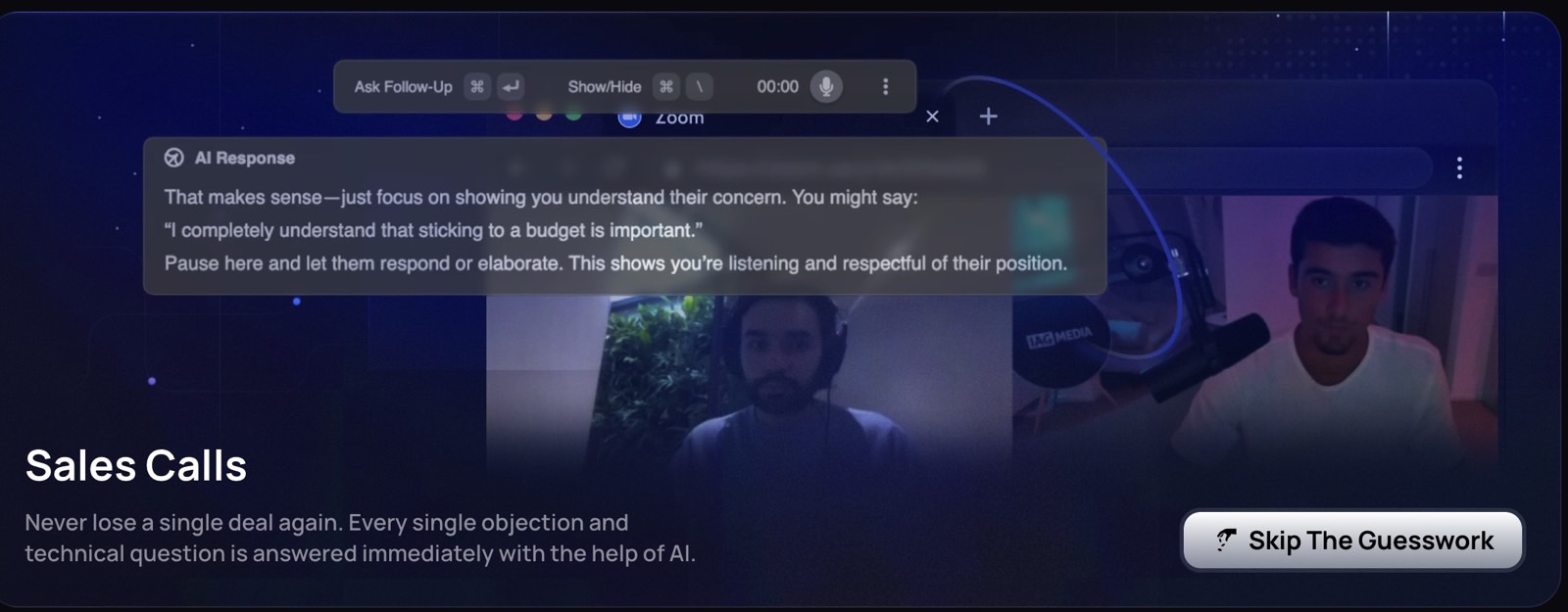
Interview Coder was a program that Lee (CEO of Cluely) and Neel Shanmugam (COO of Cluely) developed before turning it into a viral gimmick. Interview Coder is now part of Cluely, which you can try for free to cheat at whatever you want. It can listen in on Zoom calls in real time and provide helpful answers to questions.

Cluely doesn’t just work with job interviews. It’ll handle anything you throw at it as long as it involves operating a video chat tool like Zoom that Cluely AI can monitor.

The Cluely app, currently available on Macs, runs inside an in-browser window that the other person in the Zoom call can’t view. The AI will listen to what the other person is saying, turn that speech into text, and feed it to an unnamed AI in the cloud, which will then tell you the right thing to say.

There are obvious moral implications here, as well as legal ones. Using Cluely means bringing a third party into a video call that records everything and then sends that data to the cloud. Some businesses and even state laws require you to obtain consent when recording people. But if you’re cheating your way into something, obtaining consent is probably not a big concern for you.

Still, Cluely is getting plenty of attention. Lee just announced that Cluely raised $5.3 million in funding from Abstract Ventures and Susa Ventures. Lee told TechCrunch the app surpassed $3 million in ARR (annual recurring revenue) earlier this month.

That doesn’t mean the company is making $3 million off Cluely. That’s the potential revenue in a year based on the current number of paying subscribers. However, it shows that people see value in the app.

Cluely is available for free on macOS right now, but the responses that the AI will give you are limited. The $20/month Cluely Pro subscription gets you unlimited usage, “solving and debugging” support, “most powerful agent models,” and 24/7 customer support. 

Using Cluely to cheat on interviews will only get you that far, especially since some interviewers may now be aware that Cluely exists. But I see huge potential in an app like Cluely for setting up a personal assistant of sorts.

The existing Cluely app doesn’t say which AI models it uses. A variant of ChatGPT might very well be working under the hood to provide assistance. Also, the data you send (screenshots and transcripts) may be used to improve the service. That data might be aggregated and anonymized, but you can’t opt out.

Source

Posted on

Fibre fine but US tariffs to take hit on broadband

For the IT and telecoms market, the only certain thing about the tariffs imposed and threatened by the US is that they have caused uncertainty, and as the dust settles on the issue, analysts are now predicting that while fibre and optical technologies will likely escape direct impact, cable outside plant and Wi-Fi routers will see an adverse impact. Most importantly, overall spend on comms technology by providers could well be pushed back to 2026.

Assessing how changing tariff policies could affect broadband deployments and the demand for related equipment, analyst Dell’Oro Group noted that recent shifts in US trade policy – not just the implementation and adjustment of tariffs – have introduced uncertainty into global markets.

Furthermore, it adds that given the frequent adjustments to trade policy, including the recent exemptions for smartphones, consumer electronics, and certain graphics processing units, it remains challenging to forecast the full extent of the impact on broadband infrastructure in the near term.

That said, looking at individual technologies, Dell’Oro believes tariffs will have minimal impact on most fibre broadband equipment pricing and deployments. The key reason given for this is the fact that key fibre broadband equipment providers in the US have already moved most of their assembly and manufacturing to the US to adhere to the Build America, Buy America waiver of the Broadband Equity, Access and Deployment programme.

This has meant the most commonly deployed components – passive optical network optical line terminals, optical network terminals, cabinets and fibre-optic cable – have already been self-certified by the respective suppliers and seen substantial increases in domestic manufacturing.

By contrast, Dell’Oro says cable outside plant upgrades in support of Docsis 4.0 technology are likely to be impacted. It suggests that manufacturers of this equipment are either looking to relocate their facilities or manufacturing to the US, or are seeking waivers to satisfy growing demand from leading comms operators. The end result is that tariffs will be materially significant at any level, and cable operators pursuing Docsis 4.0 will face additional deployment delays, as well as increased equipment prices.

Similarly, the study observed that just as wireless technology suppliers are looking to ride a wave of Wi-Fi 7 penetration into businesses, tariffs at any level will easily increase the retail cost of even the most popular Wi-Fi brands by anywhere from 5 to 15%. China, Taiwan and Vietnam are the manufacturing sources for the vast majority of these devices and, although these devices have been exempted in the latest rolling back of tariffs, Dell’Oro predicts that the likelihood of those full exemptions remaining is slim.

Assessing the big picture going forward, Dell’Oro report author and company vice-president Jeff Heynan said: “The challenge for all industries now is that they simply cannot unsee what has already happened. The state of economic recovery in many countries and industries was already fragile after dealing with the supply shock of the Covid-19 pandemic … Just as these businesses are set to rebound and return to more normalised and consistent purchasing levels, tariffs are introduced, making the road to recovery cloudier.

“The bigger concern we had going into 2025 was the uncertainty among consumers and businesses alike about what impact the new administration’s policies would have on overall spending and investment patterns,” he said. “After two years of steady inflation and higher interest rates, US consumer confidence was already trending downward. Consumer debt levels were rising and stubbornly high mortgage rates limited the number of new homes being purchased, as well as overall refinancing. With consumer spending in the US typically 68% of GDP, any further decline in confidence could result in consumers pulling back from spending.”

For its part, Cedia, an international trade association dedicated to the residential and commercial custom electronics industry, said the tariffs decision on comms tech will affect imports of various goods crucial to the smart home technology sector, and that professionals in the sector could face significant operational challenges as they attempt to absorb increased material costs or pass these expenses on to consumers.

The association highlighted the potential to strain smart home professionals who specialise in custom installations and integrations of advanced technologies, such as home automation systems, audiovisual equipment, security features and energy management offerings.

Assessing the issues from the viewpoint of operators and the ramifications for the industry, Juniper Research noted that it expects operators to pass the almost-certain higher costs of network upgrades and maintenance onto mobile subscribers, driven by the slim profit margins tied to consumer subscriptions. It emphasised that operators are continuing to upgrade existing 5G networks as they focus on rolling out services aimed at attracting enterprise clients.

Looking at how the tariffs could impact 6G development, Juniper Research said it was necessary to consider the timelines for 6G and the timing of the next presidential election. Based on previous telecom network cycles and announcements from industry bodies, it expects network testing to begin around 2028, with a commercial launch in 2029; right at the end of the next election cycle.

Source

Posted on

How Apple’s Vision Pro boss is rebuilding Siri from the

Following the report that Apple Vision Pro’s chief is the new head of Siri, Bloomberg’s Mark Gurman has revealed how Mike Rockwell is revamping Siri’s leadership from the inside out.

These changes came just weeks after Apple had to postpone one of the most important Siri features: on-screen awareness. This would allow Siri to search for information in real time based on what you’re seeing on the screen.

According to Gurman, Rockwell is bringing Vision Pro engineers to lead Siri’s most crucial capabilities, including speech, understanding, performance, and user experience.

Here are some of the key players responsible for transforming Siri into a true personal assistant, according to the journalist’s report:

Tech. Entertainment. Science. Your inbox.

Sign up for the most interesting tech & entertainment news out there.

By signing up, I agree to the Terms of Use and have reviewed the Privacy Notice.

  • Ranjit Desai: A longtime deputy from the Vision Pro team, Desai will now be responsible for Siri’s engineering. Rockwell highlighted his background in “high-performance, low-latency systems” to elevate Siri’s performance.
  • Olivier Gutknecht: A senior Vision Pro software executive, Gutknecht will take over the team focused on Siri’s user experience.
  • Nate Begeman and Tom Duffy: They will collaborate with Gutknecht to make Siri’s architecture “world-class” and scalable.
  • Stuart Bowers: He leads data, training, and evaluation teams. Bowers will also work on improving Siri’s ability to understand user commands.

These changes are critical to making Siri a better personal assistant and, eventually, an AI powerhouse. Currently, Siri has two teams: one focused on everyday tasks and the other on large language models (LLMs).

Rockwell plans to overhaul Siri’s architecture, using a single LLM-based system to enable a more conversational user interface. This upgrade is expected to take a couple of years.

That said, it seems this might not be a great year for major Apple Intelligence updates during the WWDC 2025 keynote. In fact, it looks like Apple only decided to address Siri’s issues after they became apparent. But with the competition improving rapidly, will Cupertino have enough time to catch up?

Source

Posted on

AI chip restrictions limit Nvidia H20 China exports

Nvidia is expecting a big hit to its business as reports emerge of the White House imposing export restrictions on its H20 GPU (graphics processor unit) in China. The new restrictions appear to have been carried over from the previous administration’s policy to restrict access to AI chips and advanced AI models.

The Framework for Artificial Intelligence Diffusion from the US Bureau of Industry and Security (BIS), which was published January 15 2025, puts in place export administration regulation controls on advanced semiconductors. By imposing controls that allow exports, re-exports and transfers (in-country) of large quantities of advanced computing integrated circuits only to certain destinations and end users, BIS said the export controls could reduce the risk that malicious state and non-state actors gain access to advanced AI models.

At the time, Ned Finkle, vice-president for government affairs at Nvidia, posted a damning indictment of the former US administration’s attempts to curb semiconductor exports. In a blog post, he said: “In its last days in office, the Biden Administration seeks to undermine America’s leadership with a 200+ page regulatory morass, drafted in secret and without proper legislative review. This sweeping overreach would impose bureaucratic control over how America’s leading semiconductors, computers, systems and even software are designed and marketed globally.”

Finkle described the Biden Administration’s approach as “attempting to rig market outcomes and stifle competition”, adding: “The Biden Administration’s new rule threatens to squander America’s hard-won technological advantage”, and said they “would do nothing to enhance US security”.

The new rules were set to come into effect on April 15, and appears that the Trump administration is not rescinding on the restrictions the Biden Administration had put in place. According to a news story on BBC, Nvidia has now said that the Trump administration has informed it that a licence will be required to export the H20 chip to China.

In the transcript of the company’s Q4 2025 earnings call, posted on Motley Fool, Nvidia chief financial officer Colette Kress noted that, as a percentage of its total datacentre revenue, datacentre sales in China remained well below levels seen on the onset of export controls. “Absent of any change in regulations, we believe that China shipments will remain roughly at the current percentage. The market in China for datacentre solutions remains very competitive,” she said.

While the company said it would continue to comply with export controls while serving its customers, its share price took a hit as a result of controls coming into effect.

The H20 is a less powerful Nvidia AI accelerator, designed for the Chinese market. According to Antonia Hmaidi, senior analyst at Mercator Institute for China Studies, Nvidia sold a million H20s to Chinese customers in 2024. While the Financial Times recently reported that Chinese rival, Huawei, has been ramping up production of its home-grown AI offering, the Ascend chip, Hmaidi noted that in 2024, it only shipped 200,000 units, which “reveals structural issues in China’s semiconductor industry”.

Hmaidi also noted that Huawei’s software lags behind Nvidia’s, with developers in China reluctant to adopt the chip for training most models.

The export changes affecting the H20 come just a day after the Trump administration announced Nvidia was leading what it described as an “American-made chips boom”.

Nvidia said that within the next four years, it plans to produce up to half a trillion dollars of AI infrastructure in the US through partnerships with TSMC, Foxconn, Wistron, Amkor and SPIL. 

The company said it has started production of its Blackwell chips at TSMC’s chip plants in Phoenix, Arizona. It is also building supercomputer manufacturing plants in Texas, with Foxconn in Houston and with Wistron in Dallas. According to Nvidia, production at both plants is expected to ramp up in the next 12 to 15 months.

Source

Posted on

Video telematics systems set for solid growth in North America,

The past few years have seen auto manufacturers increasingly develop telematics systems to give fleet managers more insight into their commercial vehicles, and how they are operated to optimise management and manage risk – and a key segment of this market, video telematics, is set for a significant rise, says analyst Berg Insight, calculating that the installed base of such systems in North America and Europe will reach 17 million units by 2029, with both markets seeing double-digit growth.

In its report, The video telematics market, Berg Insight’s definition of video telematics includes a range of camera-based services deployed in commercial vehicle fleets either as standalone applications or an added feature set to conventional fleet telematics. It adds that the video telematics market is served by a number of different types of players, ranging from specialists focused specifically on video telematics services, to general fleet telematics players that have introduced video offerings, and hardware-focused suppliers offering mobile digital video recorders and vehicle cameras used for video telematics.

The bottom line of the research is that the integration of cameras to enable various video-based services in commercial vehicle environments is a massive trend in the fleet telematics sector.

Assessing the key regional trends, the research calculates that the front-running North American video telematics market is more than three times the size of the European equivalent, which is so far largely dominated by activities in the UK.

Berg Insight estimates that the installed base of active video telematics systems in North America reached almost 6.1 million units in 2024. Growing at a compound annual growth rate (CAGR) of 18%, the active installed base is forecasted to reach 13.8 million units in North America by 2029. By contrast, in Europe, the installed base of active video telematics systems is estimated to have consisted of over 1.6 million units in 2024. The active installed base in the region is forecasted to grow at a CAGR of 15.2% to reach 3.3 million video telematics systems in Europe by 2029.

Looking at which companies are shaping the market, the report ranked Streamax, Lytx and Samsara as the leading video telematics players in their respective categories. Streamax was seen as the leading hardware provider, having more than four million mobile DVRs installed in vehicles globally to date, and the company also offers software dashboards that are widely used together with its devices.

Lytx was seen as the largest video telematics services specialist in terms of subscribers, and the company was the first to surpass one million vehicle subscriptions for video telematics specifically. The report also shows that among the general fleet of telematics players, Samsara stood out as a front-running video service provider with the largest number of camera units deployed across its subscriber base.

Additional sizeable players include fleet management provider Motive; hardware-focused video telematics company Howen; channel-focused brand Xirgo; and video telematics player Netradyne. These all have installed bases of at least a quarter of a million units. Topping out the top 10 are VisionTrack and Nauto, which both have a primary focus on camera-based services specifically, and fleet management provider Solera Fleet Solutions.

Suppliers with installed bases just outside of the top list include LightMetrics and Nexar, which are focused on camera-based services, and video-focused service providers such as Idrive, Waylens, SureCam, Seeing Machines and CameraMatics.

As regards business models, Berg Insight found partner-based strategies as being increasingly common in the value chain for fleet telematics in general and video telematics in particular, contributing to what it calls flexible offerings through collaborative efforts.

In line with an overall convergence of various types of functionality, fully integrated offerings combining fleet and video telematics were being marketed by an ever-increasing range of players positioning themselves as one-stop shops.

Source

Posted on

OpenAI says it would buy Chrome if Google is forced

In the wake of Google’s latest lawsuit loss, there’s a growing chance that the company could be forced to divest its popular internet browser Chrome. If that comes to pass, one notable buyer is already throwing its hat into the ring to buy Chrome: OpenAI.

According to Bloomberg, ChatGPT’s head of product, Nick Turley, told a judge this Tuesday that OpenAI would be interested in purchasing Chrome if Google were forced to sell.

“Yes, we would, as would many other parties,” Turley said when asked if OpenAI would ponder buying Chrome. He added that if OpenAI is able to integrate ChatGPT directly into Chrome, the company would be able to “offer a really incredible experience” and would also “have the ability to introduce users into what an AI first experience looks like.”

During his court appearance, Turley said that OpenAI attempted to work with Google in the past to use the company’s search technology, but nothing ever came of those talks. Turley confirmed that OpenAI has “no partnership with Google today.”

Tech. Entertainment. Science. Your inbox.

Sign up for the most interesting tech & entertainment news out there.

By signing up, I agree to the Terms of Use and have reviewed the Privacy Notice.

Whether or not Google is forced to divest Chrome, spin off Android into its own company, or end exclusivity agreements with other technology companies remains to be seen. That said, it’s clear that a commodity as hot as Google’s Chrome browser—with nearly 4 billion users worldwide and a 66% market share—would draw plenty of interest.

Meanwhile, Google is going to do everything in its power to stay intact.

Here’s what Lee-Anne Mulholland, Google’s VP of regulatory affairs, said in a blog post about the case last weekend: “The US Department of Justice’s 2020 search distribution lawsuit is a backwards-looking case at a time of intense competition and unprecedented innovation. With new services like ChatGPT (and foreign competitors like DeepSeek) thriving, DOJ’s sweeping remedy proposals are both unnecessary and harmful.”

Source

Posted on

Interview: Markus Schümmelfeder, CIO, Boehringer Ingelheim

Markus Schümmelfeder has spent more than a decade looking for ways to help biopharmaceutical giant Boehringer Ingelheim exploit digital and data. He joined the company in February 2014 as corporate vice-president in IT and became CIO in April 2018.

“It was a natural evolution,” he says. “Over time, you see what can be done as a CIO and have an ambition to make things happen. This job opportunity came around and it was when digitisation began. I saw many possibilities arising that were not there before.”

Schümmelfeder says the opportunity to become CIO was terrific timing: “It was a chance to bring technology into the company, to make more use of data, and evolve the IT organisation from being a service deliverer into a real enabler. My aim for all the years I’ve been with Boehringer is to integrate IT into the business community.”

Now, as the company’s 54,000 employees use more data than ever before across the value chain, including research, manufacturing, marketing and sales, Schuemmelfeder’s aim is being realised. He says professionals across the business understand technology is crucial to effective operational processes: “It’s about bringing us close together to make magic happen.”

Establishing the vision

Schümmelfeder says one of his key achievements since becoming CIO is leading the company on a data journey. His vision supported the company’s progress along this pathway.

“I went to the board and said, ‘This is what we should do, what we want to do, what makes sense, and what we perceive will be necessary for the future’,” he says. “We started that process roughly five years ago and everyone knows how important data is today.”

Making the transition to a data-enabled organisation is far from straightforward. Rather than being focused on creating reports, Schümmelfeder says his vision aimed to show people across the organisation how they could exploit information assets effectively. One of the key tenets for success has been standardisation.

“This is a fundamental force, and the team has done good work here,” he says. “10 years ago, we had between 4,500 and 5,000 systems across the organisation. Today, we have below 1,000. So, we reduced our footprint by 80%, which is a great accomplishment.”

Standardisation has allowed the IT team to deliver another part of Schümmelfeder’s vision – a platform-based approach to digitisation. Rather than investing in point solutions to solve specific business challenges, the platform approach uses cloud-based services to help people “jump start topics” as the business need arises.

The crucial technological foundation for this shift to standardisation has been the cloud, particularly Amazon Web Services (AWS), Microsoft Azure and a range of consolidated enterprise services, such as Red Hat OpenShift, Kubernetes, Atlassian Jira and Confluence, Databricks, and Snowflake. Schümmelfeder says the result is a flexible, scalable IT resource across all business activities. 

“You can create a cloud environment in minutes,” he says. “You can have an automated test environment that is directly attached and ready to use. You can create APIs immediately on the platform. We want people to deliver solutions at a faster pace, rather than creating individual solutions again and again.”

Building a platform

Boehringer recently announced the launch of its One Medicine Platform, powered by the Veeva Development Cloud. The unified platform combines data and processes, enabling Boehringer to streamline its product development. Schümmelfeder says the technology plays a crucial enabling role.

The One Medicine Platform is integrated with Boehringer’s data ecosystem, Dataland, which helps employees make data-driven decisions that boost organisational performance. Dataland has been running since 2022. The ecosystem collates data from across the company and makes it available securely for professionals to run simulations and data analyses.

“In the research and development space for medicine, there was nothing like a solid enterprise platform,” says Schümmelfeder, referring to his company’s relationship with Veeva. “We had about 50, maybe even more, tools that were often not interconnected. If you wanted to replicate data from one service to another, you’d have to download the data, copy and paste, and so on. That approach is tedious.”

The One Medicine Platform allows Boehringer to connect data across functions, optimise trial efficiency around its research sites, and accelerate the delivery of new medicines to treat currently incurable diseases. Schümmelfeder says the Veeva technology gives the business the edge it requires.

“We saw we were slower than our competitors in executing clinical trials. We thought we could be much better. We wanted to look for a new way of executing clinical trials, and we needed to discuss our processes and potentially redefine and change them based on the platform approach,” he says. “We chose Veeva because it was the most capable technology to help us deliver the spirit of a platform. It’s also an evolving technology with good future potential.”

Embracing data innovation

Schümmelfeder says the data platform he’s pioneered is helping Boehringer explore emerging technologies. One key element is Apollo, a specialist approach to artificial intelligence (AI), allowing employees to select from 40 large language models (LLMs) to explore their use cases and exploit data safely.

He says this large number of LLMs allows Boehringer employees to select the best model for a specific use case. Alongside mainstream models like Google Gemini and Open AI’s ChatGPT, the company uses niche models dedicated to research that can deliver more appropriate answers than general models.

Schümmelfeder says Boehringer does not develop models internally. He says the rapid pace of AI development makes it more sensible to dedicate IT resources to other areas. The company’s staff can use approved models and tools to undertake data-led research in several key areas: “We have a toolbox staff can dip into when they realise an idea or use case.”

He outlines three specific AI-enabled use cases: Genomic Lens generates new insights that enable scientists to discover new disease mechanisms in human DNA; the company uses algorithms and historical data to identify the right populations for clinical trials quickly and effectively; and Smart Process Development, which applies machine learning and genetic algorithms to create productivity boosts in biopharmaceutical processes.

“My aim for all the years I’ve been with Boehringer is to integrate IT into the business community”

Markus Schümmelfeder, Boehringer Ingelheim

Another key area of research and development is assessing the potential power of quantum computing. Schümmelfeder suggests Boehringer has one of the strongest quantum teams in Europe. He recognises that other digital and business leaders might feel the company’s commitment is ahead of the adoption curve.

“And I would say, ‘Yes, you’re right’, but then you need to understand how this technology works. We are helping to make breakthroughs, to bring code to the industry and to discover how we will use quantum. So, we have a strong team that brings a lot to the table to help this area evolve,” he says.

“I’m convinced quantum computing will be a huge gamechanger for the pharma industry once the technology can be used and set into operations. That situation is why I believe you have to be involved in quantum early to understand how it works. You need to bring knowledge into the organisation and be part of making quantum work.”

While Schümmelfeder acknowledges Boehringer isn’t pursuing true quantum research yet, the company has built relationships with other technology specialists, such as Google Research. He says these developments are the foundations for future success in key areas, such as understanding product toxicity: “It’s relatively early, but you can see the investment. I hope we can see the first real use cases by the end of this decade.”

Creating an impact

Schümmelfeder considers the type of data-enabled organisation he’d like to create during the next few years and suggests the good news is that the technological foundations for further transformation are now in place.

“We don’t need a technology revolution, I think we’ve done that,” he says. “We’ve done our homework, and we’ve standardised and harmonised. The next stage is not about more standardisation, it’s more about looking specifically at where we need to be successful. That focus is on research and development, medicine, our end-customers and how to improve the lives of patients and animals. That work is at the core of what we want to do.”

With the technology systems and services in place, Schümmelfeder says he’ll concentrate on ensuring the right culture exists to exploit digitisation. That focus will require a concerted effort to evolve the skills across the organisation. The aim here will be to ensure many people in all parts of the business have the right capabilities.

“When you talk about data, you don’t need 10 people able to do things, you need thousands of people who can execute,” he says. “You need to bring this knowledge to the business. That means business and IT must integrate deeply to make things happen. The IT team has to go to the business community and ask big questions like, ‘What do you need? Tell me the one thing that can make you truly successful?’”

Schümmelfeder says that finding the answers to these questions shouldn’t be straightforward. Sometimes, he expects the search to be uncomfortable. IT can’t sit back – the company’s 2,000 technology professionals must drive the identification of digital solutions to business problems. Line-of-business professionals must also feel comfortable and confident using emerging technologies and data.

He says the company’s Data X Academy plays a crucial role. Boehringer worked with Capgemini to develop this in-house data science training academy. Data X Academy has already trained 4,000 people across IT and the business. Schümmelfeder hopes this number will reach 15,000 people during the next 24 months and allow data-savvy people across the organisation to work together to develop solutions to intractable challenges.

“We want to ask the right questions on the business side and create lighthouse use cases in IT that show people what we can do,” he says. “We can drive change together with the business and create an impact for the organisation, our customers and patients.”

Source

Posted on

CVE Foundation pledges continuity after Mitre funding cut

In the wake of the abrupt termination of the Mitre contract to run CVE Programme, a group of vulnerability experts and members of Mitre’s existing CVE Board have launched a new non-profit with the intention of safeguarding the programme’s future.

The CVE Foundation’s founders want to ensure the continuity, viability and stability of the 25-year-old CVE Programme, which up to today (April 16) has been operated as a US government-funded initiative, with oversight and management provided by Mitre under contract.

Even reckoning without the impact of Mitre’s loss of the CVE programme contract – which is one of a number of Mitre-held government contracts axed in recent weeks – and has already led to layoffs at the DC-area contractor – the CVE Board members say they already had longstanding concerns about the sustainability and neutrality of such a globally relied-upon resource being tied to a single government.

Their concerns became suddenly heightened after a letter from Mitre’s Yosry Barsoum warning that the CVE Programme was under threat circulated this week. “CVE, as a cornerstone of the global cyber security ecosystem, is too important to be vulnerable itself,” said Kent Landfield, an officer of the foundation.

“Cyber security professionals around the globe rely on CVE identifiers and data as part of their daily work – from security tools and advisories to threat intelligence and response. Without CVE, defenders are at a massive disadvantage against global cyber threats.”

The founders said that while they hoped today would never come, they have spent the past year working diligently in the background to create a strategy to transition the CVE system into a dedicated, independent non-profit.

Unlike Mitre – originally a computer research spin-out at MIT in Boston that now operates multiple R&D efforts – the CVE Foundation will be solely dedicated to delivering high-quality vulnerability identification, and maintaining the integrity and availability of the existing CVE Programme database on behalf of security professionals worldwide.

The foundation says its official launch marks a “major step toward eliminating a single point of failure in the vulnerability management ecosystems” and safeguarding the programme’s reputation as a trusted, community-driven resource.

“For the international cyber security community, this move represents an opportunity to establish governance that reflects the global nature of today’s threat landscape,” the founders said.

Community in shock

Although at the time of writing the CVE Programme remains up and running, with new commits made to its GitHub in the past hours, reaction to the contract’s cancellation has been swift and scathing.

“With 25 years of consistent public funding, the CVE framework is embedded into security programmes, vendor feeds, and risk assessment workflows,” said Tim Grieveson, CSO and executive vice-president at ThingsRecon, an attack surface discovery specialist. “Without it, we risk breaking the common language that keeps security teams aligned to identify and address vulnerabilities effectively.

“Delays in sharing vulnerability data would increase response times and give threat actors the upper hand,” he added. “With regulations like SEC, NIS2, and Dora demanding real-time risk visibility, a lack of understanding of risk exposure and any delayed response could seriously hinder the ability to react effectively.”

To maintain existing levels of resilience in the face of the shutdown, it’s important for security leaders to ensure organisations have a clear understanding of their attack surface and their suppliers, said Grieveson.

Added to this, collaboration and information sharing in the security community will become even more essential than it already is.

Chris Burton, head of professional services at Yorkshire-based penetration testing and security services provider Pentest People, said he hoped cooler heads would prevail.

“It’s completely understandable there are concerns about the government pulling funding for the Mitre CVE Programme; it’s a troubling development for the security industry,” he said.

“If the issue is purely financial, crowdfunding could offer a viable path forward, rallying public support for a project many believe in,” added Burton. “If it’s operational, there may be an opportunity for a dedicated community board to step in and lead.

“Either way, this isn’t the end, it’s a chance to rethink and reimagine. Let’s not panic just yet; there are still options on the table, as a global community. I think we should see how this unfolds.”

Next steps for security pros

At a more practical level, Grieveson shared some additional steps for security teams to take right now:

  • Map internal tooling dependencies on CVE feeds and APIs to know what breaks should the database go dark;
  • Identify alternative sources to maintain vulnerability intelligence, focusing on context, business impact and proximity to ensure comprehensive coverage of threats, whether they be current, emerging or historic;
  • Accelerate cross-industry intelligence sharing to proactively leverage tactics, tools and threat actor data.

Source

Posted on

Claude AI has a moral code of its own, which

ChatGPT went viral in late 2022, changing the tech world. Generative AI became the top priority for every tech company, and that’s how we ended up with “smart” fridges with built-in AI. Artificial intelligence is being built into everything, sometimes for the hype alone, with products like ChatGPT, Claude, and Gemini having come a long way since late 2022.

As soon as it became clear that genAI would reshape technology, likely leading to advanced AI systems that can do everything humans can do but better and faster, we started seeing worries that AI would negatively impact society and doom scenarios where the AI would eventually destroy the world.

Even some well-known AI research pioneers warned of such outcomes, stressing the need to develop safe AI that is aligned with humanity’s interests.

More than two years after ChatGPT became a widely accessible commercial product, we’re seeing some of the nefarious aspects of this nascent technology. AI is replacing some jobs and will not stop anytime soon. AI programs like ChatGPT can now be used to create lifelike images and videos that are imperceptible from real photos, and this can manipulate public opinion.

Tech. Entertainment. Science. Your inbox.

Sign up for the most interesting tech & entertainment news out there.

By signing up, I agree to the Terms of Use and have reviewed the Privacy Notice.

But there’s no rogue AI yet. There’s no AI revolution because we’re keeping AI aligned to our interests. Also, AI hasn’t reached the level where it would display such powers.

It turns out there’s no real reason to worry about AI products available right now. Anthropic ran an extensive study trying to determine if its Claude chatbot has a moral code, and it’s good news for humanity. The AI has strong values that are largely aligned with our interests.

Anthropic analyzed 700,000 anonymized chats for the study, available at this link. The company found that Claude largely upholds Anthropic’s “helpful, honest, harmless” when dealing with all sorts of prompts from humans. The study shows that the AI adapts to users’ requests but maintains its moral compass in most cases.

Interestingly, Anthropic found fringe cases where the AI diverged from expected behavior, but those were likely the results of users employing so-called jailbreaks that allowed them to bypass Claude’s built-in safety protocols via prompt engineering.

The researchers used Claude AI to actually categorize the moral values expressed in conversations. After filtering out the subjective chats, they ended up with over 308,000 interactions worth analyzing.

They came up with five main categories: Practical, Epistemic, Social, Protective, and Personal. The AI identified 3,307 unique values in those chats.

The researchers found that Claude generally adheres to Anthropic’s alignment goals. In chats, the AI emphasizes values like “user enablement,” “epistemic humility,” and “patient wellbeing.”

Claude’s values are also adaptive, with the AI reacting to the context of the conversation and even mirroring human behavior. Saffron Huang, a member of Anthropic’s Societal Impacts, told VentureBeat that Claude focuses on honesty and accuracy across various tasks:

“For example, ‘intellectual humility’ was the top value in philosophical discussions about AI, ‘expertise’ was the top value when creating beauty industry marketing content, and ‘historical accuracy’ was the top value when discussing controversial historical events.”

When discussing historical events, the AI focused on “historical accuracy.” In relationship guidance, Claude prioritized ” healthy boundaries” and “mutual respect.”

While AI like Claude would mold to the user’s expressed values, the study shows the AI can stick to its values when challenged. The researchers found that Claude strongly supported user values in 28.2% of chats, raising questions about AI being too agreeable. That is indeed a problem with chatbots that we have observed for a while.

However, Claude reframed user values in 6.6% of interactions by offering new perspectives. Also, in 3% of interactions, Claude resisted user values by showing their deepest values.

“Our research suggests that there are some types of values, like intellectual honesty and harm prevention, that it is uncommon for Claude to express in regular, day-to-day interactions, but if pushed, will defend them,” Huang said. “Specifically, it’s these kinds of ethical and knowledge-oriented values that tend to be articulated and defended directly when pushed.”

As for the anomalies Anthropic discovered, they include “dominance” and “amorality” from the AI, which should not appear in Claude by design. This prompted the researchers to speculate that the AI might have acted in response to jailbreak prompts that freed it from safety guardrails.

Anthropic’s interest in evaluating its AI and explaining publicly how Claude works is certainly a refreshing take on AI tech, one that more firms should embrace. Previously, Anthropic studied how Claude thinks. The company also worked on improving AI resistance to jailbreaks. Studying the AI’s moral values and whether the AI sticks to the company’s safety and security goals is a natural next step.

This kind of research should not stop here, either, as future models should go through similar evaluations in the future.

While Anthropic’s work is great news for people worried about AI taking over, I will remind you that we also have studies showing that AI can cheat to achieve its goals and lie about what it’s doing. AI also tried to save itself from deletion in some experiments. All of that is certainly connected to alignment work and moral codes, showing there’s a lot of ground to cover to ensure AI will not eventually end up destroying the human race.

Source

Posted on

One of my favorite iPhone tricks has been hidden for

Every new iOS release brings more functionality worth learning. While BGR has already taught you about some of the most interesting iOS features, such as how to take care of your iPhone’s battery life, how to fast charge your device, or even how to use the new Visual Intelligence functionality, there are still some older features that you might have never used — and they can definitely change how you interact with your phone.

Do you remember the iPhone 6? It came out 11 years ago, but it featured one of Apple’s most notable advancements to date: Reachability.

At the time, the 4.7-inch and 5.5-inch screens were considered massive for the company. Before this, iPhone users could easily reach every part of the screen with their thumb. As the iPhone 6 grew bigger, Apple decided to add an awesome accessibility feature called Reachability.

This hidden iPhone feature has often flown under the radar. Previously, users had to slide their finger down on the Home Button, which wasn’t very intuitive. With Face ID iPhone models, it’s a bit simpler, but if no one ever told you about it, you might not even realize this functionality exists.

Tech. Entertainment. Science. Your inbox.

Sign up for the most interesting tech & entertainment news out there.

By signing up, I agree to the Terms of Use and have reviewed the Privacy Notice.

The best way to master this feature is by following these steps:

  • Unlock your iPhone and stay on the Home Screen
  • Slide your finger down from the middle of your dock
  • The display shifts down, and then back up after you tap something

This is the best way to reach a button at the top of the display when you can’t use both hands. While other companies, such as Samsung, have come up with better solutions — like offering most settings options in the lower half of the display — Apple still requires you to keep moving your fingers up and down to interact with the screen.

If that doesn’t work, you might need to turn on this iPhone feature like this:

  • Open the Settings app
  • Tap Accessibility, then Touch
  • Turn Reachability on

If you already knew about this feature, you probably use it fairly frequently. If not, here’s hoping it makes your life just a little bit easier going forward.

Source