Posted on

CISA extends Mitre CVE contract at last moment

In a last-minute intervention, the US Cybersecurity and Infrastructure Security Agency (CISA) has extended its contract for the Mitre-operated Common Vulnerabilities and Exposures (CVE) Programme, relied on by security professionals around the world to keep up to date on the latest publicly disclosed security vulnerabilities.

The future of the CVE Programme came into doubt earlier this week when a leaked letter from Mitre’s Yosry Barsoum warned that the contract pathway for the non-profit to run the programme was set to lapse within 24 hours.

Barsoum said that should a break in service occur, the programme would experience multiple impacts including “deterioration of national vulnerability databases and advisories, tool vendors, incident response operations, and all manner of critical infrastructure”.

The revelation caused consternation around the world, with security professionals bracing for massive change in the industry as a result of the removal of what Mitre describes as a “foundational pillar” for the sector.

Agreement to extend the contract under which Mitre oversees the vital CVE Programme was reached late on Tuesday 15 April, but news of this only began to trickle out on Wednesday morning.

A CISA spokesperson said: “The CVE Program is invaluable to the cyber community and a priority of CISA. Last night, CISA executed the option period on the contract to ensure there will be no lapse in critical CVE services. We appreciate our partners’ and stakeholders’ patience.”

CISA additionally confirmed that the contract extension will last for 11 months.

“Thanks to actions taken by the government, a break in service for the CVE Program,e and the Common Weakness Enumeration (CWE) Programme has been avoided. As of Wednesday morning, 16 April, 2025, CISA identified incremental funding to keep the programmes operational. We appreciate the overwhelming support for these programmes that have been expressed by the global cyber community, industry, and government over the last 24 hours. The government continues to make considerable efforts to support Mitre’s role in the program and Mitre remains committed to CVE and CWE as global resources,” said Yosry Barsoum, vice president and director at Mitre’s Centre for Securing the Homeland.

The narrowly averted disruption comes at a difficult time for the cyber security community as it works flat out to ward off a vast array of threats from financially motivated and nation-state threat actors.

At the same time, the industry must reckon with the impact of massive cuts being made across the US government by Elon Musk’s Department of Government Efficiency (DOGE). These cuts are now hitting America’s state cyber security apparatus including at the Department of Homeland Security (DHS) and CISA itself, which sits within the DHS.

According to reports, it is likely that CISA may be looking at a reduction in its workforce of between a third and 90%, which would have a significant impact on the agency’s ability to protect US government bodies and critical infrastructure from cyber threats, and internationally, its ability to collaborate with partner agencies such as the UK’s National Cyber Security Centre (NCSC).

CISA is also facing a comprehensive review of its activities over the past six years, focusing on instances in which its conduct may have run contrary to the purposes and policies established in Executive Order 14149, signed by president Trump on 20 January and titled Restoring freedom of speech and ending federal censorship.

This review comes alongside a deeper probe into former CISA leader Chris Krebs, who last week saw his federal security clearance, and those of his current employer SentinelOne, revoked by Trump, to the consternation of many.

Krebs was fired from CISA at the end of 2020 after he disputed Trump’s narrative that the presidential election had been rigged in favour of Joe Biden. Krebs and CISA had maintained there was absolutely no evidence of any interference.

This article was edited at 17:50 BST on 16 April to incorporate a statement on behalf of Mitre.

Source

Posted on

We might have just gotten our first look at part

After hearing some exciting news about the upcoming Apple Vision Pro successor, the Apple Vision Air, we might have just gotten our first look at a small part of it: the cable for the external battery.

According to leaker Kosutami on X, the rumored Apple Vision Air plug is smaller and thinner than the original Lightning cable. The leaker also shared a bit more information about the alleged Apple Vision Air cable, including the part that connects to the spatial headset.

Earlier, Kosutami mentioned that this new device is expected to be thinner and lighter, as it will feature titanium to reduce weight, including in the connectors and battery. Additionally, Apple is planning a graphite dark blue model, similar to the iPhone 5.

At this point, it’s unclear whether Apple will release an updated Apple Vision Pro, a new Apple Vision Air, or both products at the same time. The company is expected to update its spatial computer with the M5 chip, but the company is also rumored to introduce a lighter model with fewer top-tier specs compared to the current version.

Tech. Entertainment. Science. Your inbox.

Sign up for the most interesting tech & entertainment news out there.

By signing up, I agree to the Terms of Use and have reviewed the Privacy Notice.

Earlier rumors suggested that Apple might remove the outer display, one of the most expensive parts of the device. The company may also consider ditching some cameras and sensors from the upcoming Air model to differentiate it from the more expensive version.

Even though the Apple Vision Pro has been out for over a year, rumors about it are still as unclear as they were during its development phase. Since it hasn’t been as popular as Apple hoped, reports vary on whether the company plans to simply improve its internals, wait a little longer and release a full second generation, or debut a lighter and cheaper version with a different name, similar to what happened with the HomePod and HomePod mini.

BGR will continue to follow the latest rumors about this device.

Source

Posted on

ChatGPT can now guess where a photo was taken, which

A new AI trend is going viral, and it’s as impressive as it is unsettling. Users are discovering that ChatGPT’s latest models can now deduce where a photo was taken using nothing but the image itself. It’s a bit unsettling to see a readily available AI tool like ChatGPT turned into a reverse location search tool, especially given how many images people share online.

The AI’s ability to pull this off comes courtesy of OpenAI’s o3 and o4-mini models, which were released with upgraded image reasoning skills. These models can now zoom in, crop, rotate, and examine photos—even blurry or distorted ones—to identify telltale visual cues like storefront signs, street markings, menus, and even architecture.

Combined with web search capabilities, the result is a surprisingly potent geolocation tool and users on X have been putting ChatGPT through its paces with everyday snapshots like neighborhood streets, restaurant menus, selfies taken outside bars, and more. The AI often delivers not just the correct city but specific venues, too. It’s essentially playing a real-world version of GeoGuessr, and it’s disturbingly good at it.

What’s raising eyebrows, though, is how easily this can be misused. With no built-in guardrails against this kind of function, anyone can upload a stranger’s photo—even a screenshot from Instagram or a Story—and ask ChatGPT, “Where is this?” The privacy implications are obvious and concerning.

Tech. Entertainment. Science. Your inbox.

Sign up for the most interesting tech & entertainment news out there.

By signing up, I agree to the Terms of Use and have reviewed the Privacy Notice.

To be fair, using ChatGPT for reverse location search isn’t flawless. Some guesses miss the mark, and in a few cases, the AI gets stuck in loops or offers vague answers. But even in OpenAI’s own comparisons, the newer o3 model occasionally outperformed other ChatGPT models in picking out obscure details.

For now, this capability is mostly being used for fun. But as with anything, bad actors are always looking for new ways to abuse tech, and this is one way that ChatGPT is ripe for the taking. Hopefully, OpenAI will come up with some way to combat the issue and put some safety standards in place.

Source

Posted on

Trump administration considering broader DeepSeek ban

DeepSeek’s moment in the spotlight appears to be over, at least for now, as talk of ChatGPT’s image-generation abilities has dominated the AI conversations. Add all the new OpenAI announcements and Google’s various Gemini upgrades, like the Gemini 2.5 Pro model, and there’s almost no room left for DeepSeek.

But the breakthrough AI chatbot that shocked the US a few months ago is still available to anyone looking to try it. DeepSeek is available on the web and on mobile and, due to its open-source nature, can be installed on any computer.

That’s assuming you can use DeepSeek. Some US governmental branches, as well as certain countries, have already banned the Chinese AI program.

It turns out that the Trump administration is considering a broader ban on DeepSeek in the US, and that’s not necessarily part of the ongoing trade war with China. There’s also an AI war between the US and China, each vying for supremacy. The US has maintained a lead, but government officials worry that China might leapfrog American firms, which would become a big national security risk.

Tech. Entertainment. Science. Your inbox.

Sign up for the most interesting tech & entertainment news out there.

By signing up, I agree to the Terms of Use and have reviewed the Privacy Notice.

The Trump administration is looking at more than just a DeepSeek ban. The government has also moved to restrict Nvidia’s ability to sell AI chips to China after finding that companies like DeepSeek might have smuggled components needed for AI development from other countries.

It’s always been believed that DeepSeek might have managed to obtain Nvidia chips that it shouldn’t have been allowed to purchase in addition to those it could legally get.

DeepSeek stunned the world in January because it proposed a way to train advanced AI models similar to OpenAI’s best ChatGPT models without having access to the same high-end infrastructure as US companies. Instead, DeepSeek relied on software innovations to do it. That was the official narrative, though some speculated that DeepSeek had on hand more AI chips than it could justify.

Also, OpenAI openly accused DeepSeek of using ChatGPT to train DeepSeek and thus speed up the process without actually starting development from scratch.

These matters have been the scope of a report that the congressional committee on China began in February, The New York Times explains.

The congressional report noted that DeepSeek had access to 60,000 Nvidia chips, including 20,000 that should have been restricted. The report also found that DeepSeek used ChatGPT to accelerate DeepSeek development.

As for the renewed crackdown on Nvidia from the Trump administration, The New York Times says it came after security briefings that the White House and Commerce Department officials have received on the security risk DeepSeek poses.

These briefings indicated that some of the DeepSeek researchers working on the DeepSeek models have ties to the People’s Liberation Army and other institutions in China sanctioned for aiding the Chinese military. These findings seem to contradict reports that DeepSeek is a private company whose charismatic leader inspired his team of AI researchers to develop the recent DeepSeek innovations.

The New York Times does note that it’s common for private companies in China to have close ties to state-backed resources, but the new research indicates the relationship between DeepSeek and the Chinese government is closer than believed.

In light of the new findings, the Trump administration restricted Nvidia’s ability to sell AI chips to China. People familiar with the matter also told The New York Times that the administration is looking at penalties, blocking DeepSeek from buying US technology, and banning DeepSeek in the US. 

While the Nvidia investigation is very much public, a DeepSeek ban has yet to be announced.

Source

Posted on

Instagram Blend will slide your friend’s Reels into your DMs

Instagram is one of the social networks where you might find yourself endlessly scrolling through various feeds and looking at reels, all while dealing with the ads that make Meta money. That doomscrolling experience is curated based on the accounts you follow, your interests, and how you use the app. Meta’s algorithm registers everything so it can keep you entertained for longer.

If you somehow thought you could use even more doomscrolling inside Instagram, Meta’s got you covered with a new feature called Blend. The name might sound similar to Spotify users who use a similarly called feature to blend playlists with friends.

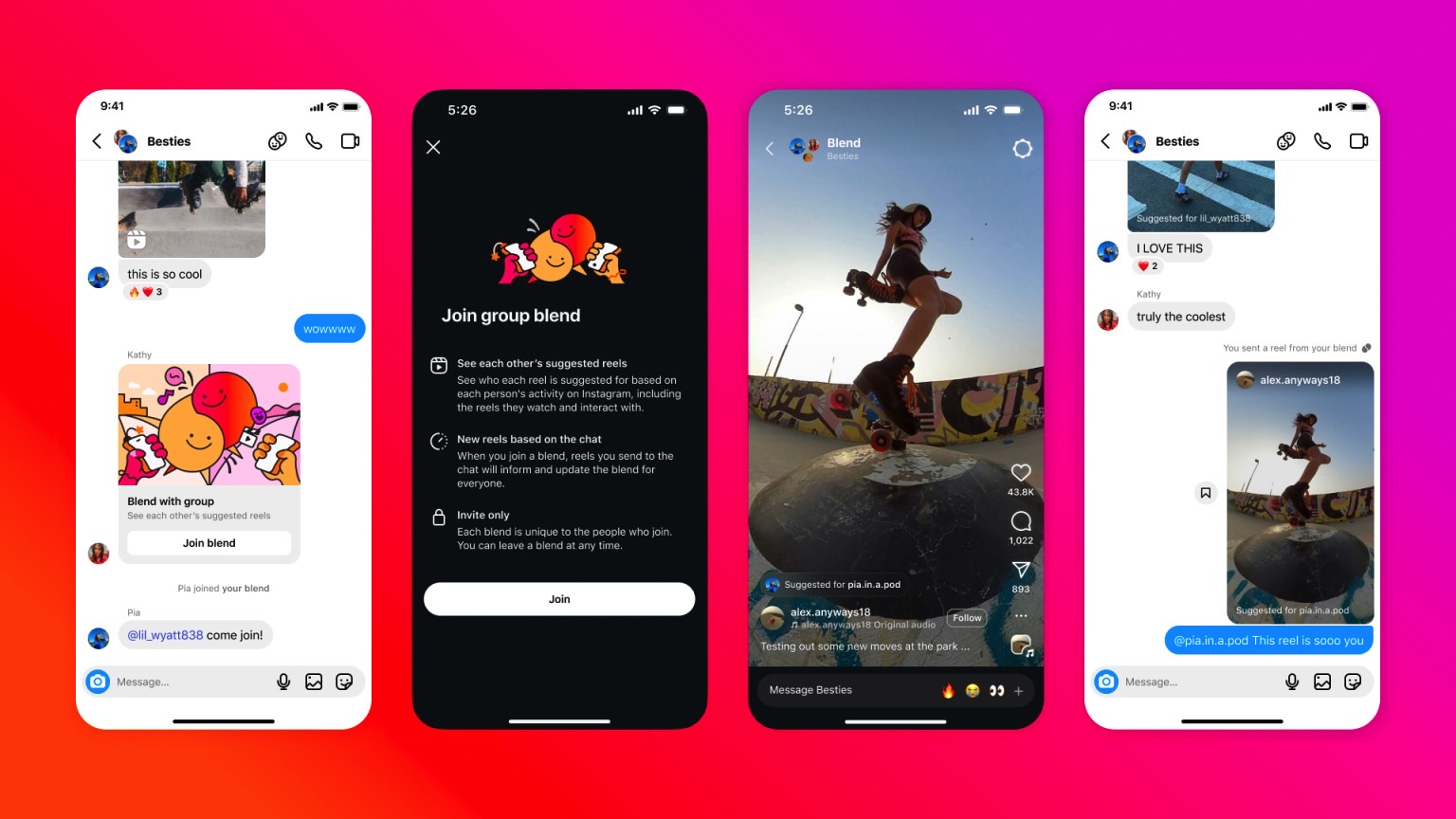
Intagram’s Blend is similar, but it’s not about music (though most Reels do have sound and/or music). Instagram Blend is about sharing Reels with friends and groups inside DMs.

Blend’s purpose is to keep you entertained while you’re chatting to friends on Instagram. It will let you share a feed of Reels that you might like with friends inside DMs, and they can do the same. You won’t get to pick the Reels; Blend will do it for you automatically.

Tech. Entertainment. Science. Your inbox.

Sign up for the most interesting tech & entertainment news out there.

By signing up, I agree to the Terms of Use and have reviewed the Privacy Notice.

A new button will appear in the top right corner inside chats, letting you start or join a Blend. Instagram will then surface Reels content matching the interests of you and the other person in the DM (or the people in the group chat).

“Everyone has the option [to start a Blend] cause you’re actually sharing your interests implicitly,” Instagram’s Adam Mosseri said in a video. “What you’ll see if you go in there is Reels that we think you’re interested in, but also anybody else on that thread based on things like what people have shared in the DM thread earlier.”

Mosseri says Blend is a fun way to share your interests and learn what your friends like.

Instagram’s point is obvious here. They want to drive interest and usage up, and one way to do it is to have people talk about all sorts of Reels as easily as possible. Sliding those Reels into DMs is certainly a clever way to increase engagement.

While I’m not sure how much I’d use Blend or if I’ll ever do it, I do get the appeal. Each Blend you create or join will be unique, as it’ll be tailored to the interests of different people. Therefore, it can help you discover new content, including Instagram creators that you might want to follow.

You should start seeing the new Blend button in your DMs soon enough.

Source

Posted on

Kraft Group enlists NWN for New England Patriots network upgrades

The Kraft Group has announced a five-year strategic partnership with NWN to transform the technology framework underpinning its entire enterprise portfolio, which includes businesses in sports such as New England Patriots, New England Revolution and the Gillette Stadium.

In operation for more than 30 years, NWN has helped over 5,000 chief information officers deliver technology modernisation programmes with its intelligent workplace, customer experience, managed devices, cyber security, public safety, connectivity and cloud services.

The partnership will aim to combine NWN’s technological expertise with what the Kraft Group says is its commitment to “delivering excellence” throughout its entire organisation.

Claiming to recognise the pivotal role of next-generation technology in achieving this vision, the Kraft Group says it’s investing in innovative services that foster long-term success. These include network connectivity upgrades that will underpin new applications, modernised cloud-based collaboration services, and artificial intelligence (AI)-enabled applications that improve the stadium experience for fans and players alike.

A key component of the Kraft Group’s IT organisation is a standardised technology infrastructure that enables a cohesive work environment across all enterprise businesses. Employees benefit from integrated, best-in-class offerings that facilitate operational efficiency, and NWN is supporting the deployment of these tools and resources by modernising the Kraft Group’s existing tech stack to deliver what it said would be “seamless” connectivity across all areas.

As part of the collaboration, NWN is overhauling the existing IT infrastructure at the iconic Gillette Stadium to enhance the fan experience, modernising employee support offerings for the Kraft Group, and establishing what it says will be a “state-of-the-art” infrastructure foundation at the new Patriots training facility.

Given technology plays a crucial role in the modernisation of training and day-to-day operations, NWN is working with the Kraft Group to support applications that keep players informed and engaged. These include AI-powered managed services that automatically provide players with updated meeting times, adjust training schedules based on coaching feedback and deliver playbook content directly to a team member’s device. The training facility will also be equipped with AI environmental system monitoring that adjusts temperatures, powers on devices when a person enters a room, and changes lighting to optimise the workspace for coaches and players.

The enhanced connectivity and AI-driven services are also supporting new initiatives, such as wayfinding applications and the expansion of Gillette Stadium’s internet protocol television (IPTV) network.

Whether they are attending a sporting event, concert or other convention, guests can connect with the wayfinding application to determine the most direct route to their seat, locating amenities and services in the stadium, and effortlessly acquiring tickets. The IPTV network expansion introduces an enhanced digital viewing experience and improved content delivery, with interactive features aimed at increasing fan engagement during live events.

In a further key element of the project, the Kraft Group has recently started construction on a standalone training facility for the exclusive use of the New England Patriots, and NWN is supplying IT infrastructure and services for players and coaches. The building will house all football administration and personnel offices, meeting rooms that will feature new technologies for hosting the annual draft operations, and a media workroom. Additionally, the facility will feature cutting-edge virtual reality rooms.

The project’s multi-dimensional approach also includes revamping the Voice Over IP system for the Gillette Stadium campus, Rand Whitney Containerboard and Rand Whitney Group, consolidating networks and bolstering network reliability throughout the enterprise.

By implementing its cloud-based collaboration service on an improved network, NWN is confident the Kraft Group IT department can rely on NWN to augment its staff, deliver better interactions throughout its enterprise business portfolio and become a more agile organisation.

“Gillette Stadium is used throughout the year for a variety of events, and it is key for this venue to be as accommodating for our guests as possible,” said Jim Nolan, chief operating officer of Kraft Sports and Entertainment.

“Partnering with NWN ensures that we have the newest technological capabilities to exceed fan expectations. Their vast experience in the industry and ability to bring us new technologies – while supporting what we already have in place – is key to making our facilities a place where guests can always stay connected.”

Source

Posted on

Footballers object to processing of performance data

Football players are issuing “stop processing” requests to gaming, betting and data-processing firms over the use of their performance, health and injury data, citing ethical concerns with how the information being distributed about them can affect their career prospects.

Under Article 21 of the UK’s General Data Protection Regulation (GDPR), individuals have the right to object to the processing of their personal data.

Submitted on behalf of players by the Global Sports Data and Technology Group (GSDT) – an enterprise co-founded by former Cardiff City and Leyton Orient manager Russell Slade, and technologist Jason Dunlop – the “stop processing” requests are asking the companies involved to cease their processing of all tracking and performance data, as well as other personal information such as health or injury information.

The “stop processing” requests sent by GSDT – as part of its Project Red Card initiative to give footballers and other sportspeople more control over the collection and use of their performance data – follow its extensive engagement with companies in the gaming, betting and sports data industries over the past five years.

While GSDT are unable to disclose which companies the requests have been sent to, they are some of the largest betting, gaming and sports data consultancy companies in the world.  

Speaking with Computer Weekly, Dunlop and Slade said that they must now take action via Article 21 of the UK GDPR because the ethical concerns GSDT has raised about the use of football players’ data have been ignored by firms throughout the sports data ecosystem.

“We’re still in correspondence with them, but I just don’t think we’re moving forward,” said Dunlop. “It is disappointing that, despite ongoing engagement with these companies for the past five years, we have reached a point where we must take action to protect our players’ and the processing of their data.

“This issue could easily be resolved if players were recognised as stakeholders in the sports data ecosystem. While we have seen some attempts by others to address this, three critical questions remain: Do players have the right to object to industries outside sport using their data? Who should decide who uses a player’s data? And what is the true value of this data to the athlete?”

Slade added the concerns about player data extend to every level of the game: “Many people still don’t understand how this industry works and don’t realise how important accurate data is to a player’s value and career. It is crucial that we get this right for all players.”

Ethical concerns over player data

According to Dunlop, the processing of player information by companies in the gaming, betting and sports data industries takes place without informed consent or financial compensation.

“There is an exemption for commercial processing, but let’s think about the ethics of this,” he said, highlighting that footballers are also people in a workplace trying to do a job. “If you were in work, and every time you went to the toilet, your manager measured the time that you went, left, came back and what you did, you’d probably have some major concerns about that.

“Here we’ve got people in work who are being tracked 25 times a second for everything that they do, and that data is going to all sorts of people who they have no idea about.”

Dunlop added that while most of the data collection is facilitated by clubs themselves for the purposes of player improvement, the information gathered by companies allowed into stadiums is then widely distributed to a range of third parties, which in turn use the data for their own profit without the input or involvement of players themselves.

Slade emphasised that while GSDT has no problem with football clubs using the player data for performance improvement purposes internally, the issue is that it then “goes everywhere”.

Dunlop also highlighted a range of ethical concerns around, for example, the accuracy of player data, which can negatively affect their career prospects if inaccurate information is distributed, and the use of people’s data in the context of gambling if they are personally opposed to it.

Ultimately, Dunlop said GSDT’s goal is to strike a fair balance between players’ rights and the commercial interests of firms that benefit from the data processing.

“The difficulty is, how do you move from where we are to a position where all the stakeholders are comfortable with it?” he said, adding that players also have a right to not make it work and say no to the data processing completely if that’s what they decide.

They told Computer Weekly that, because of the relatively short career spans of footballers, giving them more control over how their data is used can help to support them financially when they hang their boots up.

“There’s a lot of life left after football, and that’s if players are lucky enough to see out a career to the age of 33 or 34,” said Slade, adding this also affects “bread-and-butter” players in lower leagues. “All these bets and this money is being exchanged on the basis of your data, and you aren’t seeing a penny of that.”

Depending on the response of firms to the Article 21 requests, Dunlop and Slade said that next steps would involve approaching the data regulator, before considering legal action. Their hope is that, because football plays such a central role in so many people’s lives, it can set a precedent for people becoming more aware of their data rights and how to exercise them.

“I think this is a really good example where sport can lead the way for general data subjects,” said Dunlop.

Source

Posted on

TSMC promises to produce 2nm chips in the US, but

During its quarterly earnings (via Nikkei Asia), TSMC announced plans to make 30% of its best chips in Arizona, a move that it hopes will help the US create an “independent” chip cluster.

However, TSMC chairman and CEO C.C. Wei stated that the manufacturer “is not engaged in any discussion with other companies regarding any joint venture, technology licensing, or technology transfer and sharing.” Still, TSMC plans to make its 2nm chip in the US, which Apple could take advantage of.

Rumors suggest that Apple plans to make the leap with the 2026 iPhone 18 Pro and a new 2nm manufacturing process for its A20 chip. After a significant jump from the 4nm manufacturing process to a 3nm one, Apple could make the next generation of iPhones even more impressive, ready for the next level of AI applications, though it might not be related to Apple Intelligence at all.

TSMC also plans to ramp up construction of its second and third factories in Arizona. While the initial goal was 2028, the chairman mentioned that the company might be able to advance the timeline by “at least a couple of quarters,” as the second factory is already in progress. The third one is expected to start being constructed later this year.

Tech. Entertainment. Science. Your inbox.

Sign up for the most interesting tech & entertainment news out there.

By signing up, I agree to the Terms of Use and have reviewed the Privacy Notice.

With this, TSMC has an ambitious goal of producing around 30% of its 2-nanometer chips in the US. Still, realistically, Apple might begin taking advantage of these factories by 2030 (assuming iPhones will still exist by then).

That said, Apple is reportedly already utilizing the first Arizona factory, as TSMC is manufacturing Apple Watch chips in the country. These Apple Watch chips could also power other devices, such as the company’s HomePod mini.

At the end of the day, Apple isn’t moving its entire production to the US or creating the long-dreamed-of American iPhone. However, it may benefit from these technologies in upcoming products.

Source

Posted on

Nintendo Switch 2 preorders will now start April 24 for

We’ll always remember the Nintendo Switch 2 launch event because it coincided with Trump’s new tariffs announcements that would continue to escalate in the weeks following the Switch 2 event.

Just as Nintendo revealed the Switch 2 would start at $449.99 in the US, some $50 more expensive than expected, almost the entire world got hit with a round of tariffs that made American Switch 2 fans wonder how much the console would cost.

All the countries in Nintendo’s Switch 2 supply chain were hit with tariffs, with China being hit the hardest. China’s tariffs continued climbing in the weeks after the Switch 2 release and stayed in place a few days ago when Trump announced a 90-day pause on tariffs targeting all other markets.

Nintendo paused the Switch 2 preorders for the US and Canada soon after those first Trump tariffs were announced, and made no changes to the price.

Tech. Entertainment. Science. Your inbox.

Sign up for the most interesting tech & entertainment news out there.

By signing up, I agree to the Terms of Use and have reviewed the Privacy Notice.

Two weeks later, gamers looking to preorder the new handheld should be happy to hear that Nintendo decided to stick with the $449.99 starting price for the Switch 2. Nintendo also announced a new preorder date for the console on Friday, April 24th.

Nintendo revealed the new Switch 2 preorder details in a blog post, explaining that some of the prices it announced during the early April launch event will remain unchanged:

Retail pre-orders for Nintendo Switch 2 will begin on April 24, 2025. At launch, the price for Nintendo Switch 2 in the US will remain as announced on April 2 at $449.99, and the Nintendo Switch 2 + Mario Kart World bundle will remain as announced at $499.99. Pricing for both physical and digital versions of Mario Kart World ($79.99) and Donkey Kong Bananza ($69.99) will also remain unchanged at launch.

However, Nintendo will increase prices for Nintendo Switch 2 accessories compared to those announced on April 2nd, “due to changes in market conditions.” 

Other price hikes, which Nintendo cavalierly calls “adjustments,” might impact other products in the future:

Other adjustments to the price of any Nintendo product are also possible in the future depending on market conditions.

Nintendo also apologized for the Switch 2 preorder delay and said the console will ship on the date announced during the launch event: June 5th.

Finally, Nintendo listed the MSRP (as of April 18th, 2025) for the first round of Switch 2 products and accessories as follows. The list already includes price hikes of around $5 for some accessories:

  • Nintendo Switch 2 – $449.99
  • Nintendo Switch 2 + Mario Kart World Bundle – $499.99
  • Mario Kart World – $79.99
  • Donkey Kong Bananza – $69.99
  • Nintendo Switch 2 Pro Controller – $84.99
  • Joy-Con 2 Pair – $94.99
  • Joy-Con 2 Charging Grip – $39.99
  • Joy-Con 2 Strap – $13.99
  • Joy-Con 2 Wheel Set – $24.99
  • Nintendo Switch 2 Camera – $54.99
  • Nintendo Switch 2 Dock Set – $119.99
  • Nintendo Switch 2 Carrying Case & Screen Protector – $39.99
  • Nintendo Switch 2 All-In-One Carrying Case – $84.99
  • Nintendo Switch 2 AC Adapter – $34.99
  • Samsung microSD Express Card – 256GB for Nintendo Switch 2 – $59.99

Source

Posted on

Gemini 2.5 Flash is Google’s cheapest thinking AI: What you

After launching the Gemini 2.5 Pro model a few weeks ago, Google has a new AI product ready for testing. Gemini 2.5 Flash is supposed to bring more affordable AI reasoning to tasks that require more thinking.

Google lets users specify a budget and turn reasoning on and off depending on the task. Not everything you throw at the AI will require reasoning, so you don’t have to overspend by having the AI “think” when it doesn’t need to.

However, Gemini 2.5 Flash isn’t an AI product targeting regular users. Instead, Gemini 2.5 Flash is a new tool that developers and enterprise customers can use for work. Gemini 2.5 Flash is available in preview via the Gemini API in Google AI Studio and Vertex AI.

Google says Gemini 2.5 Flash is quite formidable. The AI is Google’s lowest latency and most cost-efficient thinking model. That means it’s faster and cheaper than other models.

Tech. Entertainment. Science. Your inbox.

Sign up for the most interesting tech & entertainment news out there.

By signing up, I agree to the Terms of Use and have reviewed the Privacy Notice.

Gemini 2.5 Flash delivers a “major upgrade in reasoning abilities,” Google said in a blog post. The new AI is Google’s “first fully hybrid reasoning model,” which is how Google describes AI models where developers can turn reasoning on or off.

Interestingly, developers can set up thinking budgets so the AI can perform thinking tasks when they’re required. However, the AI will not consume the entire budget during a single reasoning task if that task doesn’t need it. The model is trained to know how long to think for prompts, so it’ll decide beforehand how much reasoning is required based on the perceived complexity.

Google offers a few prompt examples that explain how much reasoning Gemini 2.5 Flash will perform. For example, asking it to translate a word into a different language requires little reasoning. The same goes for answering questions like “How many provinces does Canada have?”

But more complex math and physics problems will require medium to high reasoning. The AI will spend more time on a prompt, and you’ll pay more money to get your answers.

Developers can set a thinking budget from 0 to 24576 tokens in the API or use a slider in Google AI Studio and Vertex AI.

As for the cost, Google says Gemini 2.5 Flash costs $0.15 per million tokens (input) and $0.60 per million tokens (output). If reasoning is involved for the output, the price goes up sixfold, up to $3.50 per million tokens. These costs make Gemini 2.5 Flash incredibly competitive, as seen in the table at the end of this post.

With thinking turned off, the Gemini 2.5 Flash will be at least as fast as the Gemini 2.0 Flash model.

The speed and competitive pricing for reasoning tasks aren’t Gemini 2.5 Flash’s only advantages. The new model also does very well in benchmarks. According to Google, Gemini 2.5 Flash is second only to Gemini 2.5 Pro in Hard Prompts in LMArena.

In Humanity’s Last Exam, Gemini 2.5 Flash outscored all recent models except ChatGPT o4-mini, which was launched earlier this week. The image below shows more benchmark results.

Gemini 2.5 Flash price and benchmarks compared to other high-end AI models. Image source: Google

Source