Posted on

China’s Robot Dogs Do A Lot More Than Fetch

China is heavily investing in robots, and the quadruped models might soon become mainstream in the region. Specialized models like one that can run as fast as Usain Bolt have been grabbing headlines, but there are more general-purpose versions making their way to consumers. Some of these new releases can be used to transport lightweight loads, capture photos and videos with auto-tracking capabilities, or just be a fun companion for family time with kids.

Interestingly enough, while we have seen a push into humanoid models, which we might consider a more familiar application, it seems they have actually been outpaced by an “older” technology — the robot dog form factor. These products have started to evolve beyond the era of just being seen at trade shows as cool, distant devices, as Chinese companies are gearing up to start actually selling them.

Some examples come from startups Vita Dynamics and Dobot. Vita released a quadruped robot for under $1,500 at the end of 2025, while Dobot started pre-sales for its Rover X1 below $1,000. Both robots have similar functionality (transporting boxes, capturing videos, and acting like a dog), but with the Dobot Rover X1, users can even switch between regular legs and wheeled ones so it can adapt to more terrain, perform tricks, and work as a security guard. As the company describes it, this robot can light your path in a camp and be your “ever-vigilant sentinel.” Still, these are not the only jobs robot dogs have been doing.

Robot dogs can be used for scientific research, nature conservation, and even war

In the same way those old iPhone ads said there’s an app for everything you might need, it seems these quadruped robots are covering a wide range of applications, from consumer creature comforts to business and research. Chinese state broadcaster CCTV, for example, reported on a robot dog navigating a simulated combat course, moving through barricades and obstacles — all while providing a real-time camera feed that can help troops scout enemy positions and move under cover.

Less-scary applications are being developed too, like a six-legged robot dog that is serving as an assistant for scientific expeditions in the Antarctic. This robot can carry heavier objects on the ice without slipping or falling due to its extra legs and anti-slip “shoes.” 

Another application comes from Hong Kong, where the Environmental Protection Department is using quadruped robots to detect bird species while also monitoring trees. So the list of their potential uses continues to grow: Robot dogs are poised to patrol streets and battlefields, help preserve nature, aid scientific research, and serve as all-purpose helpers around the house. While these are just a few examples, expect more brands to commercialize these kinds of machines going forward, like Xpeng’s humanoid robot with synthetic skin, which is slated for release in 2026.

Source

Posted on

5 Electric Vehicles With The Best Factory-Installed Sound Systems

Tattiliana/Shutterstock

When you’re in the market for a new electric-powered vehicle, some key things to look out for include range and charging (whether it has a standard North American Charging Standard (NACS) port or uses a proprietary charging system). And of course, like any other car purchase, you have to consider the usuals like drivability, practicality, safety, reliability (some EV models have proven to be quite unreliable), and more. But on top of all the technicalities, how good the factory-installed sound system is plays a key role in your buying decision, especially if you care about your music. 

If you prefer to blast your favorite tunes while cruising the highway to a weekend getaway spot or while going back home from work in the evening, then you shouldn’t compromise on the sound system. Otherwise, you’ll have to spend extra cash to upgrade the sound system in your new electric vehicle (EV) later on. And that’s exactly what you’d want to avoid, since while EVs are certainly cheaper to run than gas cars, they typically have a higher sticker price. 

So instead of having to buy an EV with a sound system that seems more of an afterthought, you should buy one of these models, as they come with some of the best music systems that you can find on an electric-powered vehicle. We picked these models by researching EVs with the best sound systems from different resources — you can read more about the selection process at the end of the article.

2025 Volvo EX90

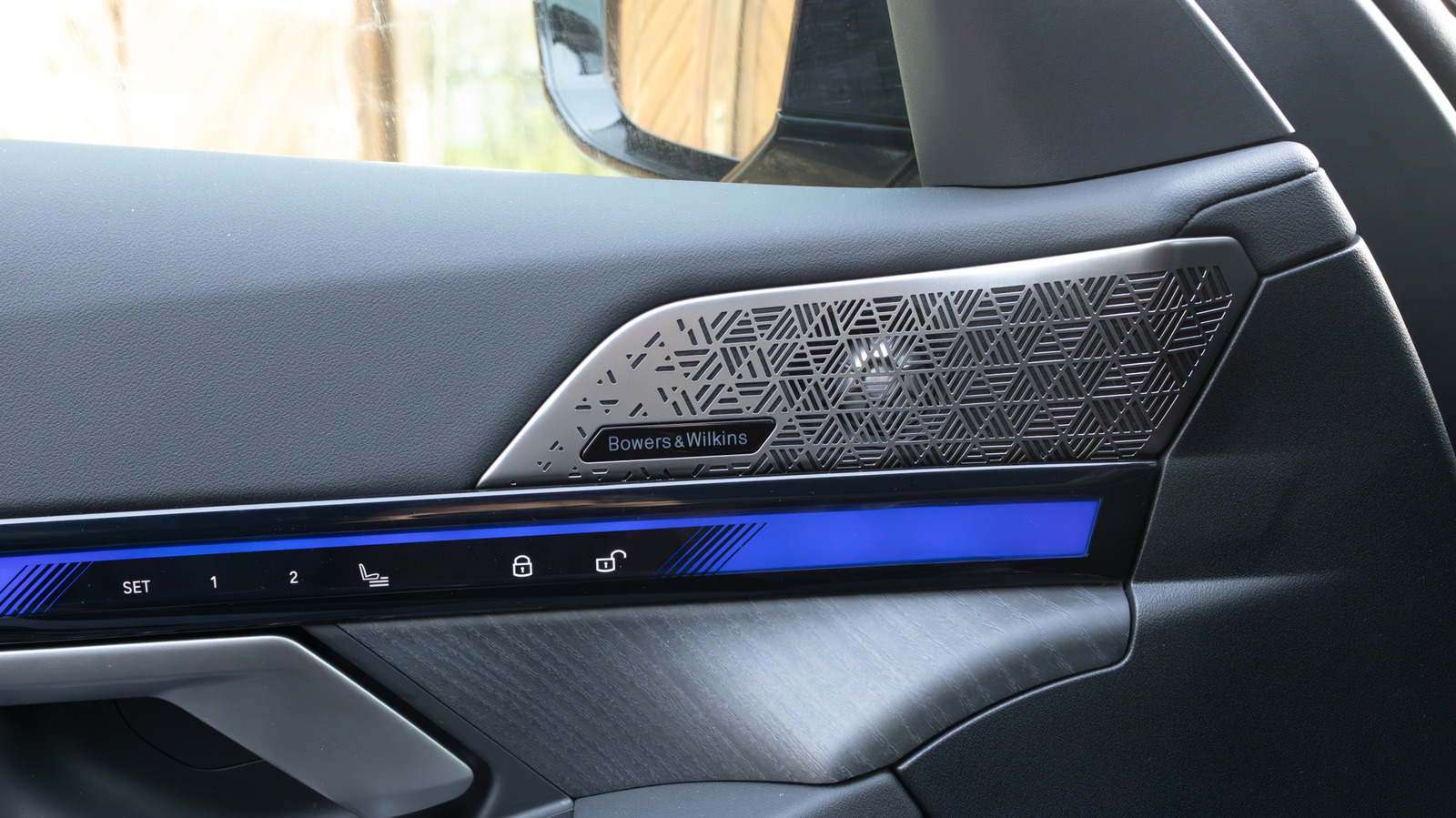
The Volvo EX90 is a luxury full-size sports utility vehicle (SUV) with three rows that can seat up to seven. You can get up to 310 miles per charge on this SUV, but if you’re more interested in the sound, the EX90 will surely satiate your needs. This car is equipped with a Bose Premium Sound system with 14 speakers as standard on all trim levels. Still, there’s an optional Bowers & Wilkins sound system that’ll set you back by about $3,200 if you really want the best audio. That Bowers & Wilkins system elevates the audio with its 1,610 watts of power from a total of 25 speakers. 

The EX90 places the speakers in different areas around the cabin to optimize for the three-dimensional sound, including a tweeter on the dash, some speakers in the roof, and others in the front headrests. The system has Dolby Atmos support for a more immersive sound while you’re behind the wheel. Music should even sound better in the EX90, as it has been found to have a quiet cabin that can be mistaken for some high-end luxury brands like Rolls-Royce. The Volvo EX90 starts at $81,290 for the entry-level Plus trim; the Ultra starts at $85,640. 

But given that the Bowers & Wilkins sound is a $3,200 optional addition exclusive to the Ultra trim, you should be ready to spend a bit more to have it if you want the best audio that the EX90 can deliver from the factory. If you’d like to have the same 25-speaker Bowers & Wilkins system but in a smaller package, the Volvo ES90 sedan is the perfect alternative.

2025 Cadillac Celestiq

Although Cadillac hasn’t been a standout in the luxury segment for quite a while, the company’s 2025 Celestiq is an EV worth considering if you want to get one of the best factory-installed sound systems. Known for offering one of the best audio systems in cars, the company couldn’t possibly cut corners on this segment when it came to its first-ever Celestiq EV, especially at its price. 

For the 2025 Cadillac Celestiq, the General Motors-owned brand offers an AKG Studio Reference stereo system with Dolby Atmos support in the luxury sedan. The sound system includes 38 speakers with three amplifiers. The speakers are placed in different locations in the cabin, including the headrests, in the roof, and on the doors, and the car has been praised for its sound chops in multiple car reviews. 

However, as a competitor to models from luxury brands like Rolls-Royce and Bentley and considering the fact that it’s hand-built, the 2025 Cadillac Celestiq doesn’t come cheap. It starts at $340,000, and under the hood, it offers a dual-motor all-wheel-drive powertrain with 655 horsepower and gives up to 303 EPA-rated miles per charge from a 111 kWh battery.

2026 Mercedes-Maybach EQS 680

Mercedes has built a reputation for offering high-tech models, and in recent years, the automaker has been pushing the boundaries when it comes to dashboard screens with its dash-spanning Hyperscreen. But besides the high-tech and plush interiors, the German automaker has also built a reputation for offering some of the best sound systems in a car. The automaker typically uses Burmester for audio, and the 2026 Mercedes-Maybach EQS 680 also gets the same treatment. 

The 2026 Mercedes-Maybach EQS 680 features the very best sound system the company offers as standard. Instead of the 15-speaker Burmester 3D Surround Sound system that you get on some EV models from the German brand, like the EQS 580 4MATIC, the EQS 680 includes a more capable 4D surround sound system from Burmester. This system comes with a total of 15 speakers, with two 3D speakers placed in the ceiling and two subwoofers in the luggage area cover. 

In total, the 4D surround sound system can output 710 watts. As a 4D system, it has integrated resonators into the seats, which allows you to feel the music vibrations. Since the EQS 680 is a luxury SUV, you should be ready to dig deep into your pockets if you want to enjoy its sound, as it starts at $181,000.

2026 Porsche Taycan

By default, the sound system that you get in the Porsche Taycan without any customization is a 150-watt, 10-speaker system. Obviously, that doesn’t give you the best audio if you’re an audio buff, and the German automaker clearly knows this as it offers an optional but better 710-watt 14-speaker Bose Surround Sound System or, for even better sound, a Burmester 3D High-End Surround Sound System. 

The latter offers the very best sound in the Taycan and has a total power output of 1,455 watts. This system sports a 400-watt subwoofer and has 21 speakers in total. You get a two-way center speaker, and the other speakers are strategically placed in the Taycan, with a pair of tweeters placed in the A-pillars. 

The Burmester 3D surround system includes a special Auro 3D format, which, according to Porsche, provides an immersive 3D surround sound that makes you feel like you’re in the Belgian Galaxy Studios music hall. The 2026 Porsche Taycan starts at $105,800, but you’ll have to fork out $7,430 more for the Burmester sound system. Overall, the Taycan ranks as one of the best EVs on the market.

2026 Polestar 3

Sjoerd Van Der Wal/Getty Images

The 2026 Polestar 3 is a compact crossover that, besides its sub-four-second 0 to 60mph, has an upscale interior with one of the best factory-installed sound systems. Inside the cabin, you’ll find a 10-speaker stereo sound system by default, but like most cars on this list, you can upgrade to an even better one if you’re willing to pay a little bit extra. As an optional upgrade, the Polestar 3 offers a Bowers & Wilkins stereo sound system that delivers a total power output of 1,610 watts. 

The system features 25 speakers in total and supports the Dolby Atmos surround sound format for an immersive listening experience while cruising on the highway. This EV also includes a so-called Active road noise cancellation feature with the Bowers & Wilkins sound system, which, similar to Active Noise Cancellation (ANC) in headphones, blocks external noise to give you a serene environment to listen to your music. 

However, since you need to be aware of your surroundings while driving, it doesn’t block important sounds like car horns and sirens. The speakers are placed in different locations in the cabin, including some in each front-seat headrest. The Polestar 3 starts at $67,500, and to get the Bowers & Wilkins sound system, you’ll need to get the $5,500 Plus package.

How we selected these EVs

UKRID/Shutterstock

There are a variety of EVs on the market, and each model comes with a sound system. To compile this list, we conducted research across different websites, including manufacturer sites, to find EVs that offer solid sound systems, either as standard or as an optional upgrade. 

All the EVs we’ve discussed start at different price points, although most of them are a bit pricey compared to the average cost of an EV. But if you want to get an EV with one of the best sound systems from the factory, you should be ready to pay whatever it takes.

Source

Posted on

The world’s default productivity tool is becoming a national security

When the world’s most widely used productivity suite becomes the preferred weapon of sophisticated state hackers, we all have a problem that transcends routine software bugs.

The recent exploitation of CVE-2026-21509 by Russia’s APT28 group, just days after Microsoft disclosed and patched it, isn’t merely another security incident to file away. It’s a flashing red warning indicator that the aggregation risk and our dependence on a default software platform is creating systemic risk in a world where spreadsheets and spyware are equally viable warfare tools.

APT28, also known as Fancy Bear, BlueDelta and Forest Blizzard, isn’t some shadowy newcomer. This unit of Russia’s GRU military intelligence has been wreaking havoc since at least 2007. They may have interfered in the 2016 US presidential election, compromised the World Anti-Doping Agency, targeted Nato, and they are credited with conducting countless operations against Ukrainian infrastructure. They’re sophisticated, relentless, and have a particular fondness for Microsoft’s ecosystem.

In recent years, they’ve exploited vulnerabilities in Microsoft Exchange, Outlook, and now Office itself. Their tradecraft isn’t opportunistic – it’s industrial-scale cyber warfare executed with military precision.

Severe Office vulnerability

Only recently we witnessed their latest attack. The timeline gives rise for concern as Microsoft issued an out-of-band patch for a high-severity Office vulnerability on 26 January.

Three days later, malicious documents exploiting that exact flaw started circulating in Ukraine. Phishing lure files appear to have been crafted within 24 hours of Microsoft disclosing the software flaw, a single day after the patch dropped.

Think about that timeline – this is an adversary that was either tipped off, had advance access, or was already weaponising the vulnerability before the patch even existed.

This is an adversary that was either tipped off, had advance access, or was already weaponising the vulnerability before the patch even existed Bill McCluggage

CVE-2026-21509 is a security feature bypass – the kind of flaw that tricks users into opening crafted Office files that deliver MiniDoor malware, designed to harvest and exfiltrate victims’ emails, along with PixyNetLoader malware, designed to implant malicious software on compromised systems.

The software flaw allows attackers to exploit the one thing Microsoft can’t patch – human trust. And in Ukraine, where hybrid warfare has transformed every inbox into a potential frontline, that trust is being systematically weaponised.

Structural problems

The problem is structural. IT professionals know that deploying patches isn’t instantaneous. They take time, albeit in some cases automated updates can be relatively quick. But in a conflict zone wrestling with bandwidth constraints, outdated systems, and limited access to enterprise-grade licensing, that vulnerability window becomes a chasm.

If Ukrainian organisations are running older Office builds because they lack resources for restrictive, subscription-based licensing, or can’t afford IT automation for patching, they’re sitting ducks. This is a strategic liability, and other nations need to understand the systemic risk they too face.

Microsoft’s patching cadence deserves further scrutiny, and this incident highlights that recognition delays matter, even outside of active conflict zones. When vulnerabilities are actively exploited before patches arrive or are installed, we’re no longer managing risk, we’re into documenting damage and incident recovery.

Delays in Microsoft patch deployment shouldn’t be inevitable – when your patch management depends on manual schedules, restricted bandwidth, or enterprise support you can’t access, that delay becomes a shooting gallery for groups like APT28.

And the Microsoft problem doesn’t end with Office. The growing dependence on Microsoft’s cloud infrastructure introduces sovereignty concerns that should alarm anyone paying attention.

Single point of failure

Recent Azure outages, whether from cyber attacks or botched updates, have demonstrated how a single point of failure implanted in Redmond can cascade globally. When national governments, critical infrastructure, and essential services run on cloud platforms controlled by one company, we’re not just talking about vendor lock-in. We’re talking about digital colonialism disguised as convenience that introduces systemic risk.

Market concentration compounds this risk. When a single platform is effectively the default across governments and corporations globally, vulnerabilities don’t fail in isolation – they fester and spread.

Licensing models and interoperability barriers that discourage diversification entrench this monoculture. The result is aggregation risk on a geopolitical scale – its bugs are potential weapons in grey-zone conflicts where every user is a potential target, and every attachment could be a trap.

This isn’t just a cyber security challenge – it’s a market structure problem. Structural risks require structural remedies. Bodies like the UK Competition and Markets Authority (CMA) and the European Commission’s Directorate-General for Competition have a clear role here, by ensuring that concentration in productivity and cloud services does not translate into national and global security vulnerabilities.

The ability to diversify and introduce real competition in secure cloud and productivity ecosystems is becoming a matter of digital sovereignty and defence resilience.

The way forward

So what’s the path forward? Microsoft must rethink vulnerability disclosure and patching for high-impact products introducing faster mitigation pathways and protective heuristics that can be deployed before formal patches are released.

Enterprises and governments need to invest in automated patch management and redundancy planning.

And regulators need to recognise that monoculture is inseparable from security risk.

The next frontier of cyber security policy isn’t just about defending networks – it’s about making markets safer by design.

Bill McCluggage was director of IT strategy and policy in the Cabinet Office and deputy government CIO from 2009 to 2012.

Source

Posted on

This Is The Cheapest New MacBook You Can Currently Buy

9dream studio/Shutterstock

We may receive a commission on purchases made from links.

Apple’s MacBook lineup is widely liked for its impressive battery life, superior performance, and seamless integration with the company’s other devices. While it doesn’t include a ton of laptops, the MacBook Air and Pro models are available in a variety of configurations and have two size options each. However, when it comes to the price tag, MacBooks aren’t particularly cheap. That’s why Apple is reportedly working on a low-cost MacBook model that could take on cheap Windows laptops and Chromebooks. However, it’s yet to be officially confirmed and may take a while to arrive. So, if you are in the market today for the cheapest brand-new MacBook model, which should you go for?

The 13-inch Apple MacBook Air with the M4 chip is the cheapest MacBook you can buy new right now. Its base model with 16 GB of RAM and 256 GB of storage is available for as low as $850 on Amazon, down from its list price of $999. This price is not the lowest for the M4 MacBook Air, and it has gone down as low as $740, so you may score the MacBook even cheaper if you wait for the right moment. While you may think the MacBook Air version with the M3 and M2 chips may be cheaper, they are becoming pretty hard to come by and aren’t really available for less than $900. Here’s a look at what you can expect from the M4 MacBook Air and how it’s a great laptop for most people.

All you need to know about the 13-inch MacBook Air (M4)

Jonathan Weiss/Shutterstock

The 2025 MacBook Air is a substantial upgrade over previous generations. While that may not look like it on the surface, the M4 chip inside, according to Apple, is twice as fast as the M1 chip and can deliver 23 times faster performance than the fastest Intel-based MacBook Air models. Keep in mind, the last Intel-based MacBook Air came out just six years ago, in 2020.

Besides the impressive M4 chip, the latest MacBook Air has a new 12 MP Center Stage webcam that’s also a big upgrade over the camera found in older MacBook Air models. You also get better multi-display support, and it can support up to two 6K external displays. Additionally, there is the same beautiful Liquid Retina display, unibody aluminum chassis, and built-in Touch ID support.

Connectivity options are good, with Wi-Fi 6E and Bluetooth 5.3 support; however, port selection remains limited to two USB-C Thunderbolt ports and a 3.5mm headphone jack. Fortunately, the presence of the MagSafe port ensures you don’t block the Thunderbolt port while charging the MacBook. The M4 MacBook Air has received glowing reviews from all over, with reviewers calling it “the best laptop for most people,” praising the new camera, and highlighting its impressive performance. Unless you are doing heavy video editing or plan to play graphic-intensive games on your machine, the MacBook Air has plenty of power to keep you satisfied.

Source

Posted on

Cisco shapes up for delivery of critical infrastructure in the

Attempting to address the growingly complex and pressing needs of businesses for whom artificial intelligence (AI) innovation is moving faster than ever before, Cisco has unveiled a range of products and services that it assured will provide the infrastructure its customers need to move fast and adopt AI safely and securely, raising ambitions for secure and trusted agentic AI.

Launched at the Cisco Live 2026 Conference in Amsterdam, the new systems are said to reinforce the IT and networking behemoth’s ability to deliver networking, security, observability and sovereignty through a unified technology platform.

Yet, as stressed by Gordon Thomson, president of Cisco’s Europe, Middle East and Africa (EMEA) region, in a world defined by AI, companies run the risk of being left behind if they are not leading with AI in their operations, and that to take maximum advantage of AI, Cisco had to think differently in four different key areas, specifically time, trust, talent and technology.

Time is slipping away

“Time is one of our most precious assets. IDC estimates that by 2030, AI investments could generate $22.3tn in economic benefit. But beware: time is already slipping away, and it’s asking hard questions of us all. Are you moving fast enough? Are you still operating as you did one, two or even three years ago? If you are, then the risk is real,” said Thomson.

“We asked enterprise technology leaders about the shift they anticipated with agentic AI, and 78% of leaders said that agentic AI will significantly reshape how their industry operates over the next few years. So all industries are going to feel this tectonic shift. Few will be exempt. And 80% of leaders said agentic will be essential for survival in 2027. That is just next year,” he added.

The speed we’re moving at today is just not fast enough. The promise of AI surrounds us, but our readiness really must catch up, and it must catch up quickly Gordon Thomson, Cisco

“We all need to redefine not just our mindsets, but our organisational DNAs, because the speed we’re moving at today is just not fast enough. The promise of AI surrounds us, but our readiness really must catch up, and it must catch up quickly. The clock is ticking. Preparedness can no longer be a long-term goal. It’s an immediate imperative. None of us can operate the same way as we did last year.”

The executive revealed further findings from the Cisco AI Readiness Index, which showed that only 11% of organisations in EMEA said they were fully prepared for AI. These companies, noted Thomson, “are already watching their competitors in the rearview mirror”, and are five times more likely to turn pilots into production and 60% more likely to see measurable value from investments in AI products and services than anyone else.

A foundation of trust

Regarding trust, Thomson said this quality wasn’t just a value but a foundation – “the currency that enables progress and accelerates change”. Trust, he said, has a number of layers and levels. For example, security trust, as it was not possible to have an AI-driven economy that Cisco could not protect. AI, he emphasised, should start with safety and security.

Secondly, he pointed to innovation trust, which matters more than ever. “You can trust our innovation not just to create the next big thing, but also to ensure our ecosystem remains open. We’re backwards-compatible, and we’re ready for what comes next. We also deliver innovation that’s built with your trust requirements.”

Thirdly, there was execution trust, and then sovereign trust. The latter, which is about finding the right balance between flexibility and control, was recognised by Cisco as also being more crucial now than ever before.

Ecosystem of talent

As he continued with his address, Thomson warned that an AI-powered economy that only a few could participate in was not a resilient one. He said a key task for Cisco was to make sure that every organisation, every community and every individual could not only participate in AI, but could benefit from what it can promise.

Agentic AI doesn’t replace human potential. It unlocks human potential. Therefore, we need to build a different skillset across our talent ecosystem, because that talent will increasingly work with and alongside AI agents Gordon Thomson, Cisco

“Only this ecosystem of talent will fuel sustainable growth, competitiveness and shared prosperity, but our workforce is changing, and we need to keep up. Agentic AI is moving from concept to capability. It can reason, it can plan, it can act alongside people. But most importantly, agentic AI doesn’t replace human potential. It unlocks human potential. Therefore, we need to build a different skillset across our talent ecosystem, because that talent will increasingly work with and alongside AI agents.”

AI-ready infrastructure

Finally, addressing technology, Thomson said that with AI, the tech industry has reached a key point as regards infrastructure, compute, networks, security and monitoring, noting that the infrastructure that firms have relied on to date wasn’t built for the scale and the velocity of future workloads. The Cisco research highlighted how 62% of IT leaders expect workloads to rise by over 30% in the next two to three years, 65% said they were struggling to centralise data, and over a third were currently unable to prevent or detect AI threats.

Future tech would be different, said Thomson. “The solution isn’t about stacking tiny new products on top of each other – that just creates complexity and will slow you down. [Success] requires a platform that uses data to be more efficient, more secure and more scalable. The result is that we’re delivering AI-ready datacentres, future-proofed workplaces and digital resilience, all built in a foundation of secure global connectivity.

“Delivering these capabilities at pace is what you need to thrive. … It’s no longer just about deploying product features; it’s about delivering real business outcomes. You do that with platforms, not with products. We are working at speed because AI isn’t waiting. That convergence of time, technology, talent and trust isn’t a coincidence. These things are defining. We can turn AI into a reality. Not tomorrow, but today.”

Unified AI platform

Key platform and service launches at Cisco Live encompassed three key areas delivered as part of a unified platform, namely the Cisco Silicon One G300 switch; AgenticOps across networking, security and observability to “transform” how IT teams reduce complexity and operate efficiently at scale; and updates to the AI Defense security solution alongside advances to its secure access service edge (SASE) offering.

The G300 switch is designed to power gigawatt-scale AI clusters for training, inference and real-time agentic workloads, and is claimed to be able to maximise graphics processing unit (GPU) utilisation with a 28% improvement in job completion time, allowing users to scale out their buildout of AI clusters. The G300 offers Intelligent Collective Networking, and is said to deliver a 33% increase in network utilisation and a 28% improvement in job completion time versus non-optimised traffic. G300-powered systems are being designed for AI network builders – hyperscalers, neoclouds, sovereign private deployments, service providers, and now enterprises.

To address the diverse requirements of AI environments, Cisco has updated its Nexus One platform with a unified management plane to bring together silicon, systems, optics, software and programmable intelligence as a single integrated solution.

The Unified Fabric of Nexus One is said to allow customers to deploy fast and adapt their networks as demands shift, even across multiple sites. The Cisco N9000 systems serve as the common hardware for a diverse set of fabrics, including Nexus Hyperfabric, with a unified management plane to centralise operations. Application programming interface (API)-driven automation and customisation are built-in.

The AgenticOps innovations will span the Cisco portfolio and are designed to help automate, scale and simplify AI-era IT operations. The system draws on cross‑domain telemetry across Cisco Networking, Security Cloud Control, Cisco Nexus One and Splunk, among other applications. These capabilities include tools, skills and platform enhancements across networking, security and observability.

With native Splunk platform integration coming in March, customers will be able to analyse network telemetry directly where data resides, without having to move it to external platforms. This is an essential capability for sovereign cloud deployments and compliance-sensitive environments where data locality is paramount.

In the security domain, the AI Defense enhancements are the biggest-ever updates to the product, bringing AI supply chain governance and runtime protections to agentic tool use. This is claimed to reduce the risk of compromise or manipulation. AI-driven SASE advancements to include intent-aware inspection of agentic AI interactions and tool requests, evaluating the “why” and “how” of agentic traffic to ward off novel threats.

Source

Posted on

4 Costco Finds That Can Help You Build Your Own

We may receive a commission on purchases made from links.

Choosing the right 3D printer is the most important choice when setting up a 3D printing station, but without having a stable surface to store it on, tools to maintain and clean it, and filament, it would be a rough ride. 3D printers are noisy and need to be operated in well-ventilated areas, so having a dedicated space for a 3D printing project is essential.

Costco has some great products that are essential in setting up a full 3D printing station, which comes from one retailer, and means less time sourcing the right gear and more time 3D printing. The centerpiece is a multi-color 3D printer supported by heavy-duty shelving, vibration control, quality filament, and practical tools for cleanup, finishing, and maintenance. Putting these products together makes for a solid and scalable 3D printing workstation with plenty of space for more printers and storage.

This includes buying the 3D printer from Costco, which can be cheaper than Amazon, depending on the kind of 3D printer you’re looking for. The Creality K2 Combo is user-friendly and not too big, making it a good entry point for those new to the hobby. It’s a great setup for experienced 3D printing enthusiasts too, making sure no space is wasted and is fit for purpose.

Costco 3D printer options

Every home 3D printing setup starts with a 3D printer. Apologies for the sudden shock. Costco typically stocks models designed for ease of use, which also bring some cool features like enclosures, automatic print bed levelling, and error detection. At the time of writing, all of the Costco 3D printers on sale have enclosures, which help regulate temperatures and allow the 3D printer to control the properties of the filament being used. This also helps print consistency, reduces noise, and gives better control when working with tougher filament materials.

Some 3D printers also come with multi-filament systems that allow multiple spools of filament to be loaded at the same time, reducing the need for manual hot swapping during longer projects. Built-in cameras are becoming quite common in 3D printers now, as it allows users to leave their printer to do its job while keeping an eye on the project remotely. It can also double as a print failure detection device. This pauses projects when a print failure occurs, so a user can resolve the issue and carry on with the project.

It’s a win-win for everyone. Beginners benefit from a simple, guided setup, pre-tuned profiles, and safety-focused features out of the box to ease their way into the essential rules of 3D printing. Experienced users benefit from tough metal frames, faster XY axis and nozzle, and support for filaments that require higher temperatures to use. That means more fun projects to experiment with.

Shelves

A 3D printer’s performance is strongly influenced by the surface it rests on, and Costco sells a three-tier modular wire shelving unit for about $65. By placing the printer on the top shelf for easy access, the other two shelves will be great for storing filament and finished projects. Each shelf is rated for 150 pounds and is 23 x 13 inches, with each rack standing at 30 inches. Shelves can be seated every inch on the frame, so there’s plenty of flexibility for storing bigger projects and adding more 3D printers, filament connectors, and filament dryers down the line.

It’s going to be a good idea to fix the racking against a solid wall to keep it from shaking whilst printing. A few off-wall saddle brackets from Amazon or your local hardware store will do the trick. To have more access to the back of the 3D printing station without moving it, mount the saddle brackets on a desired width of wood, with the wood screwed into the wall.  

Polymaker filaments are great for high-speed printing

Filament quality plays a significant role in print reliability and surface finish, and PLA is the easiest type of filament to work with. Costco is appealing to most by selling some basic colors of Polymaker PLA Pro for $59.99 and fun color filament rolls for $69.99. They’re designed for everyday printing, work well with any FDM 3D printer, and are the most commonly used material for projects.

Users have the choice of basic colors of black, white, blue, and red with the core colors pack or celestial purple, starlight Neptune, silk gold, and marble white with the fun colors pack. Of course, users can buy both packs and experiment with different color options, which is half the fun of so many 3D printing projects.

When preparing your STL file and looking at slicer settings (the software used to prepare a 3D file to then send to the printer), there will be a world of options. You can get the most out of PLA filament rolls by making sure your 3D model is standing up or on its most stable point, enable “ironing” for a smoother finish, and enabling auto-supports to make sure nothing is being printed on thin air. Also, opting for a slower print time means better accuracy and tensile strength, too.

Essential 3D print cleanup and finishing tools

3D printing can get very messy quickly, especially when you’re printing with multiple colors. 3D printers will need to purge the remaining color inside the nozzle before moving over to a new filament, resulting in dreaded filament poop. Most 3D printers have a tray for this, but that can fill up quickly, which is where the Fanttik X200 Mix cordless vacuum comes in handy.

It’s compact enough to store on a 3D print station and has enough power to clean up filament snips and poop from fans, vents, and electronics without taking the printer apart. Then, instead of keeping different tools stored on the 3D printing station, you can get a multitool to help save some space. Plus, it’s handy to have on hand in a pocket.

Costco sells CAT’s two-piece deluxe multitool set for $41.99, and it has everything needed for a 3D printing station. You can trim filament for loading, remove supports, and smooth rough edges during post-processing of your printed project. It combines cutting, gripping, and filing tools into a single kit to make life easier. Why take up more room on a shiny new 3D printer station with more tools when a printed Star Wars Stormtrooper helmet can take their place instead?

Source

Posted on

AI enters its ‘grassroots backlash’ era

Artificial intelligence (AI) exploded into the mainstream in late 2022 with the release of ChatGPT. Now, barely three years later, it has colonised modern life to a remarkable degree.

Leading chatbots are registering roughly 1.5 billion active users per month. OpenAI says 230 million of them pose questions to ChatGPT about their health and wellness each week. Global survey data indicates virtually every CEO is clamouring to integrate AI into their company due to fear of missing out. And labour markets and dating apps are now largely mediated by AI gatekeepers.

Computer-generated slop from automated content farms is rife on social media. Deepfakes are fueling political extremism and fraying social cohesion in liberal democracies. Synthetic artists are topping the Billboard music charts. Parents are snatching up teddy bears with built-in chatbots for their children.

“Everything is AI now, so nothing is AI,” one industry analyst recently told Wired magazine ahead of the 2026 Consumer Electronics Show, the tech industry’s largest retail trade fair held every year in Las Vegas. “It has reached such a point of saturation,” he said, adding that consumers don’t even consider a product utilising AI as a unique selling point anymore.

It reflects a stunning normalisation of a revolutionary technology. But not everyone is happy about it.

If 2025 marked the rapid diffusion of AI, it also may have marked a tipping point for growing public distrust of AI systems. Writers, artists, developers and online communities are increasingly questioning how AI systems are built and deployed – and whether their rapid roll out serves the public interest or simply reinforces existing structures of power.

But whether grassroots action is enough to reverse this trend and effect lasting change remains an open question.

Citizens flex their agency

Frustrated with lawmakers and byzantine legislative processes, some citizens have decided to take action into their own hands.

Fanfiction writers are coordinating campaigns against open source platforms that host catalogues of their work harvested without consent. Other creators have used tactics such as data poisoning to interfere with models built on their material. Web developers are increasingly turning to the practice of “tarpitting” – preventing AI bots from scraping content from their page by trapping them in an endless maze of site code protocols.

There’s also surging demand for older cell phones incapable of running the newest versions of popular apps. Windows users that account for more than a billion devices are refusing to upgrade to Windows 11, with its embedded AI upgrades.

“Consumer fatigue surrounding AI’s rapid rise has begun to catalyse a more analogue 2026,” wrote a Forbes contributor in January, referring to a mantra emerging on social media whereby users vow to reduce their screen time this year. In one sense, she says, it amounts to “course correcting a years-long pattern of glorifying efficiency and automation over creativity and community”.

Tyler Johnston, the executive director of The Midas Project, a non-profit watchdog group that monitors leading tech companies, says it’s clear that AI does not have the widespread popularity that its developers may have hoped for: “I’m personally not sure why this is, but I imagine that the benefits still aren’t salient for most people, and it’s not clear if the technology will, on net, benefit everyday people or disempower them.”

Activists worldwide are also confronting lawmakers about the downsides of datacentres. Locals complain that the always-on facilities are an eyesore. The buildings also drain precious water reserves, deflate adjacent property value due to relentless noise pollution and overload energy grids, triggering blackouts and a spike in utility prices. And all while accruing generous tax breaks and offering sparsely few permanent jobs. 

Pockets of the invisible precariat of human workers that make machine-learning models work are mobilising too. Rather than employing their own staff for data labelling, AI developers mostly crowdsource gig workers through platforms such as Amazon Mechanical Turk (AMT). Another method is to outsource work to third-party agencies that offer employment in “digital sweatshops” in low-wage regions abroad – places such as the Philippines, Venezuela and elsewhere.

In February 2025, a group of 339 Kenyan data workers employed to train and maintain the AI systems of major tech companies founded the Data Labelers Association. “The workers power all these technological advancements, but they’re paid peanuts and not even recognised,” the group’s president told Computer Weekly at the time. The members he represents are spread across various subsectors of AI development – ranging from self-driving vehicles to robot vacuum cleaners. 

For several years now, the non-profit group Turkopticon has likewise functioned as an online forum for AMT contractors by organising mutual aid, resources and advocacy in support of better working conditions.

Same goal, different tactics

Past attempts to address the pathologies stemming from social media show bottom-up challenges to the roll-out of novel technology can take on multiple forms.

For one, communities – in democracies, at least – can assert their interests by engaging elected representatives to influence legislation. While technologically deterministic rhetoric underpins a lot of current AI-related policies, headlines and discourse, governance remains an inherently contested process involving a range of actors and interests. And when it comes to ensuring safety around AI systems and product adoption, crowdsourcing ideas from the citizenry will be essential.

“The biggest risk is allowing a small group to unilaterally decide how AI is built and deployed,” Taiwan’s former minister of digital affairs, Audrey Tang said in an interview last year. “Only a handful of nations have the power to compete for dominance, while the other 200+ countries are effectively in a race to safety, as they have little control over AI development.” 

This highlights an opening for grassroots AI pushback to coalesce into “counter-governance” – an academic concept that refers to citizen interventions altering state-led governance processes.

As Blair Attard-Frost, a fellow at the Alberta Machine Intelligence Institute, explains, this hinges on action being overtly political. The key is effective organisation. When individuals or groups deliberately seek to challenge or disrupt state or industry control over AI, their actions qualify as “counter-governance”. By contrast, opting out of AI use based only on personal ethics or privacy concerns does not meet this threshold unless it is tied to a broader effort to reshape governance itself.

It’s not clear if [AI] technology will, on net, benefit everyday people or disempower them Tyler Johnston, The Midas Project

This dynamic was visible in recent years around the demise of the Sidewalk Labs project, a smart city development proposal for Toronto’s waterfront led by Google’s parent company Alphabet.

Despite promises of data-driven urban innovation, the project faced sustained criticism over data governance, privacy, surveillance and corporate control of public space. It was ultimately abandoned following extensive public opposition. It remains a rare example of how localised efforts and community resistance might try to constrain large-scale AI initiatives and assert collective authority over the conditions under which such technologies are adopted.

Elsewhere, federated AI systems are attempting to offer an alternative to leading models by allowing data control and model training to remain with local actors rather than being consolidated in large state or corporate platforms. Training models on distributed data without pooling raw information reduces privacy and security risks while supporting regulatory compliance and data sovereignty.

Open source models compliment this approach by giving downstream developers greater freedom to refine models for new purposes. Here, among the most striking trends, wrote two researchers in Tech Policy Press in December, “is the rise of unaffiliated developers and loosely organised online communities”.

Citing a new study of AI model downloads from Hugging Face, a machine learning tool hub, the researchers point to how “the open source ecosystem is no longer shaped primarily by large companies but by hobbyists, independent researchers, small collectives and new intermediary groups that specialise in repackaging, quantising and adapting models for widespread use”.

This new vanguard, they say, is steadily determining “which models become practical options for ordinary developers”.

Together, federated and open source AI offer the promise of broadening civic participation in AI development by incrementally shifting influence away from a handful of closed frontier models owned by Big Tech toward communities that adapt and circulate their own bespoke models. This raises the possibility that new governance standards and use cases can be built even as formal policy responses are slow-balled or fail to gain traction.

All told, the unfolding push for decentralisation by citizens to wrest some control over how AI is affecting their lives echoes the early days of the internet. Back then, American libertarian John Perry Barlow 1996’s essay A declaration of the independence of cyberspace argued web users and civil society must actively contest how digital systems are governed as they scale and consolidate power.

The future remains uncertain

Nevertheless, the concentration of AI control within Big Tech appears destined to continue in 2026. Although this may generate unpredictable impacts at the ballot box – especially in America’s November midterms – it could also have ripple effects for global AI governance given Washington’s jurisdictional authority over Silicon Valley.

More than 1,000 proposed bills to regulate AI were introduced at the state level in the US in 2025 alone. Yet the Trump administration’s AI action plan “reads just like a wish list” from Big Tech, an executive from the AI Now Institute, a non-partisan research organisation, said when the strategy was released last July.

In December 2025, Donald Trump took further action by signing an executive order blocking US states from regulating AI – a move some experts think may fracture his base of political support ahead of the polls.  

“I think one of the more interesting implications of this will be the political consequences,” says Tyler Johnston of The Midas Project. “I predict that AI will be a very salient topic in 2026, and that incumbent lawmakers that have so far allied with the industry to fight budding regulation may start to face electoral consequences for having done so. Time will tell.”

But advocacy can go both ways. Meta, for example, spearheaded the launch of a California-based super political action committee last year to enable dark money to derail the campaigns of lawmakers serious about regulating AI. It’s just one of several such efforts being sponsored by the tech industry’s most ardent boosters.

Industry associations representing Big Tech are also lobbying the Trump administration to demand carve-outs in new trade agreements to allow for the use of copyrighted material to train AI models. Meanwhile, CEOs reportedly plan to spend more than ever on AI in 2026. And the stakes are personal: roughly half of them believe their job is on the line if they can’t usher their company into the promised land of AI benefits.

So, while AI appears to have entered its grassroots backlash era, whether it is just a passing phase remains to be seen.

Source

Posted on

This Is The Best Antivirus For Windows, According To Consumer

Diy13/Getty Images

With the ever-growing threat of malware, ransomware, and phishing scams, a solid security app is essential for any Windows PC, even for savvy internet users. While Windows 11 comes with built-in Microsoft Defender Antivirus protection, it’s not a foolproof solution, lacks features, and often ranks low when compared to the best third-party security software. Fortunately, there is no dearth of antivirus and security software, with everyone claiming to be the best at catching viruses before they infect your PC.

However, not all security software is worth installing, with options from the likes of McAfee to Norton often being apps you should never install on your Windows 11 PC because they can become a bottleneck for your PC’s performance. But if you want a single recommendation, Avira Free Security Suite and Avira Antivirus Pro top the Consumer Reports (CR) rankings for best free antivirus and the best paid antivirus for Windows.

CR is an independent, trusted, and impartial source for ratings and reviews of products and services in the U.S. Avira also ranked high in the “Real-World Protection Test (July-October 2025)” of AV-Comparatives, protecting against 99.5% of the threats. AV-Comparatives is an internationally recognized research institute that tests and rates antivirus software. Here’s what the free and paid versions of the Avira security software offer and how you can get them.

What can Avira security software do for you?

Avira Free Security is the company’s zero-cost antivirus solution and can protect your PC from malware and phishing. It comes with an on-demand virus scanner and a real-time threat monitor to guard you against any malicious files hiding on your computer. It also has a software updater function, which tells you when updates are available for different apps and drivers so that your system is always up-to-date with the latest fixes. Additionally, you can use the supplied browser extensions to block malicious downloads, ads, and even tracking in your favorite web browser. However, any internet traffic outside of the browser with the Avira extension won’t be monitored. Other features include a VPN with 500MB of free bandwidth, a password manager, and a Windows tune-up tool. You can download for free from the Avira website or Microsoft Store.

The Pro version is a leaner and more antivirus-focused version that costs $65 annually; however, you can typically score a discount for the first year. It includes all the antivirus capabilities of the free version but also adds native support to block threats entering your internet traffic, including emails, as well as enhanced ransomware protection. You also get access to premium customer support via a toll-free number and email, and freedom from constant nudges to upgrade to a paid version of Avira. 

However, it lacks a software updater, a password manager, and a Windows tuner. It’s also available via the Avira website. If you’re on a tight budget and don’t mind dealing with frequent upselling, the free version is a good option. However, if you can shell out for the Pro version, you will get complete protection against both the already present threats and anything coming from the web.

Source

Posted on

Lack of resources greatest hurdle for regulating AI, MPs told

Closer cooperation between regulators and increased funding are needed for the UK to deal effectively with the human rights harms associated with the proliferation of artificial intelligence (AI) systems. 

On 4 February 2026, the Joint Committee on Human Rights met to discuss whether the UK’s regulators have the resources, expertise and powers to ensure that human rights are protected from new and emerging harms caused by AI. 

While there are at least 13 regulators in the UK with remits relating to AI, there is no single regulator dedicated to regulating AI.

The government has stated that AI should be regulated by the UK’s existing framework, but witnesses from the Equality and Human Rights Commission (EHRC), the Information Commissioner’s Office (ICO) and Ofcom warned MPs and Lords that the current disconnected approach risks falling behind fast-moving AI without stronger coordination and resourcing. 

Mary-Ann Stephenson, chair of the EHRC, stressed that resources were the greatest hurdle in regulating the technology. “There is a great deal more that we would like to do in this area if we had more resources,” she said.

Highlighting how the EHRC’s budget has remained frozen at £17.1m since 2012, which was then the minimum amount required for the commission to perform its statutory functions, Stephenson told MPs and Lords that this is equivalent to a 35% cut.

Regulators told the committee that the legal framework is largely in place to address AI-related discrimination and rights harms through the Equality Act.  

The constraint is therefore in capacity and resources, not a lack of statutory powers. As a result, much of the enforcement is reactive rather than proactive.

Stephenson said: “The first thing the government should do is ensure that existing regulators are sufficiently funded, and funded to be able to work together so that we can respond swiftly when gaps are identified.”

Andrew Breeze, director for online safety technology policy at Ofcom, stressed that regulation could not keep pace with rapid AI development.

However, regulators also stressed that they are technology-neutral; their powers with regard to AI are limited to the use case and deployment level. Ofcom, the ICO and the ECHR have no power to refuse or give prior approval to new AI products. 

The committee itself expressed a strong interest in having a dedicated AI regulator. Labour peer Baroness Chakrabarti compared AI regulation to the pharmaceutical industry. 

“Big business, lots of jobs, capable of doing enormous good for so many people, but equally capable of doing a lot of damage,” she said. “We would not dream of not having a specific medicines regulator in this country or any developed country, even though there might be privacy issues and general human rights issues.”

Regulators were in favour of a coordinating body to bring stronger cross-regulator mechanisms rather than a single super-regulator. They stressed that because AI is a general-purpose technology, regulation works best when handled by sector regulators that cover specific domains.

Forms of coordination are already in place, such as the Digital Regulation Cooperation Forum (DRCF), formed in July 2020 to strengthen the working relationship between four regulators. 

It has created cross-regulatory teams to share knowledge and develop collective views on digital issues, including algorithmic processing, design frameworks, digital advertising technologies and end-to-end encryption. 

The then-outgoing information commissioner, Elizabeth Denham, told MPs and peers that information-sharing gateways between regulators and the ability to perform compulsory audits “would ensure that technology companies, some the size of nation-states, are not forum shopping or running one regulator against another”.

Spread of misinformation 

Breeze made the case for greater international regulatory cooperation with regard to disinformation produced by AI. 

Ofcom clarified that, under the UK’s Online Safety Act, it does not have the power to regulate the spread of misinformation on social media. 

“Parliament explicitly decided at the time the Online Safety Bill was passed not to cover content that was harmful but legal, except to the extent that it harms children,” said Breeze.

While misinformation and disinformation regulation is largely absent in UK law, it is present in the European Union’s counterpart to the Online Safety Act. 

Because of the cross-border nature of large tech companies, Breeze noted that legal action on discrimination can sometimes be taken using European legislation.

Age regulation and the Online Safety Act

Regulators also addressed scepticism on age assurance safeguards in the context of the proposed social media ban for under-16s and restricting access to online pornography.

Breeze said age assurance represented a trade-off for regulators between child protection and ensuring a high degree of online privacy.

Responding to criticism that the Online Safety Act has been ineffective due to the widespread use of virtual private networks (VPNs), Breeze said: “Checks are about ensuring as many young people as possible are protected from seeing products deemed harmful to them … and there is no impregnable defence that you can create on the internet against a determined person, adult or child.”

He said that according to the evidence, the majority of children who report seeing harmful content usually weren’t looking for it. 

The same committee heard in November 2025 that the UK government’s deregulatory approach to artificial intelligence would fail to deal with the technology’s highly scalable human rights harms and could lead to further public disenfranchisement.

Big Brother Watch director Silkie Carlo highlighted that the government’s “very optimistic and commercial-focused outlook on AI” and the Data Use and Access Act (DUAA) have “decimated people’s protections against automated decision-making”.

Carlo added that there is real potential for AI-enabled mass surveillance to “spiral out of control”, and that a system built for one purpose could easily be deployed for another “in the blink of an eye”.

Source

Posted on

An Apple Watch Can Soon Control Your Rivian EV With

José Adorno/BGR

Rivian has no plans to adopt Apple CarPlay on its electric vehicles. However, over the past few months, the vehicle manufacturer has been adding a few cool Apple features. For example, in December, the company added Car Key support for some of its latest EVs. Now, according to Rivian Trackr, an upcoming software update will bring Apple Watch support for its vehicles. With that, users will be able to open their vehicle with the app and also unlock a few other perks.

In other words, the Apple Watch app will turn drivers’ wrists into a control panel for the vehicle. They will be able to access core remote functions, such as triggering the alarm, venting windows, and controlling the interior temperature using the Digital Crown. Up to four quick actions can be accessed with just a tap. Still, the key addition is that the Apple Watch app will let owners of Gen 1 Rivian vehicles (model year 2024 or earlier) unlock doors using the Rivian Apple Watch companion app, while other digital car keys remain available only on second-generation Rivian models.

Rivian and Tesla keep adding built-in Apple experiences

Photosvit/Getty Images

While Rivian’s CEO insists he doesn’t plan to add CarPlay to his vehicles, Tesla plans to support CarPlay within the regular Tesla experience users already have. Tesla is also considering offering Apple Car Key support.

Both Tesla and Rivian have built-in Apple Music support, which delivers a more familiar experience for hardcore Apple fans. Even though the lack of CarPlay limits the ability to connect your phone to play your favorite podcasts, audiobooks, or reply to iMessages, it’s interesting to see Tesla planning to go a step further for its customers.

It’s unclear when Rivian will release the Apple Watch app for drivers, but this update shouldn’t take too long to land, as Rivian Trackr tags the update as the 2026.03 update, which suggests March 2026. As for Tesla, Bloomberg says the company will soon reveal more about its plans to offer CarPlay support on its vehicles. That said, these companies aren’t considering support for CarPlay Ultra, which will reportedly come to at least one vehicle of another manufacturer this year. Besides that, Ferrari also recently announced Luce, its first EV, designed in partnership with Apple’s former design boss, and its interface resemblance to CarPlay Ultra is incredible.

Source