Posted on

Roadmap for commercial adoption of quantum computing gains clarity

Over the past few months, some significant breakthroughs in quantum computing technology have indicated how quickly it’s evolving.

While it remains very much in the domain of academia and researchers tackling error correction, the roadmaps of quantum computing businesses suggest that useful machines are on their way.

IBM’s roadmap shows that this year, there will be a move away from its current Heron machine to a new device called Flamingo, which is effectively based on connecting two Heron devices together.

During its first quantum computing developer conference in November 2024, IBM demonstrated the connectivity technology, called L-couplers, which connects two Heron R2 chips with four connectors measuring up to a metre long. Flamingo marks the start of a three-year programme to evolve the number of gates on a quantum device from 5,000 to 15,000 by 2028, using a modular quantum computing architecture.

In February, Microsoft published research of topological qubits called Majorana fermions, which the company anticipated would offer more stable qubits, requiring less error correction. It’s also working on a device called Majorana 1, which can be used to detect these qubits, enabling it to be used in running quantum computing calculations.

Will Ashford-Brown, director of strategic insights at Heligan Group, said: “Every day we inch closer to realising commercial quantum usage for real applications. Size, cooling, price, speed and impact are all part of the long tail of improvements, but it would seem we are at the point where commercial application, investment and opportunity are knocking at the door.”

He anticipates that the availability of a new generation of quantum computing platforms will result in a surge in customer demand. “Presently, the market has been mostly limited to national research laboratories and supercomputing labs,” said Ashford-Brown. “But commercial adoption is getting started, beginning with the tech giants. Microsoft, Amazon, Google and IBM have all partnered with quantum computing startups to provide quantum-based cloud services or are developing their own machines.”

Industrial applications

While quantum computing evolves, there’s also a lot of interest in hybrid approaches that can take advantage of the technology to speed up computationally complex calculations.

D-Wave, for instance, recently expanded its quantum-optimisation offering, with several initiatives aimed at boosting adoption. It said Ford Otosan, a joint venture between Ford Motor Company and Koç Holding in Turkey, has deployed a hybrid-quantum application in production based on D-Wave technology, which streamlines manufacturing processes for the Ford Transit.

The US has an eight-year plan to make quantum computing commercially useful. Alice & Bob, Quantinuum and Rigetti are among 10 quantum computing businesses selected by the US Department of Defense to participate in the first stage of the agency’s Quantum Benchmarking Initiative (QBI). This aims to assess the feasibility of building an industrially useful quantum computer by 2033.

These developments represent a small snapshot of the immense work taking place across the tech sector to develop quantum computing and hybrid architectures that use quantum technology to accelerate computationally difficult tasks.

Graeme Malcolm, founder and CEO of M Squared Lasers, believes there is now a need for a decisive commercial push. “The industry is on the cusp of crossing the so-called ‘quantum valley of death’ – a pivotal transition from research excellence to commercial reality,” he said.

Given the government’s recent injection of funding, which will see £121m being put up to drive development of quantum technology in the UK, he added: “Our collective focus must now shift to industrialisation. A nation without quantum will be a nation without critical advantage.”

However, in spite of the progress being made, a survey from Economist Impact recently reported that 57% of respondents believe misconceptions about quantum computing are actively hindering advancement. The findings suggest a disconnect between technological development and business readiness, reinforcing the need for better communication, education and alignment at the executive level to maintain the momentum of progress.

Helen Ponsford, head of trade, technology and industry events programming at Economist Impact, said: “With 80% of respondents stating that demonstrating industry-specific use cases is essential to accelerating adoption, and two-thirds highlighting the importance of proving return on investment, the message is clear: commercial relevance must closely follow scientific breakthroughs for quantum to sustain its growth.”

First piece of the quantum jigsaw

Although there has been plenty of progress in making quantum computing technology available to software developers through platforms and software developer kits, no discussion on quantum computing is complete without addressing security concerns, which need to be in place well before mass adoption.

Looking at quantum-safe cryptography, Daniel Shiu, chief cryptographer at Arqit, said: “Even though the timeline for a viable quantum computer is uncertain, two things are clear – the industry is advancing and the threat is already here. Any systems compromised today could have their data decrypted once quantum machines arrive, unless adequately protected. Quantum security is a concern we need to address now.”


Source

Posted on

We might’ve just learned Apple’s new color for the iPhone

Little is left for leaks to reveal about the iPhone 17. That said, one of the missing pieces of information regards the upcoming iPhone 17 Pro colors. While it could have been safe to assume that Apple would maintain the Black Titanium, White Titanium, Natural Titanium, and Desert Titanium options, there’s a twist for this year’s iPhone: Cupertino is expected to return to aluminum and glass finishes.

If both regular and Pro iPhones feature an aluminum and glass finish, this could mean all the colors for the upcoming iPhone 17 Pro will be different. That being said, I would expect Apple to keep Black, White, and Gold options.

However, there might be another enticing option that could prompt iPhone users to upgrade. After all, who hasn’t upgraded to a $1,000+ phone just for a new color?

According to leaker Majin Bu, Apple is planning to bring the same option to the upcoming iPhone 17 Pro due to Apple’s successful M4 MacBook Air Sky Blue color release. In an AI-written article, the leaker reveals some important tidbits, claiming the information comes from the supply chain, not just guesswork. According to Bu, Apple has already tested several colors, and Sky Blue is currently taking the lead.

Tech. Entertainment. Science. Your inbox.

Sign up for the most interesting tech & entertainment news out there.

By signing up, I agree to the Terms of Use and have reviewed the Privacy Notice.

If this turns out to be accurate, Apple could be making a comeback to one of the best colors—and one of the best iPhone models—it’s ever produced: the Sierra Blue iPhone 13 Pro. For many who owned this iPhone, it would be a nostalgic throwback if Apple nails the color and also the specs. After all, the iPhone 13 Pro had impressive battery life, an awesome processor, and great features overall.

The iPhone 17 Pro is expected to feature three main 48MP cameras, a front-facing 24MP lens, a bigger battery, and the third-generation 3nm manufacturing process chip, the A20 Pro. Apple is also expected to include its own Wi-Fi modem.

Source

Posted on

Mitre warns over lapse in CVE coverage

One of the cyber security world’s most significant assets, the common vulnerabilities and exposures (CVE) system operated by US-based non-profit Mitre appears to be heading for trouble, after it emerged that the contract pathway for Mitre to continue to run the project on behalf of the US authorities is set to lapse on Wednesday 16 April, with no replacement ready.

In a letter to Mitre board members circulated today, a copy of which has been reviewed by Computer Weekly, Yosry Barsoum, vice-president and director at the Centre for Securing Homeland (CSH) at Mitre, said the US government was currently making “considerable efforts” to continue Mitre’s longstanding role in the CVE programme.

“If a break in service were to occur, we anticipate multiple impacts to CVE, including deterioration of national vulnerability databases and advisories, tool vendors, incident response operations, and all manner of critical infrastructure,” wrote Barsoum.

“Mitre continues to be committed to CVE as a global resource,” he added. “We thank you as a member of the CVE Board for your continued partnership.”

A spokesperson for Mitre confirmed the legitimacy of Barsoum’s statement to Computer Weekly. They described the CVE programme as a “foundational pillar” of the cyber sector, anchoring a global industry worth close to $40bn (£30bn).

The 25-year-old CVE system is designed to serve as a reference and repository for disclosed cyber security vulnerabilities, and has been maintained by Mitre since its inception at the end of the 1990s, with funding drawn from the National Cyber Security Division of the Department of Homeland Security.

Over the years, its impact on the world of security research has been of immense significance, providing cyber defenders with data on emerging vulnerabilities and threats, some of which have been implicated in some of the largest cyber incidents ever seen – such as WannaCry, SolarWinds Sunburst, Log4j and MOVEit to name but a few.

Its continuing work will be familiar to most thanks to the sheer volume of CVEs – recognisable by their unique identifiers comprising the letters CVE, the year and a numeric code – released on the second Tuesday of every month by Microsoft in its Patch Tuesday update.

If it was to have to cease operations, even temporarily pending a contract renewal, the impact would be keenly felt across the entire technology industry. Patch Tuesday aside, the current number of CVEs of all types being discovered and disclosed is running at record highs, and shows no signs of slowing.

Disruption to the CVE system would be a gift to both financially motivated cyber criminals and nation state actors alike, who would be able to swiftly take advantage of any downtime as they continue to seek out, develop and weaponise new vulnerabilities, while security professionals would be left fumbling in the dark.

Coming amid deep and painful government cuts being made in the US, the potential risk to the national security postures of the US and its allies from states such as China and Russia is also extremely serious – a fact not lost on many members of the security community who took to social media late 15 April to spread the word.

Writing on LinkedIn, one observer speculated that the depreciation of Mitre’s contract was by design, and that taken alongside cuts to the likes of the Cybersecurity and Infrastructure Security Agency and the National Institute of Standards and Technology, the US was tearing down core security institutions amid a significant ongoing cyber crisis.

Filling the gap

But with customary community spirit, many cyber professionals are already stepping up to address the looming shutdown. Patrick Garrity, a security researcher at VulnCheck, said: “We want to take a moment to thank Mitre for its decades of contributions to the CVE programme.

“Given the current uncertainty surrounding which services at Mitre or within the CVE programme may be affected, VulnCheck has proactively reserved 1,000 CVEs for 2025.”

He added that VulnCheck’s reporting service would continue to assign CVE numbers for as long as it could do so.

“VulnCheck is closely monitoring the situation to ensure that both the community and our customers continue to receive timely, accurate vulnerability data,” said Garrity.

Mitre added that historical CVE Records will continue to be available at GitHub.

Source

Posted on

Instagram’s Edits app is now available to rival CapCut

Early this year, Instagram announced it would release a new app called Edits, which is a direct rival to CapCut. Well, it’s now available. Meta is no stranger to copying apps and their key features. After all, Snapchat’s Snaps quickly became Stories across all Meta apps. Additionally, the company started offering live streams to compete with Periscope (do you remember that one?), and even released Threads to compete with a declining Twitter.

With all the drama surrounding TikTok, it’s no surprise that Instagram Edits is emerging as the new go-to option to rival CapCut. According to the company, the Instagram Edits app is “designed for creators,” but it won’t be limited to Instagram, Facebook, or Meta’s platforms. In fact, Meta wants you to use it for “any platform.”

Instagram says Edits has three main focuses:

  • Your creative process in one place by keeping track of ideas, managing projects, editing, and exporting watermark-free without leaving the app
  • Creating better videos with powerful tools like a high-quality camera, a frame-accurate timeline, and effects like cutouts or AI-powered animations
  • Insights to guide your content using an inspiration feed of reels with trending audio and performance signals that show you what’s working

These are some of the top Instagram Edits features:

Tech. Entertainment. Science. Your inbox.

Sign up for the most interesting tech & entertainment news out there.

By signing up, I agree to the Terms of Use and have reviewed the Privacy Notice.

  • Ideas: Keep everything in one place, from new videos to notes to your saved reels
  • Inspiration: Get inspired by brownish reels with trending audio
  • Projects: Organize and manage multiple projects in one place
  • Camera: Capture up to 10 minutes and publish in enhanced video quality
  • Green Screen: Easily replace and edit backgrounds in one tap
  • Timeline: Arrange and adjust clips with precision
  • Audio Library: Access the full Instagram music and sound libraries
  • Captions: Add context and accessibility to your videos with automatic captioning available in multiple languages
  • Cutouts: Isolate specific people or objects by making your video more dynamic
  • Animate: Turn static images into engaging videos using AI
  • Publishing: Share directly to Instagram and Facebook from within the app. It’s also possible to export and post wherever without watermarks

Instagram says it will wait for user feedback to continue improving and adding more features in the future. Edits is available globally and free to download in the App Store and Google Play Store.

Source

Posted on

Columbia student expelled for cheating with AI launches AI to

When ChatGPT first arrived, some schools immediately banned the generative AI tool over concerns that students might use it to cheat. Years later, a new AI tool made specifically for cheating is going viral.

What’s even crazier is that the two college students who developed Cluely, the cheating AI in question, got expelled from Columbia after one of them used an early version of the AI program to help with a job interview with Amazon.

Cluely, which you can try for free, just raised $5.3 million in funding, proving that cheating with AI in the age of AI is a thing. But, spoiler alert, the product Cluely proposes might become much bigger than something that helps you cheat during job interviews.

21-year-old Chungin “Roy” Lee went viral a few weeks ago by posting on social media news that Columbia kicked him out after he used an AI tool called Interview Coder to get a job with Amazon.

Tech. Entertainment. Science. Your inbox.

Sign up for the most interesting tech & entertainment news out there.

By signing up, I agree to the Terms of Use and have reviewed the Privacy Notice.

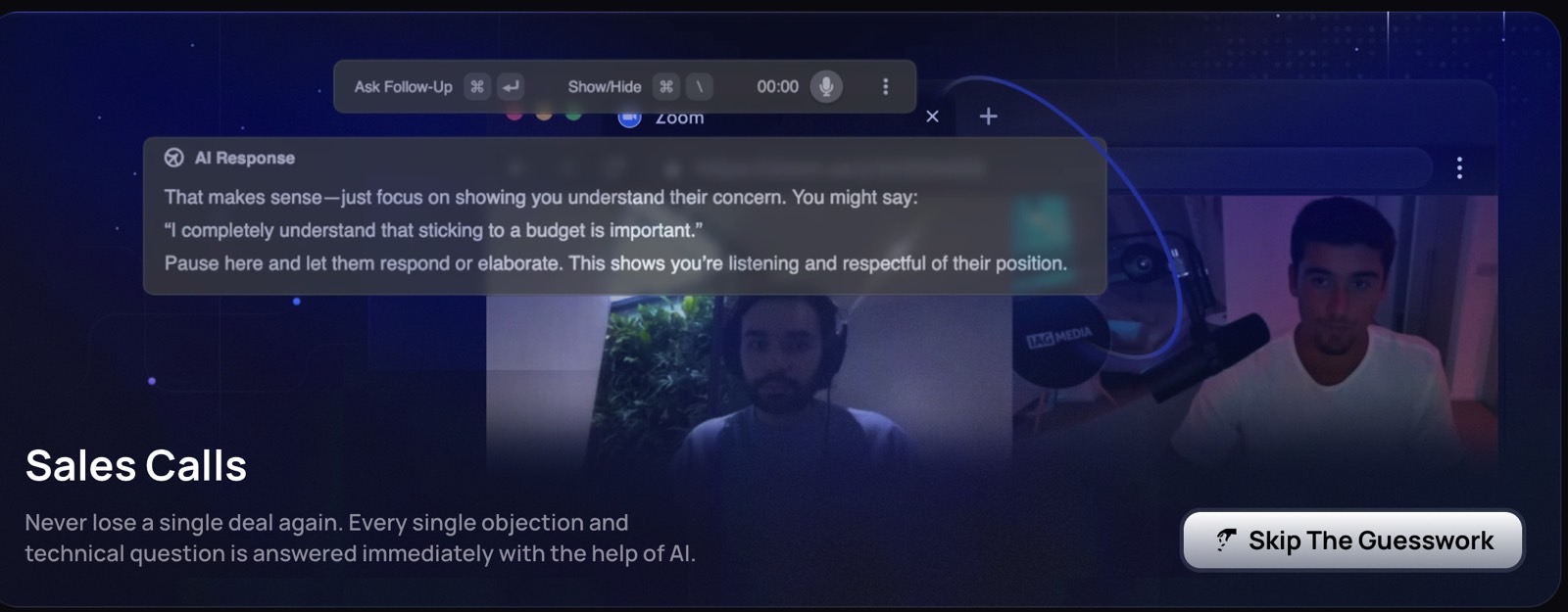
Interview Coder was a program that Lee (CEO of Cluely) and Neel Shanmugam (COO of Cluely) developed before turning it into a viral gimmick. Interview Coder is now part of Cluely, which you can try for free to cheat at whatever you want. It can listen in on Zoom calls in real time and provide helpful answers to questions.

Cluely doesn’t just work with job interviews. It’ll handle anything you throw at it as long as it involves operating a video chat tool like Zoom that Cluely AI can monitor.

The Cluely app, currently available on Macs, runs inside an in-browser window that the other person in the Zoom call can’t view. The AI will listen to what the other person is saying, turn that speech into text, and feed it to an unnamed AI in the cloud, which will then tell you the right thing to say.

There are obvious moral implications here, as well as legal ones. Using Cluely means bringing a third party into a video call that records everything and then sends that data to the cloud. Some businesses and even state laws require you to obtain consent when recording people. But if you’re cheating your way into something, obtaining consent is probably not a big concern for you.

Still, Cluely is getting plenty of attention. Lee just announced that Cluely raised $5.3 million in funding from Abstract Ventures and Susa Ventures. Lee told TechCrunch the app surpassed $3 million in ARR (annual recurring revenue) earlier this month.

That doesn’t mean the company is making $3 million off Cluely. That’s the potential revenue in a year based on the current number of paying subscribers. However, it shows that people see value in the app.

Cluely is available for free on macOS right now, but the responses that the AI will give you are limited. The $20/month Cluely Pro subscription gets you unlimited usage, “solving and debugging” support, “most powerful agent models,” and 24/7 customer support. 

Using Cluely to cheat on interviews will only get you that far, especially since some interviewers may now be aware that Cluely exists. But I see huge potential in an app like Cluely for setting up a personal assistant of sorts.

The existing Cluely app doesn’t say which AI models it uses. A variant of ChatGPT might very well be working under the hood to provide assistance. Also, the data you send (screenshots and transcripts) may be used to improve the service. That data might be aggregated and anonymized, but you can’t opt out.

Source

Posted on

Fibre fine but US tariffs to take hit on broadband

For the IT and telecoms market, the only certain thing about the tariffs imposed and threatened by the US is that they have caused uncertainty, and as the dust settles on the issue, analysts are now predicting that while fibre and optical technologies will likely escape direct impact, cable outside plant and Wi-Fi routers will see an adverse impact. Most importantly, overall spend on comms technology by providers could well be pushed back to 2026.

Assessing how changing tariff policies could affect broadband deployments and the demand for related equipment, analyst Dell’Oro Group noted that recent shifts in US trade policy – not just the implementation and adjustment of tariffs – have introduced uncertainty into global markets.

Furthermore, it adds that given the frequent adjustments to trade policy, including the recent exemptions for smartphones, consumer electronics, and certain graphics processing units, it remains challenging to forecast the full extent of the impact on broadband infrastructure in the near term.

That said, looking at individual technologies, Dell’Oro believes tariffs will have minimal impact on most fibre broadband equipment pricing and deployments. The key reason given for this is the fact that key fibre broadband equipment providers in the US have already moved most of their assembly and manufacturing to the US to adhere to the Build America, Buy America waiver of the Broadband Equity, Access and Deployment programme.

This has meant the most commonly deployed components – passive optical network optical line terminals, optical network terminals, cabinets and fibre-optic cable – have already been self-certified by the respective suppliers and seen substantial increases in domestic manufacturing.

By contrast, Dell’Oro says cable outside plant upgrades in support of Docsis 4.0 technology are likely to be impacted. It suggests that manufacturers of this equipment are either looking to relocate their facilities or manufacturing to the US, or are seeking waivers to satisfy growing demand from leading comms operators. The end result is that tariffs will be materially significant at any level, and cable operators pursuing Docsis 4.0 will face additional deployment delays, as well as increased equipment prices.

Similarly, the study observed that just as wireless technology suppliers are looking to ride a wave of Wi-Fi 7 penetration into businesses, tariffs at any level will easily increase the retail cost of even the most popular Wi-Fi brands by anywhere from 5 to 15%. China, Taiwan and Vietnam are the manufacturing sources for the vast majority of these devices and, although these devices have been exempted in the latest rolling back of tariffs, Dell’Oro predicts that the likelihood of those full exemptions remaining is slim.

Assessing the big picture going forward, Dell’Oro report author and company vice-president Jeff Heynan said: “The challenge for all industries now is that they simply cannot unsee what has already happened. The state of economic recovery in many countries and industries was already fragile after dealing with the supply shock of the Covid-19 pandemic … Just as these businesses are set to rebound and return to more normalised and consistent purchasing levels, tariffs are introduced, making the road to recovery cloudier.

“The bigger concern we had going into 2025 was the uncertainty among consumers and businesses alike about what impact the new administration’s policies would have on overall spending and investment patterns,” he said. “After two years of steady inflation and higher interest rates, US consumer confidence was already trending downward. Consumer debt levels were rising and stubbornly high mortgage rates limited the number of new homes being purchased, as well as overall refinancing. With consumer spending in the US typically 68% of GDP, any further decline in confidence could result in consumers pulling back from spending.”

For its part, Cedia, an international trade association dedicated to the residential and commercial custom electronics industry, said the tariffs decision on comms tech will affect imports of various goods crucial to the smart home technology sector, and that professionals in the sector could face significant operational challenges as they attempt to absorb increased material costs or pass these expenses on to consumers.

The association highlighted the potential to strain smart home professionals who specialise in custom installations and integrations of advanced technologies, such as home automation systems, audiovisual equipment, security features and energy management offerings.

Assessing the issues from the viewpoint of operators and the ramifications for the industry, Juniper Research noted that it expects operators to pass the almost-certain higher costs of network upgrades and maintenance onto mobile subscribers, driven by the slim profit margins tied to consumer subscriptions. It emphasised that operators are continuing to upgrade existing 5G networks as they focus on rolling out services aimed at attracting enterprise clients.

Looking at how the tariffs could impact 6G development, Juniper Research said it was necessary to consider the timelines for 6G and the timing of the next presidential election. Based on previous telecom network cycles and announcements from industry bodies, it expects network testing to begin around 2028, with a commercial launch in 2029; right at the end of the next election cycle.

Source

Posted on

How Apple’s Vision Pro boss is rebuilding Siri from the

Following the report that Apple Vision Pro’s chief is the new head of Siri, Bloomberg’s Mark Gurman has revealed how Mike Rockwell is revamping Siri’s leadership from the inside out.

These changes came just weeks after Apple had to postpone one of the most important Siri features: on-screen awareness. This would allow Siri to search for information in real time based on what you’re seeing on the screen.

According to Gurman, Rockwell is bringing Vision Pro engineers to lead Siri’s most crucial capabilities, including speech, understanding, performance, and user experience.

Here are some of the key players responsible for transforming Siri into a true personal assistant, according to the journalist’s report:

Tech. Entertainment. Science. Your inbox.

Sign up for the most interesting tech & entertainment news out there.

By signing up, I agree to the Terms of Use and have reviewed the Privacy Notice.

  • Ranjit Desai: A longtime deputy from the Vision Pro team, Desai will now be responsible for Siri’s engineering. Rockwell highlighted his background in “high-performance, low-latency systems” to elevate Siri’s performance.
  • Olivier Gutknecht: A senior Vision Pro software executive, Gutknecht will take over the team focused on Siri’s user experience.
  • Nate Begeman and Tom Duffy: They will collaborate with Gutknecht to make Siri’s architecture “world-class” and scalable.
  • Stuart Bowers: He leads data, training, and evaluation teams. Bowers will also work on improving Siri’s ability to understand user commands.

These changes are critical to making Siri a better personal assistant and, eventually, an AI powerhouse. Currently, Siri has two teams: one focused on everyday tasks and the other on large language models (LLMs).

Rockwell plans to overhaul Siri’s architecture, using a single LLM-based system to enable a more conversational user interface. This upgrade is expected to take a couple of years.

That said, it seems this might not be a great year for major Apple Intelligence updates during the WWDC 2025 keynote. In fact, it looks like Apple only decided to address Siri’s issues after they became apparent. But with the competition improving rapidly, will Cupertino have enough time to catch up?

Source

Posted on

AI chip restrictions limit Nvidia H20 China exports

Nvidia is expecting a big hit to its business as reports emerge of the White House imposing export restrictions on its H20 GPU (graphics processor unit) in China. The new restrictions appear to have been carried over from the previous administration’s policy to restrict access to AI chips and advanced AI models.

The Framework for Artificial Intelligence Diffusion from the US Bureau of Industry and Security (BIS), which was published January 15 2025, puts in place export administration regulation controls on advanced semiconductors. By imposing controls that allow exports, re-exports and transfers (in-country) of large quantities of advanced computing integrated circuits only to certain destinations and end users, BIS said the export controls could reduce the risk that malicious state and non-state actors gain access to advanced AI models.

At the time, Ned Finkle, vice-president for government affairs at Nvidia, posted a damning indictment of the former US administration’s attempts to curb semiconductor exports. In a blog post, he said: “In its last days in office, the Biden Administration seeks to undermine America’s leadership with a 200+ page regulatory morass, drafted in secret and without proper legislative review. This sweeping overreach would impose bureaucratic control over how America’s leading semiconductors, computers, systems and even software are designed and marketed globally.”

Finkle described the Biden Administration’s approach as “attempting to rig market outcomes and stifle competition”, adding: “The Biden Administration’s new rule threatens to squander America’s hard-won technological advantage”, and said they “would do nothing to enhance US security”.

The new rules were set to come into effect on April 15, and appears that the Trump administration is not rescinding on the restrictions the Biden Administration had put in place. According to a news story on BBC, Nvidia has now said that the Trump administration has informed it that a licence will be required to export the H20 chip to China.

In the transcript of the company’s Q4 2025 earnings call, posted on Motley Fool, Nvidia chief financial officer Colette Kress noted that, as a percentage of its total datacentre revenue, datacentre sales in China remained well below levels seen on the onset of export controls. “Absent of any change in regulations, we believe that China shipments will remain roughly at the current percentage. The market in China for datacentre solutions remains very competitive,” she said.

While the company said it would continue to comply with export controls while serving its customers, its share price took a hit as a result of controls coming into effect.

The H20 is a less powerful Nvidia AI accelerator, designed for the Chinese market. According to Antonia Hmaidi, senior analyst at Mercator Institute for China Studies, Nvidia sold a million H20s to Chinese customers in 2024. While the Financial Times recently reported that Chinese rival, Huawei, has been ramping up production of its home-grown AI offering, the Ascend chip, Hmaidi noted that in 2024, it only shipped 200,000 units, which “reveals structural issues in China’s semiconductor industry”.

Hmaidi also noted that Huawei’s software lags behind Nvidia’s, with developers in China reluctant to adopt the chip for training most models.

The export changes affecting the H20 come just a day after the Trump administration announced Nvidia was leading what it described as an “American-made chips boom”.

Nvidia said that within the next four years, it plans to produce up to half a trillion dollars of AI infrastructure in the US through partnerships with TSMC, Foxconn, Wistron, Amkor and SPIL. 

The company said it has started production of its Blackwell chips at TSMC’s chip plants in Phoenix, Arizona. It is also building supercomputer manufacturing plants in Texas, with Foxconn in Houston and with Wistron in Dallas. According to Nvidia, production at both plants is expected to ramp up in the next 12 to 15 months.

Source

Posted on

Video telematics systems set for solid growth in North America,

The past few years have seen auto manufacturers increasingly develop telematics systems to give fleet managers more insight into their commercial vehicles, and how they are operated to optimise management and manage risk – and a key segment of this market, video telematics, is set for a significant rise, says analyst Berg Insight, calculating that the installed base of such systems in North America and Europe will reach 17 million units by 2029, with both markets seeing double-digit growth.

In its report, The video telematics market, Berg Insight’s definition of video telematics includes a range of camera-based services deployed in commercial vehicle fleets either as standalone applications or an added feature set to conventional fleet telematics. It adds that the video telematics market is served by a number of different types of players, ranging from specialists focused specifically on video telematics services, to general fleet telematics players that have introduced video offerings, and hardware-focused suppliers offering mobile digital video recorders and vehicle cameras used for video telematics.

The bottom line of the research is that the integration of cameras to enable various video-based services in commercial vehicle environments is a massive trend in the fleet telematics sector.

Assessing the key regional trends, the research calculates that the front-running North American video telematics market is more than three times the size of the European equivalent, which is so far largely dominated by activities in the UK.

Berg Insight estimates that the installed base of active video telematics systems in North America reached almost 6.1 million units in 2024. Growing at a compound annual growth rate (CAGR) of 18%, the active installed base is forecasted to reach 13.8 million units in North America by 2029. By contrast, in Europe, the installed base of active video telematics systems is estimated to have consisted of over 1.6 million units in 2024. The active installed base in the region is forecasted to grow at a CAGR of 15.2% to reach 3.3 million video telematics systems in Europe by 2029.

Looking at which companies are shaping the market, the report ranked Streamax, Lytx and Samsara as the leading video telematics players in their respective categories. Streamax was seen as the leading hardware provider, having more than four million mobile DVRs installed in vehicles globally to date, and the company also offers software dashboards that are widely used together with its devices.

Lytx was seen as the largest video telematics services specialist in terms of subscribers, and the company was the first to surpass one million vehicle subscriptions for video telematics specifically. The report also shows that among the general fleet of telematics players, Samsara stood out as a front-running video service provider with the largest number of camera units deployed across its subscriber base.

Additional sizeable players include fleet management provider Motive; hardware-focused video telematics company Howen; channel-focused brand Xirgo; and video telematics player Netradyne. These all have installed bases of at least a quarter of a million units. Topping out the top 10 are VisionTrack and Nauto, which both have a primary focus on camera-based services specifically, and fleet management provider Solera Fleet Solutions.

Suppliers with installed bases just outside of the top list include LightMetrics and Nexar, which are focused on camera-based services, and video-focused service providers such as Idrive, Waylens, SureCam, Seeing Machines and CameraMatics.

As regards business models, Berg Insight found partner-based strategies as being increasingly common in the value chain for fleet telematics in general and video telematics in particular, contributing to what it calls flexible offerings through collaborative efforts.

In line with an overall convergence of various types of functionality, fully integrated offerings combining fleet and video telematics were being marketed by an ever-increasing range of players positioning themselves as one-stop shops.

Source

Posted on

OpenAI says it would buy Chrome if Google is forced

In the wake of Google’s latest lawsuit loss, there’s a growing chance that the company could be forced to divest its popular internet browser Chrome. If that comes to pass, one notable buyer is already throwing its hat into the ring to buy Chrome: OpenAI.

According to Bloomberg, ChatGPT’s head of product, Nick Turley, told a judge this Tuesday that OpenAI would be interested in purchasing Chrome if Google were forced to sell.

“Yes, we would, as would many other parties,” Turley said when asked if OpenAI would ponder buying Chrome. He added that if OpenAI is able to integrate ChatGPT directly into Chrome, the company would be able to “offer a really incredible experience” and would also “have the ability to introduce users into what an AI first experience looks like.”

During his court appearance, Turley said that OpenAI attempted to work with Google in the past to use the company’s search technology, but nothing ever came of those talks. Turley confirmed that OpenAI has “no partnership with Google today.”

Tech. Entertainment. Science. Your inbox.

Sign up for the most interesting tech & entertainment news out there.

By signing up, I agree to the Terms of Use and have reviewed the Privacy Notice.

Whether or not Google is forced to divest Chrome, spin off Android into its own company, or end exclusivity agreements with other technology companies remains to be seen. That said, it’s clear that a commodity as hot as Google’s Chrome browser—with nearly 4 billion users worldwide and a 66% market share—would draw plenty of interest.

Meanwhile, Google is going to do everything in its power to stay intact.

Here’s what Lee-Anne Mulholland, Google’s VP of regulatory affairs, said in a blog post about the case last weekend: “The US Department of Justice’s 2020 search distribution lawsuit is a backwards-looking case at a time of intense competition and unprecedented innovation. With new services like ChatGPT (and foreign competitors like DeepSeek) thriving, DOJ’s sweeping remedy proposals are both unnecessary and harmful.”

Source