Posted on

Gifts For Remote Workers: Desk Upgrades They’ll Thank You For

Miljan Zivkovic/Shutterstock

We may receive a commission on purchases made from links.

For anyone who works remotely, their workspace matters greatly. And a key part of their workspace is the desk. They sit at their desk for hours on end almost every day to get work done. Since their desk plays a key role in their work-from-home setup, they’ll thank you for finding them a gift that makes their life easier while working remotely. 

But gifting someone who works remotely can be challenging because they probably already have all the basics: a desk, a basic pair of headphones, a monitor, an ergonomic chair, and more. Despite that, there are many gadgets they don’t have but don’t know they need and others they already have but could use an upgrade after years of use.

If you’re stuck on what to give them as a gift this holiday season, don’t despair. We’ve compiled a list of the best desk upgrades to gift anyone who works remotely that they’ll certainly appreciate. They include an upgrade to their existing desk for a height-adjustable one, better noise-cancelling headphones, and a few other gadgets to level up their workspace.

Flexispot Comhar Standing Desk

If the person you want to gift uses a basic fixed-height desk for work, a height-adjustable desk is one of the best gifts you can get them, as it makes working from home easier. And because a desk is central to any work-from-home setup, it will be one of the biggest (if not the biggest) upgrades to their workspace. Flexispot is one of the go-to companies for desks, and the Comhar electric standing desk is a great option. 

The 55-inch variant can carry up to 154 pounds, hence it is capable of comfortably supporting a multi-monitor setup. It comes with an electric-powered motor for adjusting the height from a low of 28.7 inches all the way to 48 inches. The desk has four memory height presets, letting you set your preferred heights for quick access. The smart control panel on the desk also includes two ports for charging, including one 27W USB-A port and another 45W USB-C port. You also get an embedded drawer that makes it possible to keep the workspace free from clutter at all times.

A nice touch to the Comhar standing desk is an anti-collision feature to ensure the desk doesn’t crash into objects or cause injury. You can pick between a 48-inch and a 55-inch tabletop depending on workspace needs. The Comhar electric standing desk comes in various colors, including white, dark walnut, maple, and more. It currently boasts a 4.4 rating with over 2,700 reviews. The Flexispot Comhar standing desk is currently on sale at Amazon for $227.99 and $294.49 for the 48-inch and 55-inch variants, respectively.

Anker Soundcore Space One

Focusing when working from home can be challenging due to the noise from the surroundings, either from other people in the house or from the outside. That’s why a gift like the Soundcore Space One over-ear headphones with active noise cancellation (ANC) capabilities will be greatly appreciated by anyone working remotely. 

With a promise of up to 40 hours of playback with ANC enabled and 55 hours without on a single charge, the Space One can be used for several days without the need to top up. What makes the Space One even better is that they have multipoint connection support – it can connect to up to two devices at the same time, which should cover essential devices in any workspace. User reviews note that the Space One is comfortable to wear for extended periods as well, thanks to its soft headbands. 

In the sound department, they include 40mm drivers and support the LDAC Bluetooth codec, delivering decent sound for a pair of wireless headphones. And if you don’t like the default sound profile, you can download the companion app for different presets, or manually curate your own custom profile using the in-app equalizer. As one of the top-rated headphones under $100, the Space One has an average rating of 4.4 out of over 11,000 reviews on Amazon. You can buy the Space One on Amazon for $99.

Everlasting Comfort Adjustable Footrest

A footrest is one of those gadgets you don’t know you need until you actually get your hands on it. There are many benefits of a footrest while working at a desk, including helping you stay in a neutral position, which can prevent certain health issues down the line. Everlasting’s Comfort Adjustable Footrest is a great pick with a 4.5-star rating as of this writing from over 27,000 reviews. Unlike other footrests that use a hard surface, this one has a high-density foam with adjustable nodes at the base. 

What’s cool about this footrest is that you can use it in different ways: with the base, without it, or upside down as a rocker. You can also use the base alone since it’s detachable and includes pressure point nodes that help relieve tension in the feet. The Everlasting Comfort Adjustable Footrest normally costs $49.99 but is now on sale for $39.97 on Amazon.

Lume Cube Edge Light

Working remotely often means attending meetings to be in sync with coworkers. That’s why a gift like the Lume Cube Edge Light is a handy desk upgrade for remote workers. This device comes in handy in online meetings by enhancing your look by making your face well lit. Although it uses LEDs, it has a softening lens and a diffuser that ensures the light doesn’t strain your eyes. 

Plus, you can adjust brightness as well as color temperature using the available dedicated control buttons. The Lume Cube Edge Light comes with a desk clamp, so it’s easy to mount and doesn’t take up any space. As a result, it can be gifted even to those who have small workspaces. The light’s desk clamp can attach to surfaces up to 3.3 inches thick, hence it can fit even on slightly thick desk tops. 

Lume Cube’s Edge Light also has adjustable pivot points and a swivel head that make positioning easy. With a 4.3-star rating from over 940 reviews, users love it for its professional light quality, small physical footprint, and placement flexibility. The Lume Cube Edge Light 2.0 is available on Amazon for $149.99.

Insta360 Link 2 PTZ Webcam

While the Insta360 Link 2 webcam is a bit on the high end, it’s packed with lots of handy features. That’s why it’s regarded as one of the most feature-packed webcams on the market. As such, it’s not only a great value for the money but also a perfect gift for someone who works remotely. It features a 1/2-inch sensor that can shoot in 4K and has HDR support; therefore, it will massively improve picture quality in meetings for just about anyone. With a two-axis pivot, the Insta360 Link 2 can rotate freely. The AI-powered tracking feature that follows you around takes advantage of the pivot’s flexibility. 

There’s also a special desk view mode that tilts the camera down to showcase what’s on the desk without any complicated setup. The webcam also has a built-in mic with noise canceling that blocks much of the background noise, as per multiple user reviews. Other handy features on the Insta360 Link 2 include privacy mode when you don’t need to use the webcam and whiteboard mode for showcasing content on a physical whiteboard. 

This webcam also has convenience features for online meetings like gesture controls, background removal, background blur, and background replacer. On Amazon, it has a 4.6 rating from over 980 reviews and is available for $199. However, if you want something a bit cheaper and don’t mind missing out on a few bells and whistles, its Link 2C sibling costs $149.99 on Amazon.

How we picked these products

Svetlana-cherruty/Getty Images

We compiled this list after extensive research on the most useful ways that you can enhance any work-from-home setup. Each product in this list stands out with a solid rating of at least 4.3 from over 900 user reviews on Amazon. Additionally, we paid close attention to what users say about the products to find the best option that you can give someone you care deeply about.


Source

Posted on

Datacentre energy demands set to soar by 2030 as AI

The surging demand for artificial intelligence (AI) is fuelling growth in datacentre markets across the world, with figures from Gartner highlighting the twin impact of these trends on global electricity supply and demand patterns.

Projections released by the IT analyst house suggest the electricity demands of datacentres will grow by 16% this year and are on course to double by 2030. At the same time, Gartner analysts estimate that the amount of electricity consumed by the global datacentre market will hit 448 terrawatt hours (TWh) in 2025, rising to 980 TWh by 2030, with much of this energy consumed by power-hungry AI workloads hosted in these datacentres. Its figures show that AI-optimised servers are expected to account for 21% of the total amount of power consumed by datacentres this year, rising to 44% by 2030, when they will also represent 64% of the incremental power demand for datacentres.  

“While conventional servers and supporting infrastructure contribute to overall datacentre electricity consumption, the rapid rise of AI-optimised servers is fuelling the increase in datacentre power consumption,” said Gartner research director Linglan Wang. “Their electricity usage is set to rise nearly fivefold, from 93 TWh in 2025 to 432 TWh in 2030.” 

On a region-by-region basis, Gartner said the US and China are expected to account for more than two-thirds of the global electricity demand generated by datacentres. Specifically, Gartner said US  datacentre electricity usage is projected to rise from 4% to 7.8% of regional consumption between 2025 and 2030, with Europe increasing from 2.7% to 5%.

Growth in China and in the Asia-Pacific region is expected to be more moderate, because – as Gartner terms it – the area favours the use of more power-efficient servers and benefits from “superior infrastructure planning”.

With governments across the world, including the UK, trying to become AI leaders, there has been much talk about the need from various countries to accelerate the build-out of their datacentre infrastructure in support of these plans. This has prompted concerns about how these datacentres will be powered, particularly in the UK where energy security in the popular London datacentre hub is a known issue, and whether it will be possible to do so sustainably.

Gartner said the current situation, whereby large swathes of the world’s datacentres are powered by fossil fuels, is not sustainable, but the situation is improving.

“New clean on-site power alternatives – such as green hydrogen, geothermal and small modular reactors – are beginning to emerge and will become viable fuel alternatives for datacentre microgrids by the end of the decade,” said Gartner in a research note.

In the near-term, however, Tony Harvey, vice-president analyst at Gartner, said natural gas is likely to remain the main power source for datacentres, adding: “In the next three-to-five years, we anticipate rapid growth in battery energy storage systems to balance the fluctuations of solar and wind energy. While geothermal microgrids offer great promise, its high initial costs and permitting challenges will likely keep it a niche option for now.” 

Source

Posted on

UK government unveils essential signals safeguarding scheme

Just as it was warning of the activities of a Russian spy ship close to UK territorial waters, in particular how it could present a threat to communications, the UK government has announced it is to spend £155m to boost the UK’s resilience and global leadership in the critical field of positioning, navigation and timing (PNT) services.

PNT is the bedrock for virtually all modern-day activities from finance to transport that depend on access to reliable and accurate information. Examples cited include satellite navigation services that help people get from A to B, but also timing signals – without which mobile phones and even stock markets could not function properly. Indeed, the UK government cited a study showing that just a 24-hour outage of satellite navigation services could cost the UK economy £1.4bn.

It added that fully secure and smoothly running PNT services were vital for the growth of the economy, particularly in high-growth sectors such as AI and data, and for the delivery of public services.

Yet the UK government warned that recent years have shown the threats posed by the jamming or spoofing of PNT services by hostile actors, and PNT can even be impacted by natural events like solar flares from the sun.

It stressed that in what it called “an uncertain world” where the threats to PNT are growing, the UK cannot be complacent, and added that strengthening the UK’s PNT capabilities will give direction to the growing PNT industry, supporting the wider economy and national renewal, while cementing the UK’s position as a global PNT leader. 

“Having resilient and enduring access to position, navigation and timing services is a critical part of life in today’s world, and a major plank in the UK’s national security,” said UK science minister Patrick Vallance.

“So many of the things we take for granted every day, from using our phones to planning a journey, simply couldn’t happen without it. The UK is a leader in this field, but in an uncertain world, we cannot be complacent. The funding we are announcing today will ultimately help protect Britain from the risks posed to PNT, from both accidental outages and hostile acts, safeguarding everyone’s wealth and well-being.”

The £155m funding is intended to support a programme of work to boost the resilience of UK PNT – including initial work that would provide PNT that is independent of signals from satellites, making it harder to jam or spoof. Funding will also support work on PNT resilience at the UK’s National Physical Laboratory, and on a future system that could monitor for threats to the UK’s PNT proactively. 

The investment has four key planks; £71m to begin work on a UK National Enhanced Long-Range Navigation (eLoran) programme, providing PNT across land, air and sea that is independent of signals from satellites, and hard to jam or spoof; £68m for further development of the National Timing Centre programme; £13m for work on a UK Global Navigation Satellite Systems interference monitoring programme; and £3m for a Space Based Time Transfer R&D programme.

The National Timing Centre is being delivered by the National Physical Laboratory, to develop the UK’s first nationally distributed time infrastructure. As well as boosting resilience, it is seen as being able to help use cases such as 5G, satellite communications and self-driving vehicles. 

The UK Global Navigation Satellite Systems interference monitoring programme will aim to deliver “world-leading” capability for the UK to monitor and react to threats to PNT signals, like jamming and spoofing, and develop the technology required to deliver global timing systems independent of GPS and other Global Navigation Satellite Systems.

The move comes after the UK government agreed to work closer with both the US and France around PNT resilience, as part of September’s UK-US Technology Prosperity Deal, and July’s UK-France Summit. The UK government said it also supported the Royal Institute of Navigation to deliver advice, upskilling and best practice that it assured was vital to the PNT industry.

Source

Posted on

What Is ‘Ghost Tapping’? The New Tap-To-Pay Scam You Should

Jacob Lund/Shutterstock

The Better Business Bureau (BBB) issued a public warning about a new scam that could affect people looking to pay with mobile apps and certain credit and debit cards at the register. It’s called “ghost tapping”, and no, it has nothing to do with a neighborhood specter or an invisible hand tapping your shoulder. Despite the silly name, ghost tapping could net thieves hundreds or thousands in stolen funds.

Ghost tapping is a scam that specifically targets tap-to-pay cards and mobile wallets. Examples of the latter include PayPal and Venmo apps on iPhone and Android devices that support tap-to-pay functionality and mobile payments. To understand how the scam works, you need to comprehend the technology in use. Tap to pay relies on Near Field Communication (NFC), which allows devices to communicate with each other and send data when they are within close proximity. When you use tap to pay, you complete a transaction by tapping your mobile phone, smartwatch, or payment card to the processing device. This “tapping” sends your payment info to the payment terminal.

Thieves can take advantage of this simple payment method in many ways. Ghost tappers might bump into you in crowded spaces and surreptitiously move a tap-to-pay card reader within scanning distance. Fraudsters could ask you to donate a small amount to charity, while actually charging you much more. Some scammers might pretend to be vendors and rush the process so you don’t notice the item’s true cost. In October of 2025, Newsweek reported that a Missouri resident lost $100 to a ghost tapper carrying a handheld card reader.

How to avoid ghost tapping scams

Milorad Kravic/Getty Images

To guard yourself from ghost tapping scams, be mindful of how you’re using the related payment systems. Consider how crowded your surroundings are before you pay; keep some distance between you and other people, and limit tap-to-pay usage in high-risk or unfamiliar places. You should also set up transaction alerts so your bank or mobile app can notify you whenever a transaction occurs, even if it’s tiny. The BBB also recommends you perform daily audits of your accounts and all expenses. Furthermore, when not in use, keep your payment devices or cards in a Radio Frequency Identification (RFID)-protected wallet or sleeve.

The rise of ghost tapping comes at a time when new NFC standards that enhance contactless payments and extend communication ranges are almost ready to roll out. These changes could make it easier for ghost tappers to steal your digital cash.

It truly pays to be cautious. Audit the apps and services you’re using; make sure you understand the foundational technologies they utilize (including NFC), and maintain a solid grasp on how to protect yourself when ghost tapping strikes. Can you report fraud and recover lost funds through the apps and services you’re using? Having a plan before you become a victim is the key to acting fast.

Source

Posted on

Management reboot essential for agentic AI strategy

According to research from MIT Sloan Management Review and Boston Consulting Group (BCG), agentic artificial intelligence (AI)-based applications will lead to major management headaches. This is because technology purchases have traditionally been considered either as a substitute or a complement to human workers. Technology automates or augments and so can either be considered as a tool or as a worker.

The fact that agentic AI can act both as a tool and as a coworker breaks down traditional management logic, the authors of The emerging agentic enterprise: how leaders must navigate a new age of AI report warn. The report looks at how organisations now face an unprecedented challenge to manage a single system that demands both human resource approaches and asset management techniques.

For instance, the report points out that IT leaders look for predictable, scalable systems with clear technical specifications. Chief financial executives need investment models with measurable returns and depreciation schedules, while human resources executives require performance management frameworks and supervision protocols. 

Sylvain Duranton, global leader of BCG X, the technology arm of the advisory firm, predicted that more money is likely to be spent on technology than on people. “When you look at the company of the future, it is pretty likely that the relative share of tech cost versus people cost will shift with a higher share allocated to tech costs.”

In the report, BCG and MIT Sloan Management Review warned that existing management principles are incompatible with how agentic AI is being deployed both as a tool and a worker. While tools scale predictably, workers adapt dynamically. The report’s authors note that agentic AI’s ability to do both simultaneously requires new organisational design principles. 

Duranton noted that people management tends to involve a lot of considerations such as social engineering and negotiations with unions. “The same will come to the relationship with technology providers,” he predicted.

Another management change is that business heads need to assess the right time to invest in agentic systems and how these investments are made. According to BCG and MIT Sloan Management Review, business leaders are faced with balancing long-term capability building with short-term returns.

As the report’s authors point out, traditional tools require large upfront costs but deliver predictable returns through established depreciation schedules. Human workers, on the other hand, are an ongoing variable expense, but, as MIT Sloan Management Review note, their value appreciates with experience and training.

The report warns that agentic AI defies both models, requiring substantial initial development costs and ongoing variable costs, such as training models on new data. While many technology systems require ongoing maintenance, agentic AI systems simultaneously depreciate through model drift while appreciating through fine-tuning and emergent capabilities.

Duranton urged executives and IT leaders to rethink how they approach supplier relationship management. He said: “I think that it’s high time for many CIOs, and even the CEO and the C-suite, to strategise in terms of managing their portfolio of technology providers because these costs will be increasing over time.”

The fact that agentic AI evolves and develops over time means that value calculations fail since the most valuable applications have yet to be conceived. According to the report’s authors, conventional timing models applying conventional replacement schedules risk rapid value decay as systems fall behind the technological curve. This is because a traditional approach to upgrading the tech does not take into account for the speed of technological evolution.

Even if an AI system is able to deliver efficiencies right from the start, over time this could lead to a wider deployment, which has an impact on operational cost. Duranton recommended that IT and business executives assess the goal and intention of their technology strategy, as well as the portfolio of IT providers and products they use, to understand how much of the strategy relies on external technology providers, who may dictate the pace of innovation and future costs.

Source

Posted on

Apple denies ‘locking in’ iCloud users as £3bn legal claim

Apple has dismissed a legal claim that it has breached UK competition law by overcharging and “trapping” users who sign up to use its iCloud storage service, on the first day of a court hearing regarding the matter.

The tech giant is the subject of a £3bn legal action raised against it by Which?, with the consumer rights advocate claiming that Apple has locked millions of UK consumers into using its iCloud storage technology through its “rip-off” pricing since 1 October 2015.

A three-day court hearing into the matter, scheduled to conclude on 21 November 2025, starts today. Its purpose is to determine if Which? should be granted permission by the Competition Appeal Tribunal to act as a class representative on this matter, so that it can pursue compensation on behalf of the 41 million UK iCloud users it claims were affected by Apple’s behaviour.

Which? first filed its complaint against Apple in November 2024, and stated at the time that its intention was to secure £3bn in compensation for the UK-based Apple device users it claims were “unfairly” locked into using the iCloud service.

Specifically, Which? claimed that Apple has breached competition law by “favouring its own cloud storage services” on iOS devices, and by failing to resolve technical restrictions that lock users into the iCloud platform, while making it difficult for users to seek out alternative providers.

“It is Which?’s belief that Apple, the second-largest public company in the world, has abused its position, stifling competition and ripping off millions of customers in the process,” said Which?, in a statement. “Which? asserts that this has led to consumers being overcharged each year through their monthly iCloud subscription fees.” 

According to Which?, the court hearing marks a “significant milestone in the battle for more choice in the consumer cloud market” and, if successful, could “help millions of consumers get redress for Apple’s anti-competitve abuse”, the organisation’s statement continued.

Which? CEO Anabel Hoult added that the court hearing itself is an “essential step” in the organisation’s “fight” to represent the millions of UK consumers it believes are owned nearly £3bn in compensation as a result of Apple’s alleged behaviour.

Which? wants to make clear that no company can abuse its position without facing serious repercussions,” said Hoult. “Taking this legal action means we can help consumers to get the redress that they are owed, deter other companies from using similar tactics and drive a more competitive market with positive outcomes for consumers.”

When Which? first announced details of the legal action, Apple shared a statement with Computer Weekly, outlined its rejection of “any suggestion” that its iCloud practices are anti-competitive. The statement added: “And [Apple] will vigorously defend against any legal claim otherwise.”

On the first day of the court hearing, an Apple spokesperson restated its view to Computer Weekly that the company has no case to answer. “These claims are unfounded,” the spokesperson said. “We work hard to make iCloud a great experience, but no customer is required to use it and customers in the UK have plenty of alternatives to choose from.”

Source

Posted on

IBM Tried To Replace Its Workforce With AI But Hired

Hjbc/Getty Images

AI is advancing rapidly, and there are many discussions about how it will affect the general workforce. It may or may not replace traditionally human-owned positions, but there are already signs of it happening. While nearly all companies invest in AI to some degree, reports indicate that a mere one percent believe the technology is at maturity. In other words, it’s not ready for primetime. However, a recent experience IBM had might prove otherwise. The company laid off over 8,000 employees, who it considered redundant, and replaced them with artificial intelligence automation.

Only, IBM discovered the human element was necessary, after all, albeit in different high-growth sectors. Arvind Krishna, IBM’s chief executive, told the Wall Street Journal that the company actually increased its total employment after the initial reductions. On the surface, it might seem like a win for those opposed to AI, but you need to pay attention to why more people were hired. The AI helped automate certain operations, and it was successful, but that also freed up other resources for parts of the company that needed human expertise.

It deployed AskHR, an AI-powered conversational agent for administrative tasks, which helped automate 94% of its related work duties and resulted in a $3.5 billion productivity boost. But that also created demand for specialized roles like software engineers and marketing specialists. The corporate speak is that “strategic redeployment” allows companies like IBM to create new employment opportunities. That could be good or bad news, depending on your viewpoints and whether you’re affected by lay-offs. AI is creeping into everything these days, and it’s not comforting, especially since we know most of the internet is written by AI at this point.

Does this reveal anything about the future of workforce AI?

tadamichi/Shutterstock

AI does have the potential to improve lives. There are more than a few things it can do you’ll be thrilled you never have to do manually, again. Modern AI systems can also do several things beyond just talking, chatbot-style. It can help plan workouts, plan vacations, create websites, assist with coding, generate creative content, and analyze transcripts and documents. That also highlights why it’s suitable for companies like IBM to automate various administrative tasks, like spearheading vacation requests, payroll processing or document management.

However, the more sinister side is that no one has really stopped to think about what’s going to happen to those displaced by these technologies, at least not in a meaningful way. The World Economic Forum predicts that 92 million jobs could go away by 2030 because of AI. The footnote is that it may generate up to 170 million new jobs, much like what IBM has experienced. But for those displaced, do they simply step away for good? Do they retrain in a new field? Will they be able to find work after going through those motions? 

Automation can save a lot of time and a lot of money, obviously, but the corporate world doesn’t seem concerned with the human cost. With companies like IBM laying off thousands — Microsoft laid off 9,000, Amazon ousted 14,000, Accenture about 11,000 — it might be time to seriously consider the future of this displacement.

Source

Posted on

EU sets out plans to cut red tape on digital

A set of digital initiatives for European companies has been proposed by the European Commission to streamline regulations and data sharing. The initiative includes European Business Wallets, which the European Commission (EC) said will offer companies a single digital identity to simplify paperwork and make it much easier to do business across EU member states. 

Valdis Dombrovskis, commissioner for economy and productivity, said: “Today’s proposal represents an important first step in our digital simplification agenda, aiming to create a more favourable business environment for European companies.”

The proposals aim to reduce €5bn in administrative costs for compliance by 2029, while the European Business Wallets promises to unlock another €150bn in savings for businesses each year. 

Through the European Business Wallet, the EC plans to offer businesses a way to digitally sign, timestamp and seal documents. It is being positioned by the EC as a way to securely create, store and exchange verified documents, and to communicate securely with other businesses or public administrations in their own and the other 26 member states.

Among the measures being put in place is a simplification of the EU AI Act for smaller businesses. including technical documentation requirements, saving at least €225m per year. There is also a broadening of compliance measures for innovators providing regulatory soundboxes and real-world testing. The EC plans to have an EU-level sandbox ready by 2028.

The AI Office is being empowered to provide centralised oversight of AI systems built on general-purpose AI models, which the EC said would reducing governance fragmentation. The timeline for applying rules to AI systems deemed “high risk” is also being adjusted to a maximum of 16 months. This is to start once the EC confirms the needed standards and support tools for the companies developing such systems are made available.

From a cyber security perspective, the EC is proposing a single-entry point where companies can meet all incident-reporting obligations. General Data Protection Regulation (GDPR) is set to become more innovation friendly and the EC has proposed a Data Union Strategy to unlock high-quality data for AI by expanding access, such as through data labs. The EC claims the Data Union Strategy will also strengthen Europe’s data sovereignty through a strategic approach to international data policy by offering an anti-leakage toolbox, which provides measures to protect sensitive non-personal data and guidelines to assess fair treatment of EU data abroad.

“By simplifying rules, reducing administrative burdens and introducing more flexible and proportionate rules, we will continue delivering on our commitment to give EU businesses more space to innovate and grow,” Dombrovskis added.

The proposals include targeted exemptions to some of the EU Data Act’s cloud-switching rules for SMEs, which the EC said could result in around €1.5bn in one-off savings.

Finnish commissioner Henna Virkkunen, who is also responsible for tech sovereignty, said: “By cutting red tape, simplifying EU laws, opening access to data and introducing a common European Business Wallet, we are giving space for innovation to happen and to be marketed in Europe. This is being done in the European way – by making sure that fundamental rights of users remain fully protected.”

Source

Posted on

Amazon’s Bestselling Wireless Apple CarPlay Accessory Is On Sale For

We may receive a commission on purchases made from links.

Having Apple CarPlay in a vehicle is pretty sweet, and going wireless can make it even sweeter. Though Apple’s custom interface for a vehicle’s infotainment system supports wired and wireless iPhone connections, being able to do away with a charging cable can help save space. Fortunately, if you’re still tied down by a USB connection, Amazon currently has a great offer for you.

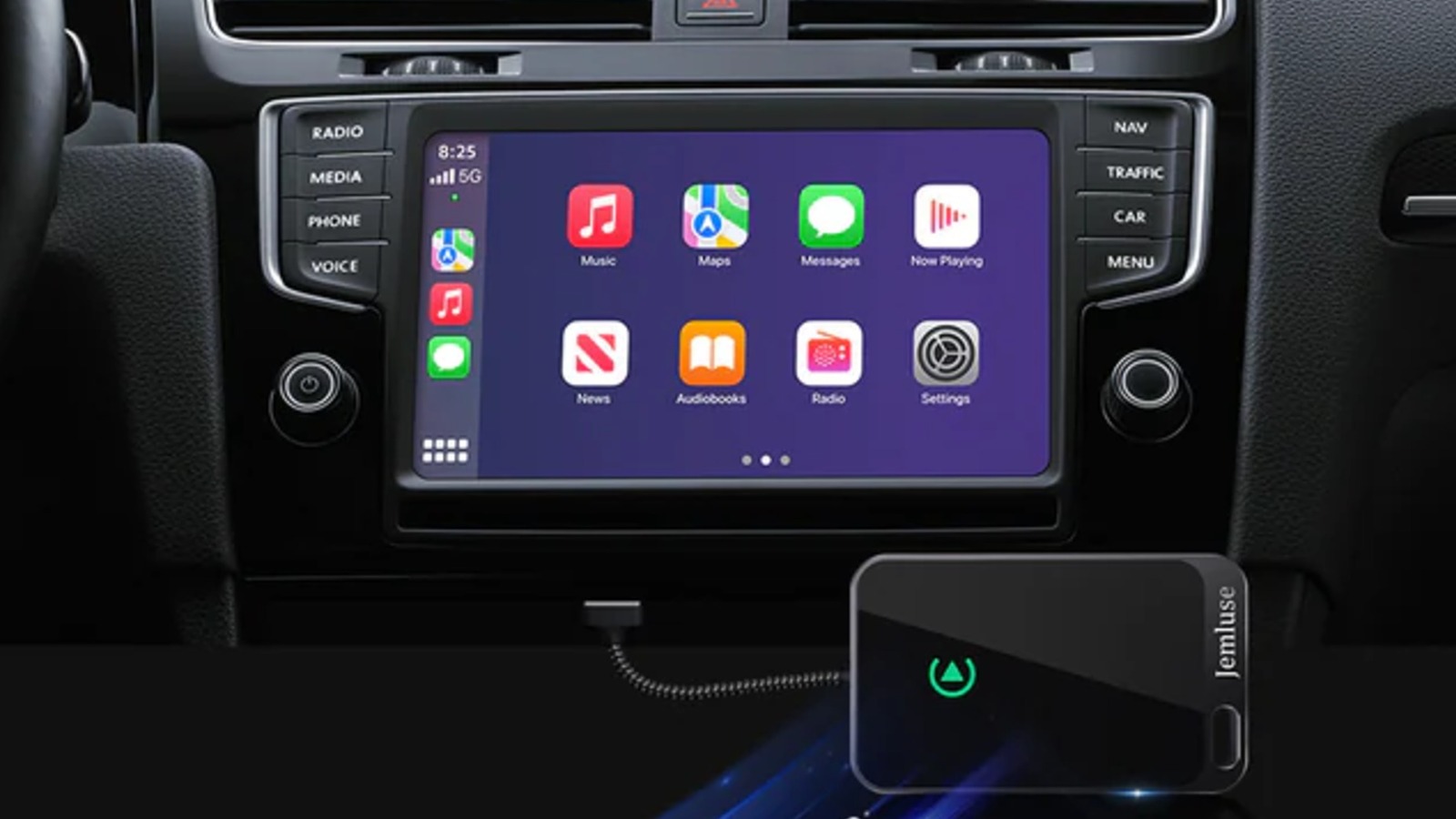
Right now, Amazon has the Jemluse Wireless CarPlay Adaptor on sale for $49.99, saving you 37% off the typical $79.98 price tag. Along with a currently discounted price, the Jemluse has the hardware to perform well, and it’s one of the most popular choices currently available on Amazon. Though there are some things to keep in mind when you’re thinking about buying a CarPlay adapter, this device is a smart choice, and not just because of the discounted price.

With the holiday season approaching, this can be a great gift for someone in your life who is tangled up by cables. That, or you can simply get it as a little treat for yourself to improve CarPlay in your own vehicle. While a wired connection isn’t going to ruin your CarPlay experience like certain settings do, you may find that going wireless offers you more freedom while you drive.

Jemluse Wireless CarPlay Adapter on sale at Amazon

Along with touting itself as a plug-and-play device that’s easy to use, the Jemluse Wireless CarPlay Adapter was specifically built for bringing wireless CarPlay to your vehicle. So long as you’re running iOS 10 or later and have an iPhone 6 or newer, you can take advantage of everything the adapter has to offer.

The Jemluse adapter features 5.8Ghz Wi-Fi and Bluetooth 5.3 for fast connectivity and maintaining a strong connection between your vehicle and the adapter. The device itself also includes an 8-core processor, which the manufacturers says can deliver speeds 10 times faster than other comparable devices. It also comes with an adapter so you can easily switch between USB-A and USB-C, depending on the needs of your vehicle.

Along with being the #1 Best Seller in Car Audio & Video Input Adaptors on Amazon, the Jemluse Wireless CarPlay Adapter also has a 4.4-star rating and over 6,300 reviews. Customers appreciate its quick setup time, lack of lag, and even its relatively small size. Between its solid design, easy connection process, and online updates, the Jemluse is a serious contender against other brands in this price range. We already considered it a good CarPlay adapter for wireless connections, and the money you can save through Amazon makes this a sure-fire win.

Source

Posted on

US indicts three cyber pros who moonlit for ransomware gang

US prosecutors have indicted three cyber security professionals who are alleged to have extorted multiple organisations using the ALPHV/BlackCat ransomware locker in their spare time.

Between them, the three racked up five known victims, a doctor’s office and an engineering company based in California, a medical device company based in Florida, a pharmaceutical company based in Maryland, and a drone manufacturer based in Virginia.

The filing, made in the US District Court for the Southern District of Florida in October, but first reported a month later by the Chicago Sun Times, names Kevin Tyler Martin and an unnamed individual referred to as Co-Conspirator 1 – both of whom worked as ransomware negotiators for DigitalMint, a Chicago-based incident response firm – and Ryan Clifford Goldberg – an incident response manager for Sygnia Cybersecurity Services.

The three men are accused of hacking into their victims’ networks, stealing data and executing ALPHV/BlackCat. They allegedly demanded ransoms of between $300,000 and $10m, and received at least one cryptocurrency payout worth approximately $1.27m.

According to a September FBI affidavit, their cyber crime spree began in May 2023, when the unnamed conspirator obtained an ALPHV/BlackCat affiliate account which he shared with Goldberg and Martin – who is identified in the affidavit as Co-Conspirator 2. They split the profits they made between themselves after paying the gang its “share”. The money was laundered through a mixing service and multiple crypto wallets.

In the affidavit, originally shared by TechCrunch, the FBI said that when interviewed earlier this year, Goldberg confessed to having been recruited by Co-Conspirator 1, and that he took part because he was trying to clear his debts.

Goldberg and his wife are subsequently thought to have left the US on a one-way flight to France on 27 June.

Computer Weekly understands that both DigitalMint and Sygnia are cooperating fully with the federal investigation.

As previously reported by our sister title, SearchSecurity, Sygnia has worked ALPHV/BlackCat attacks in the past and has in-depth knowledge of the gang, which has been implicated in many high-impact ransomware attacks in recent years – among others, it was used against Las Vegas casinos by Scattered Spider acting as an affiliate, and Change Healthcare.

Insider threat

Jamie Akhtar, CEO and co-founder of CyberSmart, described the incident as one of the most unusual he had ever seen as a security pro, not least because the accused men directed their actions outward and not back at their own employer. 

“Insider threats, whether witting or unwitting, are a well-known risk across all sectors,” he said. “However, when a cyber security professional uses the skills they’ve developed in the workplace to target other organisations, it raises an entirely different concern.

“Even within cyber security vendors, not everyone has pure intentions, [and] just because an organisation specialises in defence doesn’t mean it’s immune from becoming a source of risk,” added Akhtar. “Employees in tech and security roles are often highly skilled and trusted with privileged access, a combination that can be dangerous if oversight and support are lacking.

“For organisations, this brings to light the importance of rigorous access controls, regular behavioural and access reviews and a culture that encourages open communication and wellbeing checks,” he said.

“Financial pressure, stress or personal grievances can all push individuals toward actions they might never have considered before. Prevention means not just monitoring systems, but also understanding and supporting the people who use them. Trust is essential, but it must always be verified.”

Source