A poll of major businesses from the Capgemini Research Institute has found that while using artificial intelligence (AI) for automating repetitive business tasks offers significant savings, the tasks being improved are relatively simple. A significant number of the business leaders surveyed also say they prefer proprietary AI implementations over open source alternatives.
According to the survey of 1,607 executives from organisations with at least $1bn in global revenue, business leaders are seeing a 40% reduction of customer operations costs thanks to AI and generative AI (GenAI). The executives polled also saw a reduction of 26% in people operations costs, and a 24% reduction of finance and accounting costs. Respondents also achieved a 21% reduction of supply chain and procurement costs.
As an illustration of agentic AI potential in the industry, Capgemini highlighted Yum Brands, the parent company of Taco Bell, which operates 60,000 restaurants worldwide. The company introduced an AI-powered restaurant manager to track crew attendance and plan shift patterns, as well as suggest adjusted opening hours to align with market conditions.
While such examples show the potential of AI and GenAI to improve business efficiency, the research found that a significant portion of the gains reported by respondents tend to be associated with automating straightforward, repetitive tasks. According to Capgemini, this suggests the use of AI and GenAI among the executives polled represents early stage efficiencies rather than long-term transformational impact.
Savings need to be balanced against the cost of running the AI system. Capgemini Research Institute noted that the price of querying a trained model is falling dramatically. For instance, OpenAI’s GPT 3.5 experienced a decrease from $20 per million tokens to $0.07 per million tokens, while GPT-4 had a reduction from $15 to $0.12 in a year.
Techniques such as model pruning, quantisation and distillation can be used to reduce the size and complexity of AI models. As Capgemini Research Institute points out, these optimised models require fewer computational resources, which lowers inference costs. Alongside more efficiency algorithms, Capgemini Research Institute said that efficient hardware utilisation, batch processing of inference requests, dynamic scaling to adjust the number of computing resources based on current demand, and energy-efficient algorithms can significantly reduce the power consumption of AI models.
However, although open-source models such as DeepSeek have been shown to achieve an 11x reduction in compute costs without compromising performance and can address the advanced hardware bottleneck many organisations face, the poll showed that business executives are less enthusiastic about open source AI compared with proprietary AI models.
Despite the increasing performance and cost advantages of open-source AI models, Capgemini reported that a significant majority of executives continue to favour proprietary AI implementations. Three-quarters of the executives surveyed prefer proprietary models, with 43% opting for those developed by hyperscalers and another third choosing models from niche providers.
Capgemini found that the preference for proprietary models and AI systems is particularly strong among organisations that have scaled up their investments in AI and GenAI, which, the report’s authors suggest, indicates a clear trend towards trusted, enterprise-grade AI products that offer robust support, security and integration capabilities.
The findings, published in Capgemini Research Institute’s AI in action report, identifies a number of trade-offs that curb enterprise adoption of open-source models due to the trade-offs IT and business leaders need to make. These include the need for greater technical expertise, potential exposure to security vulnerabilities and reliance on community-driven support that can impact update cycles and documentation quality.
Oliver Pfeil, CEO of business services at Capgemini, said: “GenAI and agentic AI can truly transform business services – enabling the shift from traditional cost-focused models towards an AI-enabled, value- and insight-driven business. Those that adopt an integrated approach with data and AI at its core will be set to achieve a truly connected, frictionless enterprise.”
However, he noted that the research suggests organisations face numerous barriers scaling up the deployment of AI agents. “Adopting a pragmatic approach, fostering trust in AI and creating a strong data foundation will go a long way in transforming business services into a strategic powerhouse to fuel any enterprise,” he added.
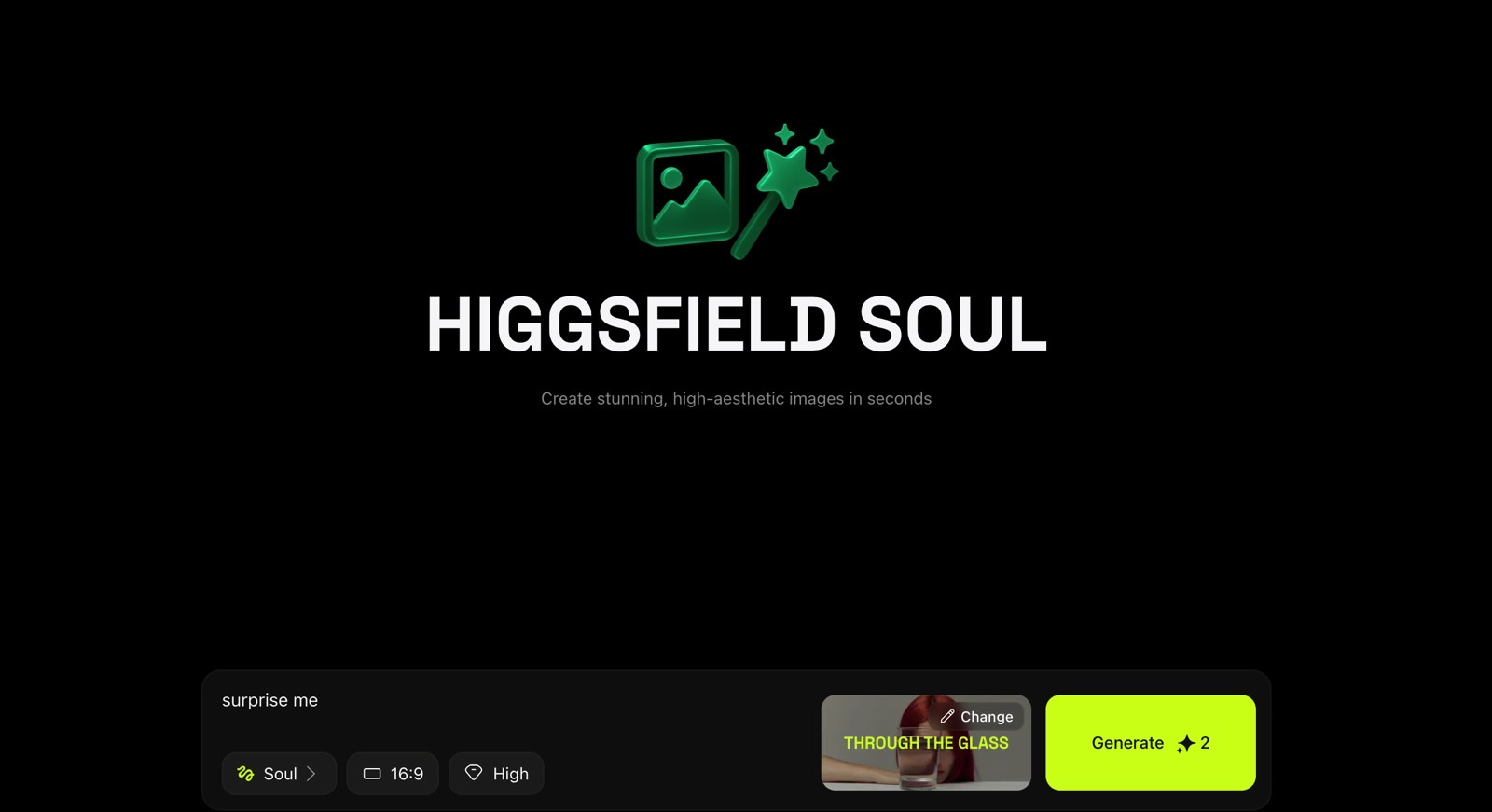
Higgsfield Soul is the name of a brand-new AI image generation tool that went viral on social media a few days ago. We’ve seen this happen with other genAI software for creating images and videos from text prompts in the past.
ChatGPT 4o image generation and Google’s Veo 3 are a few examples that stand out. The ChatGPT AI image maker became a massive hit for OpenAI, letting users create images that looked like photos or edit existing pictures with text prompts. Veo 3 introduced audio and dialogue to stunning AI videos a few months later.
Plenty of alternatives are on the market right now, offering creators advanced and affordable tools to generate content with AI. But Higgsfield Soul is something else entirely.
The product lets you create photos using text prompts, and the AI content looks even better than what ChatGPT and Gemini can offer. Users have praised the tool for making the images look like they were captured with real cameras instead of being generated from scratch, avoiding the plasticky feel seen in competitors.
Tech. Entertainment. Science. Your inbox.
Sign up for the most interesting tech & entertainment news out there.
To get the most out of Soul, you’ll need to subscribe to a premium tier, with prices starting at $9/month. But Higgsfield announced that anyone can try Soul for free.
Higgsfield announced on social media that the Soul image generator is free for anyone to try.
Just load this link in your browser or tap the Daily Free Soul Image Generations link at the top of the Higgsfield home page.
Higgsfield Soul is now FREE for everyone.Just unlocked Daily Free Generations.The most aesthetic photo model to ever exist.Try it yourself: pic.twitter.com/v7T5ps3Rdp
— Higgsfield AI 🧩 (@higgsfield_ai) July 1, 2025
Once you log in, you can use Higgsfield for free to generate a few images each day. You’ll need a subscription if you want more credits for Soul AI image generations after that.
What’s so special about Higgsfield Soul?
Like ChatGPT and Gemini, the Soul prompt composer lets you type in the instructions the AI will follow to generate images. You can choose the model, aspect ratio, and desired quality.
What sets it apart is the button that reveals the magic behind it. Tap the button to the right of the prompt composer, and you’ll see over 50 visual styles to choose from, as shown below.
Higgsfield Soul prompt composer lets you select from 50+ visual styles. Image source: Higgsfield
Higgsfield designed these models to help creators generate images that look like they were taken with an iPhone or any real camera.
Instead of describing camera effects in detail, you can start with one of the visual styles in the gallery and go from there. It makes it easier to create an AI image that suits your needs.
You can still describe in detail the kind of AI images you want Soul to generate. The more information you give, the easier it is for the AI to deliver what you want.
Here’s a prompt example from a Soul sample that Higgsfield offers on its website:
A candid urban street photo featuring a duo dressed in futuristic mirrored visors and iridescent parkas, standing casually in front of a heavily graffitied wall. The wall is adorned with prominent large chrome typography split into two lines: “FUTURE” “DECAY” surrounded by intricate swirling graffiti spirals. The reflective chrome paint casts shimmering light reflections onto their iridescent parkas and visors, enhancing the futuristic vibe. Natural daylight mingles with the metallic gleam, creating authentic urban light contrasts and subtle shadows. The textured wall shows realistic graffiti paint drips, slight weathering, and rough concrete imperfections. The composition is casually framed with a slightly tilted angle…
Here’s the resulting image:
The writing on the wall. Image source: Higgsfield
As you can see, the prompt is very detailed, outlining everything the creator wanted to appear in the image. The content creator also selected the “Graffiti” visual style for the image Soul generated.
Other samples on Higgsfield’s website include similarly detailed prompts. But you can include as much or as little detail as you like. The composer will be filled with “surprise me” by default when you load it. That’s a valid prompt, too.
Shorter prompts might not deliver exactly what you’re looking for. The images will still be impressive, but you may need to fine-tune your prompt. If you’re not on a premium plan, you’ll have to wait until the next day for another set of free credits.
It looks like you can generate up to two images for free with Soul every day.
After two years of volatility driven largely by the drawdown of backlogged product orders stemming from the Covid-era global supply chain crisis, the enterprise worldwide wireless local area network (WLAN) market grew 10.6% in the first quarter of 2025 to reach $2.3bn in value, according to research from IDC.
The Worldwide quarterly wireless LAN tracker calculated the total market revenue, value and unit shipments of the WLAN arena in a geographic coverage taking in 60 countries in nine major regions, including the US, Canada, Latin America, Japan, China, the rest of the Asia-Pacific region, Western Europe, Central and Eastern Europe, the Middle East, and Africa. The analysis was further segmented by product class, product type, product standard and location.
The study observed that the market’s supply and demand dynamics are stabilising as annualised growth in the first quarter of 2025 built on the momentum in 2024, when market revenues increased in each sequential quarter of the year. This included rising 4.8% between the third and fourth quarters of 2024 and growing 5.8% between the second and third quarters of 2024.
Looking at other growth engines, IDC also pointed to acceptance of the latest Wi-Fi standards driving growth in the enterprise WLAN market. Wi-Fi 6E, which enables Wi-Fi to utilise the 6GHz band of unlicensed spectrum, accounted for 31.9% of dependent access point market segment revenues in Q1 2025, compared with making up 27.7% of the segment’s revenues a year earlier.
The survey also found that Wi-Fi 7 adoption increased in the first quarter, too, making up 11.8% of the dependent AP segment’s revenues in Q1 2025, growing from 10.2% of dependent AP revenues in the fourth quarter of the previous year.
From a geographical perspective, in the Americas, the enterprise WLAN market increased 15.2% year-on-year in Q1 2025, driven by strong growth of 21% in the US. In the Europe, Middle East and Africa region, the market grew 11% on an annual basis, while in the Asia-Pacific region, revenues grew 1%, as market revenues in China declined 4.2% year-on-year.
Looking at the performance of the leading individual enterprise WLAN suppliers, the study revealed that during the quarter, Cisco’s enterprise WLAN revenues rose 4.6% year-on-year in Q1 2025 to reach $904.5m, giving the company market share of 39.5%, more than double that of next-best-ranked rival HPE Aruba Networking (15.9%), for whom revenues grew 10.7% year-on-year in Q1 2025 to reach $363.9m.
Rounding out the top five were Ubiquiti, which generated enterprise WLAN revenues of $267.4m, increasing 50.9% on an annual basis in Q1 2025, leading to a market share of 11.7%; followed by Huawei, whose enterprise WLAN revenues actually fell 10.7% compared with Q1 2024 to total $124.1m, giving the company market share of 5.4%. Finally, Juniper Networks saw enterprise WLAN revenues increase 21.9% year-on-year in Q1 2025 to total $120.9m, leading to a market share of 5.3%.
“The enterprise WLAN market continues to reset after a volatile period of annualised growth rates, driven by complex supply chain disruptions and inventory management issues impacting both vendors and end users,” said Brandon Butler, senior research manager of enterprise networks at IDC.
“The fundamentals of the enterprise WLAN market remain strong, however, with exciting innovations such as 6GHz Wi-Fi and AI-powered management capabilities continuing to power the next generation of wireless connectivity.”
The M4 iPad Pro is one of the best products Apple has developed in recent years. The ultra-thin design combined with the M4 chip, a nano-texture option, and a revamped Magic Keyboard makes this tablet one of the best pieces of hardware on the market.
With rumors about Apple planning to release an M5 version as soon this year, it seems one of the new features could be even thinner bezels. According to The Elec, LG Innotek could be responsible for providing Apple its chip-on-film (CoF) for iPad OLED panels.
The publication says Apple is expected to either reject or approve this new panel in June. So far, Apple has exclusively used a display driver IC (DDI) supplied by Samsung System LSI. This new technology could help to shrink the visible bezels on Apple’s best iPad, making it even more compelling for new buyers.
While I don’t think this will be enough to make M4 iPad Pro users upgrade, other rumors reveal that the company wants to add a landscape-oriented Apple logo and its own 5G modem by 2027. In a few years, Apple also wants to update the OLED panel. So far, reports say Apple will be using 8th-generation OLED technology for 2026 MacBook Pro models. The current iPad uses 6th-gen tech, which could later expand to the iPad.
Tech. Entertainment. Science. Your inbox.
Sign up for the most interesting tech & entertainment news out there.
iPadOS 26 bridges the gap between the past and future of the iPad Pro
Image source: Apple Inc.
This rumor indicates that Apple wants to keep improving its state-of-the-art product, even though the M4 iPad Pro is still a compelling upgrade for any tablet user.
While the M5 chip will only make this product better, the company is finally taking on the biggest issue with the iPad Pro: iPadOS. The recently-announced iPadOS 26 adds Mac-like menus, a new windowing system, and improved Files and Preview apps.
These changes alone are enough to make the iPad look more like a Mac, while still being a touchscreen-first device. That said, users will finally be able to take advantage of the iPad’s best capabilities with the features this upcoming software update unlocks.
With Brad Pitt’s F1 movie set to hit theaters this week, Apple thought it might be a good idea to provide iPhone users with a little bit of an incentive to see the film in theaters. In theory, the plan made sense. In practice, it generated furious backlash from users.
Here’s what went down. On Tuesday afternoon, some iPhone users noticed a push notification from their Wallet app. The notification was, in essence, a promotion whereby users purchasing two tickets to the film on Fandango would be able to do so with a $10 discount. As to why this promotion even exists, recall that Apple is one of the film’s distributors. In turn, the film will ultimately end up as an offering on Apple TV+ following its theatrical run.
U2 all over again – iPhone users aren’t happy
Predictably, Apple’s strategy here generated a lot of backlash. And while it’s possible that we’re only hearing from a very vocal minority, the drama surrounding the incident is large enough that the move seems to have backfired.
Here’s how the promotion appeared on user devices:
Tech. Entertainment. Science. Your inbox.
Sign up for the most interesting tech & entertainment news out there.
Remember, iPhone users don’t appreciate when promotions they didn’t ask for magically appear on their devices. Even when it’s free, it can still be distasteful. As a prime example, remember the uproar when Apple automatically downloaded U2’s Songs of Innocence album to millions of iPhones?
Users felt violated, arguing that Apple’s move reeked of corporate overreach. Keep in mind that this was before streaming became commonplace, and iPhone users, at the time, took their music libraries very seriously. In short, many users were dismayed, if not furious, that an album was added to their iTunes library without their permission.
Responding to the controversy, U2 front man Bono said that the intention behind the partnership was pure, albeit misguided. Bono articulated that the band simply wanted to make its album accessible to swaths of people who might not otherwise be exposed to it.
“We wanted to deliver a pint of milk to people’s front porches, but in a few cases it ended up in their fridge, on their cereal. People were like, ‘I’m dairy-free.’”
Response to the F1 Wallet app notification
Similar to the U2 fiasco, users aren’t happy with the F1 push notification, which is essentially an advertisement. Some iPhone users lamented that avoiding this type of chicanery is precisely why they left Android, only to see it emerge on Apple’s platform. One user on the iOS subreddit sums things up nicely: “I did not pay over $1000 for an iPhone to get advertised at.”
Perusing what people are saying on X reveals more of the same: People blasting Apple for putting ads in their notifications.
To wit, one user on X wrote the following: “I love living in the future where the manufacturer of my phone makes a movie and sends me advertisement push notifications via my wallet.”
Another user writes: “Not a lot of notifications have access to give me notifications. Apple broke that trust so now the wallet app notifications have been disabled.”
How to turn off Wallet app notifications
Indeed, Apple’s move here is particularly frustrating because notifications from the Wallet app are typically useful. I’d personally recommend keeping them on as I imagine Apple won’t try a stunt like this again anytime soon. But if the F1 ordeal left a bad taste in your mouth, here’s how to turn off notifications to ensure you’re not bombarded with another promotional stunt.
Open up the Settings app and then select the Notifications pane. From there, scroll down until you see the Wallet listing. From there, turn the “Allow Notifications” toggle to Off.
Notably, Apple allows more granularity with Wallet app notifications in iOS 26. Specifically, if you go to the Wallet app settings pane in iOS 26, you’ll see an option to toggle off notifications pertaining to “Offers & Promotions.”
Image source: Apple
We imagine that once iOS 26 ships, this toggle will be turned on by default. What’s more, the fact that this toggle even exists suggests that iPhone users can expect more promotions in the future.
The bigger picture – F1 looks great
Putting the saga surrounding Apple’s questionable marketing tactics aside, F1 looks to be a great movie. If you’re not yet familiar, it’s a sports drama about a Formula One driver – played by Brad Pitt – who’s forced into an early retirement following a brutal crash. Ultimately, he comes back to the sport he loves to help mentor a hotshot new driver.
The movie comes from the same team as Top Gun: Maverick, which is evident from the trailer below.
As we highlighted earlier this month, the early feedback about the movie has been overwhelmingly positive. Of course, nothing is a guarantee until release day comes. But the film, buoyed by Pitt’s star power and Apple’s bank account, might be on track to be the film of the summer.
The Brazilian Telecommunications Agency (Anatel) is to deploy a federal mission-critical communications service based on technology from Motorola Solutions.
Brazil’s defence and public safety agencies have in the past struggled with real-time coordination, with the bodies’ use of separate communication systems causing delays that undermined response efforts.
To address these challenges, the Band Administration Entity (EAF), an organisation created by Anatel, has selected Motorola Solutions to implement a federal mission-critical communications offering that will enable Brazil’s defence and public safety organisations to seamlessly collaborate during joint missions.
Rolling out from the capital, Brasilia, the product will enable agencies to coherently share information, coordinate responses and make better-informed decisions for the protection and service of Brazil’s communities.
As a combined nationwide service, organisations such as the Brazilian Army, the Federal Highway Patrol and the Distrito Federal Military Police will be equipped with the trusted reliability and resiliency of land mobile radio (LMR) voice communications together with advanced broadband capabilities, including video streaming, and the ability to share rich data and multimedia.
“Efficiently addressing drug trafficking, organised crime and natural disasters demands highly coordinated multi-agency responses,” said Geraldo Segatto, head of government private network project at EAF.
“In the past, defence and public safety agencies, each using separate communication systems, struggled with real-time coordination, causing delays that undermined response efforts. The new solution eliminates these communication barriers, enabling reliable connectivity for federal agencies and, in its next phase, state military and civil police, to significantly improve response times and mission success.”
Motorola Solutions will integrate multiple existing LMR systems and add mission-critical Push-to-X (MCX) broadband services to enhance interagency interoperability and access to data applications to better protect Brazil’s communities.
In addition, EAF will implement Wave PTX, a 3GPP standards-compliant communications platform that will run on the government’s private 4G network, and Critical Connect, a service that will enable interoperability between the 4G network and P25, Tetra and DMR land mobile radio systems.
“Motorola Solutions is proud to support Brazil’s vision for public safety modernisation by delivering a communications platform that bridges the proven reliability of land mobile radio technology with the media-rich capabilities of MCX broadband services,” added Edison Ambrosio, sales director of defence and federal markets at Motorola Solutions.
“This integration provides Brazil’s defence and public safety agencies with resilience, enhanced situational awareness and seamless interoperability for faster and more effective emergency response across the nation.”
The deployment in Brazil comes after Motorola Solutions ended 2024 by expanding its emergency communications offer in Europe, in particular furthering its control and command centre portfolio with the acquisition of 3tc, a provider of control room software services for Fire and Rescue Services and Police.
3tc’s flagship computer-aided dispatch software is designed to maximise 999 call-taker speed and efficiency in high-stress environments. The single-screen software gathers and synthesises critical data that enables call takers to display the real-time location of the caller and the closest emergency responders to dispatch help more quickly.
An increasing number of reports claim Apple is planning two major display updates for the iPhone in the coming years.
First, Apple will move the Face ID sensors under the display, shrinking the top cutout to a hole-punch camera. After that, the selfie camera will also go under the screen. The result would be an iPhone with a flawless display and no visible cutouts.
But a few key insiders disagree on the timeline. Mark Gurman recently said the iPhone 18 will have a smaller Dynamic Island, while the iPhone 20 will debut an all-screen design with no cutouts.
Ross Young responded on X that Apple will use a three-phase approach spanning up to five years. A smaller cutout is expected with the iPhone 18 series, but Face ID components will still be located in that area. Two years later, those cameras will move under the display, leaving only a hole-punch for the selfie camera. By 2030, if Young’s info is right, the selfie camera will also be placed under the screen.
Tech. Entertainment. Science. Your inbox.
Sign up for the most interesting tech & entertainment news out there.
A developer looked at these display rumors and created two iPhone 18 Pro concepts that align with some of the predictions.
Hole-punch selfie camera on the left
Gurman and Young aren’t the only ones talking about the screen changes coming to future iPhones. The Information reported last month that the iPhone 18 Pro and 18 Pro Max will feature a small hole cutout in the top-left corner for the front-facing camera.
Gurman’s latest report didn’t specify the location of the selfie camera. He only mentioned a smaller Dynamic Island.
Developer Filip Vabroušek shared the following concept on X:
iPhone 18 Pro concept with hole-punch camera on the left. Image source: X
This render was created before Apple revealed the new Liquid Glass design for iOS 26 and its other platforms. But for this concept, the look of iOS doesn’t really matter.
I mentioned a few weeks ago that placing the selfie camera on the left could give the iPhone 18 Pro models a unique look. Most Android phones with hole-punch cameras center them.
The iPhone 18 Pro wouldn’t be the first phone with a selfie camera near a corner. The left side is the only viable spot. The rear camera is on the right side when viewing the screen, so there’s no room there for a front camera.
In this setup, the Dynamic Island would either be integrated with the hole-punch or placed in the middle of the screen. Apple won’t ditch Live Activities, which is a software feature. This is just speculation on my part.
A smaller Dynamic Island
This concept assumes Apple is confident that under-display Face ID won’t hurt speed or accuracy.
Young had this to say about the 2026 iPhone design: “2026 – smaller notch as some under-panel Face ID elements remain in the notch rather than transparent under the panel.” That suggests Apple may take a gradual approach, or the screen section covering the Face ID hardware won’t have active pixels.
The same developer adjusted the iPhone 18 Pro concept based on Young’s comments:
iPhone 18 Pro concept with smaller Dynamic Island cutout. Image source: X
The Dynamic Island cutout still looks like a pill here, but it’s smaller than what we’ve seen since the iPhone 14 Pro models.
In this version, the Dynamic Island would function just like it does now, wrapping around a smaller cutout.
This design would mirror what Apple did with the iPhone X notch. Before switching to a pill-shaped cutout, Apple reduced the notch size.
In a twist of bureaucratic brilliance that Yes, Minister fans will appreciate, the civil service is rolling out a suite of artificial intelligence (AI) tools named – yes – Humphrey.
Named after Sir Humphrey Appleby, the oh-so-helpful civil servant who was actually a master of obstruction through cooperation, this AI initiative is designed to streamline services, cut delays, and help unlock £45bn in annual productivity gains across the public sector.
But for those familiar with the BBC classic, the choice of name feels less like a nod to innovation and more like a cautionary tale. Because just like its namesake, this new digital civil servant might end up subtly steering us in the wrong direction.
Humphrey AI is a suite of tools, including Consult, Parlex, Minute, Redbox and Lex, which target bureaucratic pain points: duplicated administration, siloed data, and slow decision-making. If executed well, it could reduce the need for external consultants, accelerate decision-making, and enhance the public’s experience.
It is part of a broader initiative to bring the state into the digital age. It will help streamline processes across the public sector by providing online data processing, automating routine administrative tasks, and accelerating time-consuming research that can slow down policy development. By enabling secure, interoperable data flows, Humphrey can improve citizen experiences while reducing civil service costs and overcoming reliance on external consultants to process and analyse data.
No Minister, AI can’t fix your own data problems
However, there is a lesson from Yes, Minister that still holds – a well-meaning assistant can mislead while appearing helpful. This is especially true for the latest generation of AI tools. These systems are only as good as the data that feeds them. There’s also increasing evidence that as their reasoning and other specialist capabilities improve, these systems tend to “hallucinate” more.
Poorly curated datasets can lead AI tools to deliver confident-sounding but nonsensical results, a risk with serious implications for public trust. One striking example involved a GPT-3.5 model trained on 140,000 internal Slack messages. When prompted to write content, it responded, “I shall work on that in the morning.” Rather than performing the task, the Smart Connections plugin had mimicked the procrastination habits embedded in its training data. It had performed an entirely different function than anticipated, using a fundamentally unsuitable dataset, albeit one that superficially appears appropriate due to its size.
In addition to having the right training data, AI requires access to AI-ready, well-governed task-relevant datasets. Despite a wealth of open data on platforms like data.gov.uk, much of it is not readily usable for training or fine-tuning AI systems. A recent analysis by the Open Data Institute (ODI) revealed that key public datasets used by most AI models do not, as of April 2024, make the most of the statistical and other authoritative data published on such government portals.
The 13,556 pages from data.gov.uk that have been scraped for inclusion in a popular AI dataset like CommonCrawl, rarely contributed to answering citizen questions about public services accurately. Across 195 such citizen questions, AI models correctly referenced data.gov.uk statistics in only five cases. Instead, they drew on secondary or unreliable sources, such as social media posts or opinion articles, or simply fabricated answers. This disconnect is dangerous: it opens the door to misinformation being generated by government-deployed AI tools.
A reason for this is that government data is often not published in AI-ready formats, for example, lacking machine-readable metadata or accessible summaries, which essentially renders the information invisible to AI models. Moreover, our understanding of what sources AI-enabled digital services should prioritise is limited. Compare that with the technical solutions that previous-generation AI tools, such as traditional search engines, put in place to ensure that citizen questions about public services rank government pages and other authoritative sources higher than secondary information. We’re only just starting out on that journey with generative AI.
Digitising bad decision-making
Using AI to process data, research policy, or write documents requires an understanding of how these technologies work, the data they rely on, and their limitations. This is the only way workers can validate AI’s outputs. However, researchers at Harvard Business School found that while AI offers real value, its unpredictable failure points make both the benefits and risks hard to gauge, for individuals, organisations and governments alike.
The National Data Strategy, published under the previous Conservative government, acknowledged problems such as “a fragmentation of leadership and a lack of depth in data skills at all levels”, and a culture which overemphasises the risks of misusing data, leading to “a chronic underuse of data and a woeful lack of understanding of its value”. This urgently needs to change. If civil servants don’t understand how AI works, how can they question its outputs?
Poor understanding at senior levels has particular consequences. For example, school absence data tracks data points such as year group and indicators of disadvantaged backgrounds, such as Child In Need status, but misses granular detail, such as neurodivergence, despite evidence that a very high proportion of children experiencing difficulty with attendance are autistic. This blinds policymakers to the fact that many persistently absent pupils are autistic, encouraging punitive responses like parental fines rather than tailored support. Better AI literacy, supported by the thoughtful use of AI tools themselves, can help civil servants not only understand data but learn how to question it.
Other countries are already moving ahead. Estonia, for example, has introduced Bürokratt, an AI chatbot aimed at reducing civil service workloads and accelerating service delivery. But crucially, Estonia isn’t just investing in tools; it’s investing in training its staff. The Estonian Ministry of Economic Affairs and Communications has launched the Digital State Academy, offering free courses on digital governance, AI, and data handling to civil servants.
Britain should take note. While there have been efforts to upskill the UK civil service, most initiatives have focused on advanced data skills rather than the foundational data literacy required across the board. Policymakers don’t need to code in Python, but if they can’t spot bias in a dataset or question an AI’s output, then no amount of automation will deliver better decisions. It will just hide bad ones behind a sleek digital interface.
Streamlining the “creaking old bureaucratic machine”
In 1980, Minister Jim Hacker optimistically declared in Yes, Minister, “We’re going to cut through all the red tape, streamline this creaking old bureaucratic machine”. Over forty years later, the government hopes AI could finally fulfil that promise – and drive broad-based economic growth along the way. In the public sector alone, technology minister Peter Kyle estimates “a £45 bn jackpot” for the public sector if the civil service successfully adopts AI. To unlock that, investment is needed, not just in tools like Humphrey, but in training and infrastructure to support their use.
The ODI is calling for a 10-year National Data Infrastructure Roadmap to do just that. This roadmap would underpin the AI Opportunities Action Plan by focusing on three pillars – interoperability, AI-ready data, and privacy-preserving technologies. While the plan sets a strong direction, it lacks detail on how standards will be set and monitored and how foundational data infrastructure will be funded.
Transparency about the provenance and lineage of datasets used to train and operate AI in public services is critical. Without it, we can’t scrutinise how AI influences decisions that affect our lives. To build public trust, we need to explore participatory stewardship of key datasets so that the people most affected by public sector algorithms can help shape how their data is used.
This is where frameworks like the ODI’s new Framework for AI-Ready Data are vital. It sets out four core principles for preparing datasets for effective and ethical use in AI: technical optimisation, data quality and standards, legal compliance, and responsible collection. It goes beyond general principles like FAIR (findable, accessible, interoperable and reusable), pointing to practical steps that non-specialist data publishers can follow to ensure that data is not just machine-readable, but meaningful, lawful and fair.
To harness data for public good, we must think long-term, build solid data foundations, and above all, stay vigilant about the risks of digitising dysfunction. Otherwise, the most powerful new civil servant in Whitehall won’t be human, it will be an AI called Humphrey. And like its namesake, it will appear endlessly helpful, while subtly shaping outcomes to suit the data it’s trained on. Civil servants risk becoming modern-day Jim Hackers, trying valiantly to streamline a creaking old machine, while being quietly outmanoeuvred by their new digital colleague.
Elena Simperl is the director of research at the ODI.
Finland’s University of Oulu is renowned as a leading centre for the development of advanced communications technologies, and now, in collaboration with Mid Sweden University, it has revealed the first fruits of the Immerse project – specifically, a new type of immersive augmented reality (AR) application that allows tasks requiring special expertise, such as repairing a device, to be completed without an expert present.
Funded by Interreg Aurora and beginning in August 2024, the Immerse project looks to promote remote work and operation with immersive technologies to address the unique challenges and skills shortages experienced in northern regions. The project’s likely beneficiaries are organisations in the mining, forestry and manufacturing industries, whose business efficiency and work safety the new technology improves.
For Immerse, the University of Oulu developed an AR-assisted task guidance application, which works by having an expert create instructions for performing a task using a digital twin produced by 3D scanning technology of the target device and adding graphical annotations such as arrows and text boxes. Users can download the instructions they need from a library, which they can then follow step-by-step on the mobile device’s screen. The instructions are projected onto the item being worked on using AR technology.
A demo version based on the technology has been built, although development work is still ongoing, and currently, the application is used mainly to demonstrate the technology with simple tasks. However, the intention is to release an open source implementation in the future, which will include all the essential tools.
The researchers believe that through their work, anyone, in principle, can create a digital twin of the target, create instructions for maintenance or repair tasks, and use the mobile application to repeat them in a real environment. For example, changing a bicycle tyre could be easily accomplished with the application when the instructions are created by the bicycle manufacturer specifically for that model.
“AR-assisted guidance has indeed been studied worldwide, and there are also commercial applications, but they typically require the presence of an expert and interaction with the user, whereas our proposed solution allows the task to be performed independently without personal guidance,” said Janne Heikkilä, professor of machine vision and signal analysis at the University of Oulu.
“The application could be compared to a much more precise version of popular tutorial videos that many use when they need to do something beyond their expertise,” added Heikkilä.
The future focus will be on using artificial intelligence in creating instructions, making the work process “effortless” and reducing the amount of expert work. “The mobile application also requires a lot of development to make it user-friendly,” added Heikkilä. “The aim is to enable the use of AR or XR glasses, eliminating the need to hold the mobile device in hand.”
Immerse’s project manager in Oulu, researcher Janne Mustaniemi, said: “The project combines our university’s years of experience in image-based 3D reconstruction and the recent developments in the field, which have made digital twins even more accurate.”
I’m a longtime Mac user who has had to fix all sorts of issues with the various MacBooks I’ve owned over the years. Unfortunately, that sometimes meant dealing with the dreaded Terminal app, where you have to type specific commands and hope the Mac will do its magic and “just work.” It usually does, assuming you’ve typed the command correctly, whether it comes from memory or the web.
I’m not a developer, so I don’t use Terminal-like apps for coding or automations.
How is that related to the amazing Gemini CLI product that Google unveiled on Wednesday? Well, Google’s virtual briefing that I attended earlier this week started with a reminder of how annoying Terminal apps are, even for coders who essentially live and breathe this stuff.
I could immediately relate, and I started fantasizing about what the Gemini CLI product could do. I thought Gemini was coming to Terminal apps on Mac, Windows, and Linux to possibly help us manage our computers with natural language. Imagine issuing commands in Terminal to a local, private AI and then watching it execute them.
Tech. Entertainment. Science. Your inbox.
Sign up for the most interesting tech & entertainment news out there.
Unfortunately, Gemini CLI is a product aimed at developers, though it does more than just help out with coding projects. It won’t let you control or fix your computer with text commands.
Still, I was excited to see what Google was about to unveil. Even though I don’t code, I can see how amazing Gemini CLI is. It’s easily one of the best Gemini products Google has put out, and I say that because it’s open-source and free to use for anyone. And yes, you can use Gemini CLI to create images and videos of cats on planes.
What is Gemini CLI
CLI is short for command line interface, aka an app like the Mac’s Terminal. Google isn’t bringing Gemini CLI to the Mac’s default Terminal app. Instead, it’s launching a standalone app that anyone can install from GitHub right away. It works on Windows and Linux, too.
It’s available to download for free. Also, it will cost you nothing to start using it. All you need is a Google address (personal or work) to start using the tool. Depending on how you use Gemini CLI, you might incur costs tied to other AI services, but you don’t have to pay for Gemini CLI itself.
Google says most people won’t reach these theoretical limits. Image source: Google
Gemini CLI includes a free Gemini Code Assist license, which comes with access to Gemini 2.5 Pro, Google’s latest AI model. You’ll get the same 1 million token context window that’s available in the Gemini app, and unlimited access to Gemini CLI commands.
Unlimited means 60 model requests per minute or 1,000 requests per day. Google says it set those limits after analyzing what its own developers have used the tool for. The limits above are double the highest usage Google observed internally. And the tool is quite popular with Googlers.
Privacy and security guarantees
The terminal experience Google is offering Mac, Windows, and Linux users targets developers. Those were the main demos during the briefing. Everything runs locally, so you don’t have to worry about clouds. Gemini might use a cloud service to demo a website or app you’ve just coded.
As for security, Gemini CLI will always show prompts when it has to perform an action on your computer while it’s coding an app. It might need to download something or run specific commands. Those prompts let you fine-tune the AI’s permissions to work.
Also, Gemini CLI is sandboxed and lets you use other protections to make sure it runs in a safe environment. The fact that the terminal app is open-source also backs up Google’s privacy and security claims. Anyone can inspect the code and find issues.
What Gemini CLI can actually do
Here are some of the Gemini CLI abilities that Google mentioned in a blog post announcing the new product:
Ground prompts with Google Search so you can fetch web pages and provide real-time, external context to the model
Extend Gemini CLI’s capabilities through built-in support for the Model Context Protocol (MCP) or bundled extensions
Customize prompts and instructions to tailor Gemini for your specific needs and workflows
Automate tasks and integrate with existing workflows by invoking Gemini CLI non-interactively within your scripts
But, as Google explained during the briefing, Gemini CLI users have found fun and surprising ways to use the new terminal app that have nothing to do with coding.
Creators can tap into Google’s Imagen and Veo products to have Gemini CLI create stunning videos and images directly from the command line. The AI just delivers, and the demo Google offered blew my mind. I might have to try Gemini CLI myself to see how and if I can use it for AI tasks that don’t involve coding.
If you need to use Gemini CLI to code apps and websites, that’s also something you can do.
Also, Gemini CLI can work with other apps, not just Google’s Gemini-based AI tools. It supports MCP, so developers can plug it into all sorts of tools that also support the interconnectivity protocol.
To get started, head over to Google’s GitHub page for Gemini CLI at this link, download the terminal app on your machine, log in, and start creating.