Posted on

watchOS 26 will bring third-party widgets to Control Center, leak

Apple might want to consider moving up its WWDC 2025 keynote, because the internet seems intent on spoiling every announcement ahead of time. After spilling the beans about iOS 26 app upgrades and new features for AirPods earlier this week, 9to5Mac returned on Thursday with a fresh leak about watchOS 26.

watchOS 11’s Smart Stack. Image source: José Adorno for BGR

Citing a reliable source, 9to5Mac says that watchOS 26 will give third-party app developers the ability to put widgets in Control Center on Apple Watch. Plus, the source says the layout will be “fully customizable” in the Watch app on iPhone, allowing Apple Watch owners to add, remove, and reorder widgets directly from their smartphones.

watchOS 11, last year’s update for Apple’s wearable OS, gave widgets on Apple Watch a major overhaul. In addition to adding widgets for severe weather alerts, Photos, and Shazam, widgets also started showing up automatically in the Smart Stack.

This was a step in the right direction, but it was also a rather limited implementation of widgets, especially compared to what we see in iOS and iPadOS.

Tech. Entertainment. Science. Your inbox.

Sign up for the most interesting tech & entertainment news out there.

By signing up, I agree to the Terms of Use and have reviewed the Privacy Notice.

Potentially game-changing

As an Apple Watch owner myself, I’ve always found the device to be relatively limited beyond its exercise and health-tracking features. For many, those use cases are enough, but this opens the door to so much more functionality than was previously available.

We don’t know exactly what this implementation is going to look like, nor do we know if it will be ready in time for the launch of watchOS 26 this fall. The good news is that we won’t have to wait much longer to find out, as Apple will take the virtual stage on June 9th at 10:00 a.m. PT / 1:00 p.m. ET to tell us all about its upcoming software updates.

Source

Posted on

GameStop broke some customers’ Nintendo Switch 2 units with a

The Nintendo Switch 2 preorder turned out to be quite a rollercoaster for US buyers. First, there was the price shock. The Switch 2 was slightly more expensive than expected. Then came Trump’s tariffs, which forced Nintendo to postpone pre-orders in the US for several weeks.

The Japanese gaming giant ultimately decided not to hike Switch 2 prices and opened pre-orders in the US. Unsurprisingly, the available stock sold out online quickly. As the early June launch approached, some buyers discovered their pre-orders had been quietly canceled because some retailers didn’t have enough stock.

Finally, the release date came. Plenty of gamers lined up in front of their local stores to try to buy a Switch 2 on launch day.

Imagine going through all that trouble and finally securing your Switch 2 in a store, only to find your brand-new console has a broken display right out of the box because store employees stapled your receipt through the front of the box and into the console’s screen.

Tech. Entertainment. Science. Your inbox.

Sign up for the most interesting tech & entertainment news out there.

By signing up, I agree to the Terms of Use and have reviewed the Privacy Notice.

This unfortunate accident happened to a bunch of buyers who got their Switch 2 consoles from one GameStop store in Staten Island. GameStop confirmed that it’s aware of the issue and will replace all consoles for free.

Fans took to Reddit and X to post photos of their punctured Switch 2 screens. The console still works. The display is damaged, but the staples didn’t render it useless. Still, it’s a frustrating experience to deal with.

Store employees stapling receipts to boxes isn’t new. It happens all the time, and it’s hard to blame them. The bigger issue is the way the Switch 2 is packaged. The screen faces outward and is only protected by a thin piece of cardboard. A staple can easily punch through and puncture the screen.

GameStop confirmed to IGN that it was investigating the matter and that it “will make customers whole” after reports surfaced online.

Later, GameStop took to X to clarify that the Switch 2 staple accidents happened in only one location in New York.

“We’ve addressed a unique case of staples damaging Switch 2 screens, isolated to one store,” GameStop said, adding a touch of humor to the tweet. “Replacements have been offered. Staplers have been confiscated.”

It’s unclear how many displays were punctured, but judging by social media reports, it’s more than just a few.

According to Tom’s Hardware, a now-deleted Reddit post claimed the GameStop store in New York had its entire pre-launch batch of Switch 2 units damaged by staples.

While some buyers might have worried they’d have to wait weeks or months for another batch of Switch 2 units to ship to the US, it looks like GameStop has already started replacing the damaged consoles.

One of the X users who posted images of the damaged Switch 2 screen shared the following update a few hours later:

**UPDATE*** For all those wondering this @gamestop branch actually came in clutch and the branch sourced around NY and NJ to provide replacements to everyone who this happened to. Not an ideal saga but happy they made things right!

It’s unclear at the time of this writing if all the punctured Switch 2 consoles have been replaced, but they will be. If you haven’t opened your Switch 2 from that location or didn’t notice the screen damage, you still have time to get a replacement. Just return it to the GameStop store and they’ll swap it out.

Maybe Nintendo should consider adding extra protection to prevent this kind of accident in the future. Buyers should also ask the store to hand them the receipt instead of stapling it to the box. Another safer option would be stapling it to one of the thinner sides of the Switch 2 box.

Source

Posted on

CityFibre doubles broadband speed with 5

With rivals BT and Virgin Media O2 going all in on full-fibre network deployment across the UK, the country’s third-largest provider, CityFibre, has today revealed a “multi-gig” broadband product that will enable internet service providers (ISPs) to offer residential and business customers connectivity with symmetrical speeds of 5.5Gbps.

This is twice as fast as the country’s current service of 2.5Gbps, according to CityFibre, made possible by a 10Gbps XGS passive optical network (XGS-PON) technology upgrade that began in 2022, and is already rolled out across 85% of CityFibre’s network and due for completion later this summer. The 5.5Gbps wholesale product will be made available across CityFibre’s nationwide full-fibre network, with faster multi-gig services due to launch in 2026.

CityFibre calculates that its new service will offer data downloads three times faster and uploads 45 times faster than leading rivals’ full-fibre services delivered over a gigabit passive optical network (GPON) network. Indeed, CityFibre claims its upgraded XGS-PON network provides numerous benefits over GPON technology, including network cost savings, reduced power consumption, improved performance and enhanced efficiency.

“The UK’s full-fibre future is here, thanks to CityFibre’s powerful, 10Gbps, XGS-PON network. Our ISP partners are already connecting customers with speeds over 2Gbps and exceeding expectations when it comes to quality and reliability, but our next generation of full-fibre will set a new standard for what’s possible,” commented CityFibre CEO Greg Mesch.

“CityFibre started out to challenge the incumbents and bring choice and competition to the UK market. This is another huge step forward, giving ISPs more power and flexibility than ever before, and bringing affordable multi-gig speeds and an unrivalled experience to millions of UK consumers.” 

Along with the 5.5Gbps wholesale announcement, CityFibre revealed that it has completed the primary build of its full-fibre network in Reading. The new network is now ready for service to over 97,000 homes, covering around 98% of homes and most businesses in the town and surrounding areas.

Construction began on the £58m project in 2020, and CityFibre has since laid around 1,230km of dense, full-fibre infrastructure across Reading, which is almost the equivalent of 12 lengths of the town’s local professional football stadium. While the primary build is now complete, CityFibre said it will continue to explore opportunities to connect more homes and businesses, including flats, new-build homes, business parks and homes on private roads.

Residents and businesses in Reading can gain gigabit-capable full-fibre broadband from a range of ISPs, including Vodafone, TalkTalk, Giganet and Zen, with other providers expected to join the network soon. All premises passed by the network can schedule a full-fibre installation within five working days of placing an order.

Commenting on the Reading deployment, CityFibre partnership manager Neil Madle said: “Thriving towns like Reading stand to gain significantly from next-generation digital infrastructure, unlocking new growth and opportunities. Connectivity continues to play a vital role for residents, businesses and public services. With our full-fibre network, Reading will enhance its resilience and future-proof its infrastructure, creating value for residents and businesses alike.”

Source

Posted on

Google AI Mode brings gorgeous interactive graphs to Search

I wasn’t a big fan of Google’s AI Overviews when they debuted atop Google Search. I still don’t like the feature, even though it’s more reliable than it was early on and, supposedly, quite popular with fans. Some searches don’t need an AI summary at the top, especially one you might question. Others can really benefit from a deeper, more meaningful conversation with the AI.

That’s where AI Mode comes in. It’s a separate Google Search experience built around a conversation with the AI. Rather than being pushed in your face like AI Overviews, AI Mode gets its own tab, making AI interaction a deliberate choice.

AI Mode feels like having a chatbot right inside Google Search, and that can be immensely helpful. I talk to ChatGPT about most of my internet searches these days. OpenAI’s chatbot is my go-to, but I’d do the same with Gemini, Claude, or any other alternative that can browse the web in real time.

Having AI Mode in Google Search is a similar experience. For some people, it might be even better than using Gemini or ChatGPT. Come to think of it, AI Mode might be the one feature that gets me to return to Google Search, which I’d largely abandoned before ChatGPT gained internet search abilities.

Tech. Entertainment. Science. Your inbox.

Sign up for the most interesting tech & entertainment news out there.

By signing up, I agree to the Terms of Use and have reviewed the Privacy Notice.

The Gemini-powered AI Mode is about to get even better. A few weeks ago, Google announced several exciting features at I/O 2025, including new shopping experiences for AI Mode that really impressed me.

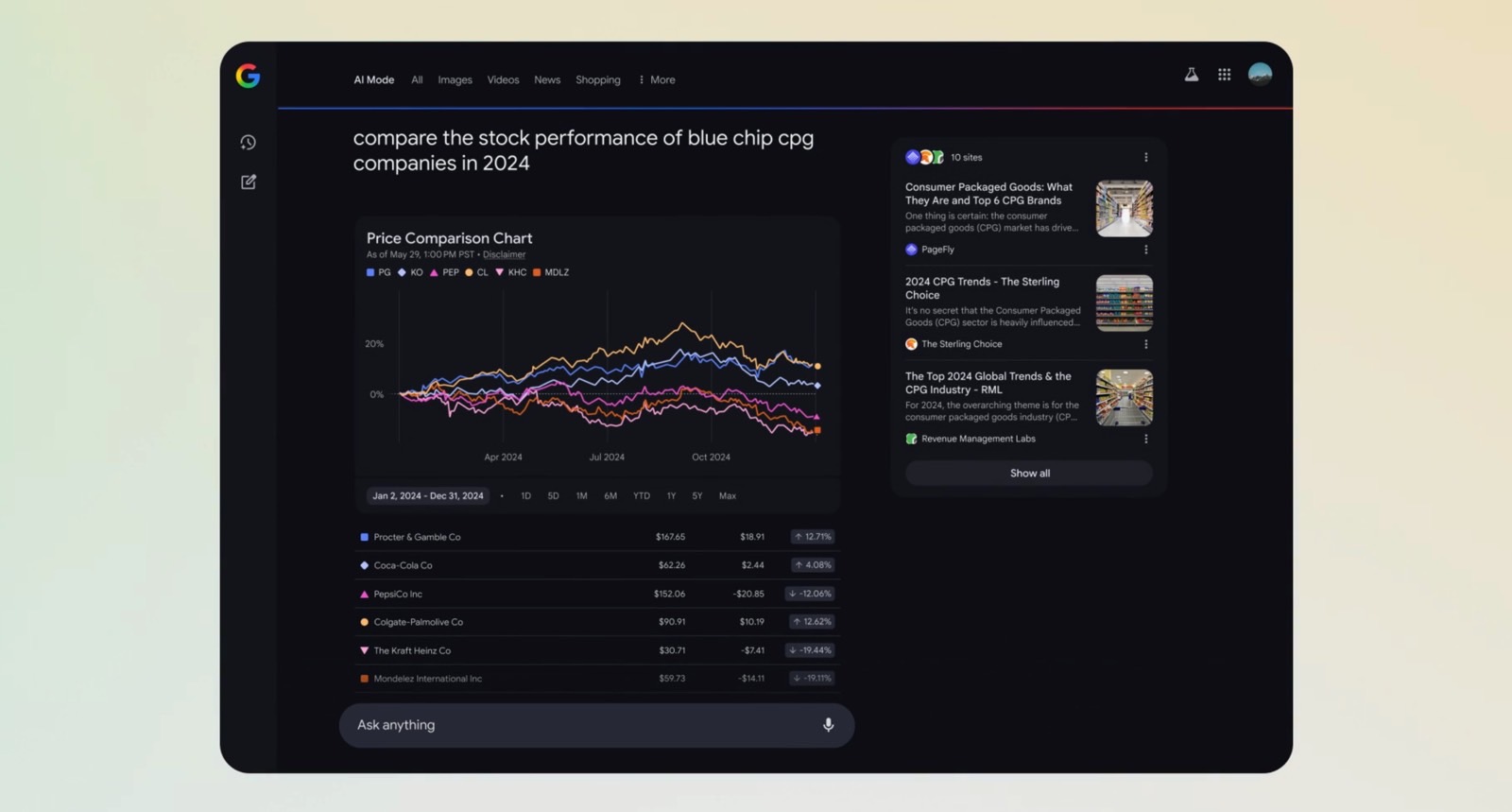
Google said the new features will start rolling out to Google Search users in the US soon, not just at I/O 2025. The first one is already available to AI Mode users: support for interactive graphs. You can tell the AI to make charts and graphs for you, and it’ll do it instantly.

The feature might not sound that exciting at first. But as someone who has asked ChatGPT to make graphs in the past, I think it’s an incredible tool to have on hand, especially for certain professionals. Being able to visualize data instead of just reading about it really helps with understanding complex topics.

Here’s how Google described the custom chats and graphs feature a few days ago:

When you need some extra help crunching numbers or visualizing data, Al Mode will analyze complex datasets and create graphics that bring them to life, all custom built for your query. Perhaps you want to compare the home field advantage for two different baseball teams. Search will provide an analysis and generate an interactive graph to address your specific question, using Google’s real-time sports information. We’ll bring this for sports and finance queries.

AI Mode can generate interactive graphs for users. Image source: Google

The first interactive graphs are here to handle finance data, not sports. If you’re working in finance or just want to see how your stocks are performing, you can ask AI Mode for graphs using simple, natural language. Say something like “compare the stock performance of blue chip CPG companies in 2024,” and AI Mode will create an interactive graph.

You’ll be able to hover over parts of the AI-generated chat, and the graph will react in real time so you can focus on specific data. And since this is a regular AI Mode chat, you can ask follow-up questions related to the graph data the AI just gave you.

The new AI Mode feature will be available to Labs users in the US at first. I expect it will eventually make its way into the standard Google Search experience.

You can ask AI Mode more questions related to that graph. Image source: Google

If you’re just discovering AI Mode, Google’s blog at this link will give you a look at how it works and how it evolved from the initial AI Overviews rollout.

Source

Posted on

European Commission should rescind UK data adequacy

Seven civil society organisations are calling on European Commissioner Michael McGrath to rescind the UK’s data adequacy status, citing major concerns around the country’s ongoing erosion of privacy and data rights.

Writing to McGrath in an open letter dated 3 June 2025, the organisations argue that current data handling practices in the UK – in combination with the government’s forthcoming data reforms – represent a significant divergence from European data protection standards.

Expressing their “deep concerns,” the civil society groups – including European Data Rights (EDRi), Access Now, Statewatch, and Privacy International – said that since the UK was granted adequacy by the European Commission (EC) in June 2021, “the UK has seen a sustained and systemic erosion of privacy and data protection”.

Noting that straying from the standards set out in the European Union’s (EU) General Data Protection Regulation (GDPR) and Law Enforcement Directive (LED) has already undermined the fundamental rights of European citizens, the groups said “this degradation would be furthered” by the UK government’s proposed Data Use and Access Bill (DUAB).

“Allowing third countries such as the UK to benefit from unrestricted personal data flows with the EU while simultaneously weakening legal safeguards at home does not only endanger the rights of people in the EU, it also undermines the credibility of the EU’s data protection framework, exposes EU businesses to unfair competition, and devalues the Union’s regulatory leadership on the global stage,” they wrote.

“The UK government’s proposed reforms and recent actions threaten to imperil the UK’s data and privacy protections. This status of affairs will fuel uncertainty and threaten individuals and businesses alike.”

They added that without decisive action from the EC, there is “a substantive risk” that fresh UK adequacy decisions could be struck down by the Court of Justice of the European Union (CJEU).

In exiting the EU, the UK became a “third country” under the bloc’s rules, which means the EC will have to periodically assess whether the country’s data protection framework and practices provide an essentially equivalent level of protection for EU citizens’ data.

After it initially granted the UK separate adequacy status’ under both the GDPR and LED, the EC was clear in warning that the decision may yet be revoked if future data protection laws diverge significantly from those in Europe.

Problematic data protection practices

Commenting on the DUAB proposals – which “would represent a systematic weakening of privacy and data protection safeguards” – the civil society groups noted the bill will diminish the right not to be subject to automated decision-making; delegate “extensive” legislative power to UK ministers that would allow them to circumvent Parliamentary scrutiny when making decisions around the legality of data processing or transfers; and otherwise grant government and law enforcement agencies “expansive access” to personal data.

They added that the DUAB would also allow organisations to transfer data to jurisdictions with clearly lower data protection standards, potentially turning the UK into a “data laundering hub”.

The groups also highlighted further legislative initiatives with negative data protection implications outside of the DUAB. This includes the forthcoming Border Security, Asylum and Immigration Bill, which they argue is “incompatible with the fundamental principles” of the GDPR and LED because it would subject the data of European citizens to UK intelligence services and counter-terrorism legislation.

They also noted how the upcoming Fraud Bill would place millions of benefit claimant’s bank accounts under constant algorithmic surveillance, with banks being compelled to disclose people’s sensitive financial information at the “speculative discretion” of ministers. They said such bank account monitoring can happen regardless of whether an individual is based in the UK.

However, the concerns shared were not limited to upcoming legislative proposals, and include issues around current data protection practices. Regarding the independence of the Information Commissioner’s Office (ICO), for example, the groups highlighted its reticence to take regulatory actions that carry the full force of law.

“In 2024, the ICO published statistics which revealed that they had only taken regulatory action on one complaint out of the 25,582 which they had received, favouring actions that lack the force of law when they did respond,” they wrote.

“We are concerned that the ICO’s overreliance on [these] actions … is a symptom of the political pressure the ICO is receiving to not obstruct innovation or growth for UK businesses at the expense of UK data subjects’ effective right of redress.”

They also highlighted the data regulator’s decision not to formally investigate clear data protection concerns around UK policing’s use of hyperscale public cloud infrastructure, after Computer Weekly revealed in June 2024 that Microsoft could not guarantee the sovereignty of policing data hosted on its Azure platform.

They noted that despite calls from the Scottish Biometrics Commissioner to investigate the problems identified by Computer Weekly, “the ICO refused to intervene … citing concerns that ruling on the legality of the police cloud infrastructure would frustrate the operation of the UK-US Cloud Act Agreement”.

While Computer Weekly’s previous reporting on police hyperscale cloud use has identified major problems with the ability of these services to comply with the UK’s law enforcement-specific data rules, the government’s DUAB changes to police processing are seeking to solve the issues identified by simply removing the requirements that are already not being complied with.

Other serious concerns raised by the civil society groups include the growing use of live facial-recognition (LFR) technology by police, which is progressing “without effective oversight, transparency or mechanism to assess necessity and proportionality”, and the use of secretive Technical Capability Notices (TCNs) to compel service providers to remove encryption at the government’s behest, as the Home Office recently did with Apple.

“Adequacy isn’t a courtesy, it’s a legal guarantee that people’s fundamental rights are protected when their data is sent abroad,” said Itxaso Domínguez de Olazábal, a policy adviser at EDRi.

“The UK is systematically rolling back those protections, and in doing so, it is putting at risk not just EU people’s data, but the principle of rights-based governance itself. If the Commission extends adequacy despite clear divergence, it sends a troubling signal: that data protection is negotiable when trade or geopolitics are at stake.”

Commenting on the letter, Mariano delli Santi, a policy officer at the Open Rights Group, described the DUAB as “the latest in a series of attacks on data protection and privacy in the UK”.

He added: “Successive governments are not only harming the British public with these attacks, but are undermining our relationship with the EU. Losing our adequacy status at a time when the UK is trying to improve its economic outlook would be a costly self-inflicted wound that must be avoided at all costs.”

Computer Weekly contacted the Department for Science, Innovation and Technology (DSIT) about the letter, but received no response by time of publication. Both the department and ministers have previously and repeatedly said the DUAB has been crafted with data adequacy in mind.

Computer Weekly also contacted the EC, but similarly received no response by time of publication.

Source

Posted on

Microsoft outlines three-pronged European cyber strategy

Microsoft has today launched a European Security Programme (ESP) for government bodies in the region, throwing a protective embrace around all 27 European Union (EU) member states, EU accession candidates, European Free Trade Association members, the UK, Monaco and the Vatican.

Recognising that the European cyber threat landscape is in a state of flux as the confluence of artificial intelligence (AI) and digital technologies drives evolution and surfaces new challenges, Microsoft vice-chair and president Brad Smith said Europe could not afford to stand still in cyber matters, particularly as ransomware gangs and nation-state threat actors run rampant.

The programme builds on a pre-existing Government Security Programme (GSP) that has been operating in a similar capacity for some time, but Microsoft said it now wants to increase the flow of information and resources to help European governments increase their resilience.

As such, the ESP contains three core elements: increasing threat intelligence sharing with government agencies; investing more to strengthen security capacity and resilience; and expanding partnerships to disrupt cyber attacks and take down criminal networks.

“Together, these efforts reflect Microsoft’s long-term commitment to defending Europe’s digital ecosystem – ensuring that, no matter how the threat landscape evolves, we will remain a trusted and steadfast partner to Europe in securing its digital future,” said Smith, as he launched the programme at an event in Berlin.

“Our commitment to Europe is deep, enduring and unwavering,” he continued. “We believe that Europe’s digital future is one of the most important opportunities of our time – and protecting that future is a responsibility we share.

“We will stand shoulder to shoulder with European governments, institutions and communities to defend against threats, build capacity and strengthen resilience,” said Smith. “We are proud to be a trusted partner to Europe, and we will continue to work every day to earn trust through transparency, collaboration and a steadfast commitment to protecting what matters most.”

Microsoft’s later initiative forms part of a broader set of European Digital Commitments announced a few weeks ago – which includes plans to expand its regional datacentre capacity by approximately 40% over the coming years.

Digging deeper

Microsoft went on to outline how each of the three pillars of the ESP will work:

Threat intelligence sharing: Using AI to support analysis of cyber threat activity and glean more insight in real time, helping governments defend proactively. Meanwhile, the capacity of the existing Digital Crimes Unit (DCU) will be expanded to support law enforcement partners through the Cybercrime Threat Intelligence Programme.

At the same time, Microsoft’s Threat Analysis Centre will ramp up its analysis of influence operations in Europe to help governments stay ahead of disinformation campaigns and other hybrid threats targeting the region’s democracies.

Finally, Microsoft will offer prioritised security updates and vulnerability notification and management services to European partners. All participating governments will also receive a dedicated point of contact to coordinate responses and escalate concerns.

Security investment: Microsoft plans to pump additional resources to further its work with governments, civil society bodies and innovators, to strengthen local cyber capabilities and capacity, and improve resilience. It is already piloting a programme alongside the Europol Cybercrime Centre (EC3) to embed DCU personnel at its Netherlands-based HQ to work better together.

Additionally, Microsoft is renewing its existing partnership with the CyberPeace Institute, supporting non-governmental organisations and making more resources available to expand cyber support in eastern Europe via the Western Balkans Cyber Capacity Centre, supporting a geopolitically sensitive and digitally under-resourced part of Europe where malicious actors continue to work to destabilise countries bordering or hoping to join the EU.

More broadly, Microsoft hopes to fund AI security research and innovation, and is already working with the UK Laboratory for AI Security Research, which is supported by Plexal and The Alan Turing Institute, among others, to better support the security of open source development projects, raising the security posture of European projects such as Log4J and Scancode alongside a recently launched GitHub fund.

Expanding partnerships: The final pillar of the ESP will see Microsoft work more closely with law enforcement and regional bodies to identify new and innovative ways to disrupt malicious cyber activity.

Microsoft is already a key player in this regard – only last month, it worked with Europol EC3 on the Lumma infostealer takedown that had compromised nearly 400,000 devices in Europe. On the basis that more of that kind of thing is always a good idea, Microsoft recently launched the Statutory Automated Disruption Programme to automate legal abuse notifications to hosting companies, helping them remove malicious domains and IP addresses quicker. It will also be working with internet service providers on a similar basis.

As part of this expansion, Microsoft will lean more on the DCU, which in recent years has become much more active in running its own legal actions against nation-state threat actors – such as the October 2024 action against Star Blizzard (aka Coldriver), which has seen the group forced to significantly alter its tactics. Smith hinted that more such coordinated disruptions were on the horizon.

Source

Posted on

Greenerwave opens hub to offer French revolution in space comms

Greenerwave has opened a location in French aerospace hub Toulouse to offer a specialised technical environment designed to boost its ambition to revolutionise satellite communications through “disruptive technology”.

Founded in 2015 by French National Centre for Scientific Research (CNRS) researcher Geoffroy Lerosey and Mathias Fink (ESPCI Paris), Greenerwave specialises in the control and orientation of electromagnetic waves, designing and developing technology that “drastically” improves the energy efficiency of equipment, making it more economical and environmentally friendly and less dependent on semi-conductors.

From a deeper technological basis, Greenerwave said it has developed a “breakthrough” technology based on reconfigurable intelligent surfaces (RIS) and proprietary physics-based algorithms.

This approach enables real-time steering of signal-carrying waves by shifting complexity from hardware to software, according to Greenerwave. The result “significantly” lowered energy consumption and reduced use of semiconductors.

The technology currently sees application across various sectors, ranging from the automotive industry to satellite communications and the internet of things (IoT). Its solution – passive and low in semiconductor consumption – is also designed to enable the development of a new generation of antennas that are more energy-efficient and have a lower carbon footprint.

The Toulouse site, located near the Cité de l’Espace, has three core objectives: test, optimise, integrate. As it scales up its industrial capabilities, the unit is seen as strengthening Greenerwave’s operational and technical capacities, drawing on existing deep expertise in integrating complex systems, especially in antenna architecture for low Earth orbit (LEO) satellite constellations.

The infrastructure includes an anechoic chamber, a custom outdoor structure for terminal validation, and next-generation RF testing equipment. These facilities will allow for the integration and validation of Greenerwave’s multi-orbit Satcom terminals.

Looking at the move from a broader strategic corporate context, Greenerwave noted that as satellite communications become increasingly central – whether for connectivity, defence or the management of critical infrastructure – innovation is proving to be a decisive lever for technological sovereignty.

Greenerwave said it was aiming to contribute meaningfully by offering passive, energy-efficient solutions that are poised to redefine the standards of satellite communication antennas.

Greenerwave sees Toulouse as standing out as one of Europe’s most dynamic space hubs, being an intersection of innovation, research and industry. Moreover, beyond the city’s historical roots in aeronautics, Greenerwave said Toulouse is recognised as a key centre for satellites, orbital technologies and space applications. By choosing to set up operations there, Greenerwave is entering a “unique innovation ecosystem” that supports the acceleration of its technologies and its ambitions.

The company added that the move will underscore its commitment to strengthening European technological sovereignty in a highly strategic domain.

“Toulouse is more than an industrial hub – it is a powerhouse of expertise, innovation, and ambition,” said Greenerwave CEO and co-founder Geoffroy Lerosey.

“This move is a vital lever to raise awareness of our sovereign European technology: resource-efficient, globally competitive and built for resilience. Our mission is clear: to help build a more robust European space sector, anchored in low-impact technologies that reduce critical dependencies.”

Currently employing nearly 120 people – most of whom based in Paris – Greenerwave is expanding with a new expert team in Toulouse. The locally recruited team includes talent from Thales Alenia Space, Airbus Defence and Space, and Eutelsat OneWeb.

It plans to grow the Toulouse team with several positions to be filled by the end of 2025, underscoring its intent to establish a lasting presence in the region.

Source

Posted on

iPhone 17 and Galaxy S26 price hikes seem inevitable, and

Unhappy with Apple moving iPhone production to India to skirt tariffs imposed on China, President Trump threatened Apple twice that the iPhone could be subject to tariffs, with the latest warning dropping a few days ago. Trump said that iPhones sold in the US that are not made in the US will see a 25% tariff.

Trump said that if iPhones aren’t made in the US, “a tariff of at least 25% must be paid by Apple to the US.”

Making an affordable iPhone in the US is simply not possible. Many have discussed this matter during April, when Trump’s tariff announcements shook the world, sending stocks tumbling down. Renewing threats of new tariffs won’t make it any easier for Apple to overcome many of the problems that make manufacturing iPhones in the US a problem.

Also, if Apple ends up paying that 25% tariff to the US for all iPhones coming to America from India and China, it’s very likely that Apple will pass on that extra cost to iPhone buyers.

Tech. Entertainment. Science. Your inbox.

Sign up for the most interesting tech & entertainment news out there.

By signing up, I agree to the Terms of Use and have reviewed the Privacy Notice.

Various insiders, including the well-known Ming-Chi Kuo, say it’s cheaper for Apple to continue making iPhones in India for the US market and deal with the tariffs later. In such a case, the more expensive iPhone would also be cheaper for the consumer looking to buy a new device than an iPhone made in America.

Whatever the case, the iPhone 17 series will be more expensive than the iPhone 16 models.

Also, it’s not just Apple that will be hit with tariffs in the near future. Trump said that Samsung and anybody else importing iPhones in the US will see similar tariffs. That means the Galaxy S26 series, due to launch in early 2026, will also bring price hikes that Samsung can’t possibly escape.

“In terms of profitability, it’s way better for Apple to take the hit of a 25% tariff on iPhones sold in the US market than to move iPhone assembly lines back to US,” Kuo said on X in response to Trump’s announcement on Friday.

Kuo explained in a separate tweet that Trump going after Apple might be a calculated political move meant to increase exposure. Whatever happens next, Trump can benefit from his attack on Apple:

If Apple moves iPhone assembly back to the US, Trump can promote it as a major “Made in America” achievement and key policy win. If Apple secures an agreement to temporarily shield itself from Trump’s targeting, Trump still secures other benefits he desires through the deal. When the need to promote “Made in America” arises in the future, he can resume targeting Apple and apply pressure with tariff threats.

Separately, The New York Times ran a story about the cost of an iPhone made in America. Well-known Apple enthusiast John Gruber took that story apart for its various claims, including estimates from analysts that an iPhone made in the US would more than double the price to $2,000 or more.

While Gruber’s criticism is warranted, and he’s right that there’s no basis for that quote, especially when it doesn’t mention which iPhone will see such a price hike, that estimate still drives home the main point here. US consumers might soon have to face a mild iPhone 17 price hike (from tariffs) or a major iPhone price hike for future models (from US production costs).

There’s absolutely no way Apple can make a cheaper iPhone in the US anytime soon or in the more distant future. Apple would have already done so, if such scenarios were possible.

When Kuo made his case that Trump going after Apple is a political move, the insider started with this question:

Apple is a consumer electronics company whose current products and services have no significant connection to national security, so why is it persistently and publicly targeted by Trump?

Apple is indeed far from being a national security threat. It’s one of America’s top companies, maybe the most important one. The iPhone is a highly coveted product around the world.

Asked why he would want to hurt an American company, Trump said that the same 25% tariff would apply to anybody selling phones in the US that are not made in America. He singled out Samsung in those comments. Samsung, by the way, is also not a national security threat.

If Trump pursues these smartphone-focused tariffs, the Galaxy S26 series might see price hikes. Like Apple, Samsung can’t move production to the US. It would be equally expensive for Samsung to make smartphones in a region that’s ill-equipped and untrained for such an endeavor.

Whatever happens with Trump’s proposed 25% tariff on iPhones and other smartphones sold in the US, I’ll remind you that Apple is already paying tariffs on different products. During its most recent earnings call, Apple said that tariffs will amount to $900 million for the June quarter.

I asked ChatGPT what the iPhone would cost if Apple decided to use its best-selling product to offset those tariffs by increasing the price of the iPhone right now. The AI said the iPhone should be up to $50 more expensive so Apple can compensate for that lost revenue. That scenario did not involve iPhone, iPad, or Mac tariffs.

Finally, I’ll also point out recent reports that predate Trump’s iPhone tariff threat. They said Apple is already looking at raising iPhone 17 costs and figuring out ways to explain the price hike without blaming tariffs. If Trump’s proposed 25% tariff happens, there’s no way for Apple to justify price hikes without blaming the tariffs.

Source

Posted on

SXSW London: Risk of AI removing choice

Among the interesting talking points discussed during the South by Southwest (SXSW) London festival in Shoreditch was the importance of maintaining human creativity and ingenuity in the era of artificial intelligence (AI).

AI models are being improved every day, and its risk to the creative industries was one of the topics explored at SXSW.

The implications of AI developments and how people need to adapt in an era when AI can surpass human thinking has implications across society and will touch every industry.

Given AI is being broadly adopted across society, among the considerations is how to prepare young people so they can work alongside AI tools rather than compete. Since a tool like ChatGPT can answer exam questions, in a panel discussion, James Kirkham, founder and CEO at Iconic, acknowledged the challenge young people are facing doing their GCSEs. “How are we going to show the importance of human creativity?” he asked.

The implications of his comments are that kids would gain a more useful life skill by learning how to ask the AI the right questions, rather than learning facts they are then tested on in an exam.

Kirkham went further, discussing the need to teach children about taste. As generative AI becomes adept at writing and creating art and video content, he believes it is important that children understand why something is perceived as more tasteful compared with something else.

This may seem obvious, but the panel discussion explored how the choices people make are being algorithmically manipulated.

Risk of AI to humanity

During the panel discussion, Erika Wykes-Sneyd, general manager and vice-president at Adidas Studio, spoke about how technology providers were working to make AI-based technologies more integrated into society. “I think the technology companies are making us comfortable,” she said. “AI needs to be warm and fuzzy to drive adoption.”

The development work to improve these AI systems happens behind the scenes as people use the products. For Wykes-Sneyd, the challenge for society is how it can demonstrate human creativity as the AI systems get better and better at providing content.

In the age of exponential digital acceleration, she said: “What we’re realising is that what makes us messy and what makes us human is what we need to get closer to.”

Kirkham warned: “To stand out, we need to be at our creative best.” However, he pointed out that for the past few years, people have been completely enslaved by what he described as “their algorithmic lives in a quest for convenience”.

For instance, the idea of a recommendation engine or an AI feeding relevant content has been adopted by society to help people save time. But this has led to a herd mentality, where people stop thinking about the choices they are making and everyone is guided to choose similar things. “This leads to a kind of vanilla vagueness,” said Kirkham.

People may say they would like to see new music, but as he points out, they actually want a singer-songwriter that is a little bit like Ed Sheeran. These decisions are programatically baked into AI tools, which, as a consequence, limits the content people are presented with, such as on social media feeds.

Beyond algorithms innocuously removing people’s ability to choose, they are set to automate much of existing work, according to Wykes-Sneyd. She noted that 70% of the work that is done inside companies is rather like an internal slide deck presentation, where much of the actual work can be replaced by an AI. “The way we work will have to radically change,” said Wykes-Sneyd.

Her view on how companies will succeed is by organising around small teams that can not only work creatively and collaborate, but are also grounded in how their work contributes to the business’s profit and loss accounts.

Source

Posted on

Legends ASM taps Boldyn to enhance fans’ entertainment experience

Since providing Sunderland’s Stadium of Light with a Premier League-quality communications infrastructure, Boldyn Networks has furthered its partnership with Legends ASM to equip the First Direct Arena in Leeds with “an advanced 5G infrastructure” accessible to fans and to all mobile network operators.

A product of a takeover by Legends group in 2024, ASM Global is a global producer of entertainment experiences. It offers venue and event strategy and management services that are based on locally tailored solutions and technologies to achieve maximum results for venue owners. The company’s venue network spans five continents with a portfolio of more than 350 arenas, stadiums, convention, exhibition centres and performing arts venues.

Sports and music fans have ratcheted up their demands of the experience they receive at arenas. Music fans attending concerts now want their live experience to be different and more engaging than before. Furthermore, Boldyn said, with 87% of event goers posting to social media at an event and 77% accessing their tickets digitally, the high speed and uninterrupted service marks a major development in the experience available at live entertainment venues in the UK.

The shared network infrastructure provider believes that fans will have a “revolutionising” and entertaining experience when they can access state-of-the-art 5G mobile connectivity at a large venue. This includes being able to quickly access the arena, order food and drinks from phones, uploading HD videos four times faster, easily finding friends at the event, and getting home smoothly and safely.

In its other projects, such as that in Sunderland, Boldyn Networks has developed a business model and technology stack for high-demand density (HDD) use cases. To deliver connectivity in the Legend ASM venues worldwide, Boldyn is deploying a neutral host 5G distributed antenna system (DAS) solution at the First Direct Arena – a major entertainment venue based in Leeds city centre, hosting live music, comedy, entertainment shows, corporate and sporting events.

“Boldyn’s state-of-the-art network is transforming the way visitors experience events at our arenas,” said Martin McInulty, general manager at First Direct Arena. “In the UK, fans in Leeds are the first to benefit by having the ability to capture ‘wow’ moments in ultra-HD and sharing them with friends and family in real time.

“The new seamless, robust 5G connectivity also enables best-in-class venue management. We’re excited with how connectivity can optimise everyone’s journey at our venues, and we will continue leveraging Boldyn’s infrastructure to unlock the power of the ‘future wow’.”

Paul Osborne, chief commercial officer for UK and Ireland at Boldyn Networks, added: “We are incredibly proud to provide high-speed 5G mobile connectivity to Legends ASM’s passionate fans.

“We want to enhance the experience for everyone, from visitors to staff, by providing a platform for a range of new digital services. Our deployments also demonstrate the power of shared infrastructure.”

The arena is being equipped with advanced 5G infrastructure that all UK mobile network operators can access and enable their subscribers to enjoy the benefits. Mobile operator O2 – with whom Boldyn is working with at the Stadium of Light project – is the first network to sign up their customers connect to the network.

Robert Joyce, director of mobile access engineering at O2, said: “Given our long-history of giving our customers access to the best live entertainment, it’s only natural that they will be the first to benefit from our next-generation 5G network at venues across the country.

“We are committed to improving the connected experience for our customers no matter where they are, including in busy locations such as stations, stadiums and arenas.”

Source