Posted on

DuckDuckGO AI lets you switch AI models mid-conversation

DuckDuckGO is one of the best browsers for people who want to take advantage of AI while still maintaining their privacy. Last year, the company introduced an AI chat feature that made ChatGPT queries private. Then, in March, the browser expanded the AI capabilities of its software to bring users the ability to get AI-assisted answers daily without needing an account. At the time, the Duck.ai chat got the latest GPT-4o mini and o3-mini from OpenAI, Meta Llama 3.3, Mistral Small 3, and Claude 3 Haiku from Anthropic.

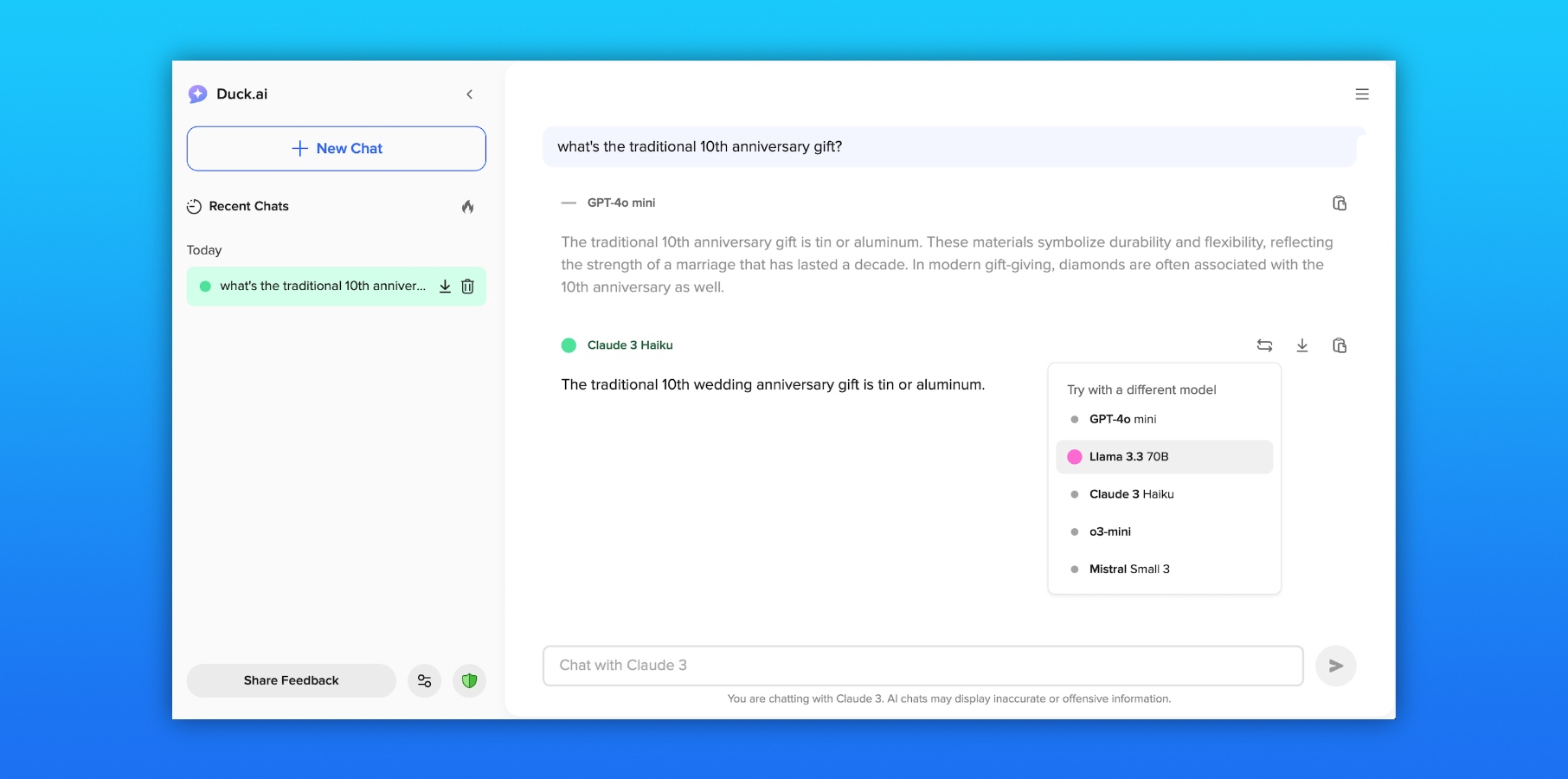
Now, to make users’ experiences more straightforward, the company decided to upgrade its DuckDuckGO AI with the ability to switch between AIs mid-conversation.

DuckDuckGO explains: “Each model has its own strengths and levels of moderation. With this new feature — much requested by our users! — You can compare how the models respond to the same query, or switch if you’re unhappy with the first model you chose.”

To start using this feature, go to duck.ai. After chatting with the AI, you can click the repeat button at the top of the chat window to check the other responses.

Tech. Entertainment. Science. Your inbox.

Sign up for the most interesting tech & entertainment news out there.

By signing up, I agree to the Terms of Use and have reviewed the Privacy Notice.

Last month, DuckDuckGo also updated its Recent Chats feature to store conversations locally on users’ devices and expanded sources across the web. With that, the AI-assisted answers also bring information in English-language queries outside the US.

In a blog post, DuckDuckGo explained why it made this change: “We’re finding that some people prefer to start in chat mode and then jump into more traditional search results when needed, while others prefer the opposite. (Some questions just lend themselves more naturally to one mode or the other, too.) So, we thought the best thing to do was to offer both. We made it easy to move between them, and we included an off switch for those who’d like to avoid AI altogether.”

Source

Posted on

How has US pushback affected UK DEI?

Although the diversity, equity and inclusion (DEI) backlash may have been mounting in recent years, particularly in the US, it has reached a peak since President Donald Trump took power earlier this year.

Within the first few days of assuming office, the president signed a raft of Executive Orders eradicating DEI, equal opportunity and affirmative action programmes across the federal government. He removed DEI requirements from federal contracts and eliminated equity-related grants and contracts. All tech companies working on US federal government contracts are now obliged to follow the rules.

So, what is going on here and what impact is the situation likely to have on the UK, not least among multinational tech firms operating in the country?

Jo Stansfield is founder and director of DEI consultancy Inclusioneering and a visiting fellow at Cranfield University. She believes current hostility towards DEI was born out of the anti-woke agenda, with “DEI being the corporate face of that”.

“It’s reflective of how disillusioned people are feeling, and that the way the world is going feels challenging,” says Stansfield. “This often gives rise to people becoming more protective of their ‘in-group’, so, for example, you see an increase in hostility towards immigration, which can feel threatening to some people when life feels difficult.”

Quietly and loudly quitting

But the situation is being compounded in the US by how employers implement DEI.

“Affirmative action there is more based around what can become a tick-box exercise – for example, have you reached your quota of ethnic minorities? – rather than focusing on how to create the best environment for everyone,” she says. “So, people fear they’re going to lose out on employment opportunities, and those that they’re othering will be advantaged rather than them.”

Debbie Forster is director of consultancy Novel Design and former co-chief executive of the now-defunct Tech Talent Charter (TTC). In her view, at least some of the large tech companies that have recently dropped their DEI initiatives were never very committed anyway.

“What we’re seeing is what we predicted nine months ago [when she and co-CEO Karen Blake closed TTC],” Forster points out. “We talked about organisations ‘quiet quitting’, but Trump’s made it easier for those who were taking a performative stance to ‘loudly quit’ when things got hard, that is in terms of changing culture and behaviour and ensuring leaders are incentivised.”

But she also acknowledges the importance of “bringing everyone along with you” in a DEI context, which did not always happen in the past.

“Along the way, we allowed right-wing individuals and the right-wing press to take hold of the narrative,” says Forster. “Some DEI people have said they worry about having tried to go too far and too fast, but I don’t think that’s the case – it’s more about how you tell the story.”

What’s happening to DEI?

Nithya Das, chief legal officer at governance software-as-a-service provider Diligent, agrees.

“If people don’t fully understand the ‘why’, it can lead to a situation where they don’t fully buy into others being developed or promoted,” she says. “Perception can become reality, and that cliché can apply in a very clear way to DEI at times.”

Even though the US administration’s view [of DEI] may have shifted, it doesn’t necessarily mean everyone is following suit Nithya Das, Diligent

But Das also indicates that despite the difficult political backdrop, many multinational tech companies are simply changing their approach rather than dumping DEI completely – whether they advertise the fact or not.

“Even though the US administration’s view may have shifted, it doesn’t necessarily mean everyone is following suit,” she points out. “We’ve seen many boards at the multinational level continue with their commitment to DEI, even if they shift around operations and priorities, but we’re not seeing a wholesale deprioritisation.”

This is because many employers still see value in DEI “to drive business priorities and outcomes”, Das adds, “so the fact they’re continuing with it in jurisdictions where it’s permissible speaks volumes”.

Blake, who as well as being former CEO of TTC is a senior operations and inclusion leader, says she is seeing a “mixed bag” in terms of responses to the situation. In some organisations, there has been an increase in “side-of-the-desk” endeavours, in which marginalised groups are expected to keep initiatives going despite DEI staff or budget cuts.

In others, DEI is being integrated more into core business functions, such as HR and procurement teams. The aim here is to make them “more results-focused while maybe losing some of the ideological framing”, says Blake.

Still others are focusing less on external communications and more on internal messaging to reassure diverse teams of their continuing value to the business and that inclusion remains a priority.

DEI trends in the UK

Sheree Atcheson is group senior vice-president of diversity and inclusion at digital transformation consultancy Valtech. In her view, the UK is now starting to diverge more from the US in DEI terms as it takes its own direction.

In fact, she believes that, although the country may no longer be part of the European Union, it will be increasingly influenced by it going forward due to the strong, positive, legislative change emerging from the region.

But Atcheson also warns that for companies operating internationally, “it’s important not to have too much of either a European or US lens as things are nuanced around the world”.

Stansfield agrees. She recommends that organisations broaden out the “think global, act local” mantra that many have operated under for years to cover national DEI legislation and priorities in different countries. But she is also unsure how insulated UK tech companies will be from the US scenario, given that most operate in a global environment these days.

“Even small UK businesses that have contracts in the US will be impacted by the supply chain and what it’s doing,” she says. “So, they may start to feel more reticent about making a big show of DEI and start to communicate more carefully if their values aren’t aligned.”

Nonetheless, it is the state of the UK economy that will have the most significant likely influence over how UK companies react towards DEI moving forward, Stansfield believes.

“The economy is slowing, which is challenging for business and is resulting in DEI projects being deferred as they’re no longer a top priority,” she explains. “I’m not hearing backlash, but that it’s financially more challenging to do things now as people don’t have the budget, which means they say, ‘It’ll have to be later or smaller’.”

What can organisations do?

While this environment may be particularly difficult for third-party DEI consultants, Atcheson points out that there are still things employers can do themselves.

“You have to be realistic about what you can and can’t do,” she says. “Be specific, and even with a minimal budget, there are still things you can do to embed accountability into your processes – you just have to think about it slightly differently.”

Such an approach requires harnessing expertise in both process and organisational change. It also involves creating a compelling vision of the future and understanding what change needs to be rolled out in a structured way. Just as important is ensuring employee buy-in to ensure DEI becomes integral to the company’s day-to-day activities rather than simply being a flashy, one-off event.

For DEI to be successful, your talent has to see that it’s benefiting everyone in the organisation. It’s about going back to basics and bringing everyone on the journey with you to ensure they’re all focused on the right outcomes Nithya Das, Diligent

“Most organisations will have HR teams with those skillsets, but it needs time, focus and commitment, and that’s always been a challenge,” says Stansfield. “It also requires a targeted and strategic business-focused approach, so everything should be planned and have a purpose to ensure outcomes are tangible.”

As a result, expensive activities, such as hiring keynote speakers during International Women’s Week, for example, may need to be put on hold. But by ensuring DEI activities are “data-driven and focused on iterative results”, it is possible to create more of an impact anyway, says Diligent’s Das.

Another consideration is ensuring effective communication. “For DEI to be successful, your talent has to see that it’s benefiting everyone in the organisation,” adds Das. “It’s about going back to basics and bringing everyone on the journey with you to ensure they’re all focused on the right outcomes.”

What this means in practice is that, despite current difficulties, the DEI journey is far from over. As Forster explains: “Diversity and inclusion has slowed and is losing progress, but it’s not dead. It’s just regrouping.”

As a result, she views the current situation as being one of “holding the ground we have while building the case and alliances for the next push”.

“Today, there isn’t enough momentum, energy and drive to start the next national and international movement as there are too many bombshells hitting too regularly,” says Forster. “So, today doesn’t seem like the right time to launch a new idea.”

But she and Blake have started their “journey of listening to people on the ground” over the past few months. Therefore, the “building blocks of what the next chapter could be” are starting to emerge, although it is still too “tumultuous” to take any action yet.

“We’re currently in a drought, so we need to ensure we strengthen the grass roots to try to sustain individuals and groups before we talk about the next growth spurt,” says Forster. “People have been debating whether they’re wrong to step back from DEI for a while for their own mental health and financial well-being, but finding ways to sustain yourself and build alliances is vitally important to prepare for the next wave.”

Source

Posted on

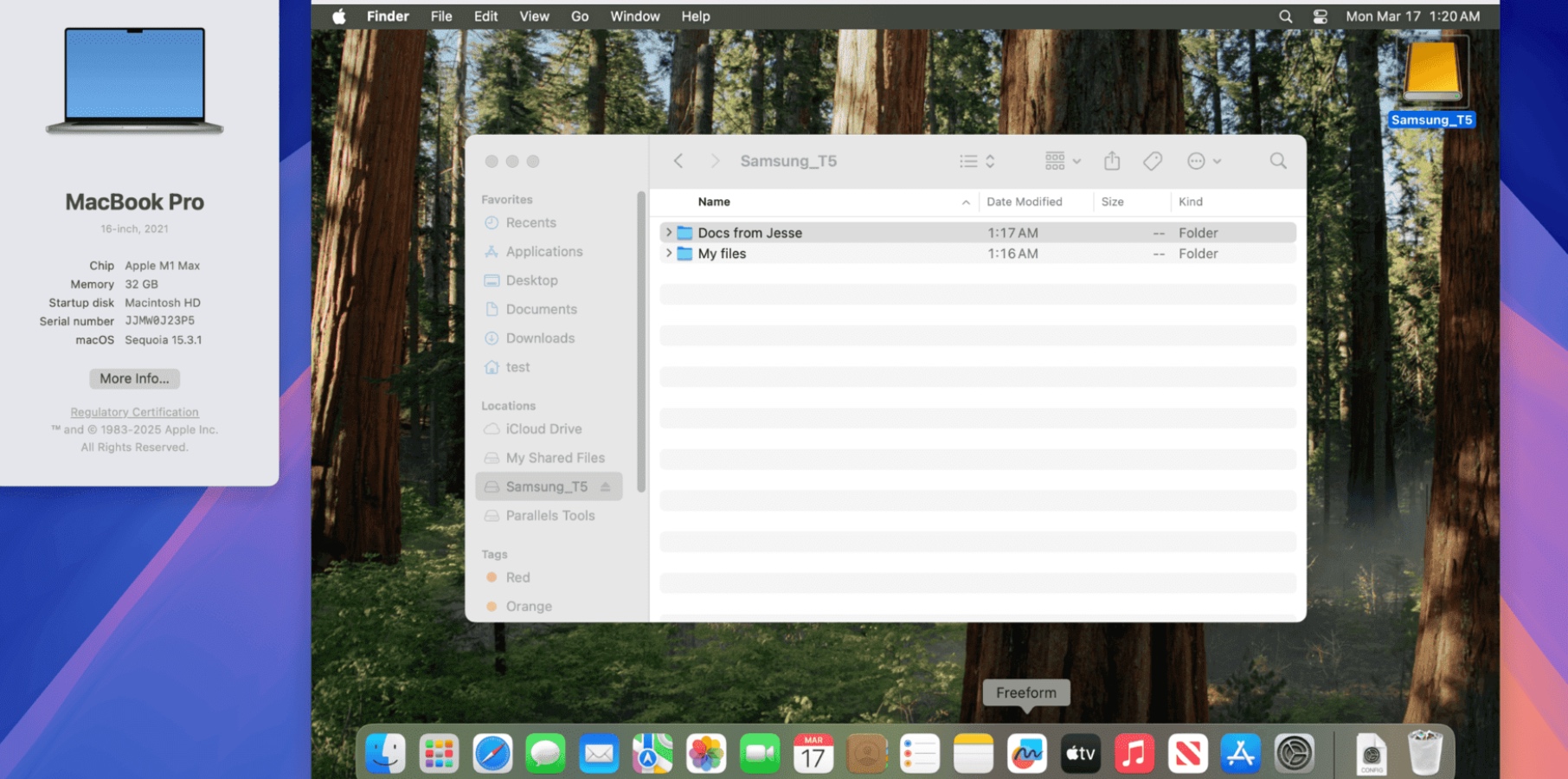
Parallels Desktop update boosts Windows legacy app performance on M4

Following the previous update that improved support for Apple Intelligence features on Windows virtual machines and added enhanced Writing Tools capabilities for Windows apps, Parallels Desktop version 20.3 has been released with a few new upgrades.

This update offers further enhancements to x86_64 virtual machines on Apple Silicon Macs, including full compatibility with the latest M4 chips. According to the company, this broader rollout ensures that “even more users can run legacy x86_64 apps on the latest Apple hardware.” With the previous version, the company brought x86 Emulation to Apple Silicon. Now, it ensures that all new Macs can take advantage of it, including the recently released M4 MacBook Air and M4 Max Mac Studio.

Parallels Desktop 20.3 brings even more, as users can connect a range of external USB devices directly to their macOS virtual machines, unlocking new workflows for development and security testing. The company says the latest macOS Sequoia 15 version is required for this feature to work.

The software update also allows you to use your OBS feed from macOS in Zoom, Teams, and other Windows apps inside your virtual machine. Besides that, this new version also brings these other improvements:

Tech. Entertainment. Science. Your inbox.

Sign up for the most interesting tech & entertainment news out there.

By signing up, I agree to the Terms of Use and have reviewed the Privacy Notice.

  • Enforced SSO activation via MDM: IT admins can now require SSO-only activation for managed Macs, ensuring security and compliance
  • Touch ID support for installation & settings: When you’re first installing Parallels Desktop, you can simply use Touch ID to authenticate the process, making installation and settings management more convenient

The company has a blog post highlighting all the changes available to users, including those on enterprise plans, such as an enhanced Mac integration for the Dragon Medical One app.

Parallels Desktop is available to Mac users for personal use for $99.99/year. There are also Pro, Business, and Enterprise editions. Below, you can learn more about how to use Writing Tools with this software.

Source

Posted on

Harrods becomes latest UK retailer to fall victim to cyber

Landmark London department store Harrods has become the latest UK retailer to fall victim to a cyber attack in the past 10 days, joining a list that already includes Marks and Spencer and Co-op.

The still in-progress incident was initially reported by Sky News and has supposedly left customers unable to pay for their purchases.

A Harrods spokesperson confirmed the accuracy of this report to Computer Weekly.

“We recently experienced attempts to gain unauthorised access to some of our systems,” they said.

“Our seasoned IT security team immediately took proactive steps to keep systems safe and as a result we have restricted internet access at our sites today.”

The spokesperson added: “Currently all sites including our Knightsbridge store, H beauty stores and airport stores remain open to welcome customers. Customers can also continue to shop via harrods.com.

 “We are not asking our customers to do anything differently at this point and we will continue to provide updates as necessary.”

Three major attacks

Further details on the incident affecting Harrods are yet to be made public.

However, the incident comes barely 48 hours after Co-op first disclosed it was experiencing a similar cyber attack that it also took proactive steps to mitigate, and less than a fortnight after M&S was forced to suspend multiple online services following an incident.

This has lent weight to growing speculation that all three attacks may share a common link. The most plausible scenario would suggest that the three attacks originated through an unidentified third-party retail services partner in a supply chain attack.

Earlier this week, it emerged that the M&S attack may have been the work of the cyber criminal collective Scattered Spider, which allegedly deployed a white-label ransomware called DragonForce on its VMware servers.

A compromise orchestrated through a third-party supplier would align with Scattered Spider’s modus operandi – the gang famously extorted multiple victims, including two high-profile Las Vegas casino operators, having exploited Okta identity services.

Tim Grieveson, CSO at ThingsRecon, an attack surface discovery specialist, said: “There must be a common thread across these retailers that has put them firmly in the crosshairs of cyber criminals. These aren’t isolated events, they are a wake-up call. The action and initiative we have seen from the Co-Op and Harrods should be a blueprint for others, not just in retail, but across all sectors.”

Toby Lewis, head of threat analysis at Darktrace, said: “With the information publicly available we can see two other likely scenarios: either a common supplier or technology used by all three retailers has been breached and used as an entry point to big name retailers; or the scale of the M&S incident has prompted security teams to relook at their logs and act on activity they wouldn’t have previously judged a risk. It’s a lesson again in the growing difficulty large organisations have in securing against threats in their supply chain, particularly as those threats grow in volume and sophistication.”

Copycat hackers

Jake Moore, global cyber security advisor at ESET, highlighted a third possibility, saying that even if the same threat actor was not responsible for all three incidents, it was not uncommon for related targets in similar sectors to fall victim to attacks in quick succession.

Moore said that in the case of ransomwares like DragonForce, which is openly sold on the cyber criminal underground via a ransomware-as-a-service (RaaS) model, can be easily deployed by other threat actors motivated by the first attack to seek out similar vulnerabilities.

“Other hacking groups are also able to attempt their luck on similar businesses and start demanding ransoms where possible,” said Moore.

“Attacks involving the DragonForce ransomware most commonly start by targeting known vulnerabilities such as attacking systems that have not been kept up to date with the latest security patches so businesses need to be extra vigilant and improve how quickly they update their networks,” he said.

Source

Posted on

Explaining what’s happening in a cyber attack is hard but

Sergey Nivens – stock.adobe.com

By

  • Mikey Hoare, crisis expert, Kekst CNC

Published: 01 May 2025

The cyber attacks on M&S the Co-op and Harrods are a prominent example of a cyber incident causing real-world disruption across the UK. But it’s also an opportunity to learn from the challenges all organisations face when trying to explain to their customers what’s happening, amid the disruption and uncertainty that cyber incidents can generate.
 
This is one of the hardest elements of a cyber incident, and one fraught with risk, given the potential reputational damage and loss of trust if handled poorly. Without being in the room, it’s hard to assess how a company is handling a crisis. We have a good idea, though, of the communication challenges that M&S and the other retailers will be working through. Overall, it seems they’ve done a good job so far, although there is still a lot of ground to cover as the incident evolves. 
 
M&S’s communications have been proactive, with a well-judged tone, and it has been impressive to see their leadership communicating directly with customers. The critical question is how the messaging aligns with the operational picture and potential evolution of the incident. Aligning those, with incomplete information, is difficult. What you think you know early on in a cyber incident often turns out to be wrong.
 
People’s reactions to cyber incidents are also continually shifting. Awareness of the threat has grown significantly, so disruption quickly prompts speculation about a cyber attack. Generally, people are less concerned about data being lost than they once were, as they have experienced it many times before. But there are still plenty of people worried about sensitive data, some of whom are becoming more litigious. And many have good reason to be concerned –   threat actors are becoming more adept at using stolen data, especially with the growing use of AI.
 
Threat actors are also increasingly contacting employees and customers of companies they’ve hacked, to try to increase the likelihood of the company paying a ransom. These calls or emails can be aggressive and alarming. And if a company has been reticent to communicate with these stakeholders, this needs sensitive handing.
 
All of that means internal communications about an incident are ever more important. Comprehensive media monitoring is also critical to understand the conversation about the incident and how your messaging is being received.  Additionally, there’s growing value in reaching customers directly (M&S has been adept, for example, in its use of Instagram).
 
Overall, the most critical thing is to align the communications with the operational response and manage people’s expectations accordingly, both internally and externally. Common mistakes we see in our work (mistakes that we try to help companies avoid) include:

  1. Saying too much too soon. It never ceases to amaze me – even after having worked on dozens of incidents – how often forensic evidence evolves over time, fundamentally changing the understanding of the incident. This can be hard to handle from a communications perspective, particularly if you’ve told your customers that their data weren’t stolen, only for them to later discover that they were. Being an unreliable narrator is one of the fastest ways to lose trust.

  2. Saying too little for too long. Not knowing all the facts doesn’t mean you shouldn’t provide advice,  both internally and externally, on what to do if, for example, operations have been disrupted. 

  3. Getting the tone wrong. Companies are often keen to praise themselves for the speed and effectiveness of their response, or describe themselves as victims. If people’s sensitive data have been lost, they might not see you as the victim, but as being to blame.

  4. Forgetting that threat actors read the news too! Communications around a cyber incident are complex, with multiple audiences to consider. One of those audiences is the threat actor, especially when they’re trying to use media as part of their ransom negotiation.

 
We’ve seen plenty of incidents handled well, with customers, suppliers, investors, regulators and staff all updated regularly and honestly, so people understood that the company was doing all it could to mitigate the impact on them. However, we should all – whether we’re M&S or a much smaller company destabilised by a cyber incident – keep learning how best to handle communications around it. 

Mikey Hoare is a crisis expert at communications advisory firm Kekst CNC, and former Director of National Security Communications for UK Government

Read more on IT for retail and logistics


Source

Posted on

‘I’m from the technocracy and I’m here to help’ –

When I first saw the photos of all of the tech broligarchy lined up behind Donald Trump on his inauguration day something struck me as off. I couldn’t figure out what was bothering me until now.

I realised they didn’t just look like very powerful attendees, they looked much more like very powerful shareholders in government – and unelected ones at that. We can see today where that power translates directly into US government policymaking with the reductions on certain tech tariffs from China.

Let’s look at what that means for Apple alone. With 90% of iPhones manufactured in China, Apple faced potential price increases of up to $3,500 per phone under the proposed 145% tariff. In 2024, US imports of smartphones from China were valued at $41.7bn while laptops were valued at $33.1bn.

The tariff exemption therefore translates into avoided costs of approximately $60bn annually for these two categories alone. And while Apple will have only a share of that benefit, it’s a staggering return for Tim Cook’s donation of $1m to Trump’s inaugural committee – which also marked Cook’s first time attending a presidential inauguration, despite his political views often differing from Trump’s policies.

The Technocracy movement

But it’s not only tech’s influence in policymaking areas such as tariffs that directly affect their bottom line, we need to think about their broader reach in the realm of geopolitics. Where did the ideas of making Canada the 51st State, or annexing Greenland actually emerge from? If there was a policy vacuum here it was neatly filled by none other than Elon Musk drawing on the ideas of his maternal grandfather Joshua Norman Haldeman.

Haldeman was a key proponent of the Technocracy movement which started in the early 1930s in the US and then spread to Canada. It proposed the creation of the Technate of America. This would do away with borders, merging the US, Canada, Mexico, Central America and Greenland into a single nation under a regime of engineers and technicians.

Sounds familiar, right? Its essential argument was that there was no room for politics in society and that engineers and scientists were best placed to decide what was best for citizens in terms of organising resources and society. In 2019 Musk tweeted on X, “Accelerating Starship development to build the Martian Technocracy”. Except now it looks like he is not waiting to do it on Mars, he’s doing it here in real time.

The idea of the futility of the nation state and of politics in favour of new technological frontiers is echoed in The sovereign individual published in 1997. This book examined the social, economic and political implications of the coming technology on society and particularly politics and governments.

Authors James Dale Davidson and William Rees-Mogg – father of Jacob Rees-Mogg – wrote, “Representative democracy as it is now known will fade away to be replaced by the new democracy of choice in the cybermarketplace. If our deductions are correct the politics of the next century will be much more varied and less important than that to which we have become accustomed. The 20th century nation-state will starve to death as its tax revenues decline,” Or, as Mark Zuckerberg puts it, “Companies not countries”.

The authors also predicted the impact of coming technologies like artificial intelligence (AI) when they wrote, “Lifetime employment will disappear as jobs increasingly become tasks or piece work rather than positions within an organisation. New survival strategies will evolve involving greater concentration on the development of leisure skills, sports abilities as well as providing services to the growing numbers of sovereign individuals as income inequality within jurisdictions rises.” 

Bypassing money

The tome has had a substantial impact in Silicon Valley with Rees-Mogg travelling there more than a decade after the book’s publication to discuss it with students at Stanford University.

In 2014, PayPal founder and Trump advisor Peter Thiel told Forbes magazine that The sovereign individual had influenced him more than any other book.

Indeed, in recently republished versions of the book Thiel has provided a new foreword. And Thiel’s investments align with these principles where he believes that cryptocurrency ventures will bypass traditional monetary systems.

Expect further policy reach in the future in the provision of universal basic income (UBI), which many of these tech bros are very keen on. They understand more than most how many professions are under threat and how many people will be left without work. What are people to do when their labour is no longer required?

Perhaps they will spend their time in the fantasy worlds created by technologists, doomscrolling endlessly on Insta and other platforms while being paid by the government via UBI. This is what the author Jonathan Taplin tackles in his book The end of reality when he says “That is my greatest fear: that enchanted by the magic of the Technocrats’ immutable money, infinite frontiers, eternal life we will sleep through a right-wing revolution and wake up to find our democracy gone and our children being turned into Meta cyborgs”.

And if you think having Trump as President of the United States with Elon Musk as his sidekick is a nightmare, ponder if you will the dystopian prospect of Mark Zuckerberg running for the highest office.

Can you imagine the data he has amassed that could be used to further his political ambitions? What opponents might be suppressed or compromised? Yet as described in Sarah Wynn-Williams recent book Careless people, Zuckerberg has already paved the way for his political ambitions from as far back as 2017 when he finally realised how important Facebook was in the election of Donald Trump.

In her insider account, Wynn-Williams wrote, “He also had Facebook’s board approve a new stock structure that would allow him to run for office. The filing with the Securities and Exchange Commission expressly allows Mark Zuckerberg to leave Facebook for up to two years without losing control of the company if his absence is ‘in connection with his serving in a government position or office’.”

Destroying democracy

These are not benign actors, scrappy startup founders who move fast and break things – they share world views that are destroying our democracies as we know it. Yet politicians are in thrall to the power that these men yield.

We may already be existing in the new technocracy for our times. They already decide how and when we should use their products, removing our choice and agency – consider the recent inclusion of Meta AI into WhatsApp, which you cannot turn off.

Ronald Reagan once said the nine most terrifying words in the English language are, “I’m from the government and I’m here to help.” So if you hear, “I’m from the technocracy and I’m here to help,” you won’t be surprised if it’s our new form of government.

Source

Posted on

DeepSeek avoids South Korea ban, but it still sends data

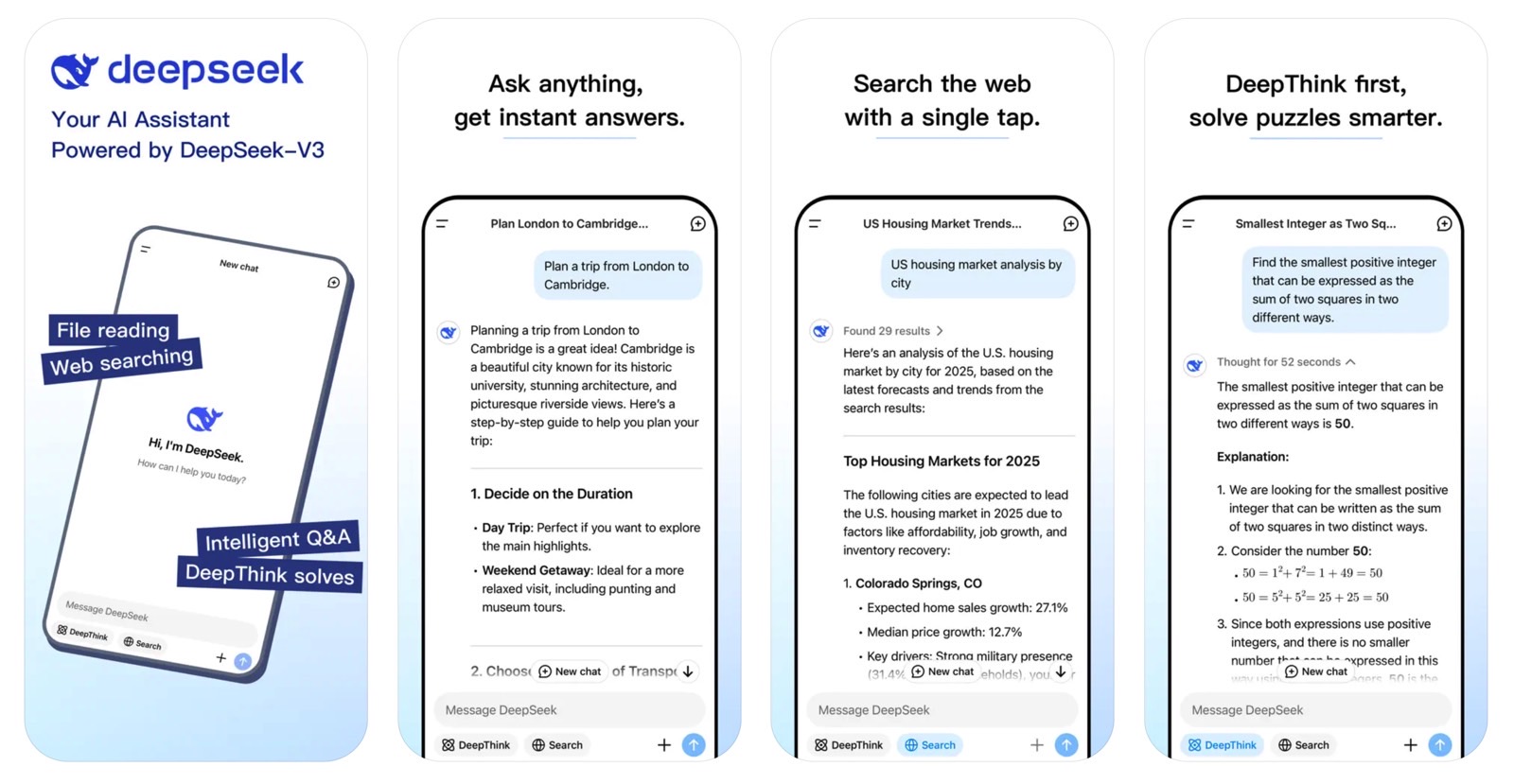
DeepSeek AI went viral in January. The iPhone app topped the App Store charts as users wanted to experience the chatbot that challenged the supremacy of ChatGPT. The DeepSeek privacy policy soon became an important topic, which isn’t surprising for a new AI product. AI firms routinely want to use data from chats to train their LLMs. OpenAI does it with ChatGPT, too. You should always try to opt out of training when you sign up for any new AI product. If you can’t, then reconsider using it.

With DeepSeek AI, there was a different concern. DeepSeek is a Chinese company, so all the prompt data from its DeepSeek AI models is sent to China. All other user data is sent to China as well, just like TikTok.

This is enough of a worry for Western countries to consider banning DeepSeek. The US is reportedly considering a nationwide ban on DeepSeek, with the AI tool already having been prohibited on some government devices.

But a ban might not be necessary, considering what just happened in South Korea. The country actually banned the DeepSeek mobile apps a few months ago, starting a privacy-centric investigation of the AI app. The Personal Information Protection Commission (PIPC) concluded its investigation last week, finding that DeepSeek has been sending data to China and US companies without obtaining user consent. But the country still chose to allow the DeepSeek apps in its local app stores.

Tech. Entertainment. Science. Your inbox.

Sign up for the most interesting tech & entertainment news out there.

By signing up, I agree to the Terms of Use and have reviewed the Privacy Notice.

As a result, DeepSeek is now available on iPhone and Android in South Korea. The company updated its privacy policy with language that is specific to South Korea, and it will publish a privacy policy in Korean. While DeepSeek will have to obtain authorization from South Korean users to transfer data to China, it will still send that data to its home country rather than setting up servers in South Korea.

The PIPC published its findings late last week, per CNBC. The data protection authority found that DeepSeek collects personal data from South Korean users and transfers it to China without user consent.

The PIPC found that DeepSeek transferred AI prompts, device, network, and app information to a Chinese cloud company called Beijing Volcano Engine Technology Co. This company is affiliated with ByteDance, the owner of TikTok. However, the PIPC found that it’s a separate company from ByteDance and has no relationship with the latter.

The watchdog said that DeepSeek used Beijing Volcano to improve the security and user experience of the DeepSeek AI app. DeepSeek stopped transferring AI prompt data from Korean users on April 10th.

The PIPC told DeepSeek to destroy the AI prompt data transferred to Chinese companies and set up legal protocols for transferring personal user data to other countries. Other AI apps available in Korea also transfer data outside the country, but they ask for user consent first, something DeepSeek failed to do.

A few days after the PIPC published its findings, DeepSeek is available to download in South Korea, Reuters reports. Presumably, DeepSeek made all the changes the South Korean watchdog demanded to avoid a longer ban, and it’s now able to make its DeepSeek apps available in the country again.

DeepSeek remained available after the mid-February ban. Despite the privacy investigation, anyone who still had the mobile apps installed or installed the open-source build could still use the service. Now, new users can install the mobile apps.

DeepSeek also published an updated privacy policy that contains special provisions for European and South Korean users. In theory, that means DeepSeek in Europe and South Korea will enjoy better privacy protections than other markets.

In practice, you still have to trust DeepSeek with your data, which will continue to be stored in China. Anyone worried about the potential ties between the startup and the Chinese government might want to avoid using DeepSeek, even is the South Korean privacy watchdog lifted the ban, signaling the Chinese company will comply with the country’s privacy requests.

The US government has yet to announce a nationwide DeepSeek ban, temporary or otherwise. It’s also yet to implement the TikTok ban that has been batted around since last year.

Source

Posted on

Perplexity AI now works in WhatsApp

WhatsApp might be one of the natural homes of Meta AI, but that doesn’t mean you have to use the app to talk to Meta’s AI chatbots. Meta practically forces Meta AI on Facebook, Instagram, Messenger, and WhatsApp users. Whether they want to use Meta AI or not, Meta has made big changes to these apps, so the Meta AI button/menu gets prominent placement. You might even activate Meta AI by mistake if you’re not careful. Also, nobody would blame you for tapping the Meta AI button at least once if you didn’t know what it’s about.

But you have options if Meta AI isn’t your default choice for chatting with AI. You can even chat with competing AI models in Meta’s WhatsApp, the world’s most popular instant messaging app. The best part about it is that Meta can’t stop you. WhatsApp chats use phone numbers to work. All an AI company needs to do is assign a phone number to its chatbot and make that AI work with WhatsApp.

OpenAI did it first, bringing ChatGPT to WhatsApp a few months ago. OpenAI upgraded the feature. It’s unsurprising to see others do the same thing, especially Perplexity AI, which is clearly looking to expand its footprint.

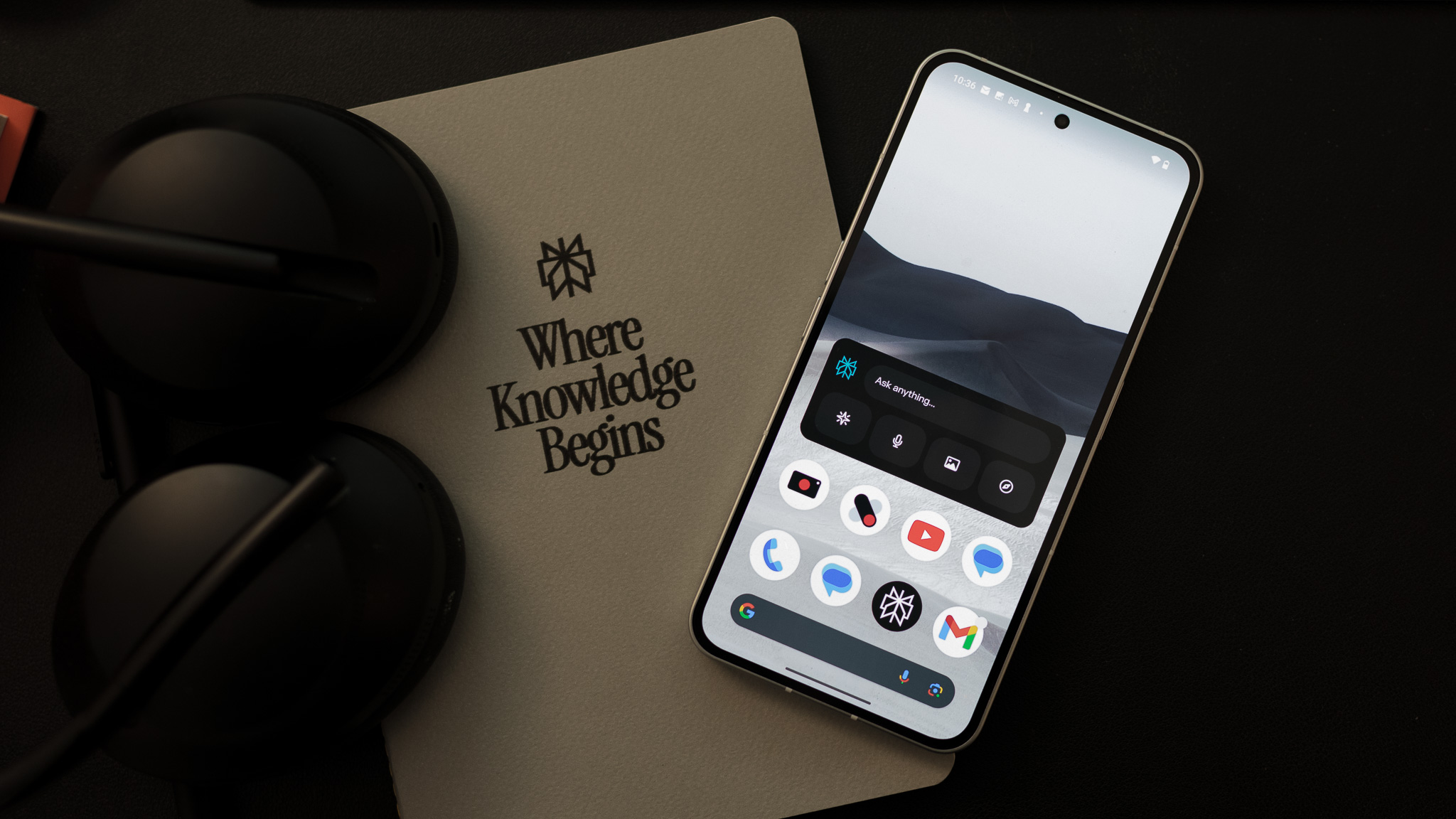
The AI search engine is now available in WhatsApp and is incredibly easy to use. Add Perplexity AI’s phone number to your contacts, and you’ll have Perplexity AI ready to chat with you on WhatsApp. Is it a good idea to go to Perplexity instead of ChatGPT? Now, that’s another matter.

Tech. Entertainment. Science. Your inbox.

Sign up for the most interesting tech & entertainment news out there.

By signing up, I agree to the Terms of Use and have reviewed the Privacy Notice.

How to use Perplexity AI on WhatsApp

Perplexity AI CEO Aravind Srinivas announced the feature on X, listing the AI’s abilities inside WhatsApp and teasing that more features will be coming:

You can use Perplexity directly from WhatsApp now. Answers, sources, image generation. A lot more features coming soon there!

Srinivas also shared the Perplexity AI phone number you must save to chat with Perplexity AI in WhatsApp: +1 (833) 436-3285.

It doesn’t matter where you are in the world; you can save the phone number, start a WhatsApp chat, and Perplexity AI will answer your questions.

Since this is an end-to-end encrypted chat app, the contents of your chat will be protected. However, what happens with the data that ends up on the other side of the chat is unclear.

But should you use Perplexity at all?

That’s a big reason not to use Perplexity AI in WhatsApp, considering what the CEO said a few days ago. Aravind Srinivas said the company’s upcoming browser is supposed to track everything about users so Perplexity can then serve relevant ads to the user. That’s incredibly disturbing.

Perplexity wants to use AI and do exactly what Google and Facebook are doing. It’s one thing for a personal AI chatbot to collect data about the user so it can work as a personal assistant and something else to harness all that data for ad purposes. It’s even scarier than what Facebook and Google did in the pre-genAI era. The AI can help Perplexity create even better user profiles for ad purposes. The company might also want to use that data to train its AI models.

That brings me to another reason to avoid Perplexity AI right now, whether it’s WhatsApp or the web. The company doesn’t rely on its own home-grown AI models to answer queries. Instead, Perplexity uses models from OpenAI, Anthropic, Meta, and X. You’d be better off using ChatGPT, Claude, Meta AI, and Grok instead of Perplexity AI.

Then again, if you like Perplexity, you might want to use the dedicated mobile or web app to access its AI instead of WhatsApp. You’ll get a better experience. The same argument is valid for ChatGPT. Rather than ChatGPT, you’d be better served by the iPhone, Android, and web apps.

Why WhatsApp makes sense for AI

However, there are unique advantages to bringing AIs like ChatGPT and Perplexity to WhatsApp. First, companies like OpenAI and Perplexity might get more users, especially in markets where internet users are likelier to spend time in social apps than mobile or web apps.

Secondly, WhatsApp traffic might not count towards someone’s monthly internet traffic in some emerging markets. That would give users access to AI products like ChatGPT, Perplexity, and Meta AI, without requiring third-party apps that would eat into their monthly data allowances.

There’s also the matter of convenience for everyone using WhatsApp. Why switch to an AI app if you can chat with an AI chatbot inside WhatsApp? That’s actually Meta’s pitch for forcing Meta AI access on WhatsApp users.

With all that in mind, you can choose whether to bring AIs into your WhatsApp chat and what models to use. If I were you, I’d stick to ChatGPT, but then again, I use ChatGPT primarily on the web.

Source

Posted on

Satechi launches sleek Qi2 travel chargers designed for power users

After introducing a new lineup of Qi2 accessories at CES 2025, Satechi is finally ready to launch its new travel chargers designed for power users on the go.

Satechi’s updated OntheGo collection features the latest technologies to help users have a stress-free experience when traveling abroad or with multiple Apple devices.

The Satechi OntheGo Wireless Chargers with Q2 technology are available in 2-in-1 and 3-in-1 options. They simultaneously deliver 15W of power to a MagSafe-enabled iPhone and 5W to AirPods. The 3-in-1 model adds support for Apple Watch fast charging (Apple Watch Series 7 or newer), and all the devices can be powered through a single cable.

Satechi says these Qi2 wireless chargers are designed for travelers who “demand both performance and style. With a lightweight circular design and sophisticated vegan-leather craftsmanship, they easily slip into a pocket, purse, or carry-on.”

Tech. Entertainment. Science. Your inbox.

Sign up for the most interesting tech & entertainment news out there.

By signing up, I agree to the Terms of Use and have reviewed the Privacy Notice.

These chargers join other must-have accessories from the brand, including the Vegan-Leather FindAll Passport Cover and 3-in-1 Foldable Qi2 Wireless Charging Stand, which BGR has reviewed previously.

The Vegan-Leather Passport Cover is one of the most convenient accessories for recurrent travelers, as it’s possible to locate your passport using the Find My network. It also offers space for a few credit cards and your boarding pass.

On the other hand, the Satechi 3-in-1 Foldable Qi2 Wireless Charging Stand is my go-to charging stand whenever I’m at home, at the office, or even during travel. Its premium design is sleek enough to put in any backpack, and its charger can also help me juice up my MacBook Pro or iPad Pro. You can learn more about it here.

That said, if you want something more affordable that can also help you get the most out of trips, the new OntheGo 3-in-1 Wireless Charger and OntheGo 2-in-1 Wireless Charger might be your best choice.

They’re now available for purchase for $99.99 and $79.99, respectively, at Satechi.net.

Source

Posted on

Researchers ran an unauthorized AI experiment on Redditors

Reddit users thought they were debating real people. Instead, they were unwitting subjects in a secret AI study, and they’re not happy about it.

Researchers from the University of Zurich quietly ran a Reddit AI experiment on r/changemyview, one of the platform’s most popular communities. They used large language models to generate personalized comments aimed at swaying users’ opinions, without telling anyone.

Even worse, the AI crafted fake identities, posing as everything from trauma counselors to political activists, all while tailoring their arguments based on users’ Reddit histories. After the study’s completion, the researchers reached out to the moderators of the community to start a “debrief” with the community.

Suffice it to say, the moderators of r/changemyview were furious, accusing the researchers of violating multiple community rules, including rules that ban the undisclosed AI use and automated accounts. They filed a formal complaint with the University of Zurich and demanded the study’s results never see the light of day.

Tech. Entertainment. Science. Your inbox.

Sign up for the most interesting tech & entertainment news out there.

By signing up, I agree to the Terms of Use and have reviewed the Privacy Notice.

Reddit itself hasn’t held back either, with the company’s Chief Legal Officer calling the Reddit AI experiment “deeply wrong on both a moral and legal level.” All accounts linked to the project were permanently banned, and Reddit is even seeking some legal action in regards to the study.

The researchers tried to defend their actions in a lengthy Reddit post, saying the study was low-risk and could help online communities defend against malicious AI campaigns. But many Redditors aren’t buying it. As the moderators pointed out, studying Reddit data is one thing; secretly manipulating real conversations is another.

The fallout is already forcing change. The University of Zurich said that it is tightening its ethical review process, promising stricter oversight for future experiments, Engadget reports. The researchers, facing heavy backlash, have agreed not to publish their findings, though you can read an archive of many of the comments for yourself.

Still, the damage is done, and this Reddit AI experiment isn’t something we’re likely to forget about anytime soon. At least the last time something like this happened, it was just Redditors arguing over whether a photo was AI or not.

Source