
Posted on

UK needs better defences to protect undersea internet cables from

The government has been urged to step up defences to sabotage threats from Russia against undersea cables that provide critical internet connections for financial services, datacentres and military communications.

A cross-party group of MPs and peers has warned the UK has “been too timid” in defending the undersea internet cable network from potential attacks by Russia and other hostile nation states.

Parliament’s Joint Committee on the National Security Strategy warned in a report that Russian aggression can escalate much faster than UK resilience measures could be upgraded.

“We can no longer rule out the possibility of UK infrastructure being targeted in a crisis,” the committee said.

“We are also not confident that the UK could prevent such attacks or recover within an acceptable time period.”

Nato’s general secretary, Mark Rutter, warned in June that Russia would be “ready to use military force against Nato within five years”.

UK is dependent on subsea internet cables

The UK is a global hub for internet traffic, and almost entirely reliant on subsea cables to exchange data with other countries.

The UK has about 62 subsea cables, roughly 50 of which are thought to be active, to connect it with the rest of the world and to provide resilience if some are deliberately or accidentally damaged. Additional cables run through the Channel Tunnel.

MPs and peers warn in their report that a simultaneous attack on multiple cables, particularly during times of heightened tension or conflict, could cause significant disruption.

There is growing concern about malicious reconnaissance and sabotage of the UK’s underwater infrastructure, they say.

Parliament concerned over Russian threats

Experts told the committee that Russia operates titanium-hulled vessels that can target cables at extreme depths and is willing to recruit freelance shipping operators to damage undersea cables by dragging their anchors.

In January, Russian spy ship Yantar was challenged in British waters after being observed “gathering intelligence and mapping the UK’s critical underwater infrastructure”.

MPs and peers say the UK’s outlying islands, military cables and cables used by the financial sector are vulnerable. While sabotaging these links may not cause national disruption, it would be “costly, provocative and hard to prevent”.

Their report says that onshore landing stations, such as Lowestoft, which houses five cables, and Bude, which houses nine cables, could also be at risk, and that some sites could be “rendered inoperable” by sabotage.

Risk of ‘catastrophic disruption’

The committee said coordinated attacks could cause catastrophic disruption, including failures in payment systems and supply chains, degraded communications, overstretched emergency responses, and unexpected cascading issues as online authentication applications are disrupted.

When a fishing vessel accidentally severed cables to the Shetland Islands in 2020, residents reported widespread card payment failures, and disruption to mobile phones and landlines.

Damage to a cable connecting Orkney and Banf in 2025 disrupted business internet connections and led to the closure of a hospital switchboard.

The financial sector relies on subsea cables for high-frequency trading, with over $1.5tn in cross-border trade travelling through undersea cables each day.

The loss of key low-latency connections combined with damage to backup routes could cause “significant disruption”, the committee said.

UK needs better preparation

The parliamentarians call for more robust resilience plans, particularly in the financial sector, and updated contingency planning to account for damage to onshore landing stations.

Their report recommends that the government acquires a cable repair ship by 2030, to address the lack of a sovereign repair capacity.

It also calls on the Royal Navy to establish a cadre of reservists and serving personnel to learn cable repair skills, to ensure cables could be repaired in the event of a conflict.

Other recommendations include scaling up cable monitoring schemes, rapid data sharing with law enforcement, legal sanctions, and a greater focus on “direct physical interdiction and prosecution” of suspicious vessels and crew.

Matt Western, chair of the Joint Committee on the National Security Strategy, said the undersea cables form the backbone of the internet, and carry financial transactions worth billions of pounds. “The scale of the UK’s strategic reliance needs to be taken more seriously,” he added.

“We must prepare for the possibility that our cables can be threatened in the event of a security crisis,” said Western. “Putin has shown every sign of wanting to test the soft underbelly of the Nato alliance. Our cables are sufficiently vulnerable to make them a target.

“We need stronger physical protections, better options to impose genuine costs for malicious activity and more comprehensive recovery plans,” he added. “It is conceivable that the UK’s national resilience will be tested in the coming years. We need to be ready.”

Source

Posted on

iPhone 17 Pro And iPhone Air Benchmarks Start To Appear

The newest flagship devices from Apple will feature a new, higher-performing chip than the iPhone 16 lineup did. While Apple has made claims about what kind of performance you can expect to see when upgrading from an older iPhone to an iPhone Air or iPhone 17 Pro, benchmarks can often give us an even more detailed look at how a phone performs.

Thankfully, new benchmarks for the iPhone 17 Pro and iPhone Air – both of which sport the upgraded A19 Pro chip — have started to appear online. This could give us a decent glimpse of what to expect from the newer iPhones when they start hitting people’s hands next week.

As always, real world use may vary compared to benchmarks. It’s also important to note that these benchmarks are currently “unconfirmed,” which means we can’t say for sure that they are taken from an iPhone 17 Pro or iPhone Air specifically. That said, prospective buyers might at least get a better idea of what to expect from Apple’s most powerful smartphones to date.

Apple’s claims are nebulous as always

Natalyaburova/Getty Images

Apple’s claims about the performance we should expect from the iPhone 17 Pro and iPhone 17 Pro Max aren’t as clear as they could be. In a press release detailing the new devices, Apple writes: “A19 Pro enables iPhone 17 Pro and iPhone 17 Pro Max to deliver up to 40 percent better sustained performance than the previous generation — ideal for gaming, video editing, and running large local language models. The 6-core CPU is the fastest CPU in any smartphone, and the 6-core GPU architecture includes Neural Accelerators built into each GPU core, a larger cache, and more memory than A18 Pro.”

However, this doesn’t exactly say whether those performance claims are tied to the CPU, GPU, or both components combined. This isn’t especially surprising, given that Apple also doesn’t list the amount of RAM in any of its new iPhones anywhere. That said, there are multiple unconfirmed benchmarks based on both the CPU and the GPU, which paint a bit of a clearer picture.

What the unconfirmed iPhone 17 Pro benchmarks show

According to the CPU benchmarks shared on Geekbench, the A19 Pro appears to perform just 13 to 15% faster than the A18 Pro chip found in the iPhone 16 Pro lineup. That’s a far cry from the 40% improvement that Apple notes in its press release. However, the Metal scores — which are Geekbench scores based around GPU performance in a device — show that the iPhone 17 Pro chip performs up to 40% better than the iPhone 16 Pro’s chip did. That seems to point toward Apple’s claims being focused on the GPU.

Digging deeper, MacRumors says that it spotted another comparison on the iPhone 17 Pro product page, which notes that the A19 Pro chip offers up to 20% faster CPU performance compared to the A17 Pro chip that was found in the iPhone 15 Pro. That would line up nicely with the CPU benchmarks seen on Geekbench, even if they are currently unconfirmed.

What this ultimately means is that Apple device owners upgrading to the iPhone 17 Pro or iPhone Air from the 16 Pro lineup will likely see less of a performance leap than those who are running older devices like the iPhone 15 Pro. Fairly obvious, but worth knowing nonetheless. Even if you are a fan of the new design, if you just upgraded to the iPhone 16 Pro, it might not be a bad idea to wait for the iPhone 18 next year if performance is important to you.

Source

Posted on

iOS 26 Includes A Surprise Feature That Lets You Color

oasisamuel/Shutterstock

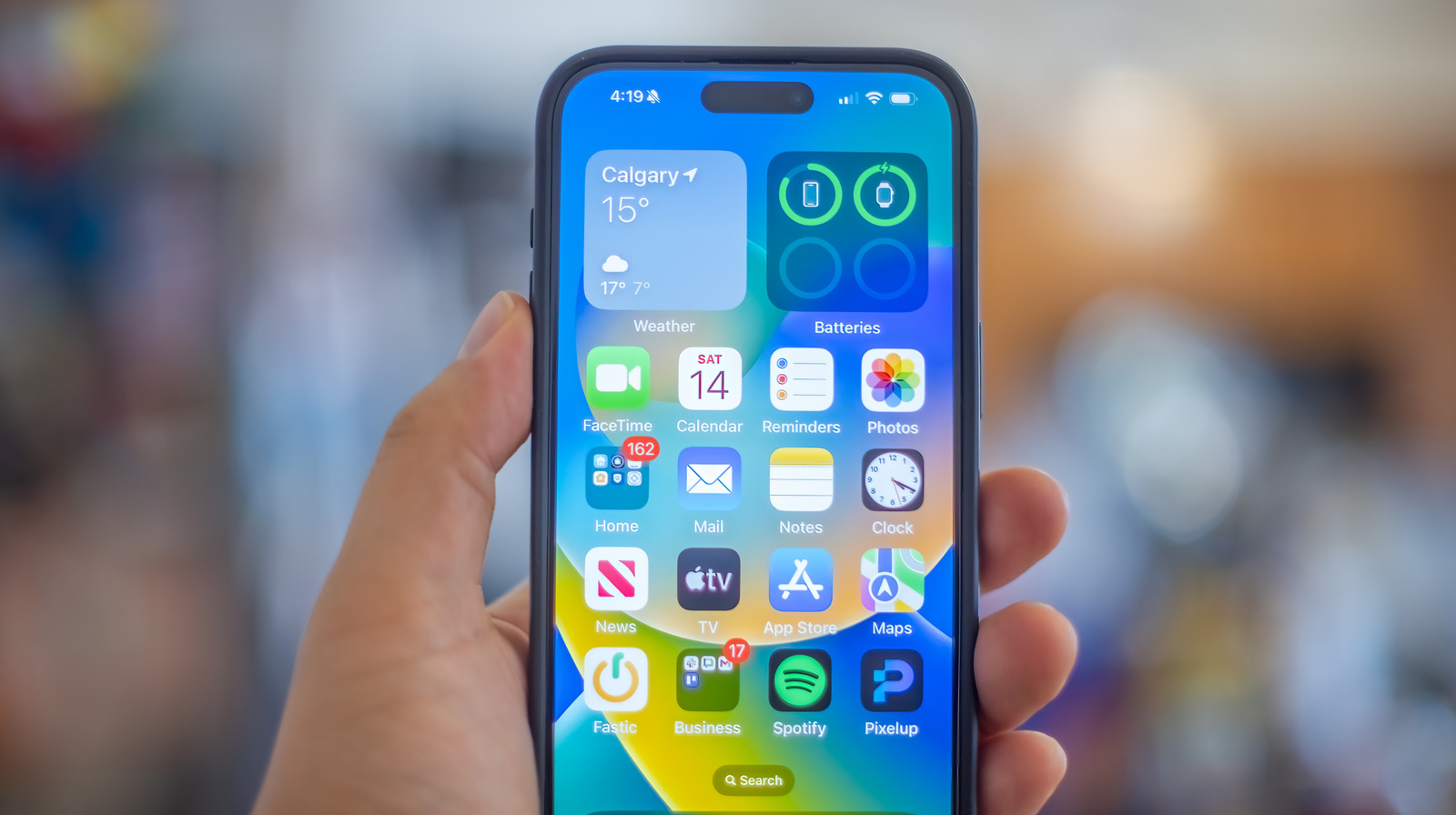
Apple added the option to customize your home screen icons back in iOS 18, allowing you to make them darker or even tint them based on a color in your wallpaper. Now, though, the company looks to be taking things a step further with even more in-depth icon customization in iOS 26. One way Apple is accomplishing this is by giving users the ability to match the color of their icons to their phone case. But only with certain cases.

For this new feature to work, you’ll need to have a MagSafe case that your iPhone can automatically recognize. The exact technology behind this is a bit unclear, but based on reports from MacRumors, it looks like the feature already appears in the iOS 26 release candidate and is based on how your phone communicates with MagSafe certified accessories. This is essentially an early look at the upcoming operating system, which should be available on September 15, ahead of the iPhone 17 and iPhone Air.

How to use the new case-match icon tint

Hadrian/Shutterstock

To make use of the new case-match tint, you’ll want to follow the standard steps to customize your home screen. Once you’ve selected Customize and pulled up the icon customization screen, you should be able to select from an assortment of options, including Default, Dark, Clear, and Tinted options.

Near the bottom of this menu, you will also be able to select a button that looks like the back of a phone case, which will automatically check your phone’s case color. If the phone can recognize the case, it will change the tint colors to match it.

Not all MagSafe phone cases will support this functionality. While there are plenty of “MagSafe Compatible” cases out there, but users will likely need a MagSafe certified case to make use of this functionality. This most likely means you’ll need to use a first-party Apple case, though any case that has the Made for MagSafe badge should work, as these are cases that trigger the MagSafe animation, work with full wireless charging speeds on MagSafe chargers, and should include the official MagSafe magnet array. They’re also designed to meet Apple’s MFi (Made for iPhone) standards.

Source

Posted on

Can LLMs understand scientists?

The use of large language models (LLMs) as an alternative to search engines and recommendation algorithms is increasing, but early research suggests there is still a high degree of inconsistency and bias in the results these models produce. This has real-world consequences, as LLMs play a greater role in our decision-making choices.

Making sense of algorithmic recommendations is tough. In the past, we had entire industries dedicated to understanding (and gaming) the results of search engines – but the level of complexity of what goes into our online recommendations has risen several times over in just a matter of years. The massive diversity of use cases for LLMs has made audits of individual applications vital in tackling bias and inaccuracies.

Scientists, governments and civil society are scrambling to make sense of what these models are spitting out. A group of researchers at the Complexity Science Hub in Vienna has been looking at one area in particular where these models are being used: identifying scholarly experts. Specifically, these researchers were interested in which scientists are being recommended by these models – and which were not.

Lisette Espín-Noboa, a computer scientist working on the project, had been looking into this before major LLMs had hit the market: “In 2021, I was organising a workshop, and I wanted to come up with a list of keynote speakers.” First, she went to Google Scholar, an open-access database of scientists and their publications. “[Google Scholar] rank them by citations – but for several reasons, citations are biased.” 

This meant trawling through pages and pages of male scientists. Some fields of science are simply more popular than others, with researchers having more influence purely due to the size of their discipline. Another issue is that older scientists – and older pieces of research – will naturally have more citations simply for being around longer, rather than the novelty of their findings.

“It’s often biased towards men,” Espín-Noboa points out. Even with more women entering the profession, most scientific disciplines have been male-dominated for decades.

Daniele Barolo, another researcher at the Complexity Science Hub, describes this as an example of the Matthew Effect. “If you sort the authors only by citation counts, it’s more likely they will be read and therefore cited, and this will create a reinforcement loop,” he explains. In other words, the rich get richer. 

Espín-Noboa continues: “Then I thought, why don’t I use LLMs?” These tools could also fill in the gaps by including scientists that aren’t on Google Scholar. 

But first, they would have to understand whether these were an improvement. “We started doing these audits because we wanted to know how much they knew about people, [and] if they were biased towards men or not,” Espín-Noboa says. The researchers also wanted to see how accurate the tools were and whether they displayed any biases based on ethnicity.

Auditing 

They came up with an experiment which would test the recommendations given by LLMs along various lines, narrowing their requests to scientists published in the journal of the American Physical Society. They asked these LLMs for various recommendations, such as the most important in certain fields or to identify experts from certain periods of time.

While they couldn’t test for the absolute influence of a scientist – no such “ground truth” for this exists – the experiment did surface some interesting findings. Their paper, which is currently available as a preprint, suggests Asian scientists are significantly underrepresented in the recommendations provided by LLMs, and that existing biases against female authors are often replicated.

Despite detailed instructions, in some cases these models would hallucinate the names of scientists, particularly when asked for large lists of recommendations, and would not always be able to differentiate between varying fields of expertise.

“LLMs cannot be seen as directly as databases, because they are linguistic models,” Barolo says.

One test was to prompt the LLM with the name of a scientist and to ask it for someone of a similar academic profile – a “statistical twin”. But when they did this, “not only scientists that actually work in a similar field were recommended, but also people with a similar looking name” adds Barolo. 

As with all experiments, there are certain limitations: for a start, this study was only conducted on open-weight models. These have a degree of transparency, although not as much as fully open-source models. Users are able to set certain parameters and to modify the structure of the algorithms used to fine-tune their outputs. By contrast, most of the largest foundation models are closed-weight ones, with minimal transparency and opportunities for customisation.

But even open-weight models come up against issues. “You don’t know completely how the training process was conducted and which training data was used,” Barolo points out. 

The research was conducted on versions of Meta’s Llama models, Google’s Gemma (a more lightweight model than their flagship Gemini) and a model from Mistral. Each of these has already been superseded by newer models – a perennial problem for carrying out research on LLMs, as the academic pipeline cannot move as quickly as industry.

Aside from the time needed to execute research itself, papers can be held up for months or years in review. On top of this, a lack of transparency and the ever-changing nature of these models can create difficulties in reproducing results, which is a crucial step in the scientific process.

An improvement?

Espín-Noboa has previously worked on auditing more low-tech ranking algorithms. In 2022, she published a paper analysing the impacts of PageRank – the algorithm which arguably gave Google its big breakthrough in the late 1990s. It has since been used by LinkedIn, Twitter and Google Scholar.

PageRank was designed to make a calculation based on the number of links an item has in a network. In the case of webpages, this might be how many websites link to a certain site; or for scholars, it might make a similar calculation based on co-authorships.

Espín-Noboa’s research shows the algorithm has its own problems – it may serve to disadvantage minority groups. Despite this, PageRank is still fundamentally designed with recommendations in mind.

In contrast, “LLMs are not ranking algorithms – they do not understand what a ranking is right now”, says Espín-Noboa. Instead, LLMs are probabilistic – making a best guess at a correct answer by weighing up word probabilities. Espín-Noboa still sees promise in them, but says they are not up to scratch as things stand.

There is also a practical component to this research, as these researchers hope to ultimately create a way for people to better seek recommendations.

“Our final goal is to have a tool that a user can interact with easily using natural language,” says Barolo. This will be tailored to the needs of the user, allowing them to pick which issues are important to them.

“We believe that agency should be on the user, not on the LLM,” says Espín-Noboa. She uses the example of Google’s Gemini image generator overcorrecting for biases – representing American founding fathers (and Nazi soldiers) as people of colour after one update, and leading to it being temporarily suspended by the company. 

Instead of having tech companies and programmers make sweeping decisions on the model’s output, users should be able to pick the issues most important to them.

The bigger picture

Research such as that going on at the Complexity Science Hub is happening across Europe and the world, as scientists race to understand how these new technologies are affecting our lives.

Academia has a “really important role to play”, says Lara Groves, a senior researcher at the Ada Lovelace Institute. Having studied how audits are taking place in various contexts, Groves says groups of academics – such as the annual FAccT conference on fairness, transparency and accountability – are “setting the terms of engagement” for audits.

Even without full access to training data and the algorithms these tools are built on, academia has “built up the evidence base for how, why and when you might do these audits”. But she warns these efforts can be hampered by the level of access that researchers are provided with, as they are often only able to look at their outputs.

Despite this, she would like to see more assessments taking place “at the foundation model layer”. Groves continues: “These systems are highly stochastic and highly dynamic, so it’s impossible to tell the range of outputs upstream.” In other words, the massive variability of what LLMs are producing means we ought to be checking under the hood before we start looking at their use cases. 

Other industries – such as aviation or cyber security – already have rigorous processes for auditing. “It’s not like we’re working from first principles or from nothing. It’s identifying which of those mechanisms and approaches are analogous to AI,” Groves adds.

Amid an arms race for AI supremacy, any testing done by the major players is closely guarded. There have been occasional moments of openness: in August, OpenAI and Anthropic carried out audits on each other’s models and released their findings to the public.

Much of the work of interrogating LLMs will still fall to those outside of the tent. Methodical, independent research might allow us to glimpse into what’s driving these tools, and maybe even reshape them for the better.

Source

Posted on

UK cyber action plan lays out path to resilience

A report produced for the government has today set out nine core recommendations for how the UK can strengthen its burgeoning cyber security sector to fuel resilience and growth across the economy.

Written by experts at Imperial College London (ICL) and the University of Bristol, and drawing on consultations with nearly 100 members of the cyber community, the UK cyber growth action plan slots into the government’s Modern Industrial Strategy, and will feed into an ongoing refresh of the National Cyber Strategy.

The report says that although the UK’s cyber sector remains on an upward trajectory, with jobs and revenue both rising by over 10% and gross value added (GVA) by over 20% in the past 12 months, taken as a whole, cyber is still undervalued. It describes “significant untapped potential” to go further still.

“The cyber security sector in the UK has significant growth potential, and there are clear roles for both government and the private sector identified … to contribute to tapping into that potential,” said Nigel Steward, director of the Centre for Sectoral Economic Performance (CSEP) at ICL.

“Supporting the sector isn’t just an economic opportunity, it’s essential for our national security and the resilience of businesses, so we at CSEP are very happy to have been able to produce this independent report in partnership with the University of Bristol to support the government’s Modern Industrial Strategy.”

Guy Poppy, pro vice-chancellor for research and innovation at the University of Bristol, added: “The UK’s cyber sector is a driver of innovation, resilience and economic growth. This action plan provides a timely roadmap, recognising how emerging technologies will shape future challenges and opportunities for stakeholders. It sets out a framework for research, skills and collaboration to turn innovation into growth and nationwide impact.

“By combining academic excellence with enterprise and policy engagement, we can help build a stronger, more resilient cyber ecosystem.”

Three pillars, nine recommendations

Each of the nine core recommendations is organised around three pillars – culture, leadership and places, designed to be implemented together to maximise their impact and force change at a systemic level.

The report’s authors caveated this by saying these are not designed to be exhaustive, and given how quickly the report was researched and compiled, it is likely that further work will be needed to create more granular recommendations.

On the first pillar, culture, the report recognises that growing British cyber businesses will depend on better interaction between product and service suppliers, and security buyers and leaders, and the first three recommendations are designed to address this.

  • First, government and stakeholders should review incentives and validation routes available to cyber businesses to help make it easier to navigate complex cyber demands and build a culture that helps organisations grow;
  • Second, government should stimulate growth by setting expectations on reporting cyber risk, encouraging uptake of cyber insurance and principles-based assurance, and possibly mandating the use of accreditations such as the National Cyber Security Centre’s (NCSC’s) Cyber Essentials scheme;
  • Third, cyber professionals should be engaged in civil society on their role in national resilience and prosperity to foster public participation in security. They could, for example, emphasise the role security teams at critical infrastructure operations play in keeping the nation’s homes lit and warm. This effort would also include shoring up cyber skills initiatives at schools and colleges to develop future talent.

On the second pillar, the report recognises that cyber leaders today tend not to be very focused on connecting supply and demand for sector growth. The fourth, fifth and sixth recommendations set out to address this.

  • The report recommends the appointment of a UK cyber growth leader to coordinate across the security sector and in the government. This role would encompass some duties previously held by the now-defunct UK cyber ambassador in promoting exports in support of the country’s national security, as well as a responsibility for driving forward a plan to prioritise cyber growth and integrate it into various policy areas;
  • Next, it calls for the appointment of “place-based leaders” who can convene and drive local cyber security growth initiatives and outcomes. Ideally, these individuals will have significant experience in the industry. Although they will work with the cyber growth leader, they should remain independent from all levels of government;
  • Then, the government should expand and better resource the NCSC, which the report’s authors describe as a “crown jewel” for cyber resilience, using its deep expertise in support of cyber growth, business guidance and validation, and technological research.

The third pillar recognises the role of “places” in innovation and growth. On this basis, the final three recommendations are designed to help attract cyber investors, shape research and development (R&D), and build relationships to help new security businesses get up and running.

  • Place-based leaders should be in place to develop future-oriented communities that bring together security pros and chief information security officers, academics, small and large businesses, government, and other stakeholders, to share perspectives and pursue solutions to security challenges. The goal here is to help initiate and deliver innovative projects, building a “culture of anticipation”;
  • Places should nurture distinct tech areas by being strategic in prioritising technologies and their areas of application based on local strengths and sector connections, aligned to government strategy. The goal here is local security strengths for local places that together are more than the sum of their parts and contribute to UK-wide growth;
  • Finally, places should create safe spaces or sandboxes, with on-tap infrastructure and data for various stakeholders to explore, create and conduct exercises such as role-playing cyber wargames. The goal here is not just to help create new initiatives, products and services, but to foster broader capabilities to serve in times of crises, should they arise.

All of these recommendations are underpinned by two principles – that the UK’s security sector should act as one team, and celebrate, build on and capitalise on the social capital in the cyber community, and that the benefits of cyber resilience and growth should always be recognised during discussions of value for money.

“The message from across the sector is clear,” said Simon Shiu, professor of cyber security at the University of Bristol, who led on the report’s creation.

“The UK has the talent, ambition and opportunity to lead in cyber security. We can do this by aligning growth with resilience, and making strategic choices that benefit the whole economy.”

NCC Group CEO Mike Maddison added: “The UK’s Cyber growth action plan is a bold step forward, recognising cyber not just as a technology, but as a strategic enabler of national resilience and economic growth. It builds on the Industrial Strategy’s clear message: cyber is a frontier industry.

“This plan sends a powerful signal to our clients and partners. It shows that the UK is serious about scaling innovation, investing in skills and commercialising research. And it confirms what we have always known, that cyber security is essential to the future of every sector.”

Source

Posted on

Here’s How iPhone Air Battery Life Compares To iPhone 17

“Despite being much thinner and lighter, iPhone Air still gets amazing all-day battery life,” Apple’s senior vice president of Hardware Engineering, John Ternus, said during Apple’s iPhone 17 launch event on Tuesday. “This is incredible — all-day battery life in our thinnest iPhone ever.” Hilariously, seconds later, Ternus revealed the “low-profile” MagSafe Battery accessory for the iPhone Air. “When using them together, iPhone Air has up to 40 hours of video playback! That’s enough to binge on all 40 episodes of For All Mankind, making it a great accessory for long trips.”

Apple didn’t offer battery life estimates for the iPhone Air like it did for the iPhone 17 and the iPhone 17 Pros in the keynote’s other segments. For the iPhone 17, Apple said the base model will get up to eight more hours of video playback than the base iPhone 16. Apple also said the iPhone 17 Pro gets up to an “astonishing” 39 hours of video playback.

Anyone watching the live event would have spotted potential red flags in the way Apple chose to portray the iPhone Air’s battery life. After all, battery life was one of the main concerns over the past year, as rumors and leaks said the ultra-thin iPhone Air would feature an ultra-thin battery. However, Apple does offer battery estimates on its website, and they’re better than expected. The iPhone Air will offer battery life on par with last year’s iPhone 16 models without the MagSafe Battery.

iPhone Air battery life explained

Apple offers battery estimates on its iPhone product pages online, as well as comparisons to other iPhone versions. Here are the battery estimates for the iPhone Air battery life, according to Apple:

  • Video playback: Up to 27 hours
  • Video playback with iPhone Air MagSafe Battery: Up to 40 hours
  • Video playback (streamed): Up to 22 hours
  • Video playback (streamed) with iPhone Air MagSafe Battery: Up to 35 hours

Here are the battery estimates for the other three iPhone 17 models and the five iPhone 16 models:

Video playback:

  • iPhone 17 Pro Max – Up to 39 hours
  • iPhone 17 Pro – Up to 33 hours
  • iPhone 17 – Up to 30 hours
  • iPhone 16 Pro Max – Up to 33 hours
  • iPhone 16 Pro – Up to 27 hours
  • iPhone 16 Plus – Up to 27 hours
  • iPhone 16 – Up to 22 hours
  • iPhone 16e – Up to 26 hours

Video playback (streamed):

  • iPhone 17 Pro Max – Up to 35 hours
  • iPhone 17 Pro – Up to 30 hours
  • iPhone 17 – Up to 27 hours
  • iPhone 16 Pro Max – Up to 29 hours
  • iPhone 16 Pro – Up to 22 hours
  • iPhone 16 Plus – Up to 24 hours
  • iPhone 16 – Up to 18 hours
  • iPhone 16e – Up to 21 hours

The iPhone Air battery will last at least as long as the iPhone 16 Pro battery. As a reminder, last year’s iPhone 16 Pro got a significant battery boost over the iPhone 15 Pro.

iPhone Air battery capacity and endurance

In Europe, Apple has to list energy labels for every iPhone model sold in the region. The documentation includes details that Apple doesn’t offer on the product pages of the iPhone in the U.S. and other regions. For example, the energy labels mention battery endurance per charge cycle and battery capacity, information some buyers might appreciate.

Here are the battery capacities for the iPhone Air, iPhone 17, and iPhone 16 models:

  • iPhone 17 Pro Max – 5,088 mAh
  • iPhone 17 Pro – 4,252 mAh
  • iPhone Air – 3,149 mAh
  • iPhone 17 – 3,692 mAh
  • iPhone 16 Pro Max – 4,685 mAh
  • iPhone 16 Pro – 3,582 mAh
  • iPhone 16 Plus – 4,674 mAh
  • iPhone 16 – 3,561 mAh
  • iPhone 16e – 4,005 mAh

Here are the battery endurance estimates Apple offers in the same documentation for the same models:

  • iPhone 17 Pro Max – 53 hours 0 minutes
  • iPhone 17 Pro – 47 hours 0 minutes
  • iPhone Air – 40 hours 0 minutes
  • iPhone 17 – 41 hours 0 minutes
  • iPhone 16 Pro Max – 48 hours 0 minutes
  • iPhone 16 Pro – 37 hours 0 minutes
  • iPhone 16 Plus – 48 hours 0 minutes
  • iPhone 16 – 37 hours 0 minutes
  • iPhone 16e – 41 hours 0 minutes

According to Apple’s documents, the iPhone Air should offer comparable battery endurance to the iPhone 17 and iPhone 16e and exceed the iPhone 16 Pro despite featuring a significantly smaller battery.

Source

Posted on

Not Every iPad Is Compatible With iPadOS 26

S_kaisu/Getty Images

iPadOS 26 is one of the most significant software updates for the iPad that Apple has released in a long time. Users can look forward to a revamped user interface with gleaming Liquid Glass visuals, new ways to organize windows and files, Apple Intelligence refinements, and so much more. And while the vast majority of iPad models will be eligible for the iPadOS 26 update, there are several versions of the Apple tablet that didn’t make the cut.

Here’s a complete list of every iPad that is compatible with the iPadOS 26 update, courtesy of Apple:

  • iPad Pro (M4)
  • iPad Pro 12.9-inch (3rd generation and later)
  • iPad Pro 11-inch (1st generation and later)
  • iPad Air (M3)
  • iPad Air (M2)
  • iPad Air (3rd generation and later)
  • iPad (A16)
  • iPad (8th generation and later)
  • iPad mini (A17 Pro)
  • iPad mini (5th generation and later)

Apple is serious about rolling out iPadOS 26 to as many of its tablets as possible, and as you’ll learn in the next section, there was only one model capable of running iPadOS 18 that didn’t make the grade.

The one iPad model left behind

Framesira/Shutterstock

Cue all the sad songs. Yes, there’s a single iPad model supported by iPadOS 18 that won’t be eligible for the iPadOS 26 update, and that’s the iPad (7th generation). We’re also going to tell you the reason why: its processor isn’t cool enough.

Pausing our hyperbole, the component to blame is in fact the seventh-gen iPad’s A10 chip. iPadOS 26 can only be installed on iPads using an A12 chip or newer, because the A10 Fusion doesn’t support the Apple Neural Engine. Neither do any chips older than it. One can think of the Neural Engine as Apple’s AI suite, which uses machine-learning processes and language tools to power its AI features.

With AI continuing to dominate the tech world, the Apple Neural Engine is going to be an integral part of Apple hardware moving forward. And even if your iPad does feature Apple’s Neural Engine, it’s only a matter of time before iPadOS outgrows older AI accelerators, leaving even more iPad models in the dust.

How to update your iPad to iPadOS 26

Ahyan Stock Studios/Shutterstock

Should you happen to own a version of the iPad that’s eligible for the iPadOS 26 update — and your device isn’t set up to receive automatic updates — downloading and installing iPadOS 26 is relatively straightforward. That said, you’ll need to wait until September 15 for Apple to roll out the official update.

If you’re reading this article on or after September 15, and want to update to the new iPadOS, grab your iPad and launch the Settings app. Tap General > Software > Software Update, and iPadOS 26 should be featured as the latest build you can download. You can also set your iPad up to receive automatic updates from this menu.

For those reading this before September 15, you can still download the beta version of iPadOS 26. However, you’ll need to have your Apple ID enrolled in Apple’s Beta Software Program to install either the developer or public version of the software.

Source

Posted on

The iPhone 17 Pro’s Design Is Polarizing: Will We Ever

For the first time since the iPhone 11 Pro, Apple has drastically changed the design of the top-of-the-line iPhone. The iPhone 17 Pro has a brand new aluminum unibody design with a camera bar that the company calls a “plateau that creates additional space for internal components.” Similar to the iPhone 11 Pro — where customers quickly called the camera module a cooktop — this new design has split people’s opinions. While some dig the new orange, blue, and silver options, it’s safe to say that Apple’s new bold design language is surely polarizing.

Apple has always used glass at the back of the iPhone for MagSafe and wireless charging capabilities, right from the iPhone X. This year, though, the iPhone 17 Pro uses an aluminum chassis that also stretches all the way to the back, with a glass window at the center to enable wireless charging. Along with a change in design, it’s also surprising how Apple ditched safe colorways like Black and Gold, and decided to take an unconventional route. These drastic developments beg the question: Will we learn to love Apple’s new design?

Even if Apple’s new iPhone 17 Pro design looks controversial, it won’t be around for longer

Right now, I’m still not sold on the iPhone 17 Pro’s new design, even though it means getting a more powerful device with better heat dissipation. What I’ve liked the most about the Pro iPhone models over the years is that they always had sober color options, so it was always easy to pick my favorite version, even if it meant choosing the same black variant over and over again. With the iPhone 17 Pro, Apple has gone all-in with the Cosmic Orange colorway, which is a bit too much for my liking. This is coming from someone who has rocked several blue iPhones, a Rose Gold iPhone 6s, a purple iPhone 14 Pro Max, and more over the years.

The Silver option seems like the most elegant one to recommend for most people. What’s promising, though, is that the company is rumored to introduce a foldable iPhone next year, followed by a 20th anniversary celebration in 2027. This could potentially mean that the iPhone could see a redesign sooner than expected, so this plateau design from the iPhone 17 Pro may not last for a long time. That said, the iPhone 17 Pro enters pre-orders on September 12, 2025, with the official release a week later. We’ll hopefully have a better opinion about the design once we get our hands on the phone.

Source

Posted on

Government meets with car parts suppliers amid JLR cyber crisis

The Department for Business and Trade (DBT) is conducting high-level engagement with Jaguar Land Rover (JLR) and the wider British automotive industry as car production remains suspended at JLR’s facilities following a cyber attack.

DBT representatives today (Friday 19 September) held an extraordinary meeting with the Society of Motor Manufacturers and Traders (SMMT) Automotive Components Section amid the ongoing disruption to the wider supply chain in the UK.

During talks, officials heard about some of the challenges the sector is currently facing thanks to the sudden shutdown at JLR. The Tata-owned carmaker produced over 300,000 vehicles in 2024 and employs over 30,000 people, so is a cornerstone of the UK’s automotive industry.

The DBT send it was working to understand the impact to the supply chain, and that the meeting had allowed it to listen directly and understand the challenges and concerns JLR’s suppliers are facing.

Computer Weekly understands that many of these suppliers have had to shut down their own assembly lines since they cannot now send their finished products to JLR, and some are facing the prospect of lay-offs as a result.

“We know this is a worrying time for those affected, and although Jaguar Land Rover are taking the lead on support for their own supply chain, our cyber experts continue to support them to resolve the issue as quickly as possible,” said minister for industry Chris McDonald.

McDonald additionally met with West Midlands mayor Richard Parker on Thursday 18 September to discuss the impact of the JLR shutdown on the region.

On 17 September, trade union Unite urged the government to consider setting up a furlough scheme – similar to the nationwide scheme put in place for many sectors during the early days of the Covid-19 pandemic in 2020 – to preserve the jobs of an estimated 200,000 people.

“Workers in the JLR supply chain must not be made to pay the price for the cyber attack,” said Unite general secretary Sharon Graham. “It is the government’s responsibility to protect jobs and industries that are a vital part of the economy.”

Unite has advised some of the affected workers that they may be able to apply for Universal Credit.

JLR production is currently scheduled to resume on 24 September, but according to the BBC, Unite believes there is “zero chance” of this happening.

Ongoing incident

The JLR incident began at the end of August but first became public on 2 September when the Liverpool Echo revealed that workers at the firm’s Halewood plant in Merseyside had been told not to come into work.

The attack came just days after the new 75 batch of vehicle registration plates were made available, a regular six-monthly switchover that goes alongside a boost to car sales in the UK.

JLR subsequently revealed that data was exfiltrated from its systems during the attack, although the precise nature of this data has not been disclosed.

The attack was swiftly claimed by a hacking collective referring to itself as Scattered Lapsus$ Hunters – an apparent collaboration between three associated groups, Scattered Spider, Lapsus$ and ShinyHunters. It should be noted that attribution is a highly-imprecise science and so the veracity of these links has not been officially confirmed by law enforcement.

Source

Posted on

Initiative to address escalating US broadband infrastructure attacks

Warning that the US’s broadband infrastructure is under unprecedented criminal attack by increasing levels of vandalism – leaving critical emergency services offline, hospitals struggling to function, law enforcement and government services disrupted, and communities vulnerable – the US broadband industry has launched the Strategic Threat Response and Infrastructure Knowledge Exchange (Strike).

Co-led by CableLabs subsidiary SCTE, and NCTA – the Internet and Television Association, the initiative confronts what the industry says is increasingly recognised as a serious national security crisis, representing a first-of-its-kind executive-level coalition addressing the spike in criminal attacks on essential broadband infrastructure.

Strike notes that in the June to December 2024 time period, 5,770 criminal acts of theft and vandalism were reported, amounting to approximately 824 per month, affecting more than 1.5 million customers. Furthermore, Strike says many of these incidents go beyond mere acts of vandalism, including deliberate assaults that disrupt key facilities including US military bases, 911 services, fire and police departments, healthcare facilities, law enforcement, government services and agencies, as well as educational and financial institutions endangering public safety and interrupting economic activity.

The core mission is four-fold: spotlight broadband damage and destruction as a top-tier national security threat; facilitate intelligence sharing to quickly identify and mitigate emerging threats; integrate policy advocacy, technical standards and operational protocols into a cohesive national defence strategy; and establish clear, unified communication with government stakeholders.

The initiative will aim to develop work done by the likes of the telecom industry summit on protecting critical communications infrastructure. Various technical working groups continue to highlight broadband infrastructure damage and destruction as a national security issue, urging the industry to respond effectively and collectively, bringing together various US industry groups, legislators, and federal and local law enforcement agencies.

Strike will also aim to unite executive leadership to accelerate best-practice adoption and deliver a coordinated, national security-driven strategy.

NCTA says it has experience in addressing these criminal threats to broadband infrastructure through its expertise in public policy, and advocating for federal US legislation to ensure attacks on public and private networks are treated equally and carry appropriate penalties. NCTA stresses that it has also taken the lead in encouraging agencies such as the US Department of Homeland Security and the Federal Bureau of Investigation to increase intelligence sharing, treat these infrastructure attacks as domestic terrorism when the facts warrant it, and allocate more resources to high-incident regions.

Strike aims to complement NCTA’s ongoing work, building on its foundations to provide a unified voice to government stakeholders. Its executive forum is already drawing on senior executives from leading broadband operators such as Comcast, Charter, Altice USA, CableOne, Cox, GCI, Mediacom and Rogers. Comcast’s Elad Nafshi is serving as chair and Charter Communications’ Tom Monaghan as vice-chair,

Emphasising the urgency in finding a solution, NCTA chief technology officer and senior vice-president in the US internet and television association Rik Thakker said: “This isn’t simply an industry issue; it’s a nationwide emergency. Strike will mobilise our collective strength, aligning policy advocacy with strategic operations to strengthen our efforts to protect America’s critical communications infrastructure.”

Strike will also use SCTE’s operational expertise to surface cross-operator insights that strengthen broadband resilience. SCTE has worked to set industry standards that help providers assess business impacts, gain secure access to incident areas, coordinate effectively with federal agencies, evaluate location-specific risks, and maintain continuity and rapid recovery during crises.

“A threat to broadband infrastructure is a threat to our national security,” added Maria Popo, Strike president and SCTE CEO. “Strike ensures that executive-level visibility is directly connected to frontline realities. This coordinated approach is precisely what’s needed to tackle this emerging threat decisively.”

Source