
Shop Loewe — $749
 RYO Alexandre/Shutterstock
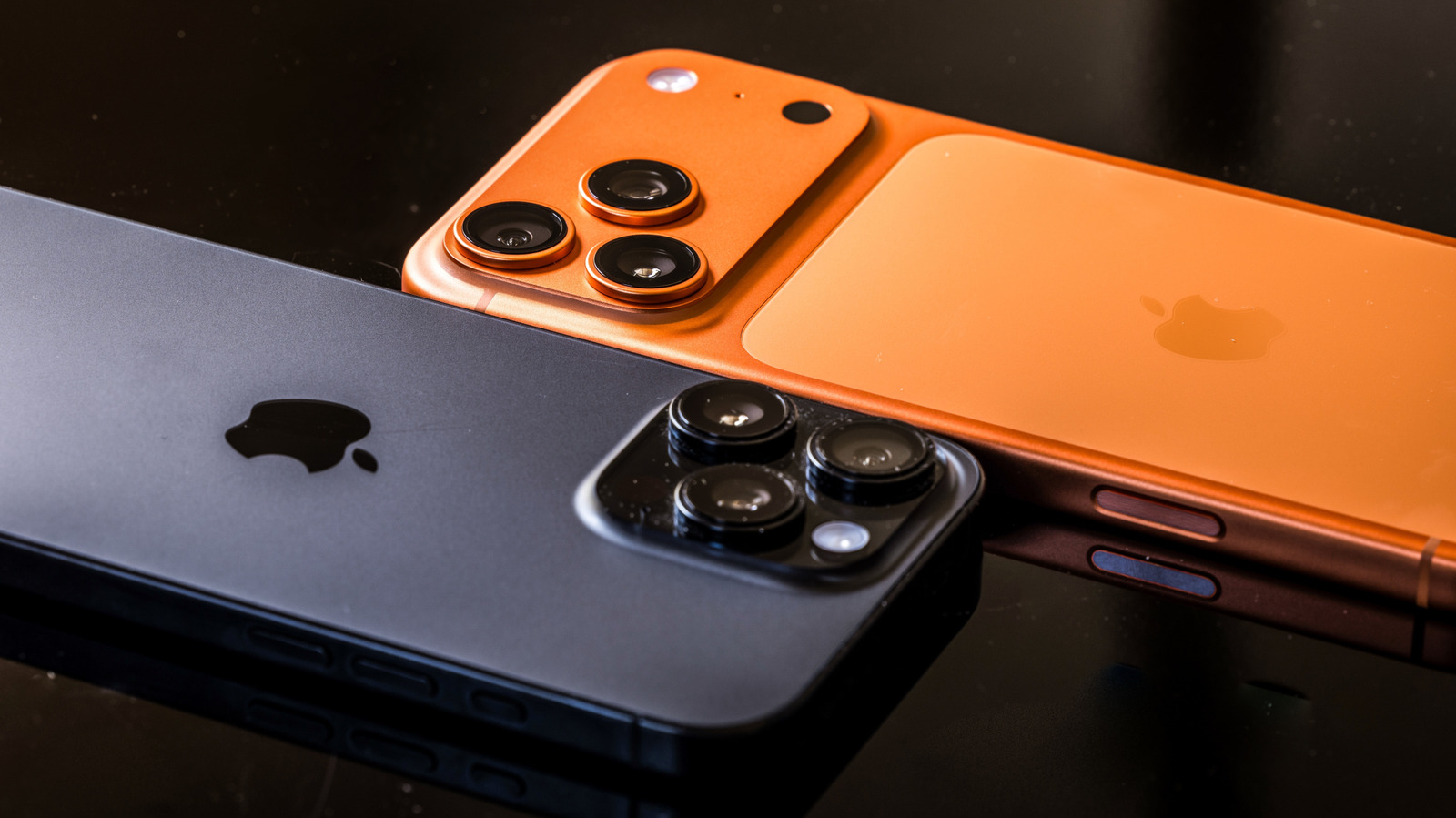
If you had a phone in the early 2000s, you’ll remember when the back of phones used to be mostly uniform, with the camera being just as thick as the rest of the device. Fast forward to 2016, and Apple’s iPhone 7 had its camera protruding from the back. You’d expect this trend to go away with time as technology develops, allowing manufacturers to fit more into less space, but the latest iPhone 17 Pro and Samsung Galaxy S26 Ultra models have the biggest camera bumps of their respective series to date.
Is there a reason that your smartphone’s camera can’t be flat, leaving a bump that makes your phone wobble each time you put it on a table? Well, yes — there are a number of factors that have led to this design, but it’s mostly a result of companies wanting to keep their phones slim. If you make your smartphone thinner but keep the camera size the same, there’s inevitably going to be a bump. With phones like the Galaxy S25 Edge being just 0.23 inches thick, the trend of camera bumps increasing in apparent size makes sense.
So why can’t these companies just make their cameras smaller? And when it comes to phones that aren’t getting thinner — such as the iPhone 17, which is slightly thicker than its predecessor — why are the cameras themselves increasing in size? The answer has to do with improving camera quality, the limitations of physics, and our current technology. Basically, if you want better photo quality, you need a bigger sensor that takes more space. This is why the best smartphone cameras all have noticeable camera bumps.
Why smartphone companies don’t make cameras smaller
 tinhkhuong/Shutterstock
A camera with a higher resolution will take sharper photos, so manufacturers often add more pixels to the camera sensors in their phones. This is what a megapixel represents, a cluster of a million pixels. However, when a company upgrades from a 50-megapixel camera to a 200-megapixel camera, the new system still needs to be small enough to fit inside the phone. If it were a straight one-to-one swap, each of the 200 million pixels would have roughly a quarter of the previous area to capture light, leading to worse quality despite higher resolution. That’s why smartphone cameras need a certain thickness — the sensors need to be a certain size to capture enough light to not compromise on picture quality.
Apart from the sensors, the physics of how a camera lens works also resist compactness. To get a clear image, you can’t place the image sensor too close to the lens itself. Light travels in straight lines and at specific angles. These rays of light converge at a specific focal point, and if there isn’t a certain distance between these two components — the camera sensor absorbing the light and the lens that redirects it — the resulting picture can appear blurry or have greatly reduced quality.
This is especially true if you want good-quality pictures from further away, such as when you’re using a telephoto lens. In the case of telephoto lenses, there are small mirrors that are used to physically increase the distance light travels. Since there’s no way to make a physical mirror or the real-world distance between any two objects more compact, a lens simply cannot be as thin as the rest of the phone without compromising on picture quality or zoom capabilities.
It doesn’t matter how thin a phone is if there’s a big camera bump
 Anna Hoychuk/Shutterstock
Many smartphone manufacturers are chasing a certain aesthetic to ensure their devices are viewed as premium, luxury phones. Lately, this has manifested in design decisions that err on the side of thinness, with several OEMs one-upping each other in a race to have the slimmest phone on the market.
A sentiment shared by many users online is that a big camera bump more or less defeats the purpose of having a thin phone. When you’re talking about compactness, any object is only as thin as its thickest part. Certain phone cases solve the issue of camera bumps by making the entire phone a uniform thickness, but at that point, is the phone really thinner?
If you use a protective cover for your phone that also makes it uniformly thick, then you didn’t benefit from it being slimmed down in the first place. However, if you’re using your phone without a case, the trend toward thinner devices will result in a more fragile phone with an uneven weight distribution and lots of wobble when you place it on its back. Considering there are no signs of camera innovations that would fix the above issues or indications that smartphone brands could revert to thicker phones, this trend is likely to continue. So your next phone might have an even bigger bump for its camera.






