Posted on

AI-enabled security pushes down breach costs for UK organisations

British organisations that have incorporated artificial intelligence (AI)-enabled solutions into their cyber security stack appear to be reaping the rewards of automation from a cost perspective at least, as data breach costs drop by hundreds of thousands of pounds.

This is according to the UK-specific cut of IBM’s latest annual Cost of a data breach report, released this week, which found that even though less than one-third of UK organisations have deployed AI-enhanced security, overall average data breach costs for those that have came in at £3.11m per annum, compared to £3.78m for those that had not.

The 2025 report, compiled on IBM’s behalf by the Ponemon Institute, surveyed more than 600 organisations and interviewed around 3,500 people worldwide that had experienced a breach in the period between March 2024 and March 2025. Approximately 8% of respondents are UK-based.

Elaine Hanley, partner at IBM cyber security services for the UK and Ireland, described AI as a massive benefit to defenders: “Organisations that are using AI-based threat detection and threat response are massively more effective than organisations that aren’t. But the negative side is that attackers are using AI. It’s a race where you’ve got threat actors using AI and being much more effective with it, then you’ve got the defenders at the organisation using AI to spot that faster.”

The IBM survey found that UK organisations making use of security AI and automation are able to identify and contain cyber attacks much quicker. Its data reveal that mean time to identify (MTTI) a breach at an AI-powered organisation was 148 days, and mean time to contain (MTTC) was 42 days, down from 168 and 64 days at organisations relying on traditional methods.

Running to catch up

The benefits of AI-powered security may be evident, but IBM also found that UK organisations are struggling to keep up when it comes to implementing AI-specific security policies.

For example, 63% of UK-based respondents said they did not have AI access controls in place to reduce the risks associated with potential cyber attacks against AI models or applications. Only 31% of UK-based respondents had governance policies in place to properly manage wider unsanctioned use of so-called shadow AI by their staff.

“IBM’s report shows a clear trend that AI technologies continue to be a great tool, not just for productivity but also for security purposes,” said Matthew Evans, chief operating officer and director for markets at TechUK.

“However, AI alone is not the answer – as data breaches become faster and smarter, people and organisations need the proper tools and skills to use AI in the right way to protect themselves. Lifelong learning in the form of courses, training, and certifications can make the difference in supporting organisations and their employees in protecting themselves from costly data breaches,” he said.

DevSecOps, SIEM, as important as AI

But this is not to say that AI is the only significant investment that defenders need to be making. The report also outlined that organisations paying proper attention to best practice around DevSecOps saw similar impacts to their breach costs, while spending security analytics and security information and event management (SIEM) also had an effect, although a slightly less valuable one.

Breach costs were pushed up at organisations that were experiencing large-scale use of shadow AI technology. Those that had more complexity in their overall security stack, and those that were failing to properly account for risks arising through their supply chains, were also seeing increased costs. Among surveyed UK organisations, third-party supplier and supply chain compromises were the most commonly identified breach causes, ahead of phishing and credential theft.

“It’s not just about how good your security is,” said Hanley. “You need to look at third-party risk management and look at all the people that you’re interacting with digitally, and make sure that they care as much as you do about security.”

Worldwide findings

More widely, the IBM report found that global average costs are falling in line with the UK, down to $4.44m (ÂŁ3.32m) on average, the first decline since 2020.

There were other encouraging trends to emerge in the data. For example, more organisations are now feeling empowered to push back against ransomware demands, with 63% opting not to pay compared to 59% last year.

However, perhaps more worryingly, the IBM data also reveal that post-breach investment plans seem to be stalling – with only 49% of breached respondents saying they planned to spend more on cyber security, compared to 63% last year.

Source

Posted on

Sam Altman Teases ‘A Ton’ Of ChatGPT Updates, But GPT-5

Andrew Harnik/Getty Images

GPT-5 has been the talk of the town lately, with reports claiming the highly consequential ChatGPT upgrade will drop in early August. Some reports suggested that GPT-5 would arrive after the launch of the highly anticipated open-source version of ChatGPT. OpenAI’s open model was rumored to launch in the final week of July, after multiple delays.

July is now over, and there’s still no open-source ChatGPT to download. These things happen. The biggest players in the field release new features on a regular basis. AI companies unveil new models and features every chance they get. The announcements come more frequently than we’re used to in the tech world. We wait a year between iPhone launches, but the next-generation AI upgrade is seemingly always just weeks away.

AI companies like OpenAI release their latest innovations as soon as they’re ready for mass consumption. ChatGPT Agent is one such example, a new AI model that can perform complex tasks on your behalf in a virtual computer of its own. The model arrived a few weeks ago, about half a year after OpenAI unveiled the Operator agent, now baked into ChatGPT Agent. The same goes for GPT-5 and the open-source ChatGPT model. OpenAI might need to conduct more safety tests before releasing the two models.

This is all speculation based on Sam Altman’s most recent tweet. The OpenAI CEO posted a teaser on X over the weekend saying that the company has “a ton of stuff” to launch in the coming weeks. He also said that hiccups might be part of the schedule, suggesting potential delays to some of OpenAI’s big launches.

Is GPT-5 delayed?

miss.cabul/Shutterstock

“We have a ton of stuff to launch over the next couple of months–new models, products, features, and more,” the CEO said, without revealing specifics. “Please bear with us through some probable hiccups and capacity crunches. Although it may be slightly choppy, we think you’ll really love what we’ve created for you!” It’s unclear why Altman felt the need to post this particular teaser on a Saturday. However, the tweet follows weeks of GPT-5 leaks and teasers, including Altman mentioning the ChatGPT upgrade on a few occasions.

“This morning, I was testing our new model, and I got a question. I got emailed a question that I didn’t quite understand. And I put it in the model, this is GPT-5, and it answered it perfectly,” Altman said during a podcast interview after a visit to Washington D.C. a few days ago. “And I really kind of sat back in my chair, and I was just like, ‘Oh man, here it is moment’ […] I felt like useless relative to the AI in this thing that I felt like I should have been able to do, and I couldn’t. It was really hard. But the AI just did it like that. It was a weird feeling.”

During his visit, there were numerous GPT-5 teasers posted online from savvy AI users who discovered that unreleased ChatGPT versions were being tested online under various codenames. All these teasers suggested the GPT-5 release was imminent. After all, Altman promised the GPT-5 upgrade for ChatGPT several months ago. Even with delays, if there are any, GPT-5 should drop this year.

What can GPT-5 do?

aileenchik/Shutterstock

Interestingly, Altman shared the update a day after The Information published an article titled “Inside OpenAI’s Rocky Path to GPT-5.” The publication said that GPT-5 should launch as soon as August, echoing similar reports from The Verge and Axios. While it didn’t say anything about a delay, that “rocky path” to GPT-5 hints at OpenAI’s struggles to build a bigger, better AI experience.

This wouldn’t be the first time we’ve heard about an AI company struggling to make meaningful upgrades to its models. It’s not just about the lack of data to train the more advanced models or the increasing infrastructure costs. Some reports claim that next-gen models like GPT-5 might not deliver the same massive leap as the GPT-4 family.

That said, The Information also presented the same general set of GPT-5 features that have appeared in other reports. GPT-5 will do away with the model picker, automatically deciding how to assist the user. Some questions will get immediate replies, while others will require in-depth reasoning. Like its predecessor, GPT-5 will be a multimodal AI, able to interpret text, images, and audio. The context window should increase in GPT-5, which should lead to improvements in memory and give the AI the ability to handle more data.

The report also noted that while the model picker is going away, OpenAI will still offer users multiple GPT-5 experiences. A core GPT-5 version will be available on the web and in its apps. Then there’s GPT-5 mini, which might work best for quick tasks. Finally, GPT-5 nano could be used on mobile devices and on other devices where an even lighter AI experience is needed.

Source

Posted on

iPhone 17 Pro Battery Leak Might Explain A Key Compromise

Wongsakorn 2468/Shutterstock

The iPhone 17 series will be unveiled in about a month, introducing one of the most noteworthy changes to the iPhone’s design since the iPhone X. The iPhone 17 Air will replace the Plus model, featuring a similar display size but a much thinner body. That’s what rumors have been saying for about a year, and iPhone leaks that pop up this often tend to be correct.

To achieve that ultra-thin chassis, Apple has made a few notable compromises, according to the same set of rumors. First, the rear camera will have only a single lens instead of the minimum of two that’s customary for most iPhones. The slim body also means the phone will feature a much thinner battery than before, with reports pegging it at around 2,800 mAh capacity. Finally, the iPhone 17 Air will not have a SIM tray in international markets where Apple still sells iPhones with physical SIM cards.

Even without leaks to spoil them, some of these compromises would seem obvious when considering an ultra-thin iPhone. The most concerning element of these rumors has always been the battery, but there’s a brand new iPhone 17 Pro battery leak that might explain a different iPhone 17 Air compromise — the rumored removal of the SIM card tray.

New iPhone 17 Pro battery leak

Leaker Majin Bu routinely shares Apple product rumors online. Not all of them turn out to be accurate, but many do. The new iPhone 17 Pro battery leak comes from Bu, who penned a blog post to show off purported iPhone 17 Air battery designs. However, he quickly corrected his report, noting that the batteries in the pictures he obtained show two different designs for the iPhone 17 Pro models.

Both batteries are enclosed in stainless steel, similar to the iPhone 16 Pro battery. That’s the only iPhone 16 model to feature a metal battery case. Batteries enclosed in metal should be safer to remove and easier to handle. They can also offer better cooling. Finally, the design allows Apple to prepare for new battery-related laws in the European Union.

If the images Bu produced are accurate, we’re going to see metal batteries in at least one iPhone 17 model. However, Bu makes a strange claim about these purported iPhone 17 Pro batteries. He says Apple will use two different L-shaped battery designs in the iPhone 17 Pro series, one for the U.S. market (image above) and one for international markets like China (image below). The latter would accommodate the SIM slot, which is absent from U.S. models. If that’s accurate, then the U.S. iPhone 17 Pro models should feature a slightly larger battery than the international ones.

The iPhone 14 models were the first ones to ship without physical SIM cards in the U.S. Apple did not repurpose that space to increase the battery capacity, and every iPhone sold in the U.S. since then has come without SIM trays. But they all featured the same batteries as their international counterparts. If Bu’s claim is accurate, this might be the first year when iPhones without SIM trays feature larger batteries.

What does this mean for the iPhone 17 Air?

The iPhone 17 Air, with its rumored 5.5mm profile, could benefit from this battery design choice. Internal space becomes an even bigger problem if you reduce the iPhone thickness significantly. Battery life has to be a priority for Apple, especially for the ultra-thin iPhone 17 Air. Bu’s iPhone 17 Pro battery leak seems to suggest that Apple will indeed sacrifice the iPhone 17 Air’s SIM card slot to utilize that space for extra battery capacity. This is speculation for now, and we’ll have to wait for the first iPhone 17 teardowns to see what sort of battery design Apple used.

Of all the rumored iPhone 17 Air compromises, dropping the physical SIM might be the most controversial. I say that as someone looking to buy the iPhone 17 Air this fall, but someone who isn’t excited about going eSIM-only. That’s the norm in the U.S. but not in Europe or other international markets. I’d take a slightly smaller battery in a thin iPhone with a physical SIM card if that choice were available.

On the other hand, Bu’s claim that Apple will use two different battery designs inside the same iPhone model is unusual. First of all, Apple would have to advertise different battery life estimates for the same device. Then there’s Apple’s supply chain to consider. Apple would save more money by using the same battery design instead of having suppliers manufacture two different batteries for three of the four iPhone 17 models. If Apple uses two battery designs for the iPhone 17 Pro, the iPhone 17 and iPhone 17 Pro Max might get the same treatment.

Source

Posted on

Apple Is Working On A New Answer Engine To Drastically

DenPhotos/Shutterstock

As part of its broader effort to improve its AI offerings, Apple is reportedly putting together an “Answers, Knowledge, and Information” team tasked with improving the Siri user experience. 

Originally brought to light by Bloomberg, Apple’s goal for Siri is to provide users with a more conversational experience while also improving Siri’s ability to handle general knowledge questions. Apple’s current plan is to develop an “answer engine” capable of scouring the web for pertinent and accurate answers to user queries. This development is certainly welcome news to folks who have been frustrated with Siri’s ability to quickly and accurately answer even simple questions.

Of particular interest is that Apple’s AI improvements may not just appear in Siri, but in a separate chatbot app as well. “A standalone app is currently under exploration,” the report notes, “alongside new back-end infrastructure meant to power search capabilities in future versions of Siri, Spotlight and Safari.”

Apple believes it can fix its AI mistakes

Wongsakorn 2468/Shutterstock

Apple isn’t currently a major player in the AI space, but recent comments from Tim Cook underscore the company’s confidence that this can change. During a recent internal meeting, Tim Cook said that Apple doesn’t pride itself on being first to market, but rather the best. To this point, recall that Apple wasn’t a first mover in either the MP3 player or smartphone market, but eventually came to dominate them both with the iPod and iPhone, respectively. Therefore, Cook believes Apple can do the same with AI. Cook also stressed that Apple is taking AI incredibly seriously and that it’s also open to making strategic acquisitions to “accelerate our roadmap.”

You might also recall rumblings that Apple was interested in acquiring Perplexity AI. While such an acquisition would immediately bolster Apple’s position in the industry, Perplexity’s recent valuation at $18 billion makes an outright acquisition somewhat unlikely. While companies like Meta aren’t afraid to throw around huge sums of cash for acquisitions, Apple has historically been much more frugal. Indeed, Apple’s most expensive acquisition to date was when it purchased Beats for $3 billion in 2014.

Apple is already hiring new AI engineers

Krongkaew/Getty Images

Apple over the past two weeks alone has added dozens of new job listings for experienced AI researchers and engineers to join the Siri team. For instance, one listing from July 24 seeks a Senior Machine Learning Engineer with deep LLM expertise to help Apple develop “state-of-the-art generative AI technology.”

Apple’s effort to solidify its Siri team with top talent comes at a crucial time. Over the last few weeks, Apple lost some of its more distinguished AI engineers to rival companies. For instance, Ruoming Pang recently left Apple to join Meta after being offered a $200 million compensation package. Pang will be especially tough to replace, as he was responsible for developing the foundational models that underpin Apple Intelligence. He was also in charge of Apple’s Foundational Model team.

For now, Apple’s nascent “Answers, Knowledge, and Information” team is under the direction of Robby Walker. Walker, if you recall, labeled Apple’s slow progress with Siri “ugly” and “embarrassing.”

Source

Posted on

Cloudflare Accuses Perplexity Of Scraping Websites Blocked From AI Scraping

Ahyan Stock Studios/Shutterstock

A new report from Cloudflare claims that Perplexity has been scraping content from websites that have opted to block AI web scrapers. The company says that Perplexity’s continued attempts to hide its crawling activity has led to diminished trust from websites that have opted out of sharing their content with AI companies like Perplexity.

In a new report shared on Cloudflare’s blog, the network service provider says that Perplexity has been using stealth and modifying its user agents and source ASNs to hide their crawling activity, as well as ignoring or completely failing to fetch the robots.txt files set up for these websites.

That particular file — for those who haven’t run a website — is responsible for relaying a website owner’s preferences to bots. And since Perplexity has supposedly been ignoring the preferences set by users, Cloudflare says it has delisted the company as a verified bot and has added additional measures to its services to block the stealthy crawling attempts. These accusations could throw a wrench into other ongoing plans from third-party companies like Samsung, which might have planned to include Perplexity on its S26 smartphones.

Testing the claims

Robert Way/Shutterstock

Cloudflare isn’t just blindly making these accusations. The company says that it conducted a series of tests and experiments to determine if Perplexity was really trying to skirt outside of the boundaries set by the owners of the various websites it was scraping. According to the findings that the team shared, it does appear that Perplexity has been figuring out ways around the preferences set by the websites.

Cloudflare says that it found that when met with blockage, Perplexity resorted to using an undeclared user-agent intended to mimic Google Chrome on macOS. This undeclared crawler then utilized multiple IP addresses not listed in Perplexity’s official IP range and would rotate through those IPs as it ran into blockages from the robots.txt file for certain pages.

While a Perplexity spokesperson told TechCrunch that the bot listed in the image shared within the research report isn’t one of theirs, that hasn’t stopped Cloudflare from standing strong against its allegations. This is also not the first time that Perplexity has been accused of scraping content without the proper authorization.

The concerns over this possible breach of trust have serious implications, as AI web scrapers have been under fire for years due to concerns they would plagiarize human written content to train the AI — thus profiting off of someone’s hard work. And with Perplexity’s Comet browser making headlines lately, this kind of accusation could incentivize some users to steer clear.

Source

Posted on

5G standalone adoption accelerates mobile core network market

Just over five years into the commercial launch of 5G, many mobile network operators (MNOs) around the world are offering 5G standalone (SA) and fixed wireless access (FWA) networks for enterprises, and growth in these advances on the base 5G infrastructure will be a key driver for technology spend, according to an industry report from Dell’Oro Group.

The Mobile core network and multi-access edge computing quarterly report estimates 70 MNOs have deployed 5G SA networks in 39 countries and territories. In 2025 alone, five new 5G SA networks were launched, including Orange in France, Romania and Slovakia; Vodafone in Spain; and O2 in Czechia. Regionally, there are five networks in North America, 26 in Europe, seven in the Middle East and Africa, 13 in Northeast Asia, 13 in Southeast Asia, and six in Latin America.

It calculates that the global 5G mobile core network (MCN) market is projected to grow at a 6% compound annual growth rate (CAGR) in the period of 2024–2029, with market acceleration largely driven by the increasing adoption of 5G Standalone (SA) architecture.

In parallel, the report notes that the multi-access edge computing (MEC) market is expected to expand at a much faster CAGR (17%), fuelled by the roll-out of dynamic network slicing, reduced capability (RedCap) devices, and the rise of network APIs aligned with GSMA’s Open Gateway initiative. It adds that 17 APIs have already been defined, with support from 72 MNOs worldwide. Suppliers are actively building and marketing Open Gateway-compliant services, further accelerating MEC adoption and ecosystem expansion.

The report also found that as 3G networks shut down, Circuit Switched Core networks must be upgraded to IMS Core to maintain voice calling on 4G networks, and that would mean the IMS Core/Voice Core cumulative revenue (2025–2029) would increase by 9%.

Commenting on the report, Dave Bolan, research director at Dell’Oro Group, said: “Our forecasts are primarily driven by subscriber growth rates and the usual subscriber behaviour, and for the 5G MCN segment, our current projection is at a 6% CAGR.

However, the emergence of generative AI and agentic AI, especially with increased data traffic and expectations for continuous, low-latency connectivity, may eventually require expanded network capacity, which could push the growth rate even higher. Agentic AI is also the key to reaching L4 autonomous networking, which could dramatically reduce operational costs for MNOs.”

Another similar and recent report by Dell’Oro projects that worldwide radio access network (RAN) revenues, excluding services, will stay flat and reach $160bn in cumulative revenue over the 2025–2029 forecast period, as rapidly declining LTE revenues offset continued 5G investments. New technologies and architectures such as Open RAN, Cloud RAN and AI RAN are seen as playing an important role going forward, but the analysis concludes they are not expected to expand the RAN market.

Dell’Oro regards the flat baseline scenario as implying upside risks if non-traditional RAN growth vehicles – including FWA, private wireless, public safety and mission-critical, and MBB expansion to support changing end user requirements – accelerate the market more than expected. 

As the investment focus gradually shifts from coverage to capacity, one of the most significant downward risks is slowing mobile data traffic growth. Should mobile data traffic growth decelerate more than anticipated, and operators transition into a maintenance mode following the completion of 5G coverage, capex-to-revenue could decline more sharply than currently projected.

“After two consecutive years of steep declines that wiped out nearly $9bn of RAN equipment revenues globally, it is encouraging that market conditions are now stabilising,” added Stefan Pongratz, vice-president for RAN market research at Dell’Oro Group.

“At the same time, we should not get too excited and assume a swift recovery. Market conditions can fluctuate over the short term, partly due to the asynchronous nature of new technology deployments. However, these ebbs and flows don’t alter the fundamentals that shape the long-term trajectory.”

The analyst also sees 5G Advanced technology as playing an essential role in the broader 5G journey, but does not expect this evolution will fuel another major capex cycle. Instead, it says operators will gradually transition their spending from 5G towards 5G-Advanced within their confined capex budgets.

Source

Posted on

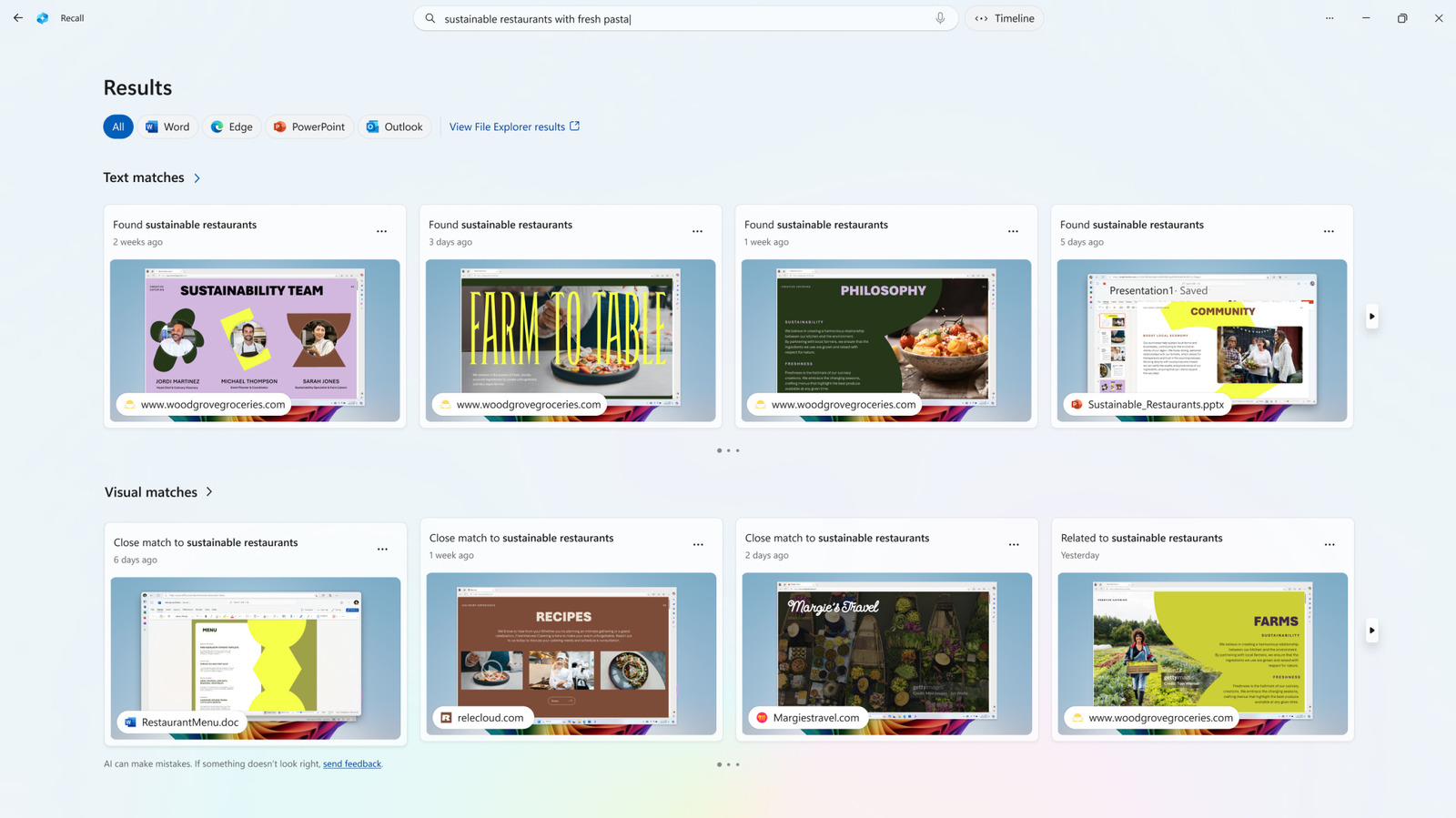
Reports Suggest Microsoft Recall Can Still Screenshot Credit Card Numbers

Perhaps unsurprisingly at this point, Microsoft’s controversial Recall feature is once again in hot water. The service, which is designed to automatically capture screenshots of your Windows desktop on a Copilot+ PC, was supposedly patched to disable it from capturing screenshots of sensitive information like credit card numbers, passwords, and more, but a new report suggest otherwise.

Despite Microsoft claiming that Recall does everything on the device on which it’s operating, there have been concerns around just how easy it might be for bad actors to get ahold of the information catalogued by Recall. This has led the company to release several updates and even temporarily remove the service in order to ensure it won’t be able to capture that information.

But it seems those “fixes” weren’t enough, as a new report from The Register claims that Microsoft Recall’s sensitive information filtering is good, but not always good enough, and that it occasionally captures sensitive information anyway.

Growing cause for concern

This wasn’t quite an unforeseen consequence, especially since filtering isn’t always going to be a tried-and-true method for blocking out sensitive content. But it does raise some questions about whether or not Recall is good enough as it is right now. It is worth noting that in this experiment, the author of the report was trying to push Recall to see when it would fail to filter out sensitive content, and some of the instances in which it didn’t filter might be too much to ask of an AI system that’s still technically labeled as a “preview” by its creators.

But there were other times where the pages that the reporter used with Recall should clearly have been seen as credit card payment pages, just without the words like “payment” and “credit card” included. It could be argued that Recall doesn’t have to understand when a specific sequence of numbers is a credit card, but one could also argue it’s better for the system to assume so and refuse to capture potentially sensitive data.

Of course, Microsoft has already made plenty of changes to Recall, but there might be more work ahead to help address these concerns. For now, though, these issues highlight one of the problems with embracing AI solutions like Recall.

It might be best to avoid Recall

Despite the sensitive information filtering, the fact that Recall can’t seem to identify credit card information unless the words “payment” or “credit card” are present does raise some questions about the filtering system’s efficacy. Other attempts to play up the system required the author of the report to resort to putting information in plain text files, which Recall then captured. That’s also concerning, but again, we can only expect the AI to identify so much of what is and isn’t sensitive information.

Personally, I wouldn’t ever fully trust a system like Recall. Even with the sensitive information filtering, there are too many possibilities for it to mess up and give potential bad actors access to far too much information if they ever gain access to my computer. And while this report from The Register is concerning, to say the least, there’s a bit of an inherent risk that comes with embracing AI like this. And you have to determine if that’s a risk you’re willing to take for the benefits that Microsoft claims it brings to the table.

Source

Posted on

MS Authenticator users face passkey crunch time

Microsoft’s move towards passwordless technology will kick up a gear from Friday 1 August 2025, when Redmond will implement new measures that in effect force users of its Authenticator application to migrate to passkeys by removing password support and deleting stored passwords

Since the start of June 2025, users of the Authenticator application have lost the ability to add or import new passwords through the app – although until July, they were able to continue saving passwords through autofill.

Since the beginning of July, they have not been able to use autofill with Authenticator and, beginning this week on 1 August, any passwords saved in Authenticator will no longer be accessible.

According to Microsoft, saved passwords – though not generated password history – and addresses will continue to be synced to user’s accounts and remain accessible through the organisation’s Edge browser.

If they have recently logged in, Authenticator users will have been promoted to set up passkeys at that time, but more guidance and next steps are available from Microsoft.

“The authentication landscape has evolved, and we now have better options available across many devices and services, with password managers, passkeys and biometrics all playing their part in reducing the burden and improving protection,” said Steve Furnell, a senior member at the Institute of Electrical and Electronics Engineers (IEEE) and professor of cyber security at the University of Nottingham.

“At the same time, these solutions are far from ubiquitous. Many leading websites still use passwords as the basis for sign-up and it varies whether other options are available or clearly signposted once accounts are set up. Password hygiene has only seen modest improvements and we’ve been addressing the same issues for decades.

“Keychains and autofill features offer some supplementary support by easing the memory burden of remembering multiple passwords. However, they don’t address the underlying bad practice in selecting, sharing and reusing passwords. Password managers can only assist if the features are properly implemented – and despite the availability of new tools, many people still struggle to maintain good password hygiene.”  

How passkeys work

Passkeys comprise two separate bits of encrypted information that must be paired to work – like a key and a lock. The first, private part is stored on the user’s device through an authentication app, and the second, public part, is stored with the destination service that has implemented passkey technology.

When a user attempts to log in to this service, it sends a notification to a user’s chosen authenticator app – others besides Microsoft Authenticator are available – on their mobile device.

The user can then use their fingerprint, facial recognition, or a personal identification number (PIN) on their device to unlock the app, which creates an encrypted, private passkey and sends it back to the service, where it is paired with the public key, thus logging the user in without them having transmitted any credential personally identifiable information (PII).

Passkeys do have some drawbacks – they are not available everywhere yet, which means some may struggle to keep up with managing them, and they require users to overcome any discomfort at incorporating biometric verification into their security practice.

Nevertheless, security experts do in general consider them to be much safer than passwords because they eliminate the need for users to memorise lengthy and complex passwords (or worse still, write them down).

Additionally, each newly generated private passkey is unique, so they cannot be reused across multiple services, and because the keys are only stored on the user device and not on the destination service’s infrastructure, they are less vulnerable to phishing attacks or keylogging malwares, and are harder to compromise in a data breach – an attacker who breached the service would only be able to obtain the public key.

A gradual transition

Darren Guccione, CEO and co-founder of Keeper Security, said that the elimination of password support by Microsoft suggests at first glance that the industry was moving rapidly towards normalising passwordless tech, however, rather than heralding anything so dramatic, the transition was proceeding rather more gradually.

“Solutions that can generate and secure traditional passwords remain critical for individuals and organisations alike even as passwordless becomes more widely adopted,” said Guccione.

Citing Keeper’s own research, Guccione said that 40% of organisations today are operating in a hybrid environment in which passwords and passkeys coexist.

“This is more reflective of the current cyber security reality – one in which passkeys offer distinct advantages but in which the infrastructure, user behaviour and systems required for universal adoption are still catching up,” said Guccione.

While this approach does introduce risks, he said, organisations that can strategically layer both passwords and passkeys can mitigate some of these by, for example, prioritising the use of passkeys in sensitive or regulated areas, such as managing privileged access to customer data.

“The end of passwords in one platform doesn’t signal the end of passwords altogether. It’s a slow and gradual transition that necessitates modern and agile security solutions,” said Guccione.

Source

Posted on

Nvidia’s Budget RTX 5050 Vs RTX 4060: Is The Upgrade

Stefan_Sutka/Shutterstock

With the latest Nvidia GPUs now available, it’s natural to consider an upgrade to a newer model. The RTX 50-series cards, which were among BGR’s best of CES 2025 picks, are worth taking a look at. Although the top-of-the-line models are performance powerhouses, don’t overlook the entry level cards, like the RTX 5050, which comes with all the same features as the pricier cards in the lineup.

New, exclusive features to the 50-series cards include the addition of upgraded machine learning-powered upscaling tech. Also available are upgraded AI cores that can push what’s possible when using creative software, making the 50-series cards a viable upgrade for gamers and creators alike. But is it worth upgrading?

When comparing the RTX 4060 with the RTX 5050, it’s clear that both GPUs are capable options when it comes to 1080p gaming. They are also affordable. Or, at least, more affordable than a 5090. If you’re a gamer, the reason to upgrade is that GPU prices moved closer to MSRP a few years ago. Plus, you’re going to get much better gaming performance from a new card. A higher, more stable framerate is a safe bet when upgrading. But when performance gains aren’t guaranteed by upgrading, what do you do?

The RTX 4060 is a better GPU

Tricky_Shark/Shutterstock

That’s not an opinion, it’s a fact. Based on head-to-head benchmarking, as seen on the RandomGaminginHD YouTube channel, the RTX 4060 is still a formidable GPU that can compete with Nvidia’s latest Ada Lovelace architecture GPUs. All the hype surrounding the Nvidia RTX 40 series reveal paid off, it seems.

When running the same game on 1080p with the ultra or RT preset, the RTX 4060 outmaneuvered the RTX 5050 card, showing that newer isn’t always better. For example, when playing “Baldur’s Gate 3,” the RTX 4060 had a framerate of 109 frames per second (FPS) compared to the 5050’s 101 FPS. In “Red Dead Redemption 2” and “Grand Theft Auto V,” the 4060 did better by 6 and 5 frames, respectively.

Granted, in games like “The Witcher 3: Wild Hunt” and “Cyberpunk 2077,” the RTX 5050 performed as well or better than the 4060. What’s worth noting is that the 5050 is a newer, pricier card that consumes more power. Based on price, performance, and power consumption, the RTX 5050 is not better than the 4060 on paper.

Upgrade to the RTX 5050 if you want the latest features

Jovana Kuzmanovic/Shutterstock

Despite being outgunned by the older RTX 4060 card, the RTX 5050 comes with new features that make it an enticing upgrade. The 5th Gen Tensor Cores improve AI performance, with the RTX 5050 having 421 AI trillions of operations per second (TOPS) compared to the 4060’s 242 AI TOPS. That may not matter much if you only need a high-end GPU for gaming, but it’s a big deal for creators, many of whom use creative software like Photoshop, DaVinci Resolve, and Blender.

The new DLSS 4 with Multi Frame Generation is another feature to get excited about. When combined, these two features can supercharge your gaming experience, significantly increasing frame rates and stability. While using AI to upscale gameplay and create new frames out of thin air can lower image quality and introduce latency, the higher FPS is a worthwhile trade-off.

If this doesn’t get you excited, you’re probably fine with your RTX 4060. But, if you can overlook a performance downgrade in exchange for the latest tech, the RTX 5050 is worth the upgrade.

Source

Posted on

Global LEO satellite comms services spend set to hit $14

Research from Gartner has pointed to the emergence of low-Earth orbit (LEO) consumer and business use cases that are driving communications service providers (CSPs) to expand the market to the point of enabling LEO satellites to become a mainstream enterprise broadband technology.

The study notes that to date, LEO satellites have primarily delivered broadband connectivity to remote locations where traditional networks don’t reach. Due to the fact that they orbit closer to the Earth than traditional satellite technology, LEO satellites can provide faster connections and lower latency. This allows them to deliver high-speed broadband and complement traditional terrestrial networks.

Gartner’s research, Forecast analysis: LEO satellite communications services worldwide, noted that the market is now entering a rapid expansion phase, with over 20 active LEO satellite service providers and more than 40,000 satellites expected in the next few years. The analyst calculates that end-user spending on LEO satellite communications services is expected to reach $4.8bn globally in 2026, an increase of 24.5% compared with the end of this year.

The analyst believes the largest growth in LEO satellite communications services in 2026 will come from businesses and consumers in remote areas with no other connectivity options, with spending expected to increase 40.2% and 36.4%, respectively. This is followed by LEO services for internet of things (IoT) connectivity (32%), maritime and aviation (13.8%), and network resilience improvement (7.7%).

Gartner’s report says emerging use cases for LEO satellite communications services can be categorised into four distinct areas: fixed and mobile broadband services; global IoT connectivity; supplementing mobile broadband services; and infrastructure backhaul.

For the former, Gartner says the main early use of LEO satellite services is for fixed and mobile broadband connectivity, especially for remote sites, and to augment existing broadband connections. Such services support use cases such as connectivity in areas with no broadband service, temporary locations like construction sites, or on ships and airplanes. They are also used for communication during emergency responses, or to improve resilience as fallback or backup connectivity to traditional broadband.

In an example cited in the report, Gartner noted that LEO-connected drones are being used in Australia to deliver 4G/5G mobile connectivity during natural disasters, while some French and US airlines are starting to offer free high-speed Wi-Fi to passengers using LEO satellite communications services.

Second, LEO IoT satellites can complement or even replace traditional IoT networks for applications needing global coverage, with limited bandwidth and latency requirements. They can be used for global asset tracking, agriculture, oil and gas, natural resources, transportation and logistics, military sensing, and security monitoring. The example given is global IoT connectivity deployed for land, sea and air using LEO satellites. An automaker in China has already launched 20 LEO satellites to improve navigation for autonomous vehicles, and plans to have a constellation of 240 satellites.

In terms of supplementing mobile broadband services, Gartner suggests LEO satellite communications services can supplement mobile broadband by providing seamless coverage and enhancing the user experience through direct-to-device connections and integration with 5G non-terrestrial networks.

Finally, regarding infrastructure backhaul, the report says both CSPs and companies with geographically dispersed operations can use LEO satellites for reliable and high-bandwidth connectivity, supporting critical applications, data transfer and communication needs independent of traditional terrestrial limitations. For example, LEO satellites can provide the necessary backhaul for the operations of government agencies and defence organisations, which often require secure and reliable communication links in remote or hostile environments.

Commenting on the report, Gartner senior director analyst Khurram Shahzad said there would be swings and roundabouts for the industry going forward. “As use cases continue to grow, companies and consumers can expect consistent internet access and internet of things sensing anywhere, without being limited by location. Even airplanes, ships and sea platforms will benefit from new means of network resiliency and a ubiquitous internet.

“Despite these expanding use cases, the industry remains nascent, with various limitations, including regulatory barriers in some countries and capacity constraints in certain areas. LEO services can also encounter roaming restrictions, lack interoperability and aren’t certified for all mission-critical maritime needs. It is important for CSPs to assess strategies on a use case basis.”

Source