Posted on

Were You Affected By The Verizon Outage? You May Be

rblfmr/Shutterstock

On January 14, 2026, the Verizon mobile network experienced an outage that lasted most of the day and purportedly affected over two million customers (via Down Detector). By 10 p.m. EST, January 14, the outage was fixed, and Verizon issued an official statement on the ordeal apologizing for the inconvenience and offering a $20 credit, which “can be easily redeemed by logging into the myVerizon app to accept.”

“This credit isn’t meant to make up for what happened. No credit really can. But it’s a way of acknowledging our customers’ time and showing that this matters to us,” Verizon’s statement reads. Besides apologizing and promising to continue working hard “day and night to provide the outstanding network and service that people expect from Verizon,” the company does not reveal what caused the outage, explain measures being taken, or mention how it plans to prevent future events like this. The good news is that if you were affected, like me, you should be able to log in to the myVerizon app and claim the credits soon, if not already.

It was odd for many Verizon users to see their home internet working just fine, even Wi-Fi on their phone, while the mobile network showed no signal at all — or in some cases, an SOS icon. I was one of the people affected for several hours on January 14. There was no way to send or receive texts, make or take calls, or handle anything data-related, at least not over mobile networks.

What caused the January 14 Verizon outage?

Khairil Azhar Junos/Shutterstock

Speaking to USA Today on January 15, a Verizon spokesperson claimed the outage was tied to software problems and mentioned the company is reviewing what happened.

This is not the first time a widespread outage affected Verizon customers. In March 2019, another major Verizon outage prevented users from sending and receiving texts over mobile networks. Yet another service disruption affected hundreds of thousands of customers in August 2025. But even previous outages didn’t last 10 hours or longer as this one has.

Verizon laid off over 13,000 employees in November 2025, adding to more than 100,000 full-time employees dismissed over the last couple of years. While there’s no indication these job cuts are tied to this outage, it likely had implications for customer experience. It’s especially problematic when Verizon quietly raised wireless bills and increased revenue, as reported in its third fiscal quarter earnings of 2025. Meanwhile, Verizon is investing in AI to lure customers away from competitors.

Source

Posted on

New tech frontier as resale moves from niche to mainstream

Recommerce, pre-loved, resale, or second-hand goods – whatever synonym one would like to use – is a big focus area for retail.

It has moved from niche to mainstream, according to the fifth annual Recommerce report from online marketplace eBay.

The report, published in November 2025, shows 89% of global consumers surveyed expect to spend the same amount or more on preloved goods in 2025 compared with 2024.With more than 27,000 people surveyed globally, including both eBay sellers and general consumers, it’s a comprehensive study that can be trusted.

A key finding from the report is that recommerce is no longer viewed solely as an alternative way to shop, but as “a conscious lifestyle choice driven by personal values, community connection and financial empowerment”.

As Jamie Iannone, CEO at eBay, says in the report: “Recommerce is redefining how people shop – led by a new generation that values connection, purpose and sustainability.

“Nearly 80% of Gen Z and millennials see themselves as part of this movement, turning their passion for preloved items into real impact.”

Iannone said eBay’s artificial intelligence (AI)-powered tools are making it “easier than ever” for people and retailers to resell goods online and give them another life under the ownership of someone new.

And the reference to technology is a pertinent one, because there’s a whole enterprise software market forming to support this ever-burgeoning area of retail.

In 2025 alone, resale platform provider Archive raised $30m in Series B funding, with the cash being used to develop the company’s “resale intelligence software”, drive more global partnerships, and deliver product innovation and services. That was announced last February, and then, in June, Germany-based Brandback revealed it had raised $7.4m across its pre-seed and seed funding rounds to support its growth in the space.

Brandback’s investment is being directed towards enhancing its engineering teams, working on its own AI capabilities, and onboarding more global retailers.

In 2025, Computer Weekly covered mobile apps 2.0, electronic shelf labels, digital receipts and in-store tech to deter criminals as four of the hottest areas of innovation and investment in retail this year, and resale tech can be added to that list.

Digital IDs and one-click listings

Last year – 12 months on from its acquisition of digital ID and authentication platform Certilogo – eBay launched a click-to-resell feature using Certilogo’s connected product smart tags. It means consumers can list their clothing on eBay in a couple of clicks of a button, with the new feature built into Certilogo’s Secure by Design digital ID.

Italian outerwear and lifestyle brand Save The Duck was the first to pilot the feature, which allows sellers to scan a QR code on garments connected with the digital ID labels for instant online listing.

The scan prompts a “resell your garment” button on the item’s digital profile which directs them to check the authenticity of the item through Certilogo’s artificial intelligence (AI)-based ID system by signing in with their eBay account. Once the check is completed, an eBay listing will be pre-filled with information, but sellers can add additional information if they wish to.

In 2023, eBay introduced what it calls its “magical listing tool”, which uses AI to extrapolate details about listings from images, and allows sellers to list items quickly and ensure buyers have comprehensive product information before making a purchase. The marketplace continues to explore new ways of using AI as new strands of the technology evolve.

Tech behind the scenes

The list of resale tech providers is extensive; it’s a crowded market, but it also provides evidence of the consumer demand for buying second-hand items from their favourite brands.

Circular services platform provider Save Your Wardrobe’s co-founder, Hasna Kourda, says “more businesses want to take a chance” when there is huge interest in a market.

Indeed, Amazon-commissioned research by economic forecast group the Centre for Economics Business Research (CEBR) found two-thirds of Brits bought second-hand goods online in 2024. The online second-hand market is expected to be worth £4.8bn in 2025, according to the study, which cited cost-of-living pressures, wider availability of pre-owned products and environmental awareness as driving factors.

US-based Archive is working with companies such as The North Face, Lululemon and New Balance to allow these brands to run their own resale channels, while Treet kickstarted a resale platform partnership with online fashion retailer Oh Polly in May.

Resale as a service (RaaS) is a growth market, and it sits within a wider cohort of circularity platforms aiming to help retailers drive value from recommerce, repair and rental.

One prominent UK player in that space is Motherwell-based ACS Clothing, which calls itself a circular fashion hub and manages the logistics, such as cleaning, storage and transportation, for retailers that offer repairs, rental and resale. It also aligns with tech providers such as Archive when retailers opt to bring in a dedicated RaaS provider.

Andrew Rough, CEO of ACS Clothing, which counts formalwear retailer Moss and Scandi denim brand Nudie Jeans’ fast-growing UK arm among its customers, says the volume of tech partners complicates the market.

“They’re all selling a similar service and, rightly, make out their tech is the best – but this makes it a bit complicated,” he explains, adding that tech partner ACS has worked with in the past have sometimes been guilty of overstating what they offer retailers.

He says retail service providers should never give the impression they can do things they can’t, underlining how ACS does a lot of the behind-the-scenes work to support brands’ front-end recommerce.

Fundamentally, though, Rough thinks retailers that have not already done so need to get into the recommerce space, “otherwise they’ll be left behind”.

“Brands contact us saying they need to do something circular but they don’t know what to do, and I find that odd because they should be meeting the demands of their customers,” he notes.

“They say, ‘We don’t really want to be in resale,’ but the truth is they already are. If you go on eBay or Depop, people are buying the product, but brands and retailers aren’t part of the transaction and they’re missing out on a great opportunity.”

Save Your Wardrobe’s Kourda says her company is unique in its sector, and that the business continues to invest in its tech stack to make its platform as compelling and useful as possible as more companies seek circular services for their customers.

One investment has been an AI damage detector which Kourda says recognises defects and provides “an instant diagnosis before planning next steps for the best repair possible”.

Brands using it introduce their individual policies to the system so they can provide a tailored service to their customers.

“It was in answer to the lack of expertise in retail and shops, where there is a knowledge gap around repairs and warranties,” says Kourda. “The damage detector connected to our mapped-out aftercare services creates an integrated solution to help businesses in an instant, allowing them to direct products to the right category.”

Embedded resale and interconnectivity

ACS integrates into multiple major resale platforms, and in 2025, it invested in and expanded its tech to allow its customers to multi-list on Depop and eBay – and it will soon do the same with luxury marketplace Vestiaire Collective, according to Rough.

“Brands can now simultaneously list the same item on different marketplaces – if bought on one, it’ll be removed automatically from the others,” he notes.

“We have enhanced our own tech capabilities so a brand can come to us directly. The reason why a brand will go to an Archive or one of its peers is because they’ll build a frontend platform, but if a brand wants their items in eBay and Depop, we can do that for them.”

Rough says the likes of eBay and Vinted are actually “driving the cost of second-hand down”.

“We have been able to show when it’s a controlled branded marketplace, the same item can sell for ten times more because people pay more because they are getting authenticity and in some cases warranty – buying off someone you trust rather than not knowing who they are,” he says.

Improving capabilities

That embedded resale is what Berlin-based Brandback touts as the key to success in recommerce, and it has a growing team of engineers working on its proposition to ensure it continues to improve its capabilities. Its software integrates directly into online retailers’ baskets, listings and checkouts, and the company says it enables a “seamless” resale experience for customers while also unlocking new revenue streams for retailers.

For example, Brandback’s software allows its retailer customers to display resale values at checkout, which it says helps boost conversion rates.

It’s a sign there’s a growing number of consumers considering the afterlife of an item before they’ve even bought it new.

Often when it comes to sustainability and technology strategy, retailers will launch things their customers have not necessarily requested. Moves will be made in the name of corporate social responsibility, meeting new legislation, or innovation for innovation’s sake.

Through its recommerce report, eBay is highlighting how consumers truly want more resale options. And according to the marketplace, shoppers are embracing recommerce for both practical and purposeful reasons, “balancing financial motivation with values-driven intent”.

Saving money

Some 81% of consumers cite saving money as one of the key reasons for buying pre-loved goods, with 45% referencing sustainability and environmental benefits.

Intriguingly, 63% of consumers consider themselves part of a “recommerce community”, with that number rising to almost 80% among Gen Z and millennials. For years, online retail has always lagged behind physical retail stores in terms of the interaction and personal relationships it can foster, but with the continued rise of recommerce, this is changing.

All of this bodes well for the tech market in the resale space, which also features software providers such as Trove, Faume and Zeercle, as well as dedicated platforms such as The Little Loop.

Depop and Vinted sit alongside eBay as tech-enabled marketplaces looking to support the growing pre-loved market.

Kourda argues that adding the option of a repair warranty and embedding it alongside resale might help luxury retailers and brands get more from the recommerce space.

“There is still maturity to come in the market – if you add repair you can increase value to the items they sell and help convert a second-hand purchase,” she says.

Room for evolution

There’s certainly room for the recommerce market – and the tech supporting it – to evolve in the 12 months ahead. And it will, according to Rough.

“It’s inevitable there’ll be consolidation in the market,” he argues.

“If you go back to the explosion of the internet and e-commerce – brands began by outsourcing it and got third parties to build websites then they went in-house. Recommerce could go down this route – there’s bound to be consolidation, and brands will want to do it themselves.

“The tech partners are a stepping stone to where retailers and brands will ultimately get to,” says Rough.

Source

Posted on

One Of Amazon’s Best Selling HDMI Cables Is On Sale

We may receive a commission on purchases made from links.

We’re always on the lookout for great tech deals, especially when said deal involves an accessory that’s useful for a variety of modern electronics. It’s likely that at least one device in your home requires the use of an HDMI cable, and Amazon currently has its own brand on sale that comes with a rather hefty discount. Like an Amazon gadget that can save you big on batteries, this is one worth checking out.

Right now, Amazon has a 3-pack of HDMI 2.0 cables for about the same price as a 4-pack of Red Bull, and they’re also highly rated by actual customers — but naturally, Amazon thinks highly of them as well. Along with good ratings, these cables also come with some decent specifications for modern equipment, and they can also support a variety of devices.

There are a variety of Amazon Basics that customers swear by, and if our list was a bit longer, it might have included the 3-pack of Amazon Basics HDMI Cables. Of course, before you buy any new cables for your electronics, you should make sure to determine what display port the device uses, as that can have an impact on transfer speeds and the like when connecting to a PC.

Save 30% on Amazon Basics HDMI 2.0 cables

It’s always worth keeping track of when it’s time to update old HDMI cables, but keeping some extras around also isn’t a bad idea depending on the number of electronics you have that need them. Currently, Amazon is selling its Amazon Basics 6-foot HDMI 2.0 cables in a 3-pack for $7.55, saving you 30% on the typical $10.79 price. There are also other options available — both in length and quantity — though not all of them are on sale.

The Amazon Basics 3-pack of 6-foot HDMI 2.0 cables features A Male to A Male ends for connections, and can support a variety of devices, including Blu-ray players, Amazon Fire TV, PS4, PS5, Xbox One, Xbox 360, and more. With 4K video support up to 60Hz and 2160p, the cables also support bandwidth up to 18Gbps, 3D, Audio Return Channel (ARC), and Ethernet. The cables are also backwards compatible, so they can work with older HDMI devices. However, the cables will not properly function with devices that output higher than 4K at 60Hz.

Along with being an Amazon’s Choice item, over 4,000 have been bought in the last month. These cables also have a 4.7-star rating with over 560,000 reviews. Customers appreciate the cables for their reliability, proper handling of 60Hz content, and durability. However, a number of 1-star reviews have complaints about the cables dying on them. Nonetheless, the current price of these cables does make them a gadget on Amazon under $10 that can actually be worth it.

Source

Posted on

UK government to spend £210m on public sector cyber resilience

The UK government has unveiled a £210m Cyber Action Plan to reinforce IT security resilience across the nation’s public services, with a new central Cyber Unit to be established to coordinate risk management and incident response across departments.

Westminster said that its new plan would “rapidly improve cyber defences across government departments and the wider public sector”. Cyber attacks can take vital services offline in a matter of seconds – as exemplified at the end of 2025 when three Greater London borough councils saw extensive disruption following an incident – “the new plan addresses this challenge head-on,” said the government.

Ultimately, it said, it wants to make sure ordinary people can use online public services with confidence, whether they are applying for benefits, paying taxes, or accessing healthcare services – this is part of a wider ambition to save up to £45bn by digitising Britain’s public services.

“This plan sets a new bar to bolster the defences of our public sector, putting cyber criminals on warning that we are going further and faster to protect the UK’s businesses and public services alike,” said digital government minister Ian Murray.

“This is how we keep people safe, services running, and build a government the public can trust in the digital age,” he added.

The government hopes the Cyber Action Plan will shine a light on digital risk across government and enable it to focus efforts where they are most needed; enable stronger, centralised action on the more severe and complex cyber challenges that departments and other government bodies could not possibly resolve on their own; and enable the government as a whole to both react quicker to ever-faster moving threats and minimise recovery times following inevitable incidents.

Security ambassadors

The launch of the new Cyber Action Plan accompanies the second reading of the Cyber Security and Resilience Bill (CSRB) in the House of Commons on 6 January 2026.

The measures in the CSRB have been detailed extensively in the past year as the legislation moved through various consultations and debates before being introduced to Parliament.

At its core, the bill reforms and enhances the now somewhat outdated Network and Information Systems (NIS) Regulations of 2018 to increase Britain’s defences against cyber attacks and protect the availability of vital services such as electricity and other utilities.

Notably, it also designates significant elements of the IT industry, such as datacentre operators and larger managed service providers (MSPs) as essential services subject to the bill’s provisions and to be regulated by Ofcom and the Information Commissioner’s Office respectively.

Alongside this, the government is also launching a Software Security Ambassador Scheme to help drive adoption of the Software Security Code of Practice announced last year.

With government statistics showing over 59% of UK organisations experienced some form of disruption following a software supply chain attack in the past 12 months, firms including Cisco, NCC Group, Palo Alto Networks, Sage and Santander have been invited to join as ambassadors to champion the code among their customers, showcase how to go about implementing it, and generating feedback to help inform future developments.

Source

Posted on

Do QLED TVs Actually Last Longer Than OLED? Here’s What

Simpson33/Getty Images

While shopping for a new TV, the question of which one lasts longer often comes up in the choice between OLED and QLED screens. These two technologies dominate the high-end market. With their higher price tags, it is natural to expect them to hold up for years which makes durability just as important as picture quality when comparing the two. While both OLED and QLED deliver excellent visuals, they differ in how well each panel technology ages.

QLED TVs regularly deliver a longer lifespan than OLED models because of the technology behind them — they use inorganic LEDs that handle prolonged use better. However, that does not mean OLED TVs are fragile or low quality. Still, their panel characteristics make gradual wear more noticeable over time which can lead to common issues.

The durability difference between these two TV screens should matter for anyone buying one since image quality alone does not cover the full picture for potential problems in the future. Choosing the right panel technology ensures the television remains a functional part of the home without a significant drop in quality over time.

QLED TVs are immune to the screen burn-in that affects OLEDs

8th.creator/Shutterstock

One of the main concerns reported by OLED TV users (and one that keeps this type of screen from lasting as long) is the burn-in effect these panels are known for. Basically, the pixels in these devices have a limited lifespan and wear down as they emit light, especially when the same image stays repeatedly; ruining your image quality. For example, watching the same channel for several hours each day keeps its logo in the same position. Those specific pixels will degrade faster, creating a “shadow” of that image that will remain visible even after switching channels.

QLED technology avoids this issue because its inorganic LEDs resist damage from prolonged use. This makes these panels significantly more resistant to the burn-in effects found in OLED models. Consequently, QLED screens last longer for high-intensity tasks like video games with static interfaces. While QLED TVs offer superior resistance, they are not completely immune. A small fraction may still show defects over the long term. However, QLED hardware minimizes the risk of the permanent damage that often proves fatal for OLED technology.

OLED panels naturally degrade and lose brightness faster than QLEDs

Burn-in plays a major role when choosing between QLED and OLED TVs, but it’s not the only concern a customer should have. Gradual image degradation can happen over time on both display types, yet the process typically moves faster on OLED due to the limitations of its technology. OLED pixels can fail unevenly over thousands of hours, in part because blue elements often have a shorter lifespan than red and green. That imbalance can lead to two noticeable issues, the first one being reduced brightness that makes the image look darker and the second one being a visible shift in color accuracy as the panel ages.

For long-term use as a main household TV, QLED models frequently maintain an image quality that’s closer to their original look. Still, the panel is not the only component that can fail. Both TV types will likely develop problems around the fifth to seventh year of use. Although those issues can typically be repaired more easily than a screen malfunctioning, that is the average lifespan of a modern television.

Source

Posted on

S/4Hana in 2026: Three ways to move off SAP ECC

This year, SAP customers are looking ahead to an imminent end-of-support deadline and are continuing their journey to update their enterprise systems to support the latest version. SAP is ending support for its Enterprise Core Components (ECC) enterprise resource planning (ERP) system in 2027, and while some organisations will opt to extend software support for their ageing SAP-based ERP systems, the majority are using the end-of-support deadline as an opportunity to reboot their SAP ERP strategy.

Forrester senior analyst Akshara Lopez wrote in a blog post in August 2025 that when it comes to transitioning from ECC, the right choice is often complicated by the business’s complexity, budget and risk appetite. SAP offers extended maintenance for SAP Business Suite 7 (including ECC) until the end of 2030. This option draws an additional cost on top of the standard maintenance fee. And, as Lopez noted, extended support is designed to provide a temporary fix, to help companies that need more time to plan and execute a migration.

Businesses also have the option to extend support through a third-party support provider. But with this option, customers will no longer have access to the latest software fixes offered by SAP. However, given that SAP is not planning to issue further updates to ECC after 2027, IT leaders who are prepared to put in layers of extra security may see third-party support as a way to keep a stable core system running.

But the majority of SAP customers are sticking with SAP, which wants businesses to move from ECC to the S/4Hana Cloud. This, according to Lopez, can be achieved either through a technical conversion of an existing SAP ERP, an entirely new implementation or a selective data transition.

Twinings Ovaltine: Deploying a ‘clean’ SAP installation

The greenfield “clean” approach that beverages firm Twinings Ovaltine took was discussed in a keynote presentation at the UK & Ireland SAP User Group conference that took place in December 2025.

During the presentation, Sandeep Seeripat, global chief transformation and technology officer at Twinings Ovaltine, spoke about the rationale for upgrading, in terms of achieving business benefits that are not possible with the legacy ERP system.

If the platform we are looking at does not help accelerate innovation, then why do it? Sandeep Seeripat, Twinings Ovaltine

“If the platform we are looking at does not help accelerate innovation, then why do it?” he asked delegates during a presentation, which looked at how the company used an out-of-the-box implementation of SAP Rise, limiting the number of customisations it needed to make.

For Twinings Ovaltine, the brownfield option, whereby the new ERP system is implemented to provide the same functionality as the system it replaces, was not an option.

He said the company wanted to move to a platform that could support its goals to meet the demands of its customers in terms of quality, experience and more innovative products.

The company’s migration journey involved standardising 10 different ERP systems, which could then be operated securely using good-quality data.

The company selected the standard implementation of SAP on Rise, deployed across multiple countries. “The fact I’m most proud of is that there are two customisations across my entire environment,” Seeripat told delegates.

What this means, he said, is that SAP programme leaders need to have a clear understanding of who in the business has veto rights that could impact the programme. “When things go wrong, who has the final say?” he added.

QD Group: Building on an ECC implementation

Retailer QD Group is an example of a company that began the migration as a brownfield implementation, where the new system initially replicated the same functionality that was available previously in ECC.

Simon Bacon, SAP operations manager at QD Group, is responsible for the day-to-day running of SAP,  including the development and deployment of SAP Fiori applications. Most recently, he was the project lead for the company’s move to S4/Hana, overseeing the project in 2025. “We agreed on a number of primary objectives. The key one was that we would have no business disruption,” he said.

Rather than just going full on just to make it look nice, we are focusing on key business outcomes Simon Bacon, QD Group

Unlike Twinings Ovaltine, this meant the company could not run with a vanilla implementation of SAP without any customisation. “We wanted to keep downtime to a minimum and keep the training requirement and change management to a bare minimum,” he said. “The new standard SAP system would have disrupted our business because of the change management.”

This led to the decision to embark on a brownfield migration, meaning that when the system eventually went live, what business users saw appeared to be the enterprise system they were already accustomed to, even though the core enterprise system had been upgraded.

“One of the key objectives was to come up with a clear transformation plan straight after go-live,” said Bacon. 

Three weeks after the initial implementation went into production, there were no problems, according to Bacon. “We were on time, on budget, and we had no incidents,” he said.

The company agreed on a list of 10 key strategic objectives for the project to achieve in 2026. These included modernisation of the user interface and making use of S4/Hana and SAP Fiori applications. “Rather than just going full on with that just to make it look nice, we are focusing on key business outcomes,” he added.

Historically, QD managed stock using reorder point planning, which means stock is reordered once levels fall below a certain threshold. As such, there is no predictive capability. While such functionality is possible with the latest SAP software, implementation requires a significant change to the business process. “We wouldn’t get approval to put in a whole new way of changing replenishment without complete buy-in and support from the business,” said Bacon. 

The team at QD needed to understand how the algorithms work to achieve greater granularity of data. “We’re building two custom Fiori applications with robotic process automation [RPA] in the background to automate the SAP activities,” he said.

The RPA was needed due to the greater level of data granularity the business required, which complicated the business process. “What we need to do is simplify it by building applications that automate the process.”

Bacon said the change to the replenishment process is an initial step. “Once that foundation for forecasting and replenishment is in place, is tried, tested and trusted, that’s when we’ll be in a stronger position to leverage some of the newer capabilities of S4/Hana, and we can start looking at artificial intelligence (AI) use cases.”

For instance, he said there are now several agentic AI use cases for replenishment and forecasting, but they are not ready yet for QD to deploy, which means Bacon and the team are taking a pragmatic approach by getting the building blocks in place and the fundamentals right before rushing down the road with all the new features SAP has to offer.

Imperial Brands: A data-centric approach

A focus on data was required by tobacco company Imperial Brands as part of its SAP upgrade.

Having grown through acquisition, Imperial Brands found itself relying on around 50 different ERP systems, which were not truly integrated. The company wanted to combine these legacy ERP systems in a single S4/Hana instance.

Our ambition was to design a global template, keeping the core clean Gunnar Glasneck, Imperial Brands

Gunnar Glasneck is the data workstream lead at Imperial Brands. In a podcast recorded at the UKISUG conference in December 2025, Glasneck said he was focusing on the implementation of the company’s SAP analytical cloud, a project that involved working with users in different regions to help them cleanse and map legacy data in preparation for the S/4Hana migration.

Imperial Brands’ S/4Hana journey began in 2022 with a business initiative called Unify. It selected two key sites – the UK and a major manufacturing facility in Poland – as the first areas in which to deploy the new system.

When asked why these sites were selected rather than piloting in less critical parts of the business, Glasneck said: “Our ambition was to design a global template, keeping the core clean. If you start with a simple factory, with perhaps two or three production lines, or a simple market, then you won’t be in a position to build a global template, or at least have a sufficiently advanced template which can then be rolled out to the other markets and factories.”

The team comprised a blend of people hand-picked from the business who knew the legacy systems and local processes, combined with a strong drive to optimise and standardise processes. These people worked with external S/4Hana experts provided by a systems integrator.

Glasneck said the company put in place a strong governance structure, which stipulated that the processes are owned by the business.

The data migration journey began with local teams that were briefed on how the project would run, profiling the legacy data and the tasks that needed to be done. “This enabled us to understand the legacy data, and enabled the local business to cleanse the data and do a mapping exercise, which was documented and handed over to our data partner, Syniti,” said Glasneck.

The profiling and cleansing of the data was a key factor in Imperial Brands’ successful S/Hana deployment, which required people in the business to take ownership of their data. But, as Glasneck noted, this was the toughest aspect of the project. It involved blending capable people from the business with functional consultants and analysts.

“I selected three business people who are at ease with data,” he said. But this can be a challenge. “The topic of data ownership is difficult to implement if you don’t have a data culture,” he added.

Migrating in 2026

These three examples demonstrate that there is no way to do an S/4Hana implementation that works for every organisation. The simplest method is to run the new system as is, with no customisation. But while this approach delivers the latest SAP features, it requires changes to the way the business works.

For this reason, some organisations may decide to implement the new system as a replica of the system it replaces. Such an approach is unlikely to deliver new business benefits, but it simplifies the implementation and reduces change management. IT leaders taking this approach will need to have a strategy to roll out additional functionality in stages, to take advantage of what S/4Hana has to offer.

The third approach, also known as a bluefield implementation, involves a new roll-out of S/4Hana followed by selective data migration, potentially reducing the change management load. Given the 2027 SAP ECC end-of-support deadline, the majority of organisations embarking on an implementation of S4/Hana this year are likely to adopt one of these strategies.

Source

Posted on

The networks that will turn potential into profit in 2026

Of all the technology topics covered by industry analysts, financiers and pundits over the course of 2025, perhaps the most interesting was that of the so-called artificial intelligence (AI) bubble. Very much a dog that didn’t bark over the past 12 months – just go ask Nvidia – those supposedly in the know ended the year more or less hedging their bets, predicting that something still “may likely” happen in the general IT space in 2026.

Yet in networking and telecoms, it can be said with some certainty that, in 2026, AI will be as indispensable as it has been for the recent past. And if 2025 was the year in which the potential of AI in networking was realised, 2026 will be a year in which networks will need to be constructed to turn this potential into profit.

As businesses and connectivity providers alike know only too well, soaring AI capacity means network infrastructure is constantly having to adapt to a multitude of external pressures and unprecedented strains.

In December 2025, IT and networking giant Cisco noted that with 22.4 billion internet of things (IoT) devices generating more than 90 zettabytes of data a year, the next 12 months will see organisations tap into the vast well of telemetry, machine, IoT and industrial IoT (IIoT) data. AI is absolutely fundamental in analysing and combining these sources of business intelligence.

Growth brings challenges

As a result, AI has fuelled an unprecedented surge in network demand, with the emergence and widespread adoption of agentic AI-enabled applications further reshaping infrastructure requirements, prompting a rapid evolution in networking solutions. Keeping pace with the next wave of AI growth will require new long-haul networks to enable the rapid scaling of capacity needs in both existing and emerging enterprise setups.

This next generation of networks will have to keep pace with AI, offering extended and greater overall network capacity and capability. Assessing in April 2025 how to solve these issues, leading research firm Omdia observed in a study, The all-photonics network enables the next-gen digital economy, that to drive the continued growth of the global AI economy, networks will need to evolve significantly to deliver enhanced capabilities.

The analyst said new, advanced optical networks were necessary to meet advanced application and service requirements, and address surging capacity needs within tight capital expenditure targets. This message will ring ever truer in 2026.

As well as supporting business agility to match bandwidth supply to service utilisation, the new advanced networks that will be deployed will need to offer the opportunity to have infrastructure with lower power consumption per bit to meet sustainability goals and reduce energy costs. And to display clearly the crushing need to address the challenge, the Omdia research calculated that when measured in gigawatts, total global datacentre capacity – what the analyst called the key enabling infrastructure for AI capabilities – is set to grow by 57% from 2024 to 2027.

Next-generation optical networks will almost certainly begin to emerge during 2026, build upon advances in core optics technology to offer improved system reach capabilities, cost optimisation, enhanced optical switching and improvements in multilayer and supplier management supported by the standards community. For enterprises in particular, such infrastructure will offer benefits such as greater security, agility and return on investment for their AI and cloud adoption.

But there could be some headwinds approaching businesses. Looking ahead to the new year, networking giant Cisco noted in December 2025 that the networking industry stood at an inflection point, with an emerging trend of AI infrastructure debt. That is to say, in the race to deploy AI, firms were deploying systems on top of ageing infrastructures that were never built for the demands of the current work environment.

Analysts and tech firms alike believe that 2026 will be defined by firms that modernise their fundamental network infrastructure, building what Cisco called “a resilient, AI-ready backbone to power a safer, faster, transformative future”.

The company also predicted that manufacturing, energy and logistics teams will increasingly use IIoT data to cut downtime and improve efficiency, marking the second phase of AI’s evolution. This shift, it said, would be powered by advances in specialised AI chips, TinyML, for ultra-efficient on-device inference, while federated learning trains models across distributed edge devices without centralising sensitive data. Cisco stressed that embedding security into the infrastructure would be essential to protect these workloads as they scale.

Another area of networking to keep an eye on will be quantum. 2025 saw a number of advances in the area, both in the software and hardware domains and it’s not unreasonable to expect a lot more of both this coming year. In the hardware space, recent work has revealed chips that enable quantum communication over existing fibre without specialised infrastructure. 2026 will also see more research into networks tapping into the behaviour of quantum particles, with commercialisation around 2030.

Advancing 5G networks

As regards the telecoms arena, for the UK at least, the key theme will be advancing the roll-out of 5G networks around the country, allowing businesses to tap into infrastructures that support more complex and richer business applications.

We’ll see operators increasingly switching off 3G networks and using their allocated frequency spectrum for 5G. There is a straightforward logic to this: 3G networks were simply not built to address the demands of the modern comms industry. They were constructed to support basic web browsing, not the high-bandwidth applications that modern businesses are based on, such as video collaboration.

2026 will see a UK mobile market where all of the major operators have switched off their 3G networks and will be offering enhanced mobile coverage across the country. Better mobile means better business. What will also be seen is an increased amount of coverage upgrades, not just in major towns and cities through more masts, but also along major roads and motorways and in coastal areas. Small cells will be installed in the busiest city centres and tourist destinations, and significant 4G and 5G network upgrades will be made at major sporting venues such as the Allianz Stadium and Wembley.

In the US and Asia, 5G Advanced networks will continue their roll-out, with firms really taking advantage of the technological benefits of the new infrastructure. Critically, 5G Advanced is the first mobile infrastructure to be purpose-built for AI. The gains will be readily apparent.

Looking further out, or, to be more accurate, upwards, 2026 will almost certainly see the continuation of the satellite communications industry. A key driver in the development of the market will be the significant increase in the number of handsets about to connect to satellite services.

In 2025, non-terrestrial networks (NTN) and satellite connectivity moved very markedly from niche to mainstream, whether in rural broadband or direct-to-cell use cases. By the end of the year, there were nearly 200 publicly announced operator-satellite partnerships in almost 100 countries and territories, and of these, 34 operators have launched commercial services. This momentum will persist into 2026.

Of those leading the industry, Starlink gained the highest orbit, sealing 44 partnerships, followed by AST SpaceMobile and Lynk. The growth of the satellite IoT market will further solidify satellite’s role in the global connectivity landscape. New constellations providing wide IoT connectivity will be a key part of the satellite communications industry.

Overall, in the networking world, 2026 will be the year when the essence will move from what is possible to what can be unlocked. A year when business plans can become business realities and when coverage and capability go hand in hand. Networks of all forms will be constructed to turn potential into profit and take enterprises into new worlds.

Source

Posted on

3 Hidden Costco Gems You’ve Been Missing Out On

Yvandube/Getty Images

We may receive a commission on purchases made from links.

Costco is well-known for its deals, especially on electronics, which is why it is recommended to always buy your tech from Costco. Whether you are looking for a vacuum cleaner, a new microSD card for your Switch 2, or a wicked drumset, Costco has your back with some fantastic sales that even members may not expect to find at their local warehouse clubs. Despite the chain’s reputation for sourcing wonderful local produce, it’s also a haven for anyone who loves to dig up unique deals. But rather than doing the hard work yourself, let us do the heavy lifting by highlighting some real steals you may have missed.

With how frequently Costco updates its product listings with new items, it can be challenging to uncover the best deals before they disappear. So rather than spending hours walking through the store or navigating its website, sit back and relax as we detail the top hidden gems you’ve been missing out on.

1. Dyson Cyclone V10 Animal + Cordless Vacuum Cleaner

If there is one constant in the cleaning world, it’s that Dyson products are rarely cheap. In Dyson’s case, the fees are well-earned, as the company revolutionized the vacuum cleaner market with its cyclonic bagless design in 1993. To this day, Dyson vacuums are still considered one of the best vacuum brands. The only trouble is, they are still pretty pricey. That is, unless you shop at Costco.

The Dyson Cyclone V10 Animal + Cordless Vacuum Cleaner is on sale at Costco for $399.99, though it typically sells for $549.99. You can even see this deal in action by looking for a similar V10 model on Best Buy or Amazon, where both are sold for almost double the price. While there is a newer V11 out there that adds a fancy display to the vacuum, plenty of reviews mention the V10 strikes a perfect balance of performance, with the only notable complaints mentioning the high price. That matches the sentiment in the user reviews on Amazon.

Thankfully, the pricing issue is easily solved by snagging the vacuum on sale, which is why Costco’s price at the time of this writing is so great. Just keep in mind this deal ends on January 19th, so you’ll need to act fast if you don’t want to miss out. For anyone who needs a new vacuum, Costco has your back with the Dyson Cyclone V10 Animal + Cordless Vacuum Cleaner at $150 off.

2. Lexar PLAY PRO 1 TB microSDXC Express Card

There is a wide selection of electronics that support storage expansion with microSD cards. In other words, there are plenty of reasons why you may require a new microSD in your life, from your old cards aging out to the new spec requirements for the Switch 2 gaming handheld. The simplest solution is, of course, to buy a new microSD.

However, if you haven’t bought one in a while, you may be surprised to learn that there’s a new generation available that boosts read and write speeds by using a faster PCIe/NVMe interface. It’s called microSDXC Express, and wouldn’t you know it, Costco is currently selling the Lexar PLAY PRO 1 TB microSDXC Express Card, bringing its $219.99 retail price seen at both Amazon and B&H down to $179.99, a savings of $40. Unlike the many questionable generic microSD cards you can find on Amazon, Lexar is well known for making quality cards. Not only is this why Lexar is a well-known and trusted brand at BGR for both SD cards and its readers, but it’s also likely why customer reviews across Costco, B&H, and Amazon have remained steadily positive.

So, if you find yourself in need of a new microSD, why not futureproof yourself with the latest-generation microSD? You literally can’t beat the price, so if you’re a Costco member, go ahead and save yourself $40 on the Lexar PLAY PRO 1 TB microSDXC Express Card. Best of all, this is the normal price at Costco, so there’s no need to worry about this deal ending anytime soon, unless stock runs out.

3. Roland TD-513 Electronic Drum Kit

Now that a couple of popular options have had a spotlight on their prices, it’s time to dive into something a bit more niche but just as much of a gem, with the Roland TD-513 Electronic Drum Kit. Costco is selling the drum kit for $2,699.99, and it’s an exclusive. It includes the $1,899.99 V51 Drum Sound Module for pro-level sound, along with space-saving Pro Kit drum pads. The price is assuredly right compared to resellers or similar sets such as the TD-516 (which offers a few more pads) or the VAD516 (if you prefer acoustic design), both of which retail for much more than the TD-513 at $3,699.99 and $5,799.99, respectively.

The first thing to note is that Roland’s 5-Series is the most current in its lineup freshly launched at the tail end of 2025, including the TD-513 and its V51 Drum Sound Module, which not only makes Costco one of the cheapest ways to snag a new 5-Series but also one of the more trusted, thanks to Costco’s excellent 90-day return policy on electronics. That gives you three months to decide whether this kit suits your needs, well past the 30-day policies you’ll find at popular music technology equipment stores like Sweetwater.

Ultimately, the Roland TD-513 Electronic Drum Kit is the most affordable set in the new 5-Series lineup, otherwise known as an entry model. And since the set is specifically designed to conserve space, it’s an excellent choice for drummers with little room to spare, as reviews indicate. So if you’re looking to upgrade to pro-level sound with a space-saving kit that’s available at an entry-level price, all the while backed by an incredible return policy, you should look no further than the Roland TD-513 Electronic Drum Kit exclusive to Costco.

How we selected these products

Tigarto/Shutterstock

An assortment of methods has been used to select the products for this roundup of Costco’s best hidden gems, ranging from the author’s firsthand experience shopping at Costco, to BGR’s years of dedication covering the store and its many great deals, to user and expert reviews across the web. All factors were considered to uncover truly unique items with fantastic pricing that most shoppers wouldn’t typically think to buy from Costco, such as a vacuum cleaner, a memory card, and an electronic drum kit. Rest assured, you won’t find better pricing on these hidden gems.

Source

Posted on

Diversity Think Tank: Weathering the Storm

As economic pressures mount and uncertainty grips the tech sector, diversity, equity and inclusion (DEI) initiatives have quietly disappeared from boardroom priorities. But history warns us what happens when we abandon progress during turbulent times.

The signs are unmistakable. The last year in the inclusion space has looked significantly different, with public withdrawals and quiet quitting seeing less focus on workplace inclusion. Across the UK’s tech landscape, diversity, equity and inclusion initiatives that once commanded CEO attention and dedicated budgets are being relegated to the “nice-to-have” category as companies tighten their belts and focus on what they perceive as core business survival. The remaining work is fighting to be renamed and rebranded to be palatable in these changed times.

Amid intense public debate on both sides of the Atlantic about DEI and the role of meritocracy, many advocates argue that merit-based approaches alone ensure success. However, this perspective often overlooks the fundamental reality that individuals begin from vastly different starting points. As the political climate shifts, DEI practitioners find themselves working to reframe and rebrand their efforts to remain viable and acceptable in these changing times.

The perfect storm brewing in tech

We are indeed living in changed times. The UK’s tech sector finds itself operating in what business theorists call a VUCA world – one characterised by Volatility, Uncertainty, Complexity, and Ambiguity. Some argue we’ve moved even beyond VUCA into a BANI environment: Brittle, Anxious, Non-linear, and Incomprehensible. These frameworks help explain why the tech sector feels particularly unstable right now.

The perfect storm includes constant restructuring, rapid adoption of artificial intelligence (AI), changing integral work frameworks, economic pressures from inflation and rising interest rates, and mounting societal expectations. In this BANI world, systems that appear robust (like established diversity programmes) can prove surprisingly brittle when pressure mounts. The anxiety this creates drives organisations toward what feels safe and familiar, while the non-linear nature of change means small budget cuts can have disproportionately large impacts on inclusion efforts.

Only 21% of positions in UK tech are held by women, and only 9% of technologists come from a lower socioeconomic background, highlighting how much work remains to be done. Yet, as uncertainty deepens and the environment becomes more incomprehensible, our collective resolve appears to be weakening.

The economic backdrop is unpredictable; after strong gross domestic product (GDP) growth in the first quarter of 2025, the UK economy looked set to grow more slowly over the rest of the year and higher employer National Insurance contributions added financial pressure on tech businesses. In this environment, DEI initiatives (often viewed as long-term investments rather than immediate necessities) become easy targets for cost-cutting.

This retrenchment isn’t unique to the UK. Much noise has been made across the Atlantic, and major corporations are continuing to scale back diversity programmes amid political pressure. But even before recent political developments, companies were already dialling back on their diversity policies due to cultural backlash, with some viewing DE&I practices as controversial rather than beneficial.

The historical pattern we cannot ignore

There’s a troubling historical precedent that should give us pause. Research from Harvard examining academic hiring during the 2007-2009 Great Recession found that financial uncertainty activates stereotypes and leads to more conservative hiring practices, disproportionately affecting Black, Hispanic, and Asian American academics. The pattern is clear: when economic pressure mounts, marginalised groups bear the brunt of the impact, experiencing higher unemployment rates and slower recovery.

This isn’t merely about individual bias – it’s about systemic responses to uncertainty. When everyone becomes “just a little bit more conservative”, hiring committees tend to rely on existing networks, which historically skew white and male, while overlooking more diverse candidates who might be seen as “riskier” choices.

These patterns suggest that our current retreat from DEI isn’t just unfortunate timing. It’s a predictable response that risks amplifying existing inequalities.

Scaling back DEI isn’t just morally questionable; it’s economically shortsighted. With the UK’s digital skills gap costing £63 billion annually, we’re narrowing our talent pipeline during a critical shortage.

As AI reshapes work, we need diverse human thinking, not homogenisation alongside machines.

Even encouraging entrepreneurship hits barriers. With 72% of VCs privately educated and only 2%of funding reaching female founders, established networks systematically exclude marginalised communities.

Why this moment matters

What makes this period particularly concerning is the intersection of multiple pressures. AI adoption is fundamentally reshaping how we work (in case you hadn’t heard), yet the teams designing and implementing these technologies lack diversity. As algorithms increasingly influence hiring, promotion, and business decisions, the lack of varied perspectives in their development will entrench existing biases at an unprecedented scale. 

The restructuring tornado sweeping through tech (with constant layoffs, mergers, and pivots) creates an environment where survival mode thinking dominates. In such contexts, investments in long-term cultural change feel like luxuries. Yet this is precisely when we need diverse thinking most. Innovation emerges when points of view collide, not from thinking in lockstep.

Charting a different course – advice for business leaders

The question isn’t whether we can afford to maintain DEI initiatives during uncertain times – it’s whether we can afford not to.

Stop treating DEI as separate from business strategy. As we navigate the path ahead, workplace wellbeing isn’t just a nice-to-have—it’s becoming a critical competitive advantage. In an era where human and AI talent work side by side, each leveraging their unique strengths, the traditional sources of business differentiation are rapidly evolving.

AI and automation are raising the floor on average performance across industries. When tools can execute routine tasks with increasing sophistication, the margin for competitive advantage narrows significantly. In this landscape, what truly sets organisations apart isn’t their technology stack- it’s their teams’ strength, creativity, and collaborative power.

Integrate diversity metrics into core business reporting. Data and the insight it provides will be more important than ever to ensure the tools and approaches we take are fit for the future. Now, it is time to get your data and accountability lined up. Robust DEI actions make a difference not just to historically excluded groups but to organisations as a whole, and companies that scale back will likely miss out.

Invest in inclusive leadership development. Rather than cutting diversity training budgets, focus on building managers’ capabilities to lead diverse teams effectively. Really focus on emotional intelligence and cultural intelligence.

Learning from those who got it right

Some organisations are defying the trend. Companies that view diversity as a competitive advantage rather than a compliance exercise continue to invest, recognising that downturns create opportunities to attract top talent from retrenching competitors.

These leaders understand that businesses with diverse, inclusive workforces consistently show stronger profitability, making continued investment in DEI a smart business bet rather than a luxury expense.

We stand at a crossroads. We can allow economic uncertainty to justify abandoning progress, or political noise to let us to forget connection and keep following the familiar pattern, where marginalised communities bear the cost of others’ fears. Or, we can recognise this moment as a test of our values and commitment to building a truly inclusive tech sector.

In a sector that prides itself on innovation and disruption, we can disrupt that tired narrative of abandoning diversity when times get tough.

The perfect storm may be upon us, but storms also create opportunities for those brave enough to navigate them differently. The question is: will we be among them, or will we become another cautionary tale of what happens when fear trumps progress?

The future of UK tech depends not just on our technology, but our humanity. Let’s ensure we don’t lose sight of either.


Source

Posted on

Your Apple TV’s Best Feature Isn’t For Streaming

One quick browse on Amazon, and you’ll find a range of accessories to make the most out of your Apple TV setup. For instance, a Bluetooth keyboard can speed up searching for the name of your favorite show without doing a million remote presses. And some noise-cancelling earbuds are great for private listening when you don’t want to disturb your housemates.

While external devices are indeed handy upgrades, one of the best ways you can enjoy your Apple TV actually comes from a built-in feature: screen savers. Streaming devices and modern TVs often include built-in screen savers to avoid image retention. This takes place when images are burned into the screen when they’re displayed for too long while the TV is idle. Beyond protecting your screen, screen savers also double as an easy way to make your TV blend in with your living space. Instead of looking like an awkward and lifeless black void on the wall, your TV can become a painting featuring gallery-quality art, a digital picture frame displaying your personal memories, and a cinematic display of the world’s best landscapes and cityscapes.

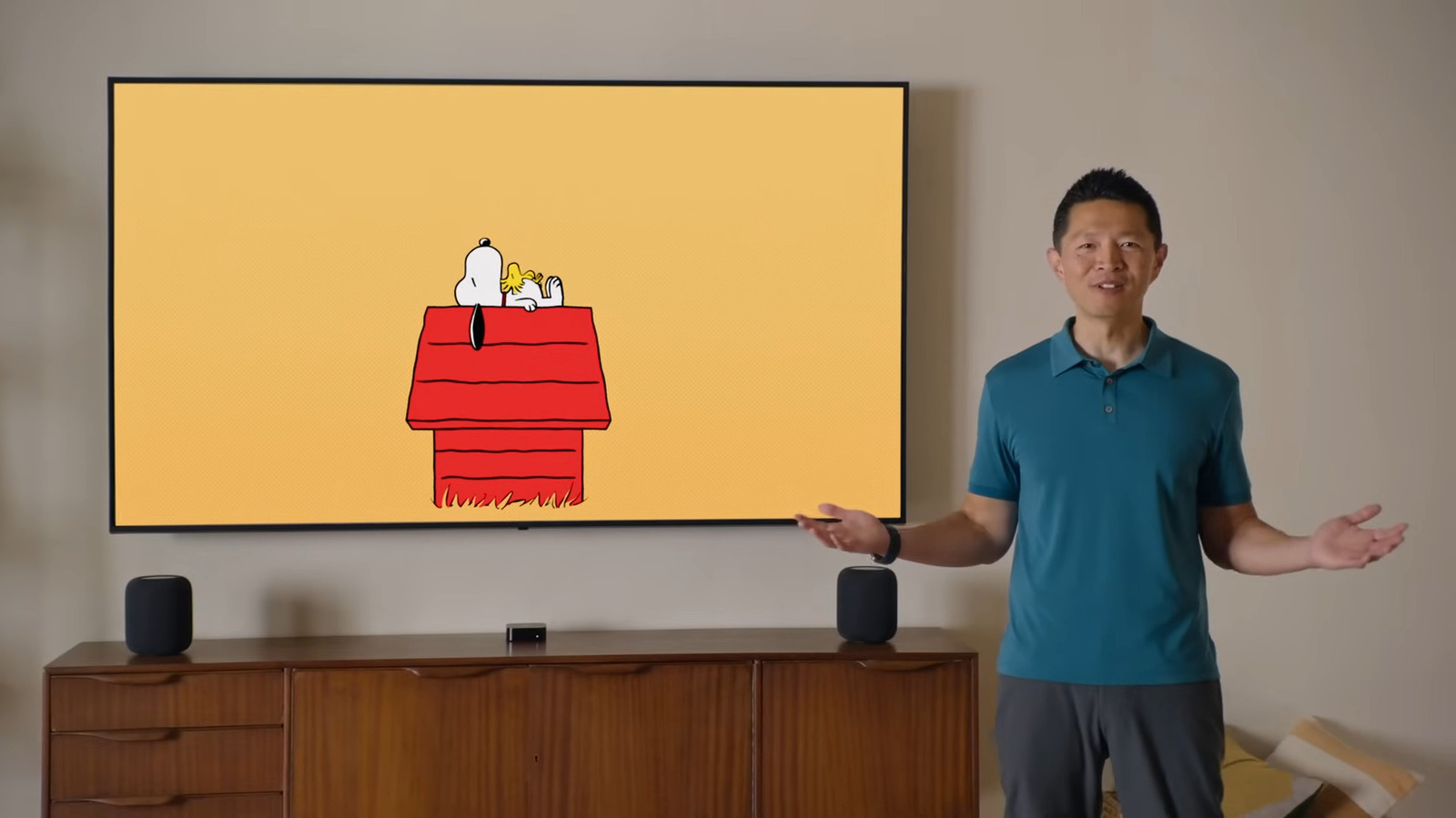
For your Apple TV, you have a choice between four screen saver types: Aerials for videos of location shots, Memories & Slideshows for photos from your iCloud Photo Library, Portraits for digital clocks with your selected images as a background, or Snoopy for themed videos of Peanuts characters Snoopy and Woodstock. The screen saver is customizable and configurable, so it’s easy to make it match your style. Here’s how to set up and use screen savers on your Apple TV.

How to set up screen savers on your Apple TV

By default, Apple TVs have the screen savers turned on. The device will automatically cycle through all available Aerials videos after five minutes of inactivity. You can easily set up your Apple TV’s screen saver to your preferred settings, though. Here’s how:

  1. Go to Settings.
  2. Open Screen Saver.
  3. Change Current Selection to the type of screen saver you want to display.
  4. Adjust Start After to your preferred delay interval between your last interaction with the TV and when the screen saver shows up.
  5. Turn off Show During Music and Podcasts to deactivate the screen saver if you have music or a podcast playing.

You can also further customize each of the screen saver types right from the Settings, too:

  1. Navigate to Settings, then Screen Saver.
  2. To customize Aerials:
    1. Under Screen Saver Preferences, click on Aerials.
    2. Change the Download Frequency (how often Aerial videos are downloaded) to Daily, Weekly, Monthly, or Never.
    3. Select which of the themes (Cityscape, Earth, Landscape, or Underwater) you want to display.
  3. To customize Memories & Slideshows:
    1. Choose Memories & Slideshows.
    2. Under Your Photos, click on Memories.
    3. Select All Memories to include everything, or Favorites to use only images added to your favorites.
    4. Go to Albums to pick specific albums, just your favorite photos, or your recently shared album.
    5. Under Other, click on Music Albums to use album art from your Apple Music library.
    6. Whenever available, go to Style and pick which transition style you want.
  4. To customize Portraits:
    1. Press Portraits.
    2. Select which options (People, Pets, Nature, and Cities) to include.
    3. Change the update frequency to your preferred time interval between portrait transitions.

Keep in mind that for Memories & Slideshows and Portraits, you have to set up iCloud Photos on your Apple TV first.

How to control your Apple TV screen saver

Although you can choose how long the period of inactivity is before the Apple TV screen saver kicks in, you can actually turn it on manually as well. This is one of the helpful Apple TV tricks every user should know. You can activate the screen saver from either the home screen, or in any app. From the home screen, press the back button on your Apple TV remote once, and then long-press on it. From any app, simply hit the back button multiple times. Your chosen screen saver should pop up on the screen. During the screen saver playback, you can still interact with it. Here’s how:

  1. Hit the up button on your remote to view all the screen saver types and switch to a new one.
  2. Tap the clickpad on your remote to display information about the screen saver. If it’s an Aerial shot, it will tell you the location. If it’s a Memory, it will say which one is shown.
  3. Swipe/press right on your remote to jump to the next visual.
  4. Click the clickpad center to turn off the screen saver.

You can also use your remote to control music playback while screen savers are on. Just hit the left or right button on the clickpad to skip to the previous, or next, song.

Source