
Shop Loewe — $749
The rise of drone warfare has resulted in a new arms race revolving around the art of shooting down drones without any conventional “shooting.” The Ukrainian army is testing a laser that blasts UAVs out of the sky, and cities in the country are setting up fishing nets to fight against drones. Meanwhile, the U.S. Navy has a different solution: Fight drones with more drones.
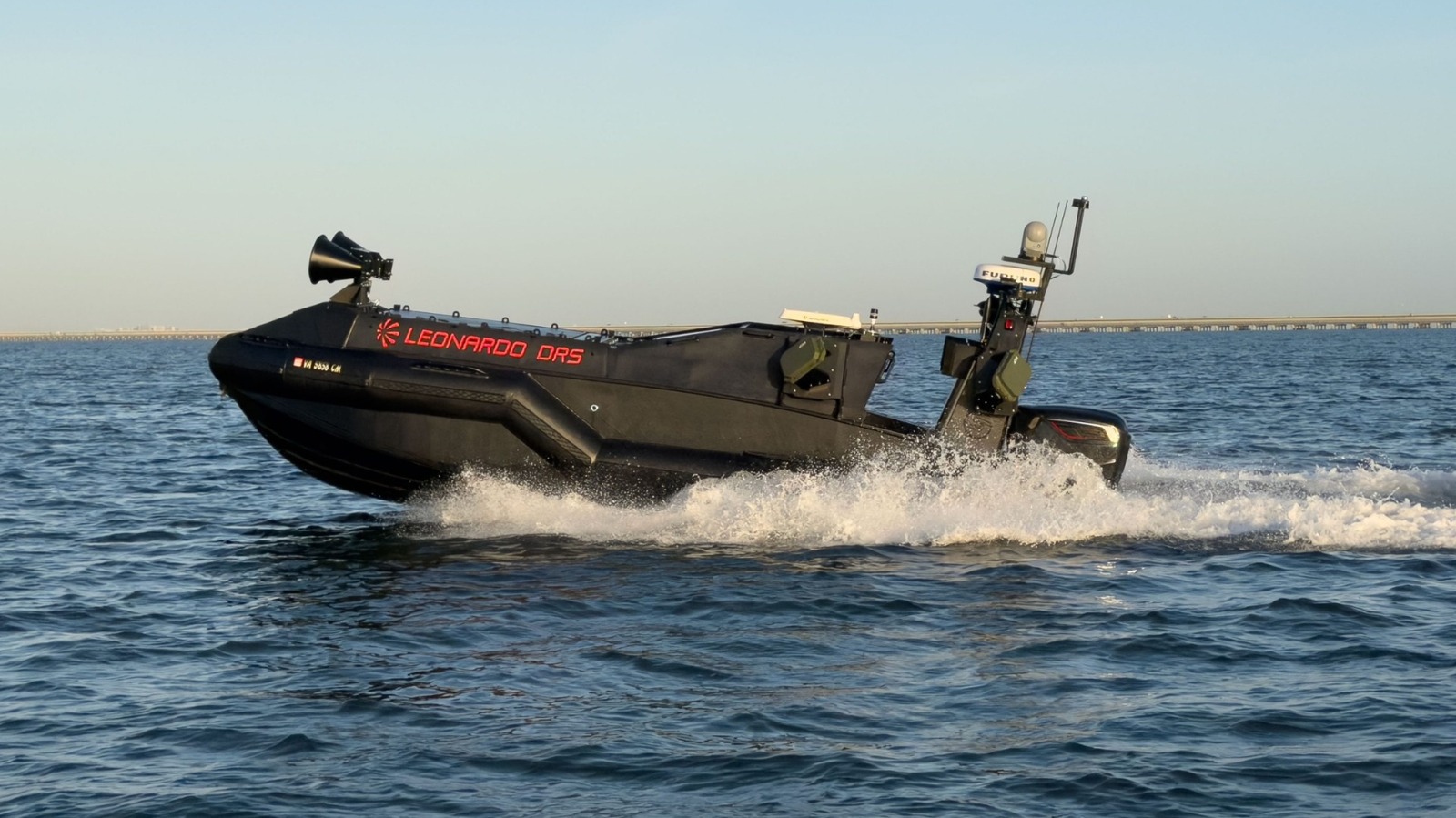
Recently, the military contractor Leonardo DRS launched its new maritime defense solution, the Maritime-Mission Equipment Package (M-MEP). This system is attached to a small fleet of dinghy drones that launch out from larger vessels. Each M-MEP ship is equipped with an electronics suite that can detect and track potential UAV threats and, more importantly, use “electronic warfare systems” to scramble the navigation arrays of the opposing drones and knock them out of the sky.
Leonardo DRS describes the M-MEP as a “modular” system that can integrate with “multiple kinetic and non-kinetic effectors.” These terms imply that M-MEP isn’t limited to just dinghies or EMP-like systems. While the Navy can use a fleet of M-MEPs to knock out drones without firing a shot, engineers could very well equip M-MEPs with more traditional systems that shoot drones out of the sky with various rounds of ammunition.
How M-MEP detects threats
Unlike anti-drone systems other organizations are developing, the M-MEP isn’t a weapon in and of itself. As previously stated, the M-MEP is designed to integrate with different “effectors” and systems. Think of it less like the buggy Ukraine is employing to hunt drones and the weapons piled in the back and more like a radar system used to detect drones … and remotely tell pilots calling the shots from a safe distance.
The M-MEP primarily runs off an advanced maritime radar that functions in conjunction with electro-optical and infrared systems. These components integrate into Leonardo DRS’ SAGEcore platform, which uses AI to quickly sift through all of the data and determine what, if anything, has been detected and notify crew members if it’s a threat. When deployed on advanced autonomous scout drones, M-MEPs can provide a “defensive line” that beams data back to remote operators. While the M-MEP can use onboard systems to scramble enemy drones, even if these countermeasures don’t work, at least operators will know to expect company.
Unfortunately, the M-MEP isn’t perfect. The platform is designed to counter “airborne threats” and should be installed in unmanned surface vehicles a minimum of 14 feet in length. Still, modality is the central focus of the M-MEP, and Leonardo DRS plans to alter and improve the system based on “emerging threats,” so these limitations might disappear one day.






