Posted on

Facebook fact-checking program shutting down Monday and will be replaced by Community Notes

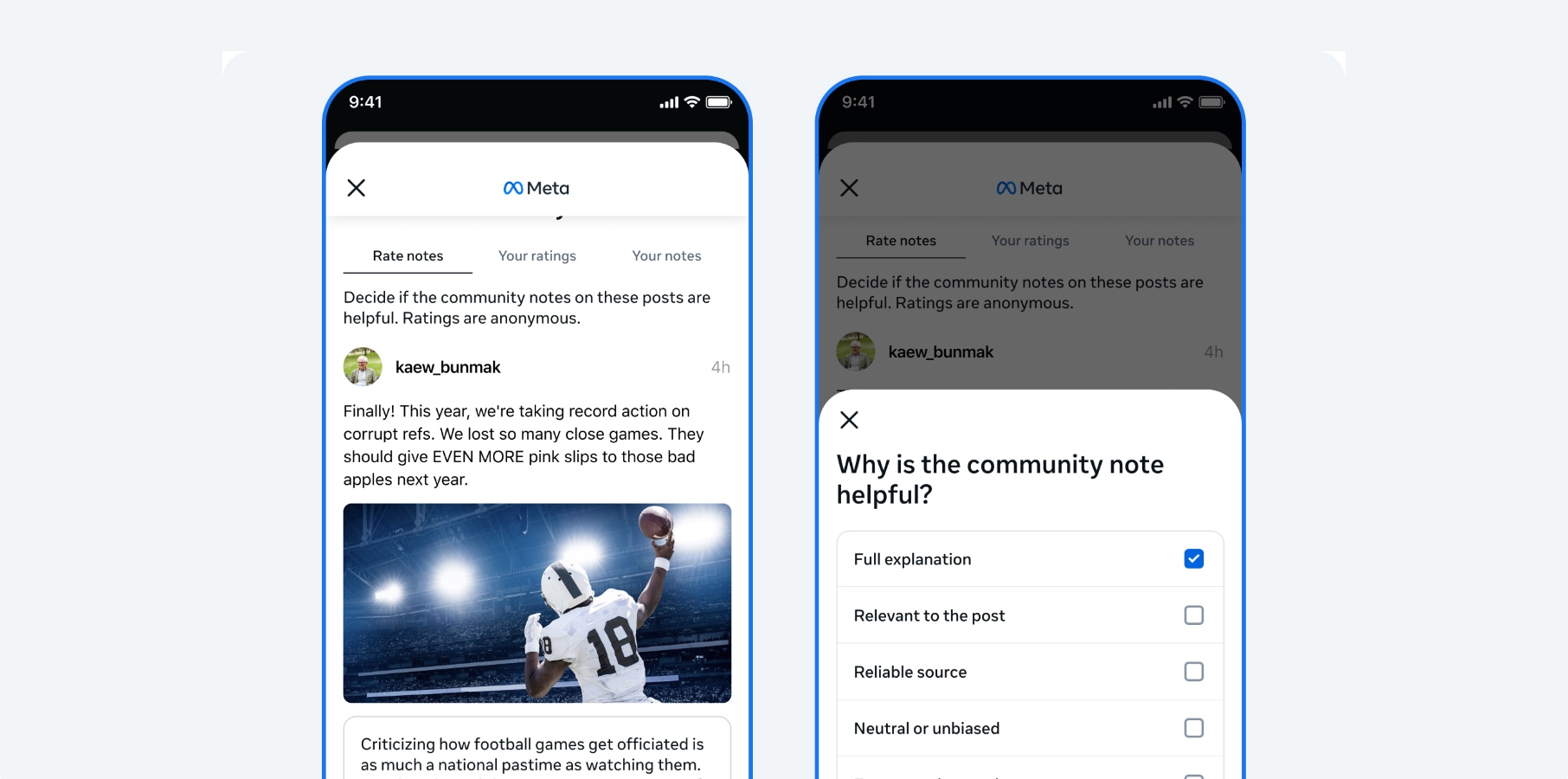
In January, Meta announced it would phase out its fact-checking program for Facebook in the US and replace it with X-like Community Notes. Now, Meta’s Chief Global Affairs Officer, Joel Kaplan, has revealed that this change will occur on April 7.

In a post on X, Kaplan wrote: “By Monday afternoon, our fact-checking program in the US will be officially over. That means no new fact-checks and no fact-checkers. We announced in January we’d be winding down the program & removing penalties.”

This change is only being applied in the US for now. However, it’s possible that it will expand globally in the future. Without the fact-checking program, Facebook users who were once condemned for publishing fake news won’t be penalized anymore.

To replace this tool, which was used by verified media members, Kaplan says Community Notes will soon appear on Facebook. “In place of fact checks, the first Community Notes will start appearing gradually across Facebook, Threads & Instagram, with no penalties attached.”

Tech. Entertainment. Science. Your inbox.

Sign up for the most interesting tech & entertainment news out there.

By signing up, I agree to the Terms of Use and have reviewed the Privacy Notice.

Going forward, even if someone writes a lie or tells a half-true, the only thing that will happen is that the post will potentially get a Community Note, just like Elon Musk’s X. The good news is that Instagram and Threads didn’t have proper fact-checking programs to begin with. They’ll now have some sort of warning about questionable posts.

In March, Meta explained how the Community Notes will work. These are some of the key takeaways:

  • Meta won’t decide what gets rated or written.
  • According to Meta: “No matter how many contributors agree on a note, it won’t be published unless people who normally disagree decide that it provides helpful context.”
  • Community Notes will have a 500-character limit.
  • Notes won’t have author names attached to them, and contributors need to be over 18 and have an account that’s more than 6 months old and in good standing, such as with a verified phone number or with 2FA turned on.
  • Notes can’t be submitted for advertisements, only on other forms of content.

Source

Posted on

Meta’s planned subsea cable will exceed circumference of Earth and support AI innovation

Meta has announced its plan for a subsea cable that will span the globe, connecting emerging economies such as India, South Africa and Brazil to the US.

Facebook, Instagram and WhatsApp’s parent company announced what is known as Project Waterworth in a blog post.

The social media giant’s vice-president of network engineering, Gaya Nagarajan, and Alex-Handrah Aimé, its global head of network investments, said the 50,000 km cable will be the world’s longest, and use “the highest-capacity technology available”. 

Regions of rapid economic growth will be connected directly to the US through the cable, which the Meta executives said “will enable greater economic cooperation, facilitate digital inclusion and open opportunities for technological development in these regions”.

Meta said it has already developed over 20 subsea cables. “With Project Waterworth, we continue to advance engineering design to maintain cable resilience, enabling us to build the longest 24 fibre pair cable project in the world and enhance overall speed of deployment,” wrote the Meta executives.

The multibillion-dollar investment, which will see cables laid at depths of 7,000 meters, will take years to complete, but promises increased access to high-speed connectivity, which it said could, for example, support artificial intelligence (AI) innovation across the world.

“AI is revolutionising every aspect of our lives, from how we interact with each other to how we think about infrastructure – and Meta is at the forefront of building these innovative technologies,” the company said. “As AI continues to transform industries and societies around the world, it’s clear that capacity, resilience and global reach are more important than ever to support leading infrastructure.”

The blog post added: “With Project Waterworth, we can help ensure that the benefits of AI and other emerging technologies are available to everyone, regardless of where they live or work.”

While subsea cables promise to enable global connectivity, there are concerns over how these costly and critical infrastructures can be protected from attacks from hostile states.

MPs and peers recently launched an inquiry into the UK’s ability to protect undersea internet cables that link the country with the rest of the world. This followed heightened threats of sabotage.

The Joint Committee on the National Security Strategy, which scrutinises government decision-making on national security, aims to assess the UK’s readiness for potential attacks on critical undersea communication cables.

The inquiry followed a statement by defence secretary John Healey, warning that Russian president Vladimir Putin is targeting the UK’s undersea oil, gas, electricity and internet cables after a Russian spy ship entered British waters.

According to the parliamentary committee, 99% of the UK’s data passes through undersea internet cables.

“As the geopolitical environment worsens, foreign states are seeking asymmetric ways to hold us at risk,” said committee chairman Matt Western. “Our internet cable network looks like an increasingly vulnerable soft underbelly. There is no need for panic – we have a good degree of resilience, and awareness of the challenge is growing. But we must be clear-eyed about the risks and consequences: an attack of this nature would hit us hard.”

The global internet, which is critical for international communications and commerce, relies on a network of 500 cables that carry 95% of internet traffic. The cables are often in remote places, making them difficult and expensive to monitor.

Source

Posted on

ARM and Meta: Plotting a path to dilute GPU capacity

News that ARM is embarking on developing its own datacentre processors for Meta, as reported in the Financial Times, is indicative of the chip designer’s move to capitalise on the tech industry’s appetite for affordable, energy-efficient artificial intelligence (AI).

Hyperscalers and social media giants such as Meta use vast arrays of expensive graphics processing units (GPUs) to run workloads that require AI acceleration. But along with the cost, GPUs tend to use a lot of energy and require investment in liquid cooling infrastructure.

Meta sees AI as a strategic technology initiative that spans its platforms, including Facebook, Instagram and WhatApp. CEO Mark Zuckerberg is positioning Meta AI as the artificial intelligence everyone will use. In the company’s latest earnings call, he said: “In AI, I expect this is going to be the year when a highly intelligent and personalised AI assistant reaches more than one billion people, and I expect Meta AI to be that leading AI assistant.”

To reach this volume of people, the company has been working to scale its AI infrastructure and plans to migrate from GPU-based AI acceleration to custom silicon chips, optimised for its workloads and datacentres.

During the earnings call, Meta chief financial officer Susan Li said the company was “very invested in developing our own custom silicon for unique workloads, where off-the-shelf silicon isn’t necessarily optimal”.

In 2023, the company began a long-term venture called Meta Training and Inference Accelerator (MTIA) to provide the most efficient architecture for its unique workloads.

Li said Meta began adopting MTIA in the first half of 2024 for core ranking and recommendations inference. “We’ll continue ramping adoption for those workloads over the course of 2025 as we use it for both incremental capacity and to replace some GPU-based servers when they reach the end of their useful lives,” she added. “Next year, we’re hoping to expand MTIA to support some of our core AI training workloads, and over time some of our GenAI [generative AI] use cases.”

Driving efficiency and total cost of ownership

Meta has previously said efficiency is one of the most important factors for deploying MTIA in its datacentres. This is measured in performance-per-watt metric (TFLOPS/W), which it said is a key component of the total cost of ownership. The MTIA chip is fitted to an Open Compute Platform (OCP) plug-in module, which consumes about 35W. But the MTIA architecture requires a central processing unit (CPU) together with memory and chips for connectivity.

The reported work it is doing with ARM could help the company move from the highly customised application-specific integrated circuits (ASICs) it developed for its first generation chip, MTIA 1, to a next-generation architecture based on general-purpose ARM processor cores.

Looking at ARM’s latest earnings, the company is positioning itself to offer AI that can scale power efficiently. ARM has previously partnered with Nvidia to deliver power-efficient AI in the Nvidia Blackwell Grace architecture

At the Consumer Electronics Show in January, Nvidia unveiled the ARM-based GB10 Grace Blackwell Superchip, which it claimed offers a petaflop of AI computing performance for prototyping, fine-tuning and running large AI models. The chip uses an ARM processor with Nvidia’s Blackwell accelerator to improve the performance of AI workloads.

The semiconductor industry offers system on a chip (SoC) devices, where various computer building blocks are integrated into a single chip. Grace Blackwell is an example of an SoC. Given the work Meta has been doing to develop its MTIA chip, the company may well be exploring how it can work with ARM to integrate its own technology with the ARM CPU on a single device.

Although an SoC is more complex from a chip fabrication perspective, the economies of scale when production is ramped up, and the fact that the device can integrate several external components into one package, make it considerably more cost-effective for system builders.

Li’s remarks on replacing GPU servers and the goal of MTIA to reduce Meta’s total cost of ownership for AI correlate with the reported deal with ARM, which would potentially enable it to scale up AI cost effectively and reduce its reliance on GPU-based AI acceleration.

Boosting ARM’s AI credentials

ARM, which is a SoftBank company, recently found itself at the core of the Trump administration’s Stargate Project, a SoftBank-backed initiative to deploy sovereign AI capabilities in the US.

During the earnings call for ARM’s latest quarterly results, CEO Rene Haas described Stargate as “an extremely significant infrastructure project”, adding: “We are extremely excited to be the CPU of choice for such a platform combined with the Blackwell CPU with [ARM-based] Grace. Going forward, there’ll be huge potential for technology innovation around that space.”

Haas also spoke about the Cristal intelligence collaboration with OpenAI, which he said enables AI agents to move across every node of the hardware ecosystem. “If you think about the smallest devices, such as earbuds, all the way to the datacentre, this is really about agents increasingly being the interface and/or the driver of everything that drives AI inside the device,” he added.

Source

Posted on

Meta is about to ruin WhatsApp with AI bots no one wants

Of all the generative AI assistants out there, Meta AI must be the most annoying for the simple fact that Meta is shoving it down our throats. No app is safe, from Facebook to Messenger to WhatsApp to Instagram. Meta AI is there whether you want it or not, and there’s no way to deactivate it.

Meanwhile, ChatGPT is entirely optional, not that OpenAI can really force it on anyone. Apple’s Apple Intelligence is also optional; you don’t have to use it even if you have access to it. Then there’s Google Gemini, which is baked into many Google products but doesn’t feel as intrusive as Meta AI. The same goes for Microsoft’s Copilot.

The worst part about Meta AI is that Meta isn’t done ruining its apps with overdoing the AI presence. We’ve just learned of AI profiles coming to Facebook and Instagram, which is extremely annoying. It gets worse; Meta will now give AI bots prime plans inside WhatsApp, a feature that nobody really asked for from the one Meta app that’s actually useful.

WhatsApp is the world’s largest chat app. It works on iPhone and Android and supports end-to-end encryption across platforms. That’s the only reason I’m still using it. That, and the fact that Meta relented on its annoying WhatsApp policy change a few years ago.

Tech. Entertainment. Science. Your inbox.

Sign up for the most interesting tech & entertainment news out there.

By signing up, I agree to the Terms of Use and have reviewed the Privacy Notice.

Come to think of it, the only reason WhatsApp is so good and still encrypted, is that the app was built this way well before Meta bought it for a small fortune.

The last thing I want in WhatsApp is support for AI chatbots. Yes, it’s great that you can save a ChatGPT number to chat with the chatbot from WhatsApp, but that’s optional.

Say that Meta feels like it has to put AI bots in WhatsApp to expose more people to Meta AI and potentially make some money in the process. I still hate the idea of WhatsApp getting a dedicated AI menu. That’s wasted screen real estate right there. It’s a feature I’ll never use, and I’m sure others will be equally uninterested.

The new AI bots menu in a WhatsApp beta release for Android.The new AI bots menu in a WhatsApp beta release for Android. Image source: WABetaInfo

Meta is testing the new interface in an Android beta version of WhatsApp. Always reliable WABetaInfo surfaced the image above that shows the new AI tab replacing the Communities tab. That menu, which might actually be useful, is merging with the Chats tab.

The new AI tab will include all sorts of AI chatbots to talk to, including third-party models that can talk to you about specific topics.

I don’t doubt that some WhatsApp users will want to use these services. I say that as a longtime ChatGPT user who chats with OpenAI’s chatbot about all sorts of things daily. But I absolutely hate the idea of any AI product being forced on me the way Meta is doing with Meta AI.

WhatsApp is especially important to me as I use it to talk to many people. It’s not just Android users in my family or friends group that like WhatsApp; plenty of iPhone owners prefer the platform over iMessage. AI isn’t needed. Or if it is, it should be hidden somewhere and accessible on demand.

It might get even worse than that. WABetaInfo found evidence in a different WhatsApp beta version that Meta wants to let users create custom AI chatbots right inside the app. The process might be similar to what’s already available on Instagram.

Support for custom AI bot creation in a WhatsApp beta release for Android.Support for custom AI bot creation in a WhatsApp beta release for Android. Image source: WABetaInfo
The feature resembles the custom chatbots available in ChatGPT and Gemini, so it’s not entirely surprising. But, again, it’s not something I want to clutter a key app like WhatsApp.

I don’t see any value in adding AI bots to WhatsApp or supporting the creation of custom ones.

Remember that if left unchecked, some custom AI chatbots might be harmful, especially when certain types of users are exposed to them. And it’s not like Meta is improving its content moderation policies, so we have no idea how it’ll police this universe of AIs it’s bringing to apps like WhatsApp and Instagram.

I can only hope that Meta will not bring these features out of beta, but that’s just wishful thinking. If anything, I take some solace in knowing that it’ll take longer for Meta to deploy the AI changes to WhatsApp in Europe.

Source

Posted on

These were 10 the biggest internet outages of 2024

There are few disasters as unifying as an internet outage. Whether it’s a popular website, social network, or online service, everyone collectively freaks out when it goes offline, as was the case when all three major US cell carriers suffered outages on the same day earlier this year.

With that in mind, the network intelligence firm Ookla sifted through Downdetector data from the first three quarters of 2024 to pinpoint the biggest outages of the year. Based on the data Ookla gathered, these were the world’s 10 largest outages of 2024:

World's largest outages in 2024 according to Downdetector.World’s largest outages in 2024, according to Downdetector. Image source: Ookla

The analysis is not an exact science, as the rankings only take into account the number of user reports on Downdetector during the outage. That said, it’s clear that the major Facebook outage on March 5 impacted more people than any other individual outage in 2024.

It wasn’t an especially long outage, but it was the most widespread of the year (so far). Some of these outages impact a small subset of users or users in specific regions, but the Meta crash hit everyone all at once, which is why it received so much attention.

Tech. Entertainment. Science. Your inbox.

Sign up for the most interesting tech & entertainment news out there.

By signing up, I agree to the Terms of Use and have reviewed the Privacy Notice.

“The second largest global outage may be the most memorable. While CrowdStrike is not a service most people think of, we saw nearly 5 million reports to services that rely on it (or rely on Microsoft which relies on Crowdstrike), including emergency services, airlines, and ride sharing apps when a routine software update went bad on July 19,” Ookla notes.

Even if you’ve forgotten about Facebook and Instagram going down, you probably remember when the faulty update from CrowdStrike nearly turned the world upside down.

Source