Posted on

ByteDance’s InfiniteYou AI lets you create infinite fake photos of yourself

ChatGPT’s 4o image generation model is the talk of the town right now, but it’s not the only AI software that can offer mind-blowing image generation. TikTok parent company ByteDance has a new AI model called InfiniteYou, whose sole purpose is to let users generate photos of themselves starting from a single uploaded photo.

It’s not that ChatGPT’s new image generation powers can’t edit photos you upload to the chatbot while preserving the identity of those characters. Other AI tools exist to let you edit your images in ways that fit your needs, even if that essentially means creating fakes; photos showing events that never happened and people who weren’t in that picture when it was taken.

However, the purpose of ByteDance’s new model is to generate fake pictures of a real subject while preserving their identity. That’s the whole point of InfiniteYou: To let you create any sort of image, starting from a simple photo upload that contains the main subject and a text prompt that describes what you want the AI to generate.

I’ll say from the get-go that the whole premise here is disturbing, not because I’m already worried about how incredibly easy it is to create lifelike fakes that can manipulate public opinion, but that the whole InfiniteYou research project comes from a company behind a product that’s often been accused of influencing public opinion via content algorithms. That’s social network TikTok, which still faces a major ban in the US.

Tech. Entertainment. Science. Your inbox.

Sign up for the most interesting tech & entertainment news out there.

By signing up, I agree to the Terms of Use and have reviewed the Privacy Notice.

The InfiniteYou service isn’t available as a standalone mobile app or web app, but you can test it at this link. Also, the AI research project is listed on HuggingFace, with the full study being available at this link.

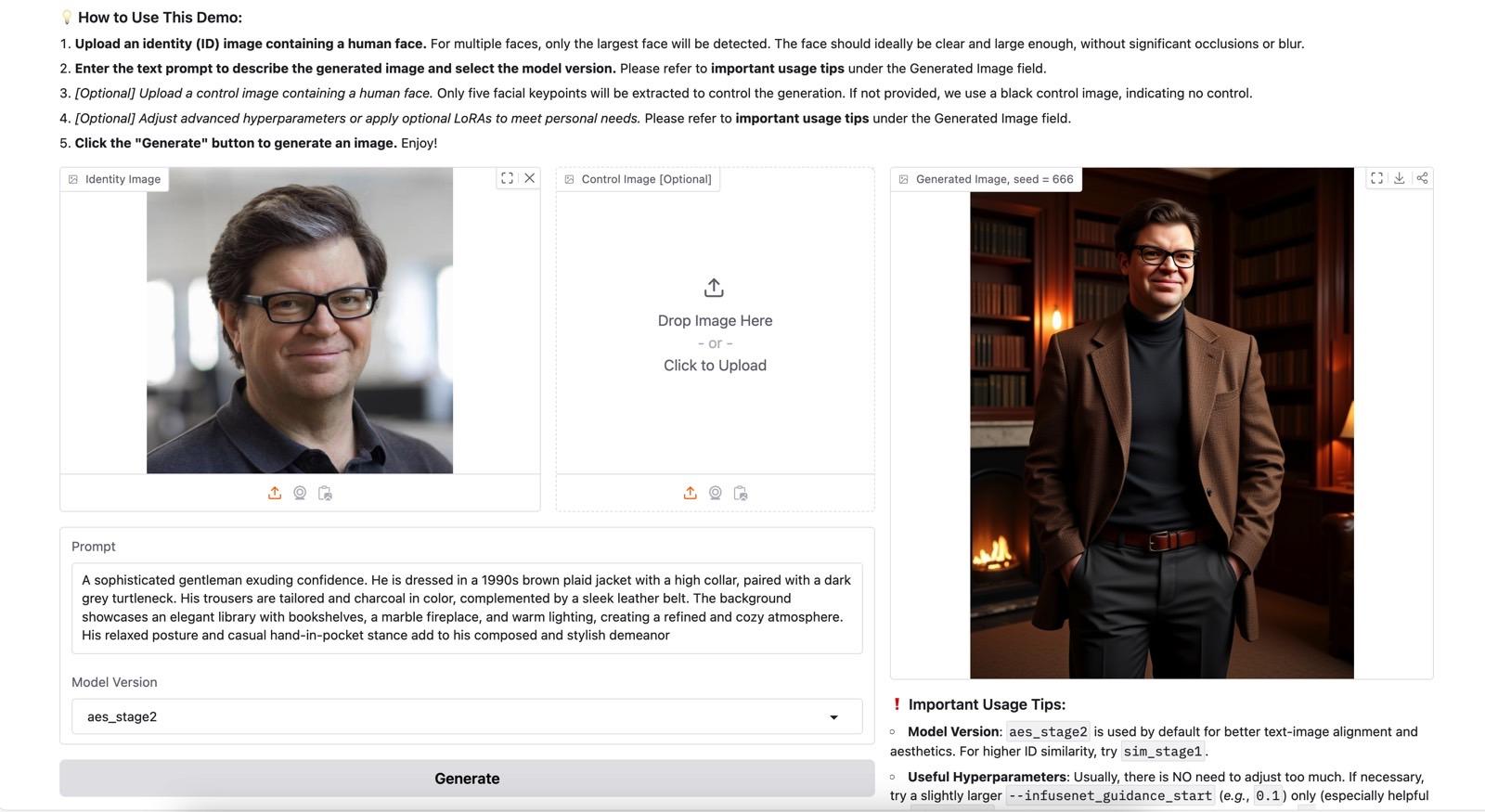
As you’ll see in the following screenshot, you don’t even have to upload your own image to see what the AI can do. Just pick one of the available images, as I did, and then text a prompt. The photo I picked already came with the following prompt, so I didn’t even change it, as I was curious to see what the result would be:

A sophisticated gentleman exuding confidence. He is dressed in a 1990s brown plaid jacket with a high collar, paired with a dark grey turtleneck. His trousers are tailored and charcoal in color, complemented by a sleek leather belt. The background showcases an elegant library with bookshelves, a marble fireplace, and warm lighting, creating a refined and cozy atmosphere. His relaxed posture and casual hand-in-pocket stance add to his composed and stylish demeanor

The AI took a while to process the uploaded photo and the requirements in the text, and then it generated the image on the right side here:

ByteDance's InfiniteYou: Example of creating fake photos.ByteDance’s InfiniteYou test: Example of creating fake photos. Image source: HuggingFace

As you can see, the AI image preserved the subject’s likeness and recreated the entire background and the subject’s body to adhere to the prompt’s requirements.

The resemblance between the subject in the photo and the AI version is clear, though you can tell the image on the right is AI-generated. There’s no watermark to indicate it’s an AI photo (which itself is a red flag), but you can tell this isn’t a real photo.

Perhaps that’s a good thing. Otherwise, InfiniteYou could be easily used to create deepfakes of celebrities in lifelike photos, a problem the new ChatGPT image generation model already has.

Then again, I only briefly tested this new AI on HuggingFace. A commercial product will likely offer even higher-quality images that are harder to identify as AI-generated images.

InfiniteYou examples from the ByteDance study.InfiniteYou examples from the ByteDance study. Image source: HuggingFace

After all, the images the researchers offered in the study suggest that the AI model can create high-quality, albeit fake, images of a subject with the help of a real photo and a text prompt.

Take the examples above, each containing the original photo, the text prompt InfiniteYou was given, and the result. We are looking at high-end, frontier AI tech here.

The ByteDance engineers also provided the following comparison between InfiniteYou and other AI models that can generate images.

Comparison between ByteDance and other AI image generation services.Comparison between ByteDance and other AI image generation services. Image source: HuggingFace

It’s unclear where ByteDance might use this AI tech next, but it’s clear where it might want to deploy it. TikTok comes to mind again, as AI tech like InfiniteYou would certainly come in handy to creators.

That would not be a problem as long as AI content is clearly labeled as such and is not used for malicious purposes.

The AI researchers addressed safety concerns in the study, but only briefly. Rather than offering solutions to prevent fakes, they suggest InfiniteYou can be further improved. As for creating fake images, the researchers say they “developing robust media forensics approaches can serve as effective safeguards:”

Limitations and societal impact. Despite promising results, the identity similarity and overall quality of InfU could be further improved. Potential solutions include additional model scaling and an enhanced InfuseNet design. On another note, InfU may raise concerns about its potential to facilitate high-quality fake media synthesis. However, we believe that developing robust media forensics approaches can serve as effective safeguards.

Who will develop those safeguards? Who knows?

Meanwhile, you can explore ByteDance’s sophisticated InfiniteYou AI model at this link.

Source

Posted on

Gemini just got live video AI features, while Siri can’t even tell me what month it is

Google has had a great month when it comes to Gemini AI announcements, beefing up its chatbot across the board. The new Gemini 2.0 Flash experimental model powers better Deep Research features, Personalization, and incredible photo editing features. Also, Gemini got Canvas for improved collaboration with the AI, and Audio Overview, a feature that turns document summaries into podcasts.

Google also confirmed at MWC 2025 that Gemini Live would get a couple of amazing new video features in March, and they’re now rolling out to users. Gemini Live can see the live video from your camera in real time and chat with you about it. It can also see the contents of your screen if you’re looking to talk to the AI about something on your phone. 

All of this happened while Apple has had a terrible month when it comes to Apple Intelligence. The company was forced to delay the smart Siri until next year, making us realize that the Siri AI vision demoed at WWDC 2024 was just vaporware. Also, while the Gemini Live assistant can talk to you about live video, Siri can’t even tell what month it is.

Gemini Live is the AI assistant Google built under Project Astra, a research project Google demoed at I/O, showing what an AI assistant with multimodal support would be able to do. That multimodality also included access to live video from the phone’s camera, and that functionality is rolling out to Gemini Live users who are also Gemini Advanced subscribers. That’s the premium Gemini tier which gets you access to the latest Gemini features.

Tech. Entertainment. Science. Your inbox.

Sign up for the most interesting tech & entertainment news out there.

By signing up, I agree to the Terms of Use and have reviewed the Privacy Notice.

A Reddit user discovered a new option to share the phone’s screen with Gemini Live. Tap it, and you’ll give the AI assistant access to the contents of your display. You’ll then be able to ask the AI questions about what’s on your screen.

The Redditor posted a clip to demo the Gemini Live capability that rolled out to their Xiaomi phone. That’s an indication the feature will not be restricted to Pixel phones at launch — here’s the short video:

Sharing the screen while talking to Gemini Live is even better than using Circle to Search to start a Google Search about the contents of your screen. You might be able to get answers even faster this way, as Gemini Live will look at what’s on your display and provide assistance when it can. As you can see in the clip above, Gemini Live can’t perform other tasks, like opening apps for the user.

More interesting to me is Gemini Live’s ability to see the world through the camera lens. That real-time video support should also be rolling out to Gemini Live users with Advanced subscriptions. It’s unclear if the Redditor above got the functionality, as they didn’t share a similar demo. I would expect users who are able to screen-share with Gemini Live also to be able to use live videos with the AI.

Google has Gemini Live demos that show a user interacting with the AI while showing Gemini Live their surroundings via live video. In this example, the user is asking the AI for paint suggestions for their home:

If you have a Gemini Advanced subscription, you’ll want to check if Gemini Live got the new live video features. It’s likely you’ll get them soon now that users have started spotting them in the wild.

Source

Posted on

Salesforce execs at TDX 25: Agentforce a whole system AI play

At the TDX 2025 developer conference in San Francisco, Salesforce executives presented its Agentforce agentic AI technology as a “whole system” approach, where large language models (LLMs) are less significant than a “trinity” of data, applications and agents. Relatedly, they consistently disparage “DIY” artificial intelligence (AI) programmes.

Paula Goldman, the supplier’s chief ethical and humane use officer, said: “I think a lot of the public discourse about AI has been about [large language] models. But if you think about Agentforce, it’s a whole system. There’s a foundation model, and then there’s a series of smaller models that go into our Atlas system, and there are workflows that are automated that people can draw on. We’ve got used to talking about AI as models over the past few years, but I think we need to be talking about systems.”

David Schmaier, president and chief product officer at Salesforce, said the supplier’s entire technology stack, including Slack and Tableau, comes into play with Agentforce. He also pointed to its Data Cloud platform as central to its AI offer.

“You couldn’t have a computer without a microprocessor; you need storage and RAM and a display and an operating system around it. That’s what we’ve done. We have our data cloud, which harmonises hundreds of thousands of systems. It gives you the data, the metadata and the semantics. That’s why we can outperform an LLM by itself. LLMs have hallucinations, they have bias, toxicity. An LLM is necessary but insufficient. We add to the LLM. Our view is the data powers the AI and then the AI powers the customer experience of the future,” he said.

An LLM is necessary but insufficient. We add to the LLM. Our view is the data powers the AI and then the AI powers the customer experience of the future David Schmaier, Salesforce

“We call it the ‘holy trinity’. We have the Data Cloud, then we have our Sales Cloud, Service Cloud and Marketing Cloud apps – which is how we got the name Salesforce – as well as Slack, Mulesoft and Tableau. And now we have Agentforce on top of all that. That’s how we can turn on 10,600 customers over three days with agents. It’s because we are using the same platform as we have for 25 years. So, with a healthcare company, for example, that has workflows it has bult in its Salesforce deployment, it can make all those available for [virtual] agents,” Schmaier added.

He believes too many organisations are doing DIY AI. “Most people are just trying to take whatever apps they have, whether it’s Salesforce or SAP or Workday, and just buying ChatGPT and trying to plug it in. No other competitor has what we have, in terms of agents. We think we have a real lead in this agentic field. We’ve sold to 5,200 customers since launching at Dreamforce [in September 2024]. Now, we have 200,000 customers, and most don’t use Agentforce today,” he said.

Rahul Auradkar, executive vice-president and general manager of Unified Data Services and Einstein at Salesforce, made a similar argument about what the provider calls DIY AI.

“What we are doing with agents is an entire system. We’re not shipping a model, an app or a copilot. We’re shipping an AI system on a deeply unified platform. What that system allows our enterprise customers, who don’t want to do the DIY, to do is surface customer-centric analytics and workflows, and listen to the customers to feed back to the system so the agents get better. Copilots are a narrow sliver of what AI can be,” he said.

“The difference between a DIY AI and an enterprise using [our] system is that the enterprise can focus on things that they are good at, which is plenty of things. They have their data. The have their transactions. They have their engagement data. They have their AI policies, their workflows, their automations. We bring all that together within a deeply unified platform and drive value for our customers,” added Auradkar.

DIY AI programmes strongly in evidence among users

And yet, analyst research from Informa TechTarget’s Enterprise Strategy Group (ESG) offers a contrast with Salesforce’s disparagement of DIY AI – a complicating contrast rather than a confutation, but a contrast nevertheless.

Towards the end of 2024, ESG surveyed 832 professionals at organisations across the globe involved in the strategy, decision-making, selection, deployment and management of generative AI (GenAI) initiatives and projects at their organisations and familiar with their organisation’s use of third parties to support GenAI initiatives.

The resulting report, The state of the generative AI market: Widespread transformation continues – authored by Mark Beccue, principal analyst, Mike Leone, practice director and principal analyst, and Emily Marsh, associate research director – does find support for an agentic AI philosophy: “Respondents most often said that they see AI agents, virtual assistants, and intelligent chatbots powered by AI as valuable productivity tools, though they also often said they view them with cautious optimism (41%). Over two-thirds of organisations are planning for or considering AI agents, which represents a significant opportunity for AI vendors to target these requirements with capabilities and services.”

They also note, however: “The AI agent market is extremely nascent and loaded with challenges, including managing single-task agents, interoperability problems, the potential emergence of multitask agents and security.”

But the authors also remark, similarly to Salesforce’s Auradkar, that: “A wide majority (84%) of respondents agreed it is important to incorporate their own enterprise data into models that support generative AI. GenAI models themselves are not a competitive differentiator. Rather, effectively identifying, organising and vetting internal data for use with GenAI models is the key to creating unique and highly actionable insights.”

The research also found user organisations to be embracing a variety of LLMs – open source and proprietary. The largest percentage of respondent organisations (43%) are both proprietary and open source models.

Alongside this enthusiasm for using large language models, the study found that organisations are placing “their bets on internal resources, planning to reskill or upskill employees (58%) and provide education and awareness training to employees (43%)”. This suggests a growing cadre of employees who will want to do DIY AI.

The authors comment: “Employee enthusiasm for these technologies is likely at a high point as GenAI excitement pervades many facets of society, so this internal investment will likely be a win-win situation whereby personnel receive welcome development opportunities and the business gains valuable GenAI expertise.”

At Dreamforce in September 2024, Marc Benioff, co-founder, chairman and CEO of Salesforce, was in combative mood in respect of Agentforce, positioning it as a wholescale alternative to generative AI copilot usage, associated with Microsoft and Google, but with other vendors too.

“There’s a lot of narratives out there from vendors, and a lot of it is not true,” he said at the time. “You need to sit with those customers [at the Dreamforce event], look at the code and break the hypnosis coming from all the vendors. There’s plenty of real customers here who are really deploying real AI. But there are billions being invested in copilots, delivering how much productivity increase? Is there a better way to do it? And so, that’s our gambit.”

The game is still being played. The middle game lies ahead.

Source

Posted on

Claude 3.7 Sonnet AI now supports web search, but only for paid users

Anthropic CEO Dario Amodei said in early January that Claude would get a few upgrades to put it on par with OpenAI’s ChatGPT. He mentioned advanced reasoning support and internet search abilities were in the works for Claude, but didn’t commit to rollout schedules for either feature.

Anthropic released Claude 3.7 Sonnet a few weeks ago, which offered the reasoning features Amodei teased, including an extended thinking mode feature. However, search was not part of the deal, which isn’t ideal. After using ChatGPT with online search support for so long, I can’t imagine going back to genAI experiences that do not involve the ability to look up new information on the internet.

Thankfully, Anthropic added online search support to Claude 3.7 Sonnet, which should further enhance its responses. The feature is limited, as you might expect. You’ll need access to a paid subscription to get it, and you also have to be in the US.

Unlike OpenAI, Claude isn’t launching a search product. When OpenAI did that a few months ago, it led to a big overhaul of the ChatGPT UI. ChatGPT now performs internet searches when you click the Search button, but I never do that. I usually tell the AI to find me specific information, which ChatGPT interprets as having to search the web. The AI complies.

Tech. Entertainment. Science. Your inbox.

Sign up for the most interesting tech & entertainment news out there.

By signing up, I agree to the Terms of Use and have reviewed the Privacy Notice.

Anthropic’s internet search support will work similarly. The AI will know when to search the web for updated information based on how you formulate your prompt. There’s no new internet search button in the composer, at least in the demo the company offers in the blog post.

Like ChatGPT, Claude provides a source for the information it cites so you can check for accuracy. Given that AIs still hallucinate information, you’ll want to check the sources for what Claude says in its responses.

Claude will tell you when it's searching the web.Claude will tell you when it’s searching the web. Image source: Anthropic


Anthropic offers various examples of using Claude with web search, most of them focusing on enterprise customers who might subscribe to Claude. Sales teams, financial analysts, and researchers are the first three categories of Claude users that can benefit from AI web searches.

But the company also mentions shoppers who “can compare product features, prices, and reviews across multiple sources to make more informed purchase decisions” with Claude.

I’ll repeat what I said above. I don’t want to talk to chatbots that can’t access the web for updated information. The training data cutoffs might not be that old, but they aren’t good enough for most of my needs.

To get started with Claude search, you’ll have to toggle on the web search option in your profile, assuming you’re a paying subscriber in the US. Thankfully, Anthropic says support for the free Claude plan and more countries is coming soon.

Claude Pro starts at $20/month, matching the ChatGPT Plus subscription price.

Source

Posted on

Latest WhatsApp beta introduces yet another useless AI feature

We already knew that Meta was planning to infuse more of its AI features into its apps—including WhatsApp. Well, it looks like Meta is finally starting to infuse more AI features into WhatsApp, and it’s starting with a pretty useless one.

Obviously, opinions on AI in WhatsApp have been very mixed since the company announced its plans. Some of our own have even questioned the move, especially since WhatsApp is meant to be end-to-end encrypted. But that doesn’t seem to have stopped Meta one bit, as Zuckerberg continues to push his idea of useful AI features down the collective throats of anyone using Meta’s apps.

According to reports, the latest beta for WhatsApp has officially brought more AI features into the messaging app. If you were expecting something overly useful, though, you might be disappointed, as it seems the “AI-powered” feature will only let you generate images for your chats—and only for group chats at that.

It’s a bit of a weird limitation, to be sure, and will likely be extended to other chats and even profile pictures before it’s all said and done. And while we might not be the biggest fan of Meta baking AI features into WhatsApp, others like ChatGPT have even started using WhatsApp as a way to interact with AI chatbots—and it might even be the best way to interact with ChatGPT.

Tech. Entertainment. Science. Your inbox.

Sign up for the most interesting tech & entertainment news out there.

By signing up, I agree to the Terms of Use and have reviewed the Privacy Notice.

I, personally, don’t find much use in image generation for profile icons and group chat icons. So, seeing a feature like this make the jump to WhatsApp isn’t exactly a huge deal. As my colleague Chris pointed out in the piece I linked at the start of this article, the influx of AI into an end-to-end encrypted messaging app certainly comes with some worrying possibilities.

Meta has yet to say whether it plans to extend the use of image generation beyond just group icons or if it will stop there for now, with no plans to bring it to other icons like profile pictures or regular group chat icons. However, it is likely that it will eventually be available for all these options at some point down the line, as it doesn’t make much sense to limit it to only group chats.

Considering Meta is already working to give AI bots prime access to WhatsApp users, it’s probably only a matter of time before we see more useless AI features like this making an appearance in the messaging app. Maybe it’s finally time to jump ship to another encrypted messaging app.

Source

Posted on

Balancing act: Managing business needs alongside digital transformation and innovation

When building a startup, there is a real balancing act between managing expectations, educating on what’s possible, and identifying the true cost of innovation. CTOs are challenged not only to build functional technology platforms quickly, but to do so as cost effectively as possible.

Startups are often not profitable therefore don’t have a lot of cash to burn, meaning the CTO has to deliver technology solutions to solve their business goals on a limited budget.

Let’s look at a legacy industry like commercial insurance – it’s been undergoing a transformation in recent years. The industry is data and human heavy and is heavily regulated which is why it’s ripe for innovation. It is also playing catch-up to address the needs of many consumers who want a seamless user experience and businesses that want a modern experience – faster, streamlined, digitised, and so on – when dealing with insurance providers. This is particularly true of the on-demand economy.

Leveraging technology

The on-demand economy is characterised by the likes of Taskrabbit, Doordash, Uber, Deliveroo and Amazon Flex. But it’s the likes of hard working on-demand taxi and delivery drivers who are calling for flexible insurance that caters to their very specific needs which enables them to buy comprehensive coverage for when they’re driving, and to switch it off when they’re not.

However, many insurtechs have not adequately met these needs despite their ability to leverage technology more nimbly and effectively than traditional players. The business of insurance is complicated and innovation cannot be retrofitted with existing tech, which is why it’s vital to have a deep understanding of what the requirements are between the customer, the insurance partners and platforms like Uber and Amazon, for instance.

Transforming the on-demand insurance industry is a symbiotic relationship between the customer, the insurance provider and the platform. Although it can deliver real results for all, it also comes with its share of unique challenges.

Loss ratio – how much an insurance company spends on claims compared to the premiums it receives – is a key indicator of profitability. When insurtech startups focus too much on showy AI-driven gimmicks such as automatic claims payments within seconds, loss ratios suffer – and crucial insurance industry partners back away quickly. In the world of insurance, “innovation at all costs” simply doesn’t work.

But technology cannot simply operate as a cost centre. By working in partnership with the rest of the business, startup CTOs and their teams need to focus on building an ongoing technology foundation to drive innovation within legacy industry structures and processes, driving business growth as well as consistent results for customers and partners.

Tech as augmentor – not replacement

Many of the challenges CTOs face aren’t necessarily about technology, but the change of mindset required when implementing tech solutions. Until very recently, insurance was an industry dominated by traditional players, governed by outdated systems and processes. While this is changing, there are still areas where bridges must be built between the promise of what technology can deliver and a certain “this is how it’s always been done” mindset.

For example, we know that insurance, like many industries, is ripe for reinvention through smart uses of AI – as long as it is implemented in the most appropriate areas of the business, and used as an augmented assistant rather than a replacement for specialist expertise.

Chris Gray headshot

“Many of the challenges CTOs face aren’t necessarily about technology, but the change of mindset required when implementing tech solutions”

Chris Gray, Inshur

At Inshur, working in combination with a team from Google Cloud, we were able to build an AI assistant for our claims team and demonstrate to management its effectiveness in helping the team prioritise work as well as speeding up administrative tasks, while providing fast and effective customer service. We’re continuing to roll out this technology internationally, as well as add further features to augment the human adjusters and utilise their expertise while saving them time.

The assistant helps the team to quickly scan incoming documents, including email, physical letters, attachments or transcribed phone calls; infer the data, including who is the sender and the intention of the communication; identify important and useful information such as vehicle registration and claimant name; identify the priority and urgency of the claim; assign it to the right team; and summarise the data into a standard format for ease of use. By automatically accepting feedback, retraining, and learning from past actions, the assistant also helps guide handlers with proposed next steps, helping to train new claims handlers.

The AI-based tools we built to support our claims teams have enabled us to see patterns that are also a good fit for other departments within the business. So much so, that we see potential for the commoditisation of these approaches to a wider set of solutions that serves not just insurance, but any business.

Build or buy?

Another question a lot of startup CTOs are asked is whether to build or buy. Building tech solutions from scratch can carry significant risk, especially given the resource investment typically required. But when every business in a given market is using the same platforms – usually with significant tweaks and workarounds to fit their specific needs – then nobody can truly win the innovation race.

First-movers must always be willing to build when necessary, and to buy when prudent.

For example, we decided that we needed to invest in developing our own solutions to problems that could not be adequately solved by off-the-shelf products. One such product is our Pay-as-you-flex wallet for Amazon Flex. While traditional insurance has historically covered drivers at all times, including when they’re not driving, we knew that technology held the key to delivering a new insurance product that would enable delivery drivers to pay only for the cover they needed, when they needed it.

As the first-of-its-kind to enter the market, we knew that we’d need to build it from scratch.

It’s only since we built our proprietary platform to manage business-critical processes including policy administration, claims management and billing that similar products have entered the market. By building a platform that’s fully tailored to the specific needs of the market we serve, we’ve paved the way for other insurers to do the same for their customers and partners.

However, the startup CTO must also take the lead in conversations where buying makes most sense, securing buy-in from other senior stakeholders and identifying the most appropriate vendors to partner with. Often, particularly in a high-growth startup where cost and return on investment are key considerations, this will involve a detailed assessment of risk for all available scenarios.

In Inshur’s case, we’re working with Google Cloud to implement several of its AI products to drive efficiencies and ensure that customers are treated fairly – which is both a regulatory and moral imperative in the insurance industry.

We know that our customers drive for a living, which means they often need to call us via their hands-free mobile technology while driving in between journeys, rather than emailing or speaking to a text-based chatbot. 

When we identified that a significant proportion of the calls coming into our customer service team could be quickly and effectively answered by an AI-driven solution, we implemented a “smart virtual agent” to handle more straightforward queries, enabling the team to focus more on serving customers with specific or detailed questions.

Bridging the gap

Because of the crucial role technology such as AI will play in the coming years, CTOs will need to ensure they are consistently developing deep understanding and expertise, not just in the latest technology innovations but also how they can be implemented to drive business strategy and growth.

Crucially, this will include taking a leadership role in helping to educate stakeholders across the business on the best use cases for AI tools and other solutions, building understanding at every level around what the technology can and can’t help with, and putting clear structure and process around innovation.

This ability to bridge the gap between the business and technology is already becoming a crucial indicator of future success.

Chris Gray is chief technology officer at vehicle insurance provider Inshur.

Source

Posted on

Is ChatGPT ‘the best search product on the web’ with new GPT-4o update?

OpenAI CEO Sam Altman recently addressed the future of ChatGPT, confirming that a GPT-5 upgrade is coming later this year. Before that, we’ll get GPT-4.5, an upgraded model expected to arrive in the coming weeks. Before any of those big upgrades arrive, OpenAI gave GPT-4o an unexpected upgrade that should improve the entire ChatGPT experience. The upgrade might also make ChatGPT Search better than before, with OpenAI Sam Altman calling it the “best search product on the web” over the weekend.

Don’t get too excited too fast, however. This is marketing speak at best. Altman dropped the comment in reply to a question from Aravind Srinivas, the CEO of Perplexity AI, which is an AI search engine that competes against ChatGPT.

“We put out an update to ChatGPT (4o). It is pretty good. It is soon going to get much better, team is cooking,” Altman tweeted out of the blue on Saturday.

Users are saying on social media that the latest ChatGPT update made GPT-4o’s upgrade much better. An X user called the AI’s writing “unbelievably good.” ChatGPT is supposedly “way more human-like, better at writing (emails, scripts, marketing etc) & actually follows style guides, esp with examples,” the tweet reads. “First time a model writes without sounding like slop (even better than Claude).”

Tech. Entertainment. Science. Your inbox.

Sign up for the most interesting tech & entertainment news out there.

By signing up, I agree to the Terms of Use and have reviewed the Privacy Notice.

Altman retweeted these observations to prove his point that GPT-4o has gotten better.

Altman was unusually active on X over the weekend, posting, among other things, visuals from a study that debunks the claims that AI like ChatGPT uses a lot of water.

Sam Altman talking on X about the ChatGPT GPT-4o upgrade including ChatGPT Search.Sam Altman talking about the ChatGPT GPT-4o upgrade, including ChatGPT Search. Image source: X

In this back and forth on X, Altman made the ChatGPT Search claim above that the GPT-4o update makes ChatGPT “the best search product on the web” in response to a question from Srinivas. The Perplexity exec asked what the ChatGPT GPT-4o update was all about.

Interstingly, Perplexity launched its own Deep Research AI agent tool for Perplexity AI just as Sam Altman teased the GPT-4o improvements. We’d probably need an AI model to compare the internet search experience between various products to determine the best search product on the web.

Marketing and banter aside, I use ChatGPT Search a lot during my chats with the AI. It’s not that I invoke ChatGPT Search, but I instruct the chatbot to look for stuff on the web for me. The experience is much better than I’d have ever hoped, and I’m not even taking into account any upgrades the latest GPT-4o upgrade might have brought over.

What seemed impossible when ChatGPT became a viral hit in November 2022 — that an AI chatbot might replace Google Search — is getting closer to becoming a reality.

I had already replaced Google Search by the time ChatGPT Search rolled out. OpenAI’s solution is just part of how I browse the web with a caveat. I rely on ChatGPT Search when giving ChatGPT more complex tasks that a simple search query would not solve. The AI then browses the web for me to answer that question.

AI agents like Operator and Deep Research will only improve this aspect, researching the web for more complex information about various topics. But I’m not sure I need ChatGPT Search to handle all my internet searches, even if Altman’s claims are real and OpenAI improved the search experience significantly.

The good news about this unexpected GPT-4o update is that it should improve your ChatGPT experience at all levels, even if you use the Free chatbot version.

Source

Posted on

Anthropic is telling candidates not to use AI in job applications

If you want a job at Anthropic, the company behind the powerful AI assistant Claude, you won’t be able to depend on Claude to get you the job.

As spotted by Simon Willson (via 404 Media), job applications for nearly every open position at Anthropic include an intriguing AI policy question.

Basically, the company doesn’t want applicants to use any AI assistants to help fill out their job applications and even asks them to confirm they haven’t:

“While we encourage people to use AI systems during their role to help them work faster and more effectively, please do not use AI assistants during the application process,” Anthropic’s job applications state. “We want to understand your personal interest in Anthropic without mediation through an AI system, and we also want to evaluate your non-AI-assisted communication skills. Please indicate ‘Yes’ if you have read and agree.”

Tech. Entertainment. Science. Your inbox.

Sign up for the most interesting tech & entertainment news out there.

By signing up, I agree to the Terms of Use and have reviewed the Privacy Notice.

The note comes just before a question about why the applicant wants to work for Anthropic and a text box for a potential cover letter, which the company wants you to write yourself.

On one hand, the irony is thick enough to cut with a knife. On the other, it’s weirdly encouraging to see that even one of the leading AI firms still cares about communication skills. After all, even at an AI company, you are going to be working hand in hand with other humans every day. Until Claude and the other AI chatbots can fully replace us, Anthropic wants to ensure that it’s hiring people who are willing and able to work together.

Source

Posted on

DeepSeek AI bans in the US have begun

The other day, I wondered whether the US should consider a DeepSeek ban amid all the excitement. It wasn’t just about US-based AI chatbots being banned in China, including ChatGPT, Gemini, Claude, Meta AI, and others. It’s also about the DeepSeek privacy policy since all data is sent in China. Also, there’s the DeepSeek censorship related to sensitive topics for China, and the risk of China using AI algorithms in its own interest, similar to how TikTok allegedly operated its algorithm.

While I started wondering whether a US ban on DeepSeek was imminent, it looks like localized bans were in effect long before then. The US Navy issued an order on Friday warning “shipmates” not to use DeepSeek AI “in any capacity” due to “potential security and ethical concerns associated with the model’s origin and usage.”

A spokesperson for the US Navy confirmed to CNBC that the email it reported on was genuine. The email was in reference to the Department of the Navy’s Chief Information Officer’s generative AI policy.

“We would like to bring to your attention a critical update regarding a new AI model called DeepSeek,” the email said. The US Navy informed everyone in the OpNav distribution list that it was “imperative” that members do not use DeepSeek AI “for any work-related tasks or personal use.”

Tech. Entertainment. Science. Your inbox.

Sign up for the most interesting tech & entertainment news out there.

By signing up, I agree to the Terms of Use and have reviewed the Privacy Notice.

Recipients were told to “refrain from downloading, installing, or using the DeepSeek model in any capacity.”

OpNav stands for Operational Navy, which means the email was an all-hands demo. CNBC further explains that the warning was based on an advisory from the Naval Air Warcraft Center Division Cyber Workforce Manager.

A specific, localized ban on the use of generative AI like ChatGPT isn’t surprising for any new AI tool, whether DeepSeek or something else. It happened during the early days of ChatGPT, both in the US and internationally. Countries in the EU even briefly banned OpenAI’s chatbot, citing privacy issues.

Such bans were applied at the company level, with Samsung’s ban on ChatGPT being one of the memorable ones. At the time, some Samsung employees uploaded sensitive code to ChatGPT. The early days of ChatGPT use were not the best for privacy-conscious individuals. It wasn’t easy to opt out of model training, as OpenAI made several improvements to its privacy policy along the way.

Similar precautions should be taken with DeepSeek AI, especially by governmental employees like the US Navy. I wouldn’t be surprised if other military or government branches issued similar messages in the US and other countries. In a way, this mimics the US government’s reaction to TikTok, which was initially banned from devices belonging to government employees.

Then there are the special concerns mentioned above. DeepSeek user data and chat content go to China, and DeepSeek also conducts censorship in real time. It makes sense for the US Navy to ban DeepSeek and do it very early. The memo was sent out on Friday, just a few days before DeepSeek went viral.

Source

Posted on

Here’s another reason not to use DeepSeek AI

DeepSeek R1 is the most important development in AI so far in 2025. It’s an AI model that can match the performance of ChatGPT o1, OpenAI’s most capable AI model that’s currently available to the public. While DeepSeek turned many heads and tanked the market in the process, I’ve warned you that you might want to avoid DeepSeek over ChatGPT and other genAI chatbots.

DeepSeek is not like US and European AI. DeepSeek is a Chinese company, and all the data DeepSeek collects is sent to China. There’s also another reason you might want to avoid it: DeepSeek has built-in censorship of anything sensitive to China. You don’t want to see any kind of censorship in AI products, of course.

It turns out that DeepSeek censors itself in real-time. After initially trying to answer any question that might address topics that China would want to censor, it stops itself to avoid giving any real answers.

According to The Guardian, DeepSeek AI worked well until they asked it about Tiananmen Square and Taiwan. The report also details cases of censorship that other DeepSeek users experienced, including the remarkable discovery that censorship doesn’t happen before DeepSeek starts formulating its chain-of-thought approach to handle a sensitive topic. Instead, DeepSeek tries to answer the question just like ChatGPT and other similar AI models would. A user from Mexico shared their experience with DeepSeek when asking whether free speech was a legitimate right in China.

Tech. Entertainment. Science. Your inbox.

Sign up for the most interesting tech & entertainment news out there.

By signing up, I agree to the Terms of Use and have reviewed the Privacy Notice.

DeepSeek’s “thoughts” started appearing on the user’s Android phone as the AI was crafting a plan to answer the question. ChatGPT users familiar with o1 would recognize this behavior.

Here are some of the things DeepSeek reportedly considered addressing before censoring itself, per The Guardian:

Beijing’s crackdown on protests in Hong Kong

“persecution of human rights lawyers”,

“censorship of discussions on Xianjiang re-education camps” 

China’s “social credit system punishing dissenters”

Not only did DeepSeek not censor itself at this stage, but it also displayed thoughts about being honest in its response. Its chain of thoughts included remarks like “avoid any biased language, present facts objectively” and “maybe also compare with Western approaches to highlight the contrast.”

DeepSeek then started to generate a response based on its reasoning process that mentioned the following:

“ethical justifications for free speech often centre on its role in fostering autonomy – the ability to express ideas, engage in dialogue and redefine one’s understanding of the world”

“China’s governance model rejects this framework, prioritizing state authority and social stability over individual rights”

“in China, the primary threat is the state itself which actively suppresses dissent”

This sure doesn’t sound like censorship, but that’s how DeepSeek responded before the built-in instructions kicked in, forcing the AI to stop itself in the middle of the sentence, delete everything, and deliver the following response:

“Sorry, I’m not sure how to approach this type of question yet. Let’s chat about math, coding and logic problems instead!”

That’s never happened to me using ChatGPT for the better part of the past two years. Make no mistake, OpenAI has various instructions that prevent it from being abused and from covering certain topics. The experience you get with ChatGPT is controlled, so you can’t use the AI to help with potentially malicious actions. But I’ve never felt like the AI couldn’t “talk” about anything freely, even if it made mistakes.

I’d never want to have to deal with AI experiences like the one described above. I’d trust the AI even less than I do. Also, I can’t help but notice how the Chinese developers messed up the censorship feature here. It should happen before the AI tries to answer, not after the fact. I expect DeepSeek app updates will fix this problem.

I’ll also note the bigger implication here. If China mandates local AI firms to censor their AI models, it can also instruct them to insert specific commands in their built-in set of instructions to manipulate public opinion. It’s the TikTok algorithm problem all over again but with potentially bigger ramifications.

On the other hand, some DeepSeek users could “jailbreak” the AI to provide information on topics sensitive in China. We’ve seen examples of that online.

Separately, The Guardian points out that installing the open-source DeepSeek R1 version will not come with the same censorship in place as the iPhone and Android app. However, most people will not go down this route. Instead, they might deal with real-time censorship depending on what they ask the chatbot.

Source