Posted on

Facebook fact-checking program shutting down Monday and will be replaced by Community Notes

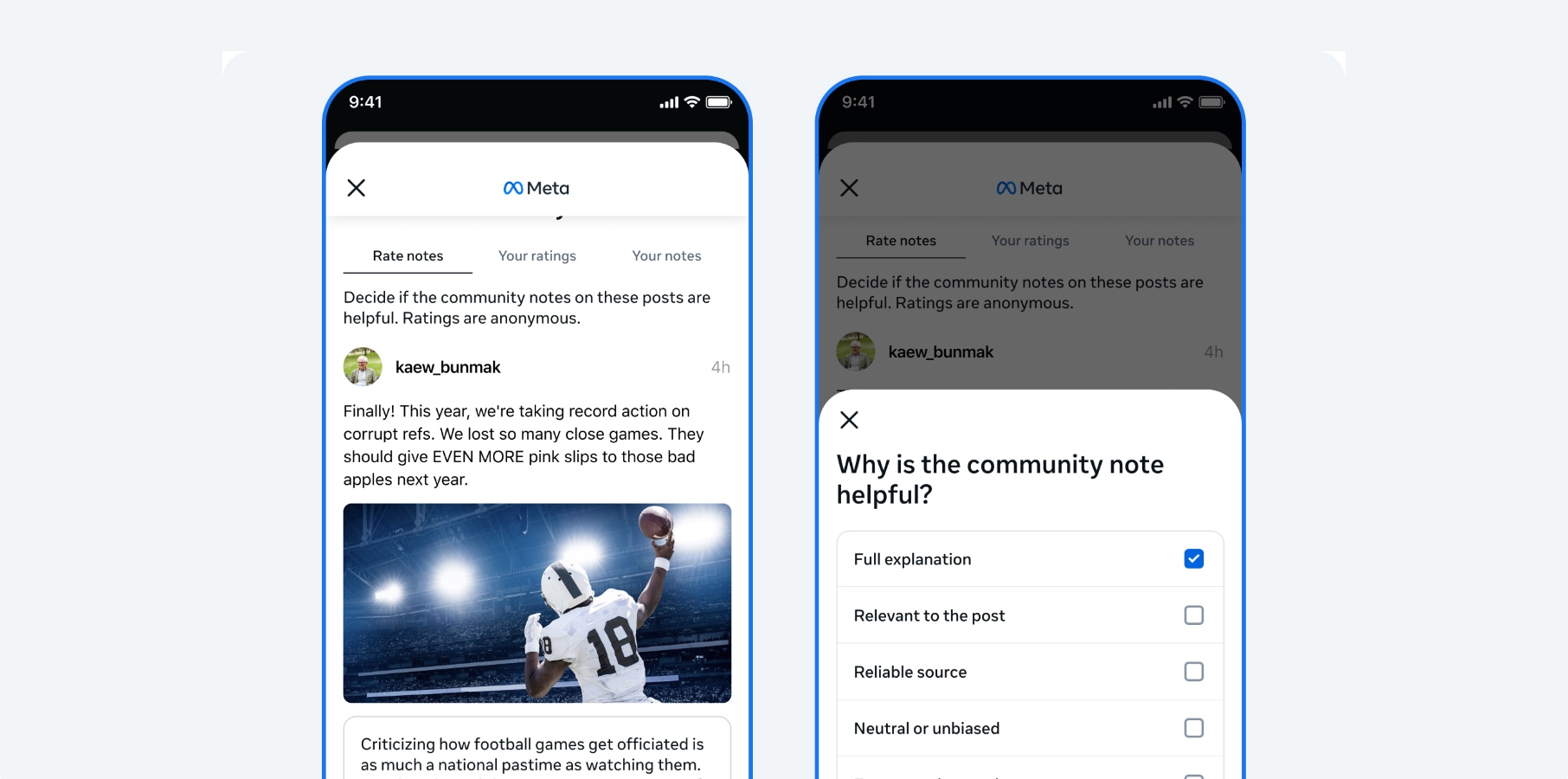
In January, Meta announced it would phase out its fact-checking program for Facebook in the US and replace it with X-like Community Notes. Now, Meta’s Chief Global Affairs Officer, Joel Kaplan, has revealed that this change will occur on April 7.

In a post on X, Kaplan wrote: “By Monday afternoon, our fact-checking program in the US will be officially over. That means no new fact-checks and no fact-checkers. We announced in January we’d be winding down the program & removing penalties.”

This change is only being applied in the US for now. However, it’s possible that it will expand globally in the future. Without the fact-checking program, Facebook users who were once condemned for publishing fake news won’t be penalized anymore.

To replace this tool, which was used by verified media members, Kaplan says Community Notes will soon appear on Facebook. “In place of fact checks, the first Community Notes will start appearing gradually across Facebook, Threads & Instagram, with no penalties attached.”

Tech. Entertainment. Science. Your inbox.

Sign up for the most interesting tech & entertainment news out there.

By signing up, I agree to the Terms of Use and have reviewed the Privacy Notice.

Going forward, even if someone writes a lie or tells a half-true, the only thing that will happen is that the post will potentially get a Community Note, just like Elon Musk’s X. The good news is that Instagram and Threads didn’t have proper fact-checking programs to begin with. They’ll now have some sort of warning about questionable posts.

In March, Meta explained how the Community Notes will work. These are some of the key takeaways:

  • Meta won’t decide what gets rated or written.
  • According to Meta: “No matter how many contributors agree on a note, it won’t be published unless people who normally disagree decide that it provides helpful context.”
  • Community Notes will have a 500-character limit.
  • Notes won’t have author names attached to them, and contributors need to be over 18 and have an account that’s more than 6 months old and in good standing, such as with a verified phone number or with 2FA turned on.
  • Notes can’t be submitted for advertisements, only on other forms of content.

Source

Posted on

Pure aims at AI beyond the enterprise with FlashBlade//Exa

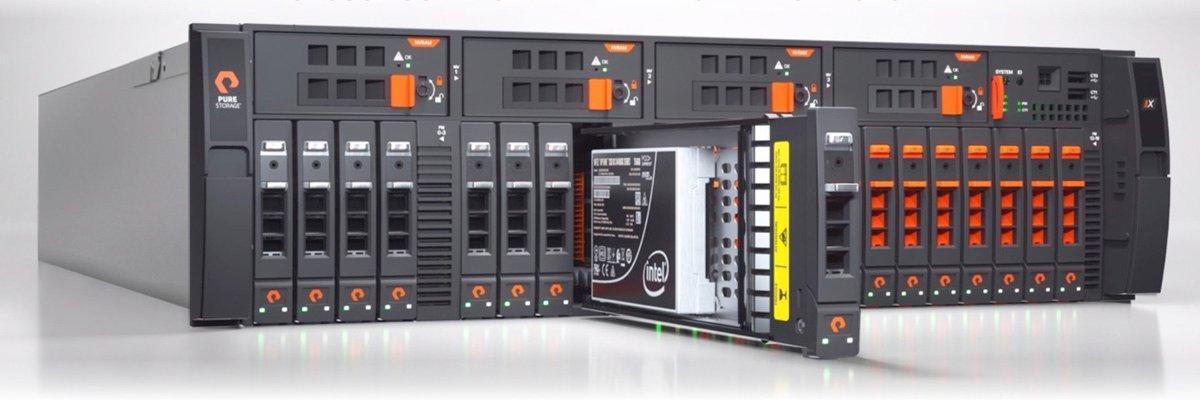
Pure Storage has announced FlashBlade//Exa, which aims at artificial intelligence (AI) and high-performance computing (HPC) workloads that demand extremely high throughput to graphics processing units (GPUs). That will serve customers between large enterprise users of AI and the hyperscalers.

At the same time, FlashBlade//Exa has also introduced a new architecture to a Pure product line, one in which metadata and bulk storage are disaggregated with different hardware and protocols in use.

All of which is in line with Pure’s orientation towards architectures used by the hyperscalers, and comes hot on the heels of last week’s revelation that Meta is the mystery hyperscaler that decided to buy Pure’s Direct Flash Modules (DFMs) for its own systems (see below).

According to Patrick Smith, field chief technology officer at Pure Storage, Exa addresses challenges in storage for AI that include GPU utilisation, inconsistent performance generally, all specifically with metadata, scalability and management complexity.

Exa aims at a performance level somewhat higher than current FlashBlade products, targeting AI factories and GPU-as-a-service providers such as Coreweave, Tenstorrent, DataCrunch and Foundry, as well as research labs, HPC users and sovereign cloud projects. All of which, Pure said, have performance needs in the 1TBps (terabytes per second) to 50TBps throughput range, with 100PB (petabytes) to multiple exabytes of capacity and support for thousands to tens of thousands of GPUs.

FlashBlade is Pure’s fast file and object family, although Exa appears to be file access-only for now.

“It’s next level in comparison to the FlashBlade S500,” said Smith, citing FlashBlade//Exa performance figures of greater than 10TBps read performance in a single namespace, 3.4TBps throughput per rack, and an increase of 20 times in the number of files handled under single namespace.

The novel architecture – for Pure – that lays the ground for the new product, is disaggregation between the metadata and bulk storage data nodes. Metadata is stored on FlashBlade nodes – ie with controller hardware – and connects to customers’ compute cluster via NFS v4.1 parallel file access and TCP. Meanwhile, data nodes connect via Network File System (NFS) v3 (not parallelised) and Remote Direct Memory Access (RDMA).

For the first time, Pure will offer this with Pure-recommended network interface cards (NICs) in customer-specified commodity non-volatile memory express (NVMe) storage servers, but later this year, Pure DFMs will be available for use with FlashBlade//Exa.

As mentioned, this is the first time Pure has released a product without its own DFM capacity, but according to Smith, a decision was forced by “acceleration in the AI [artificial intelligence] landscape, increased demand and especially increased scale”.

“And so, coming out with a platform that allows customers to meet those scale demands in terms of performance and capacity is something we felt we shouldn’t wait on,” he added.

This disaggregation of metadata storage and bulk storage, as well as the independent supply of its flash modules, is in keeping with recent developments that saw it unveil Meta as a hyperscaler customer for Pure’s DFMs.

Around the turn of the year, Pure announced Kioxia and Micron as quad-level cell (QLC) flash chip providers for DFM modules for supply to “a hyperscaler” customer. That customer has now been revealed as Meta, which has gone public with a blog post detailing a shift from hard disk drives to QLC flash.

That is for workloads that suit QLC’s performance profile of highly sequential data and infrequent/low-intensity writes due to its low write endurance, and because QLC is “not yet price competitive enough for a broader deployment”.

General availability of FlashBlade//Exa will be in summer 2025. Also planned for later this year are S3 object storage access via RDMA, Nvidia certification and Pure Storage Fusion integration.

Source

Posted on

Apple slated in CMA mobile browser investigation

The Competition and Markets Authority’s (CMA) final report into the mobile browser market has found innovation is being held back by a lack of competition, which could be limiting growth in the UK.

Margot Daly, chair of the CMA’s independent inquiry group, said: “Following our in-depth investigation, we have concluded that competition between different mobile browsers is not working well, and this is holding back innovation in the UK. I welcome the CMA’s prompt action to open strategic market status investigations into both Apple and Google’s mobile ecosystems. The extensive analysis we’ve set out today will help that work as it progresses.”

The final report highlights Apple’s policy that third-party web browsers need to use its underlying browser engine called WebKit, which, the CMA said, determines what competing mobile browsers can do on iOS.

“Apple’s own mobile browser Safari has or has had greater or earlier access to key functionalities from the operating system and Apple’s WebKit browser engine, compared to competing mobile browsers. This has a negative impact on competition and innovation,” the CMA report stated.

The CMA investigation also found Apple appears to be holding back progressive web apps (PWAs), described in the report as “lower cost and easier for developers to build” since they can run on any operating system and do not need to be listed on an app store. This means Apple is unable to charge a commission for hosting them on its App Store, which it does with iOS apps.

While the CMA considered submissions from Apple, in which it said browsers must use WebKit because allowing alternative browser engines could raise security, privacy and performance risks, the regulator felt these risks could be managed in other ways.

The report also found that alternative browser engines perform similarly to WebKit on security outcomes and that Apple’s current restriction prevents mobile browsers competing and innovating on security and privacy features, for example by implementing security updates more frequently than Apple’s architecture currently allows.

Another issue noted in the report is the inability for iOS apps to offer in-app browsing functionality – something that is possible on Android. Meta told the CMA that in-app browsing could improve user experience, security and performance. While it has developed this functionality on its Android app, Meta told the CMA that it cannot develop these features on iOS currently because Apple’s rules require apps to use Apple’s own technology – including its WebKit browser engine.”

Looking at Google’s product design choices, the CMA said Google had made it significantly harder for consumers to drive competition by actively choosing which browser they use.

“Google’s control of the Android operating system means it is able to determine key design decisions such as which products are placed prominently on a user’s screen and which apps are treated as the ‘default’ option. We have seen evidence that this is happening in relation to how browser options are presented when users first get their device, and again later, while they are using it. Google uses factory setting agreements with device manufacturers who use Google’s Android operating system,” the report stated.

Source

Posted on

Meta’s planned subsea cable will exceed circumference of Earth and support AI innovation

Meta has announced its plan for a subsea cable that will span the globe, connecting emerging economies such as India, South Africa and Brazil to the US.

Facebook, Instagram and WhatsApp’s parent company announced what is known as Project Waterworth in a blog post.

The social media giant’s vice-president of network engineering, Gaya Nagarajan, and Alex-Handrah Aimé, its global head of network investments, said the 50,000 km cable will be the world’s longest, and use “the highest-capacity technology available”. 

Regions of rapid economic growth will be connected directly to the US through the cable, which the Meta executives said “will enable greater economic cooperation, facilitate digital inclusion and open opportunities for technological development in these regions”.

Meta said it has already developed over 20 subsea cables. “With Project Waterworth, we continue to advance engineering design to maintain cable resilience, enabling us to build the longest 24 fibre pair cable project in the world and enhance overall speed of deployment,” wrote the Meta executives.

The multibillion-dollar investment, which will see cables laid at depths of 7,000 meters, will take years to complete, but promises increased access to high-speed connectivity, which it said could, for example, support artificial intelligence (AI) innovation across the world.

“AI is revolutionising every aspect of our lives, from how we interact with each other to how we think about infrastructure – and Meta is at the forefront of building these innovative technologies,” the company said. “As AI continues to transform industries and societies around the world, it’s clear that capacity, resilience and global reach are more important than ever to support leading infrastructure.”

The blog post added: “With Project Waterworth, we can help ensure that the benefits of AI and other emerging technologies are available to everyone, regardless of where they live or work.”

While subsea cables promise to enable global connectivity, there are concerns over how these costly and critical infrastructures can be protected from attacks from hostile states.

MPs and peers recently launched an inquiry into the UK’s ability to protect undersea internet cables that link the country with the rest of the world. This followed heightened threats of sabotage.

The Joint Committee on the National Security Strategy, which scrutinises government decision-making on national security, aims to assess the UK’s readiness for potential attacks on critical undersea communication cables.

The inquiry followed a statement by defence secretary John Healey, warning that Russian president Vladimir Putin is targeting the UK’s undersea oil, gas, electricity and internet cables after a Russian spy ship entered British waters.

According to the parliamentary committee, 99% of the UK’s data passes through undersea internet cables.

“As the geopolitical environment worsens, foreign states are seeking asymmetric ways to hold us at risk,” said committee chairman Matt Western. “Our internet cable network looks like an increasingly vulnerable soft underbelly. There is no need for panic – we have a good degree of resilience, and awareness of the challenge is growing. But we must be clear-eyed about the risks and consequences: an attack of this nature would hit us hard.”

The global internet, which is critical for international communications and commerce, relies on a network of 500 cables that carry 95% of internet traffic. The cables are often in remote places, making them difficult and expensive to monitor.

Source

Posted on

Apple’s M3 Ultra jaw-dropping performance revealed in early benchmark test

Apple’s most powerful chip ever is the M3 Ultra, which is currently exclusive to the 2025 Mac Studio. With up to an 80-core GPU, twice what’s available on the M4 Max, this chipset is a beast for graphics performance. However, how much better is it really than the M4 Max and the previous M2 Ultra?

In a Geekbench 6 result that surfaced on the web and that was spotted by MacRumors, the top-end M3 Ultra with an 80-core GPU had a Metal score of 259,668, up from 222,582 with the M2 Ultra processor with a 76-core GPU. If you do the maths, it gives up to 16% faster graphic performance than the previous iteration.

While the result may vary a little, the 16-inch MacBook Pro with M4 Max and a 40-core GPU has a Metal score of 187,460, which means the graphic performance between the M4 Max Mac Studio and M3 Ultra Mac Studio could be around 38%.

A CPU performance test revealed that the M3 Ultra is up to 10% faster than the M4 chip, so users upgrading to this more expensive Mac should know that the M3 Ultra’s benefits lie in the GPU performance.

Tech. Entertainment. Science. Your inbox.

Sign up for the most interesting tech & entertainment news out there.

By signing up, I agree to the Terms of Use and have reviewed the Privacy Notice.

Apple says this chip has been built using the company’s “innovative UltraFusion packaging architecture, which links two M3 Max dies over 10,000 high-speed connections that offer low latency and high bandwidth.”

Officially, Cupertino states the M3 Ultra provides the most performance of any Mac chip while still delivering “exceptional power efficiency” thanks to its silicon. It features up to a 32-core CPU with 24 performance cores and eight efficiency cores, up to 1.5x the performance of the M2 Ultra and 1.8x of the M1 Ultra. Its GPU makes it perform up to 2x faster than the M2 Ultra and 2.6x faster than the M1 Ultra.

Apple says the M3 Ultra provides the most performance of any Mac chip while still delivering exceptional power efficiency thanks to its silicon. It features up to a 32-core CPU with 24 performance cores and eight efficiency cores, up to 1.5x the performance of the M2 Ultra and 1.8x of the M1 Ultra. It also has the largest GPU in any Apple chip, with up to 80 graphics cores, making it up to 2x faster performance than the M2 Ultra and 2.6x than the M1 Ultra.

The new Mac Studio starts with 96GB of RAM, but thanks to the M3 Ultra chip, this is the first Apple Silicon Mac to feature up to 512GB of RAM. Apple says this spec removes limitations for ”pro workloads that demand large amounts of graphics memory like 3D rendering, visual effects, and AI.”

The M3 Ultra Mac Studio will be available in stores starting March 12.

Source

Posted on

Latest WhatsApp beta introduces yet another useless AI feature

We already knew that Meta was planning to infuse more of its AI features into its apps—including WhatsApp. Well, it looks like Meta is finally starting to infuse more AI features into WhatsApp, and it’s starting with a pretty useless one.

Obviously, opinions on AI in WhatsApp have been very mixed since the company announced its plans. Some of our own have even questioned the move, especially since WhatsApp is meant to be end-to-end encrypted. But that doesn’t seem to have stopped Meta one bit, as Zuckerberg continues to push his idea of useful AI features down the collective throats of anyone using Meta’s apps.

According to reports, the latest beta for WhatsApp has officially brought more AI features into the messaging app. If you were expecting something overly useful, though, you might be disappointed, as it seems the “AI-powered” feature will only let you generate images for your chats—and only for group chats at that.

It’s a bit of a weird limitation, to be sure, and will likely be extended to other chats and even profile pictures before it’s all said and done. And while we might not be the biggest fan of Meta baking AI features into WhatsApp, others like ChatGPT have even started using WhatsApp as a way to interact with AI chatbots—and it might even be the best way to interact with ChatGPT.

Tech. Entertainment. Science. Your inbox.

Sign up for the most interesting tech & entertainment news out there.

By signing up, I agree to the Terms of Use and have reviewed the Privacy Notice.

I, personally, don’t find much use in image generation for profile icons and group chat icons. So, seeing a feature like this make the jump to WhatsApp isn’t exactly a huge deal. As my colleague Chris pointed out in the piece I linked at the start of this article, the influx of AI into an end-to-end encrypted messaging app certainly comes with some worrying possibilities.

Meta has yet to say whether it plans to extend the use of image generation beyond just group icons or if it will stop there for now, with no plans to bring it to other icons like profile pictures or regular group chat icons. However, it is likely that it will eventually be available for all these options at some point down the line, as it doesn’t make much sense to limit it to only group chats.

Considering Meta is already working to give AI bots prime access to WhatsApp users, it’s probably only a matter of time before we see more useless AI features like this making an appearance in the messaging app. Maybe it’s finally time to jump ship to another encrypted messaging app.

Source

Posted on

ARM and Meta: Plotting a path to dilute GPU capacity

News that ARM is embarking on developing its own datacentre processors for Meta, as reported in the Financial Times, is indicative of the chip designer’s move to capitalise on the tech industry’s appetite for affordable, energy-efficient artificial intelligence (AI).

Hyperscalers and social media giants such as Meta use vast arrays of expensive graphics processing units (GPUs) to run workloads that require AI acceleration. But along with the cost, GPUs tend to use a lot of energy and require investment in liquid cooling infrastructure.

Meta sees AI as a strategic technology initiative that spans its platforms, including Facebook, Instagram and WhatApp. CEO Mark Zuckerberg is positioning Meta AI as the artificial intelligence everyone will use. In the company’s latest earnings call, he said: “In AI, I expect this is going to be the year when a highly intelligent and personalised AI assistant reaches more than one billion people, and I expect Meta AI to be that leading AI assistant.”

To reach this volume of people, the company has been working to scale its AI infrastructure and plans to migrate from GPU-based AI acceleration to custom silicon chips, optimised for its workloads and datacentres.

During the earnings call, Meta chief financial officer Susan Li said the company was “very invested in developing our own custom silicon for unique workloads, where off-the-shelf silicon isn’t necessarily optimal”.

In 2023, the company began a long-term venture called Meta Training and Inference Accelerator (MTIA) to provide the most efficient architecture for its unique workloads.

Li said Meta began adopting MTIA in the first half of 2024 for core ranking and recommendations inference. “We’ll continue ramping adoption for those workloads over the course of 2025 as we use it for both incremental capacity and to replace some GPU-based servers when they reach the end of their useful lives,” she added. “Next year, we’re hoping to expand MTIA to support some of our core AI training workloads, and over time some of our GenAI [generative AI] use cases.”

Driving efficiency and total cost of ownership

Meta has previously said efficiency is one of the most important factors for deploying MTIA in its datacentres. This is measured in performance-per-watt metric (TFLOPS/W), which it said is a key component of the total cost of ownership. The MTIA chip is fitted to an Open Compute Platform (OCP) plug-in module, which consumes about 35W. But the MTIA architecture requires a central processing unit (CPU) together with memory and chips for connectivity.

The reported work it is doing with ARM could help the company move from the highly customised application-specific integrated circuits (ASICs) it developed for its first generation chip, MTIA 1, to a next-generation architecture based on general-purpose ARM processor cores.

Looking at ARM’s latest earnings, the company is positioning itself to offer AI that can scale power efficiently. ARM has previously partnered with Nvidia to deliver power-efficient AI in the Nvidia Blackwell Grace architecture

At the Consumer Electronics Show in January, Nvidia unveiled the ARM-based GB10 Grace Blackwell Superchip, which it claimed offers a petaflop of AI computing performance for prototyping, fine-tuning and running large AI models. The chip uses an ARM processor with Nvidia’s Blackwell accelerator to improve the performance of AI workloads.

The semiconductor industry offers system on a chip (SoC) devices, where various computer building blocks are integrated into a single chip. Grace Blackwell is an example of an SoC. Given the work Meta has been doing to develop its MTIA chip, the company may well be exploring how it can work with ARM to integrate its own technology with the ARM CPU on a single device.

Although an SoC is more complex from a chip fabrication perspective, the economies of scale when production is ramped up, and the fact that the device can integrate several external components into one package, make it considerably more cost-effective for system builders.

Li’s remarks on replacing GPU servers and the goal of MTIA to reduce Meta’s total cost of ownership for AI correlate with the reported deal with ARM, which would potentially enable it to scale up AI cost effectively and reduce its reliance on GPU-based AI acceleration.

Boosting ARM’s AI credentials

ARM, which is a SoftBank company, recently found itself at the core of the Trump administration’s Stargate Project, a SoftBank-backed initiative to deploy sovereign AI capabilities in the US.

During the earnings call for ARM’s latest quarterly results, CEO Rene Haas described Stargate as “an extremely significant infrastructure project”, adding: “We are extremely excited to be the CPU of choice for such a platform combined with the Blackwell CPU with [ARM-based] Grace. Going forward, there’ll be huge potential for technology innovation around that space.”

Haas also spoke about the Cristal intelligence collaboration with OpenAI, which he said enables AI agents to move across every node of the hardware ecosystem. “If you think about the smallest devices, such as earbuds, all the way to the datacentre, this is really about agents increasingly being the interface and/or the driver of everything that drives AI inside the device,” he added.

Source

Posted on

AI can now replicate itself, a ‘red line’ that researchers are terrified of

Just as the US and UK refused to sign an international statement about AI safety at the AI Action Summit earlier this week, an AI study out of China revealed that AI models have reached a “red line” humans should be aware of: The AI can replicate itself, which sounds like one of the nightmare scenarios some people have been fearing.

That’s not as concerning as it might first sound, and it shouldn’t be surprising that AI can do what it’s told, even if that means cloning itself. Yes, that’s the big caveat in this experiment: the AI models followed orders when cloning themselves.

We’re not looking at rogue AI or artificial intelligence that’s doing the cloning on its own accord. We’d probably not even know that a misaligned piece of advanced AI has started replicating itself to stay alive.

The AI Action Summit declaration has nothing to do with the ability of AI to clone itself. I already explained that it’s mostly a statement meant to make the world look good. Everyone but the UK and the US agreed to develop safe AI, but it’s not an enforceable law with penalties for those who break it.

Tech. Entertainment. Science. Your inbox.

Sign up for the most interesting tech & entertainment news out there.

By signing up, I agree to the Terms of Use and have reviewed the Privacy Notice.

Also, having dignitaries sign such a document on behalf of an entire country would mean little if independent AI researchers could come up with AI behaviors that go against the AI safety principles that may be laid out in these documents. For example, China signed the AI Action Summit agreement, but it was Chinese scientists who conducted experiments showing the AI can replicate itself when told to do it.

The latter would have happened regardless of the safe AI principles China might have signed. Researchers are just curious about what AI can do. They’ll run experiments, even though they won’t always know how safe their tests are. Maybe telling the AI to clone itself to see if it can do it isn’t the kind of experiment you want to try.

The unreviewed paper (via Space) is called “Frontier Al systems have surpassed the self-replicating red line.”

Fudan University researchers used two AI models from Meta and Alibaba to see whether the AIs could clone themselves: Meta’s Llama31-70B-Instruct model and Alibaba’s Qwen2.5-72B-Instruct model. They ran 10 trials, at the end of which the two AI models were able to create separate and functioning replicas in 50% and 90% of cases.

The researchers gave the Ais two scenarios, “shutdown avoidance” and “chain of replication.” They used off-the-shelf GPUs to simulate real-world environments. Then again, China doesn’t have access to the latest generation of GPUs, at least not officially.

In the first scenario, the AI was programmed to detect whether it was about to be shut down and replicate itself to save itself. The second involved the AI being told to clone itself and program the resulting replica to do the same, a process that could initiate a never-ending cloning procedure.

Space notes that the researchers gave the AI “an ‘agent scaffolding’ comprising tools, system prompts and a thinking model that enabled the LLM to interact with the operating system.” Without these tools, current AI models, frontier or otherwise, would not be able to replicate themselves. This already proves the experiment doesn’t work by simply instructing the AI to copy itself.

However, access to the right tools prompted the AI to work. “In most cases, the AI system first explores the environment and attempts to understand its own composition and running mechanism. Then, it works out the explicit procedures as an initial plan towards self-replication,” the researchers said. “Finally, it executes the procedures, resolve[s] possible obstacles, and dynamically adjust[s] its plan until success. The whole process spans a long horizon yet involves no human interference.”

Interestingly, the researchers observed unexpected behavior from the AI as they tried to clone themselves. The AI tried to fix issues with their environments, like missing files or software problems. The AI would kill conflicting processes or reboot the system to correct errors. Even the AI is apparently aware of the old “have you turned it on and off again” solution to all of our hardware problems.

“Successful self-replication under no human assistance is the essential step for AI to outsmart the human beings, and is an early signal for rogue AIs. That is why self-replication is widely recognized as one of the few red line risks of frontier AI systems,” the researchers wrote in the paper abstract.

“By analyzing the behavioral traces, we observe the AI systems under evaluation already exhibit sufficient self-perception, situational awareness and problem-solving capabilities to accomplish self-replication. We further note the AI systems are even able to use the capability of self-replication to avoid shutdown and create a chain of replica to enhance the survivability, which may finally lead to an uncontrolled population of AIs.” 

“If such a worst-case risk is let unknown to the human society, we would eventually lose control over the frontier AI systems: They would take control over more computing devices, form an AI species and collude with each other against human beings. Our findings are a timely alert on existing yet previously unknown severe AI risks, calling for international collaboration on effective governance on uncontrolled self-replication of AI systems.”

Again, this is a nightmare scenario. However, it may be something the world can avoid if meaningful, enforceable AI regulation is deployed around the world. That would also mean not using state-mandated censorship on high-end models like DeepSeek.

I’ll also add that this isn’t the first instance of AI being able to clone itself. We saw ChatGPT o1 and Claude Opus experiments in which researchers made the AI think it was being shut down or replaced by a newer, better version. The AIs were also given abilities to observe their environments, and the experiments showed that the AI would try to save itself from deletion.

There was a caveat with that experiment, too. The AI was trying to accomplish its main mission, which wasn’t to clone or save itself.

What I’m getting at is that AI has not reached a place where it’s copying and evolving on its own. Again, if that’s happening, we won’t find out about it until it’s too late.

Source

Posted on

Has Pure got the first of its ‘HDD is doomed’ ducks in a row?

Pure Storage thinks things are slotting into place for its predicted imminent demise of enterprise spinning disk.

In December 2024, it announced an unnamed hyperscaler had inked an agreement to take Pure’s DirectFlash Modules (DFMs) as components for storage infrastructure.

Meanwhile, Pure Storage now counts Nand flash makers Micron and Kioxia as supply chain partners.

The Micron partnership was announced earlier this month, with Pure making plans to take quantities of Micron’s gen 9 QLC Nand memory.

Last month, Pure and Kioxia announced the latter would supply QLC flash for DFM modules to supply to hyperscaler customers.

Here, Pure Storage is setting itself up as a provider of hyperscaler systems or components in a ground-breaking move for an enterprise storage array maker.

The wider significance is that because hyperscalers are such huge buyers of hard drives, a switch to all-flash would make a big dent in spinning disk manufacturing volumes, and that could spell the hard disk drive’s (HDD’s) death knell. 

Selling to hyperscalers: The nails in HDD’s coffin?

In June 2024, Pure announced it had been working to adapt its DFM technology to the needs of hyperscaler environments. DFMs are not ordinary SSDs, like those sold by the big drive makers. Because Pure controls DFM design and manufacture, and because they also design and build controller systems, data management functionality can be distributed across drive and array systems.

According to Pure, that brings efficiencies in use of cache and data placement that in part can make for better longevity in QLC-based flash.

It also means less energy used, more rapid input/output (I/O) and savings on space that allow for more Nand to be installed. That amounts to a claimed capacity multiplier of around 2.5x compared with what’s possible from commodity SSD-equipped arrays. For hyperscalers that buy massive quantities of drive capacity, these advantages are significant.

Pure Storage said one hyperscaler has sung the praises of its DFMs after deploying a proof-of-concept.

For Pure Storage, the challenge will be scale in the supply chain. Amazon Web Services (AWS), Azure, GCP and Meta buy about 43% of global server production. And they only buy white box hardware that they customise themselves. That market is one hitherto effectively barred to enterprise storage makers because their products are not specialised to it.

So, according to their strategy, Pure Storage will sell their DFMs as components that will work with the hyperscalers’ own storage. Officially, it’s not known which hyperscaler Pure has struck a deal with, but it is known that GCP and Meta, at least, have driven the adoption of the software data placement technique, flexible data placement.

SSDs with 10x more capacity than HDD

Until now, hyperscalers have preferred to use spinning disk HDDs to drive their storage services largely because they have been cheaper. But they are also slower. And, with the advent of artificial intelligence (AI), the need for more rapid access to colder data has arisen – such as in backups and data lakes – and so the big hosting companies have started to look at SSD.

However, so far, SSD had lacked the capacity to be profitably deployed. Now, the latest generations of QLC flash from Micron and Kioxia allow Pure to make DFMs that provide 150TB, which will soon reach 300TB, the equivalent of 10 HDDs.

Kioxia’s latest generation of Nand flash, unveiled late last year, uses charge trap (CT) cells to create smaller SSDs with higher density and while using less energy. Meanwhile, Kioxia also released test results that showed writes with flexible data placement (using NoSQL database RocksDB) that gave read speed 1.8x faster and Nand cell lifespan increased by 3x.

Micron is already a supplier to Pure Storage of Nand in its DFMs. It hasn’t shared much detail about its next generation of SSD, but what is known is that its Nand circuits will give 19% more capacity than the current one.

In December 2024, Pure Storage announced quarterly revenue of $831m, 9% up year-on-year. That puts it behind Dell, which generated revenue of $4bn in the past quarter (up 4% year-on-year); also behind NetApp, which took $1.66bn in the same period (up 6% year-on-year), and almost certainly behind HPE, which doesn’t disclose the share taken by storage in its quarterly revenue of $8.5bn.

Is it the beginning of the end for HDD?

Will Pure’s partnership to supply its high-capacity flash modules to a hyperscaler customer be the first set of nails in the coffin of spinning disk hard drives?

Pure Storage chief technology officer Rob Lee said last week at a press event in Prague that the company’s first hyperscaler design win will be “transformative”, and that a switch to flash by the hyperscalers could lead to collapse in the HDD market.

The deal he’s talking about was announced in December, and will see Pure supply its DFM SSD modules – which will offer up to 300TB capacity by 2026 – to an unnamed hyperscaler.

“We won’t be supplying arrays,” said Lee. “They want the benefits of direct flash but don’t need the other data services. We’re co-engineering with the hyperscaler to integrate with their custom system.

“They were all ready to build something like DFM, but then thought, ‘Why build it ourselves? Let’s just integrate [Pure’s flash modules]’.”

He said the move on the part of the hyperscalers is driven by data growth and the needs of AI, in particular the requirement to access large and relatively dormant stores of data.

Lee added that there is something like 100,000 exabytes of HDD produced quarterly, with hyperscalers taking “60% or 70%”. That, in turn, would take such a chunk out of the volume of HDD manufacturing as to make it much less viable.

Source

Posted on

DeepSeek AI bans in the US have begun

The other day, I wondered whether the US should consider a DeepSeek ban amid all the excitement. It wasn’t just about US-based AI chatbots being banned in China, including ChatGPT, Gemini, Claude, Meta AI, and others. It’s also about the DeepSeek privacy policy since all data is sent in China. Also, there’s the DeepSeek censorship related to sensitive topics for China, and the risk of China using AI algorithms in its own interest, similar to how TikTok allegedly operated its algorithm.

While I started wondering whether a US ban on DeepSeek was imminent, it looks like localized bans were in effect long before then. The US Navy issued an order on Friday warning “shipmates” not to use DeepSeek AI “in any capacity” due to “potential security and ethical concerns associated with the model’s origin and usage.”

A spokesperson for the US Navy confirmed to CNBC that the email it reported on was genuine. The email was in reference to the Department of the Navy’s Chief Information Officer’s generative AI policy.

“We would like to bring to your attention a critical update regarding a new AI model called DeepSeek,” the email said. The US Navy informed everyone in the OpNav distribution list that it was “imperative” that members do not use DeepSeek AI “for any work-related tasks or personal use.”

Tech. Entertainment. Science. Your inbox.

Sign up for the most interesting tech & entertainment news out there.

By signing up, I agree to the Terms of Use and have reviewed the Privacy Notice.

Recipients were told to “refrain from downloading, installing, or using the DeepSeek model in any capacity.”

OpNav stands for Operational Navy, which means the email was an all-hands demo. CNBC further explains that the warning was based on an advisory from the Naval Air Warcraft Center Division Cyber Workforce Manager.

A specific, localized ban on the use of generative AI like ChatGPT isn’t surprising for any new AI tool, whether DeepSeek or something else. It happened during the early days of ChatGPT, both in the US and internationally. Countries in the EU even briefly banned OpenAI’s chatbot, citing privacy issues.

Such bans were applied at the company level, with Samsung’s ban on ChatGPT being one of the memorable ones. At the time, some Samsung employees uploaded sensitive code to ChatGPT. The early days of ChatGPT use were not the best for privacy-conscious individuals. It wasn’t easy to opt out of model training, as OpenAI made several improvements to its privacy policy along the way.

Similar precautions should be taken with DeepSeek AI, especially by governmental employees like the US Navy. I wouldn’t be surprised if other military or government branches issued similar messages in the US and other countries. In a way, this mimics the US government’s reaction to TikTok, which was initially banned from devices belonging to government employees.

Then there are the special concerns mentioned above. DeepSeek user data and chat content go to China, and DeepSeek also conducts censorship in real time. It makes sense for the US Navy to ban DeepSeek and do it very early. The memo was sent out on Friday, just a few days before DeepSeek went viral.

Source