Posted on

Microsoft Copilot now offers unlimited free access to Think Deeper and Voice features

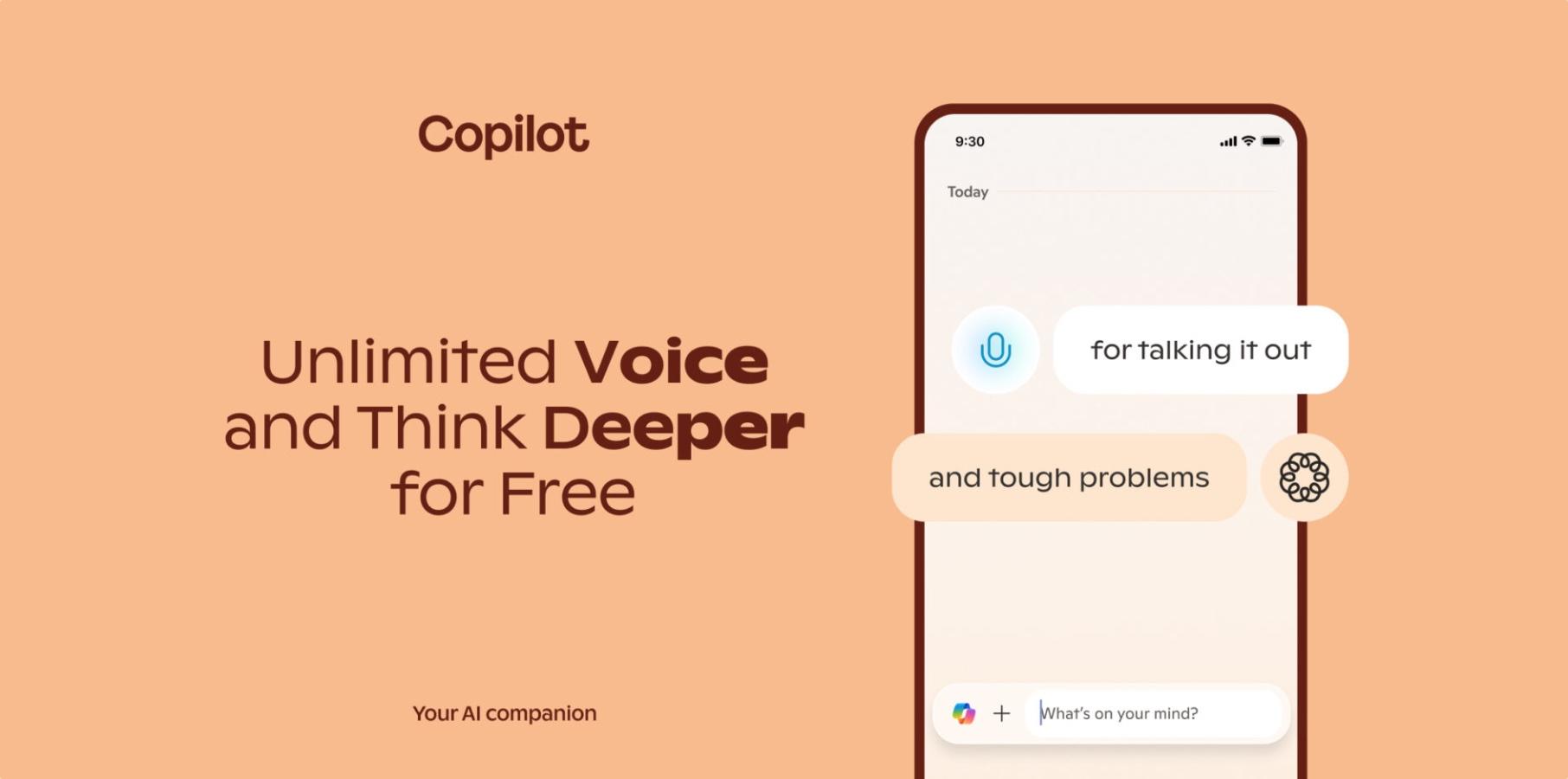
Microsoft announced that its Copilot’s Think Deeper and Voice features are now available for free, with unlimited access for all users. Powered by OpenAI’s o1 model, you can talk with Copilot using Voice and use Think Deeper’s reasoning models to help with more complex tasks.

This announcement comes as OpenAI expands its Operator capabilities to more countries, and Google Gemini is squashing superbugs which would take researchers a decade to fix. In a press release, Microsoft says, “We are seeing a lot of excitement for Voice and Think Deeper, and we know many of you have been hitting limits. This should help.”

Microsoft suggests users take advantage of Copilot’s Voice mode to practice “a few simple phrases in a new language to help you navigate when visiting a new country or meeting new people.” With Think Deeper, users can take advantage of OpenAI’s latest o1 reasoning model when making a big purchase, planning a career move, or more.

“We are working hard to scale unlimited access to advanced features to as many people as possible, as quickly as possible, starting today with Voice and Think Deeper. It’s worth noting you may experience delays or interruptions during periods of high demand or if we detect security concerns, misuse, or other violations,” the Microsoft Copilot team says.

Tech. Entertainment. Science. Your inbox.

Sign up for the most interesting tech & entertainment news out there.

By signing up, I agree to the Terms of Use and have reviewed the Privacy Notice.

Even though these features are being expanded to free users, Copilot Pro users will have priority for access to its latest models during peak usage, access to experimental AI features, and additional use of Copilot in Microsoft 365 apps. The Redmond company reveals more AI features for Pro users will be revealed soon.

Users can try Copilot’s Voice and Think Deeper features for free here.

Source

Posted on

DeepSeek is rushing to get its next-gen R2 model out sooner than expected

After taking the world by storm with the debut of its R1 reasoning model in January, Chinese AI startup DeepSeek is reportedly looking to maintain the momentum by rushing its new R2 model to market as quickly as possible, Reuters reports.

DeepSeek at first planned to launch R2 in early May, but sources familiar with the company tell Reuters that DeepSeek wants to speed up the schedule. However, the sources didn’t provide a new release date for DeepSeek-R2, which has yet to be announced.

We don’t know much about DeepSeek’s next AI model yet, but the Chinese company wants R2 to have improved coding skills and reason in languages other than English.

When DeepSeek-R1 launched, the entire industry was taken aback by the research paper that claimed the highly sophisticated model was trained at a fraction of the cost of OpenAI’s o1. The pushback was immediate, though, as OpenAI posited that DeepSeek distilled ChatGPT to train its model, and Google called DeepSeek’s claims “exaggerated.”

Tech. Entertainment. Science. Your inbox.

Sign up for the most interesting tech & entertainment news out there.

By signing up, I agree to the Terms of Use and have reviewed the Privacy Notice.

Nevertheless, many companies were quick to adopt the new model, including OpenAI investor Microsoft, which added DeepSeek-R1 to Azure AI Foundry and GitHub. You can also find R1 in the Amazon Web Services (AWS) model catalog.

With the arrival of GPT-4.5 still weeks away and GPT-5 potentially months out, DeepSeek has a chance to shake up the market once again if R2 launches soon.

Source

Posted on

Gemini AI just got a new feature ChatGPT can’t match yet

The smarter AI programs like ChatGPT and Gemini become, the more we’ll want to use them as the virtual assistants they can be. For that to happen, we’ll need the AIs to access information about us from all sorts of apps and remember details about us. We’ll also need to be able to trust companies like OpenAI and Google with increasingly more personal data.

OpenAI was the first to bring memory features to ChatGPT. It happened with Custom Instructions, a feature I’ve used since it became available. About a year ago, OpenAI also added a Memory feature to ChatGPT that allowed it to remember things about users from chats beyond the scope of Custom Instructions. All of this happens with the user’s knowledge, and memories can be deleted at any time. Also, they don’t train the AI if you set your ChatGPT privacy preferences correctly.

Gemini needed more time to get memory features similar to ChatGPT. Google rolled out the first memory features in November, but they’re available to Gemini Advanced subscribers. ChatGPT Memory features are also available to paying ChatGPT users.

However, Google has now improved Gemini’s memory in a way that OpenAI hasn’t. You can tell Gemini to recall information from your previous chats with the AI on a similar topic, which can be handy for picking up a conversation on the same subject.

Tech. Entertainment. Science. Your inbox.

Sign up for the most interesting tech & entertainment news out there.

By signing up, I agree to the Terms of Use and have reviewed the Privacy Notice.

“Starting today, Gemini can now recall your past chats to provide more helpful responses,” Google said in a blog on Thursday. “Whether you’re asking a question about something you’ve already discussed, or asking Gemini to summarize a previous conversation, Gemini now uses information from relevant chats to craft a response.”

While I have Custom Instructions enabled in ChatGPT and update them from time to time, I’m not using the memory feature. I don’t fully trust the AI to remember information about me, not that I provide information that might be too personal to hand over to the AI to begin with.

However, Google’s upgrade for Gemini is something I’d want from ChatGPT. The ability for ChatGPT to recall some conversations on a similar topic would certainly come in handy, as it would prevent me from having identical chats. That can happen from time to time.

I will remind you that ChatGPT Search did give ChatGPT a major UI overhaul, allowing users to search for previous chats. This makes it somewhat easier to recall past conversations, but I have to do it manually. Also, ChatGPT supports folders, so I can combine similar chats in the same folder to streamline my interactions with the AI.

Google’s way is better. I’d want to tell the AI to look at past conversations and find relevant information. This isn’t necessarily the same thing as the memory feature. It’s just giving the AI access to my chat data already stored in my account with a twist. I’d be able to manage what data the AI sees.

Google says that’s the case with Gemini:

You’re in control over what information is stored. You can easily review, delete or decide how long to keep your chat history. You can also turn off Gemini Apps Activity altogether by going to My Activity. Gemini may indicate when it uses your past chats in sources and related content.

The new memory feature is rolling out in English and you’ll need a Gemini Advanced subscription via the Google One AI Premium Plan. This subscription also gives you access to Google Cloud storage, which makes it a better deal than ChatGPT Plus.

Google Workspace Business and Enterprise subscribers will also get the feature in the coming weeks.

Source

Posted on

Is ChatGPT ‘the best search product on the web’ with new GPT-4o update?

OpenAI CEO Sam Altman recently addressed the future of ChatGPT, confirming that a GPT-5 upgrade is coming later this year. Before that, we’ll get GPT-4.5, an upgraded model expected to arrive in the coming weeks. Before any of those big upgrades arrive, OpenAI gave GPT-4o an unexpected upgrade that should improve the entire ChatGPT experience. The upgrade might also make ChatGPT Search better than before, with OpenAI Sam Altman calling it the “best search product on the web” over the weekend.

Don’t get too excited too fast, however. This is marketing speak at best. Altman dropped the comment in reply to a question from Aravind Srinivas, the CEO of Perplexity AI, which is an AI search engine that competes against ChatGPT.

“We put out an update to ChatGPT (4o). It is pretty good. It is soon going to get much better, team is cooking,” Altman tweeted out of the blue on Saturday.

Users are saying on social media that the latest ChatGPT update made GPT-4o’s upgrade much better. An X user called the AI’s writing “unbelievably good.” ChatGPT is supposedly “way more human-like, better at writing (emails, scripts, marketing etc) & actually follows style guides, esp with examples,” the tweet reads. “First time a model writes without sounding like slop (even better than Claude).”

Tech. Entertainment. Science. Your inbox.

Sign up for the most interesting tech & entertainment news out there.

By signing up, I agree to the Terms of Use and have reviewed the Privacy Notice.

Altman retweeted these observations to prove his point that GPT-4o has gotten better.

Altman was unusually active on X over the weekend, posting, among other things, visuals from a study that debunks the claims that AI like ChatGPT uses a lot of water.

Sam Altman talking on X about the ChatGPT GPT-4o upgrade including ChatGPT Search.Sam Altman talking about the ChatGPT GPT-4o upgrade, including ChatGPT Search. Image source: X

In this back and forth on X, Altman made the ChatGPT Search claim above that the GPT-4o update makes ChatGPT “the best search product on the web” in response to a question from Srinivas. The Perplexity exec asked what the ChatGPT GPT-4o update was all about.

Interstingly, Perplexity launched its own Deep Research AI agent tool for Perplexity AI just as Sam Altman teased the GPT-4o improvements. We’d probably need an AI model to compare the internet search experience between various products to determine the best search product on the web.

Marketing and banter aside, I use ChatGPT Search a lot during my chats with the AI. It’s not that I invoke ChatGPT Search, but I instruct the chatbot to look for stuff on the web for me. The experience is much better than I’d have ever hoped, and I’m not even taking into account any upgrades the latest GPT-4o upgrade might have brought over.

What seemed impossible when ChatGPT became a viral hit in November 2022 — that an AI chatbot might replace Google Search — is getting closer to becoming a reality.

I had already replaced Google Search by the time ChatGPT Search rolled out. OpenAI’s solution is just part of how I browse the web with a caveat. I rely on ChatGPT Search when giving ChatGPT more complex tasks that a simple search query would not solve. The AI then browses the web for me to answer that question.

AI agents like Operator and Deep Research will only improve this aspect, researching the web for more complex information about various topics. But I’m not sure I need ChatGPT Search to handle all my internet searches, even if Altman’s claims are real and OpenAI improved the search experience significantly.

The good news about this unexpected GPT-4o update is that it should improve your ChatGPT experience at all levels, even if you use the Free chatbot version.

Source

Posted on

Apple’s App Store is under investigation in China

The European Union forced Apple last year to open the App Store under the Digital Markets Act (DMA) work. iPhone users in the EU can install third-party app marketplaces, use third-party payment systems, and sideload apps as a result. Apple and the EU are still fighting over the DMA implementations.

As an iPhone user in the EU myself, I haven’t even bothered trying to take advantage of what the DMA does for me. I don’t want access to third-party apps or payment systems, and I’ll never sideload apps.

However, I said that Apple’s war on preserving the old ways of the App Store is doing more damage than good. Apple should open the App Store similarly in other markets and let every iPhone user and developer deal with the consequences. Most people will not change a thing.

The alternative is for more jurisdictions to investigate the App Store practices. Some of them can then pass laws with similar effects to the DMA.

Tech. Entertainment. Science. Your inbox.

Sign up for the most interesting tech & entertainment news out there.

By signing up, I agree to the Terms of Use and have reviewed the Privacy Notice.

China is the newest addition to the list of countries investigating Apple’s App Store practices. The government started a probe before President Trump took office, but the investigation is making the news now, in the middle of another phase of the US-China trade war. Earlier this week, China announced a formal probe into Google right after the new US tariffs on China came into effect.

The investigation into Apple isn’t as advanced, Bloomberg reports. The State Administration for Market Regulation (SAMR) is currently examining Apple’s App Store practices.

People familiar with the proceedings informed the paper that the agency has spoken with Apple officials and app developers since last year. It’s looking at Apple’s 30% fee on in-app purchases and the ban on third-party app stores and payment systems.

The agency won’t necessarily go after Apple if the conversations go well. But changes to the App Store might have to happen.

The report notes that Chinese regulators share the same concerns as other watchdogs investigating Apple’s App Store policies.

People familiar with the probe told Bloomberg that regulators believe Apple may be charging Chinese developers unreasonably high fees. Also, the unavailability of third-party app stores and payment systems on the iPhone impacts competition and hurts consumers.

The same sources said that the government may launch a formal investigation if Apple resists making changes to the App Store.

This sounds like Apple will be encouraged to open the App Store in China just like it did in the EU, but without a legal framework like the DMA in place to force Apple’s hand.

Then again, the DMA already forced Apple to develop all the tools it would need to open the App Store in other jurisdictions. Apple could probably open the iPhone in China just as easily as it did in the EU once it reaches some sort of deal with the Chinese regulator.

It’s all speculation, however. We’re looking at entirely different conditions here. Apple manufactures many of its products in China, and the government will probably want to keep Apple happy to some extent.

On the other hand, iPhone sales aren’t doing that great in China, which is a huge market for any smartphone vendor, especially Apple. The iPhone maker might want to use third-party app stores and payment systems to generate positive buzz around the iPhone.

Then there’s the US-China trade war the Trump administration reignited. Going after big tech firms like Google and Apple might be part of China’s strategy to reach a compromise.

But even without these complexities, the App Store issues would still linger. Some app developers want to pay lower fees to Apple. Others want to deploy third-party app stores and payment systems. Apple wants to keep in place the current practices and fees, as it believes its way of policing the App Store is in the consumer’s interest.

Unlike the EU’s DMA, there are no deadlines here. It’s unclear how the informal investigation will proceed, how long it will take, and when to expect App Store changes in the country.

Source

Posted on

Datafy promises to slash massive EBS overprovisioning costs

AWS EBS – Elastic Block Storage – customers usually massively over-provision cloud storage capacity and pay way more than they should. Capacity utilisation on EBS is between 10% and 30%, according to Datafy, a startup that claims it can slash AWS customers’ EBS bills by adding greater granularity to their cloud block storage deployments.

According to Gurdip Kalley, head of business development at Datafy, the core issue with AWS EBS is that it is effectively a form of direct-attached storage (DAS) but in the cloud, and that differs from other AWS block storage such as FSX which can be one-to-many. And so, because of this, customer devops engineers invariably over-provision capacity because it’s very difficult to predict usage, especially in Kubernetes deployments.

“EBS is elastic, but it’s not that elastic,” said Kalley. “So, customers pay up front for capacity, just like you do for mobile phone storage and you pay whether you use it or not.”

According to Kalley, EBS eclipses all other AWS cloud storage services in terms of revenue, with a Datafy-estimated $10bn of income. “It’s popular because it’s the easiest way to lift-and-shift storage for EC2 and EKS applications,” he said.

But there’s a problem in terms of scaling. To scale up is easy, said Kalley, but to scale down is far less so. What you have to do is to create a new, smaller volume, move the data, then break all connections with the application and the old volume and connect to the new volume, he said, adding: “Customers have said it’s basically a migration, and they’ll do this once or twice, but not after that.”

What Datafy does is deploy an agent in all instances of customer AWS compute. Here, it determines the size of volumes and replaces single larger volumes with a number of smaller ones.

This is where Datafy’s smarts reside – in its virtualisation of many volumes to make them appear as one, and so allow easier scaling as multiple volumes are added and subtracted to right-size capacity.

Kalley said there are no “non-AWS concepts” introduced to the running of Datafy agents and supra-agent intelligence. “Customer data is copied from the original volume to the Datafy volume [actually volumes, in the plural],” he said. “Now, the original can be deleted and the customer will now save money. We can grow capacity in real time as needed, with shrinking taking place to ensure the least possible disruption.”

Pricing is based on capacity managed and comes in at 20% of AWS capacity managed. If that seems a steep percentage, it’s because Datafy is confident the customer will pay a lot less than it did for over-provisioned AWS EBS storage.

For example, if you were spending $100 per month and now spend $40 per month – which assumes a previous utilisation rate of 40% – the cost of Datafy would be 20% of the latter figure and a total of $48. And you only pay if you make savings.

Datafy is available on the AWS marketplace, starting in Q1 2025.

Later in 2025, Datafy will expand its capabilities to Azure and Google Coud Platform block storage.

Source

Posted on

North Korean hackers created new macOS malware disguised as popular app installers

Another day, another macOS malware is trying to actively exploit your Mac. This time, North Korean hackers are using fake job offers hidden in updates to popular apps like Zoom and Google Chrome to invade your Mac.

As security researchers from SentinelLabs (via AppleInsider) reported, North Korean hackers are pushing the macOS Ferret family of malware. Even though Apple has successfully prevented some of these viruses with the on-device malware tool XProtect, caution is still recommended.

This is not the first time someone has tried to install malware on people’s Macs using the “Contagious Interview campaign” method. Basically, targets are asked to go on an interview through a link that shows an error message and a request to install or update some required software, such as Zoom or Google Chrome. After all, who hasn’t tried to join a call only to have Zoom or WebEx ask for an update?

Thankfully, the macOS 15.3 update added a few new security improvements to prevent this malware from infecting your Mac. However, some of the Ferret viruses can still bypass Apple’s security.

Tech. Entertainment. Science. Your inbox.

Sign up for the most interesting tech & entertainment news out there.

By signing up, I agree to the Terms of Use and have reviewed the Privacy Notice.

The researchers from SentinelLabs write: “The ‘Contagious Interview’ campaign and the FERRET family of malware represent an ongoing and active campaign, with threat actors pivoting from signed applications to functionally similar unsigned versions as required. Diverse tactics help the threat actors deliver malware to a variety of targets in the developer community, both in targeted efforts and what appears to be more ‘scatter gun’ approaches via social media and code sharing sites like Github.”

How do you protect yourself from this macOS malware threat?

The best way to protect yourself from this macOS malware threat is to ensure you have the official apps downloaded on your Mac. For example, instead of taking web Zoom calls, make sure to always have them on your Mac app. The same is worth it for WebEx. For Google Chrome, don’t forget to check updates through the browser itself. In addition, having the latest macOS update can guarantee you’re protected against the latest threats as well.

Keep checking BGR for the latest macOS malware trying to exploit your Mac and more.

Source

Posted on

ChatGPT no longer requires you to have an account to search

Google’s dominance in online search has been virtually undisputed for over 20 years, but a real challenger might have finally arrived. As of Wednesday, OpenAI no longer requires you to log in to use ChatGPT’s search engine. In fact, you don’t even need an account.

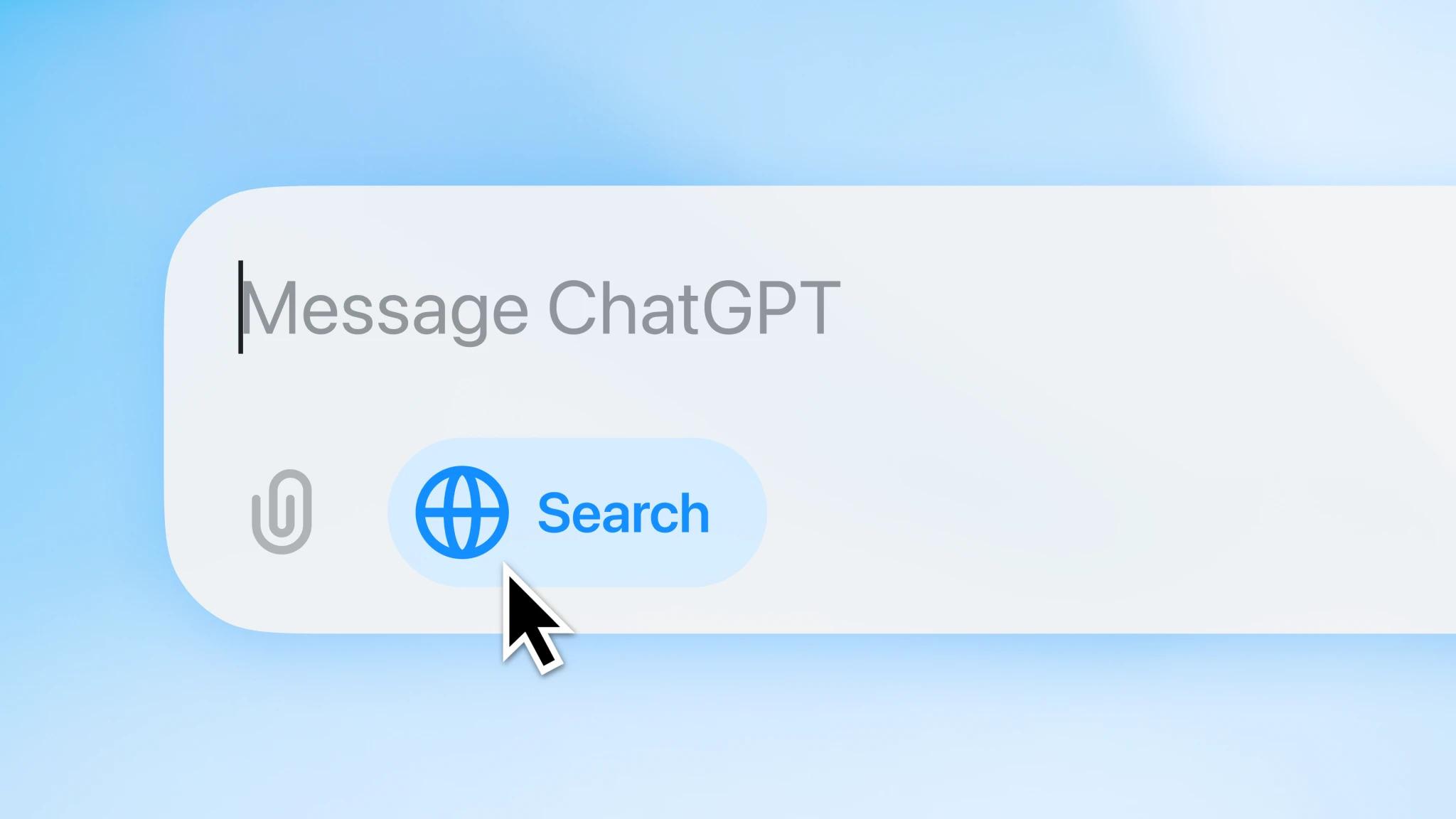
“ChatGPT search is now available to everyone in regions where ChatGPT is available,” OpenAI noted on its website in an update. “No signup required.”

OpenAI launched its search engine on October 31st, 2024, granting access to paid subscribers and SearchGPT waitlist users. It then rolled out to free users on December 16, but now, anyone can search on ChatGPT by visiting ChatGPT.com and clicking the “Search” button.

“The search model is a fine-tuned version of GPT-4o, post-trained using novel synthetic data generation techniques, including distilling outputs from OpenAI o1-preview,” OpenAI explained last year. “ChatGPT search leverages third-party search providers, as well as content provided directly by our partners, to provide the information users are looking for.”

Tech. Entertainment. Science. Your inbox.

Sign up for the most interesting tech & entertainment news out there.

By signing up, I agree to the Terms of Use and have reviewed the Privacy Notice.

Now that everyone has unrestricted access to ChatGPT search, it will be fascinating to see how many people try to ditch Google for good, and how successful they are at doing so.

This is the latest in a flood of major updates and new releases from OpenAI in recent weeks as the company pushes back against DeepSeek mania. Within the last two weeks alone, OpenAI has launched two AI agents: Operator and Deep Research.

Source

Posted on

OpenAI says it has evidence DeepSeek used ChatGPT to train its AI

Chinese startup DeepSeek stunned the world with its sophisticated DeepSeek R1 reasoning model, which is as good as ChatGPT o1. That’s not a surprising achievement; it’s only a matter of time before other AI models can replicate what OpenAI has done in terms of AI reasoning. Also, OpenAI will soon make o3 available, the successor to o1.

What really shocked the markets was DeepSeek’s research, which showed that the company was able to train R1 to achieve the same capabilities at a fraction of the cost of training o1.

Because of US sanctions, DeepSeek didn’t have access to the latest NVIDIA GPUs that AI firms like OpenAI use to train high-end AI models. It turned to software optimizations to compensate for what it lacked in hardware to create an AI model that could match ChatGPT o1.

But it turns out software optimization isn’t everything DeepSeek might have done to train its AI. OpenAI claims it has evidence that DeepSeek distilled ChatGPT to train the DeepSeek AI models.

Tech. Entertainment. Science. Your inbox.

Sign up for the most interesting tech & entertainment news out there.

By signing up, I agree to the Terms of Use and have reviewed the Privacy Notice.

If that’s true, the practice violates OpenAI’s terms of service for ChatGPT. Ironically, if OpenAI’s claim is true, it’ll make the company experience what many creators felt when they discovered OpenAI may have trained its ChatGPT models using copyrighted materials without consent.

OpenAI told The Financial Times it found evidence that DeepSeek used the US models to train DeepSeek AI.

OpenAI found evidence of “distillation,” which it believes came from DeepSeek. Distillation is a process where AI firms use an already trained large AI model to train smaller models. The “student” models will match similar results to the “teacher” AI in specific tasks.

Some early DeepSeek testers were surprised to see the AI identify itself as ChatGPT in early responses, which prompted speculation that DeepSeek AI might have been trained with ChatGPT chats.

OpenAI claims that DeepSeek might have distilled ChatGPT make sense, but it’s unclear whether the US AI firm can prove the IP theft beyond doubt. Even if it can provide conclusive evidence that DeepSeek used ChatGPT to train its AIs, there’s probably little OpenAI can do. After all, DeepSeek R1 is already out in the wild.

DeepSeek made its models available open-source, which means anyone can install them on computers. The DeepSeek app is topping the App Store, and it’s available in the Google Play store. Unless DeepSeek is banned in the US, the app won’t go away anytime soon.

The FT says that OpenAI and Microsoft investigated accounts believed to belong to DeepSeeka last year. They were using OpenAI’s API for ChatGPT access. OpenAI blocked access, suspecting they may rely on distillation to train other models.

DeepSeek has not commented on these allegations. The company is seen as a hero in China after the release of DeepSeek R1, which wiped nearly $1 billion from the US market.

On the other hand, it’s not just Chinese AI companies like DeepSeek that might rely on the distillation of ChatGPT and other frontier AIs to train better AI models. The FT notes that it’s common practice for AI labs in China and the US to use outputs from bigger companies.

OpenAI and others have already trained AI using humans to teach the models how to produce responses that sound more conversational. This is an expensive process, so smaller firms will distill established models to train smaller ones. In such a case, a company like DeepSeek would have gotten the human feedback step for free.

I said earlier that DeepSeek’s use of distillation to train R1 is something others could benefit from, Apple included. I wasn’t referring to stealing AI work done by others but to using advanced, proprietary models to train smaller models that Apple might need for its on-device Apple Intelligence approach.

If OpenAI has strong evidence that DeepSeek used ChatGPT to train its AI models, we could be looking at the second good reason to ban DeepSeek in the US and elsewhere. The first is that DeepSeek collects plenty of user data and sends it all to China.

A ban is a process that will take time. And, again, even if all of this is successful, DeepSeek will still have strong AI models on its hands, which it can use to create next-gen AI of its own.

Meanwhile, OpenAI still has to deal with allegations that it used copyrighted content without consent to create ChatGPT.

Source

Posted on

EU law could usher in transformative change to digital ecosystems

In October 2024, the European Commission (EC) published its Digital fairness fitness check report as part of a continued effort to evaluate the effectiveness of European Union (EU) legislation with consumer protection laws.

Specifically, it evaluated the efficacy of the Unfair Commercial Practices Directive, the Consumer Rights Directive, and the Unfair Contract Terms Directive.

The report revealed these existing laws “have only partially achieved the objectives of providing a high level of consumer protection”, with harmful commercial practices online costing EU consumers at least €7.9bn per year, and further drew attention to the power and information imbalances between businesses and consumers online. Now, its findings are being used to shape the latest development in tech policy in Europe, the Digital Fairness Act (DFA).

Following the report, president of the European Commission Ursula von der Leyen wrote to Michael McGrath, the EU’s commissioner for consumer protection, to urge his successor to develop a Digital Fairness Act.

The mission letter outlined five core problematic practices in consumer-facing apps and online platforms today; including “dark patterns”, addictive design, personalised targeting features, problematic commercial practices of social media influencers, and features that make it excessively difficult to cancel digital subscriptions. 

Recent legislation such as the UK’s Online Safety Act and the EU’s Digital Services Act (DSA) have aimed to address some of the illegal and harmful online practices that persist online, but a Digital Fairness Act could potentially tackle some of the more pervasive technological tools that have been adopted by tech companies and digital platforms to persuade and engage consumers.

For example, a study conducted by the EC in 2022 found that 97% of the most popular websites and apps used by EU consumers use at least one dark pattern, which are manipulative interface designs and functionalities which undermine informed consent and mislead users.

Similarly, the European Consumer Organisation’s (BEUC) consumer survey in September 2023 revealed that the majority of consumers feel personal data analysis and monetisation is unfair (60%), and less than half (43%) do not feel fully in control of the decisions they make or the content they are shown online.

With the DFA currently in its proposal phase, civil society organisations and campaigners are putting forward their suggestions to the European Commission. Many civil society organisations across Europe are hopeful that the act will tackle some of the most exploitative techniques that have been fundamental to the tech industry’s growth, and which they believe are responsible for many of the harms that digital users face today. 

Fairness by design

European Digital Rights (EDRi) is the largest European network of organisations defending rights and freedoms online, and are working on a position paper with their members on the DFA. They hope that the act will address exploitative practices often employed by Big Tech and ad tech intermediaries, which they say “exploit users’ vulnerabilities, undermine their autonomy, and disproportionately impact marginalised communities”.

One area of focus they have for the DFA is to ensure it adopts a rights-centred approach that recognises digital users not just as consumers, but as people with broader individual and collective rights.

“A core assumption underpinning this approach is that vulnerability is inherent to the digital realm as we know it today, driven by an imbalance of power and significant information asymmetries,” says Itxaso Dominguez, a policy adviser at EDRi.

To address these challenges, EDRi are advocating for embedding principles of “fairness by design” and “fairness by default” into the act. They hope this will ensure that fairness and respect for fundamental rights are integral to the development and operation of digital platforms and services, rather than optional considerations. 

Superrr Lab, an organisation advocating for just digital futures, recently published a position paper titled Digital fairness – shaping consumer protection in a just and future-proof way.

They too echo the desire for fairness by design and by default to be enshrined in the act: “The DFA will be most effective in truly enhancing digital rights if it addresses the root-causes of power imbalances in the digital realm. Consumers are humans with rights beyond markets and consumer protection law, and an effective DFA, should be shaped accordingly to ensure true digital fairness – in the sense of no discriminatory practices and opportunities for participation.”

The addictive nature of social media platforms is another digital design feature that the act could address, and an area where there is increasing public scrutiny, particularly in relation to its effects on children and young people’s mental wellbeing. Challenging this feature through policy could potentially address one of the main tenets of the industry’s extractive business model. 

“Commissioner for justice Michael McGrath has said it plainly: ‘They want to keep people online constantly, including our children, and this is how to get money from advertising’,” Rosie Morgan-Stuart, campaign and policy consultant for People Vs Big Tech, said. “Meanwhile, the evidence of harm is mounting. Binding rules are clearly needed, given the severity of the risks and Big Tech’s repeated refusal to prioritise safety over profit.”

Enforcement and real accountability

Better enforcement is another core ambition for the DFA. The Digital fairness fitness check report drew attention to the pervasive non-compliance popular among tech companies and social media platforms, and the need for real accountability. Earlier in 2024, the European Commission opened proceedings against Meta, Alphabet and Apple over their failure to effectively comply with their obligations under the existing Digital Markets Act (DMA).

“To make a real difference, the Digital Fairness Act needs to set out clear rules that are easy to understand, to apply and – if necessary – to enforce. Unfortunately, current EU law does not provide sufficient legal certainty in relation to unfair commercial practices online and therefore does not adequately protect consumers,” says Urs Buscke, senior legal officer at BEUC.

EDRi echo the need for more robust enforcement mechanisms and the prohibition of manipulative practices outright, rather than relying on voluntary compliance mechanisms, which have historically failed.

Aside from voluntary compliance mechanisms, gaps in enforcement have also persisted due to the fact that the existing directives covered by the fitness check do not contain any reporting obligations.

An ambitious digital future: breaking up Big Tech

Some believe the DFA could potentially break up the monopolies within the tech industry seen across some of the Very Large Online Platforms (VLOPs), which the DSA defines as platforms or search engines that have more than 45 million users per month in the EU. Instead, they advocate for a digital ecosystem that allows independent, third-party content curation and moderation services. 

“Unbundling the social networks could address many of the harms connected to addictive design and predatory data surveillance by providing consumers with a marketplace of options for recommender systems and other content curation tools,” says Katarzyna Szymielewicz, co-founder of freedom and privacy NGO Panoptykon Foundation. “This would also address the problematic nature of relying on VLOPs themselves as the arbiters of quality and credibility in ranking algorithms.”

On 16 January 2025, 18 former European presidents and prime ministers wrote to Von der Leyen urging the EC to pursue a structural breaking up of Google’s services to restore competition and end Google’s monopoly. 

“Forced breakups are do-able and have a long and distinguished record through modern history – from John D. Rockefeller’s Standard Oil in 1911, to Germany’s gigantic IG Farben conglomerate after the Second World War, to AT&T in 1982,” says Claire Godfrey, executive director of Balanced Economy Project.

“They’ve just fallen out of favour. The US has proposed a break up of Google to fix the search monopoly, and the EU is in a position to support the US and break the tech giant’s monopoly over digital advertising. It needs the political will and courage more than anything.”

Despite the challenges, many of those Computer Weekly spoke with said the DFA could potentially result in transformative changes to the modern digital ecosystem. “The Digital Fairness Act offers a rare opportunity to set a global precedent, ensuring that fairness, transparency and accountability are embedded into the foundations of the digital ecosystem,” says Dominguez.

But this will only happen if policymakers strive to be bold. As Kim Van Spaarentak, GroenLinks MEP, urges: “We don’t have to accept the status quo. We can still fix our online environments if we dare to be ambitious enough. Alternatives are perfectly possible.

“If ethical design becomes the standard, the online space can be a fantastic place for knowledge-sharing, community forming and creativity. But whether the EU dares to go far enough is the big question for the next few years.”

Source