Posted on

AWS and Microsoft could face ‘targeted intervention’ from CMA over UK cloud competition concerns

The competition watchdog has published the provisioning findings from its long-running investigation into the inner workings of the UK cloud infrastructure services market, which shows that competition in the sector is not working as well as it could be. For this reason, Kip Meek, chair of the CMA’s independent inquiry group, said it is advising the regulator to “consider investigating the largest cloud service providers using its new digital markets powers”.

This is because its findings suggest end-user organisations could be paying more than they need for cloud services, and are possibly at risk of being locked into using platforms that do not meet their “evolving” needs.

In a seven-page report, detailing the provisional findings of its investigation, the CMA said the lack of competition in the cloud market could mean UK customers are collectively paying hundreds of millions more per year than they need to for services.

It went on to state that UK cloud users can be locked into their “initial choice of provider” due to technical and commercial barriers that prevent customers from seeking out the services of other cloud suppliers who might have better-priced or a more innovative portfolio of services.

“We have provisionally found that AWS and Microsoft have been generating sustained returns from their cloud services substantially above their cost of capital in cloud services for a number of years,” the report said. “Customers say that cloud services offer both quality and innovation to them. However, we consider that a more competitive market would have sustained better market outcomes, including more consistently competitive prices, as well as further improvements in quality and innovation.”

Controversial licensing practices

The report also called out Microsoft’s controversial licensing practices, which typically see it charging customers more for running its software in its competitors’ cloud, as impacting on the competitive position of AWS and also Google by “partially foreclosing” them from the market.

As well as being in-scope of the CMA probe, Microsoft’s behaviour on this front is also the subject of a European Commission complaint, filed by Google in September 2024.

“[The licensing piece] exacerbates the harm we have provisionally found arising from high market concentration and barriers to entry and expansion in relation to Microsoft’s significant unilateral market power,” the report added.

To remedy the situation, the report suggests the CMA board should use powers conferred on it through the roll-out of the Digital Markets, Competition and Consumers Act 2024 (DMCCA) on 1 January 2025 to mark AWS and Microsoft out as suppliers with “strategic market status”.

This would mean the CMA could impose legally binding conduct requirements or pro-competition interventions on both firms to limit and remedy the toll their activities have allegedly had on the market.

As detailed in the report, such powers are “specifically designed to be effected in digital markets … that share a combination of characteristics that can cause them to ‘tip’ in favour of one or a few firms” by allowing the CMA to take a “targeted and iterative” approach to tackling the behaviour of such providers.

“We consider that measures aimed at AWS and Microsoft would address market-wide concerns by directly benefiting the majority of UK customers and producing wider, indirect effects by altering the competitive conditions or other providers,” the report stated.

Before any action can be taken by the CMA, a consultation on the provisional findings of its investigation needs to take place, with cloud market stakeholders now invited to share their feedback on the conclusions raised so far. The final report from the CMA’s investigation is due to drop by 4 August 2025.

In the meantime, AWS has responded to the CMA’s provisional findings by describing its proposed intervention under the terms of the DMCCA as “not warranted”, and urged it to think about the long-term impact of such a move.

“We urge the CMA to carefully consider how regulatory intervention in other areas will stifle innovation and ultimately harm customers in the UK,” a spokesperson for AWS said. “We will continue to work constructively with the CMA as they work on their final report.”

Rima Alaily, corporate vice-president and deputy general counsel in the competition law group at Microsoft, seemed to suggest in a statement to Computer Weekly that the contents of the CMA report are mistargeted. 

“The draft report should be focused on paving the way for the UK’s AI-powered future, not fixating on legacy products launched in the last century,” she said. “The cloud computing market has never been so dynamic and competitive, attracting billions in investments, new entrants and rapid innovation. What could be better for UK businesses and government?”

Meanwhile, Chris Lindsay, vice-president of customer engineering for Europe, the Middle East and Africa at Google Cloud, said the company was pleased to see the impact that restrictive licensing practices have on cloud customers feature in the CMA’s provisional findings.  

“Restrictive licensing harms UK cloud customers, threatens economic growth and stifles innovation, and we are encouraged that the CMA has recognised the harm of these practices,” he said.

Source

Posted on

Open-R1 is a truly open version of DeepSeek AI

On Monday, DeepSeek R1 crashed the stock market once it became clear to some of the investors trading AI-related stocks that the Chinese startup had found a way to train AI as capable as ChatGPT o1 without access to the state-of-the-art NVIDIA chips that OpenAI and US AI firms have access to. That’s why firms creating hardware for AI infrastructure suffered the most. NVIDIA shed nearly $600 billion in market cap, while the entire market lost almost $1 trillion.

I said at the time that the reactions might be blown out of proportion. Yes, DeepSeek employed software optimizations to develop AI as capable as o1 instead of relying on hardware. But that doesn’t mean NVIDIA’s GPUs are suddenly obsolete. It just realigns the playing field while providing a new way to innovate.

I still think that AI firms with access to the latest hardware and top-tier software talent will have an edge over Chinese rivals. All a company like OpenAI or Google has to do is replicate some of the tricks DeepSeek used to match the Chinese startup’s AI training and usage efficiency and then leapfrog it. The latest AI chips will still be very important here.

It turns out it’s not just the big AI firms that might try to copy what DeepSeek has done. A team of developers calling themselves Open-R1 wants to replicate the DeepSeek R1 success to create a reasoning AI model that’s just as powerful as R1. There’s a big twist in all of this that AI fans in Western markets will appreciate. Open-R1 should be even more transparent than DeepSeek R1.

Tech. Entertainment. Science. Your inbox.

Sign up for the most interesting tech & entertainment news out there.

By signing up, I agree to the Terms of Use and have reviewed the Privacy Notice.

DeepSeek’s decision to make its AI models open-source was brilliant. This ensured that anyone could access and install the model on their computer. From there, they’d have a local model as capable as ChatGPT o1. The open-source route would also drive up adoption and testing. News about R1’s capabilities would spread rapidly.

But, as the Open-R1 researchers explain on Hugging Face, DeepSeek R1 isn’t fully open-source:

The release of DeepSeek-R1 is an amazing boon for the community, but they didn’t release everything—although the model weights are open, the datasets and code used to train the model are not .

That’s where Open-R1 is coming in: 

The goal of Open-R1 is to build these last missing pieces so that the whole research and industry community can build similar or better models using these recipes and datasets. And by doing this in the open, everybody in the community can contribute!

Specifically, the Open-R1 team wants to answer the following questions about DeepSeek R1 while they develop an identical AI:

Data collection: How were the reasoning-specific datasets curated?

Model training: No training code was released by DeepSeek, so it is unknown which hyperparameters work best and how they differ across different model families and scales.

Scaling laws: What are the compute and data trade-offs in training reasoning models?

The researchers plan to clone DeepSeek’s development strategy for R1, further fine-tune it, and create a truly open-source Open-R1 model that anyone could use.

Interestingly, the Open-R1 researchers want to distill DeepSeek R1 and create a high-quality reasoning dataset. DeepSeek might have done its own distillation, with OpenAI claiming the Chinese startup used ChatGPT to train its earlier versions of AI. That work might have been critical to getting to DeepSeek R1. It’s unclear if OpenAI can prove these allegations with absolute certainty.

However, the Open-R1 researchers have their own strategy after distilling R1, with the blog explaining how they plan to go forward.

If successful, Open-R1 could be a stepping-stone for developing other sophisticated AI models, and anyone could do it. The advantage here is that you would not have to go through the same training process. Conversely, that’s what OpenAI says DeepSeek did with ChatGPT, using some of its outputs to save money on training the AI.

An open-source reasoning model like the Open-R1 model the researchers propose could be used for other purposes, not just math and coding. The researchers mention medicine, where reasoning AI “could have significant impact.”

That said, it’s unclear how long the project will take and when Open-R1 will be ready for testing. Other AI researchers interested in Open-R1 can check out the project on GitHub.

Source

Posted on

Apple’s hallucinated AI News summaries were just disabled in iOS 18.3 beta 3

Hallucinations are a part of the early genAI experience. Since the early days of ChatGPT, we have warned that AI will make mistakes and that you should always look for sources and check whether its claims are accurate. As hard as they might have tried, the big tech players were not spared.

Google’s AI Overviews in Search delivered advice on how to put glue on pizza and hallucinate other information, forcing Google to deal with the PR mess that followed and fix the AI before releasing it to a wider audience.

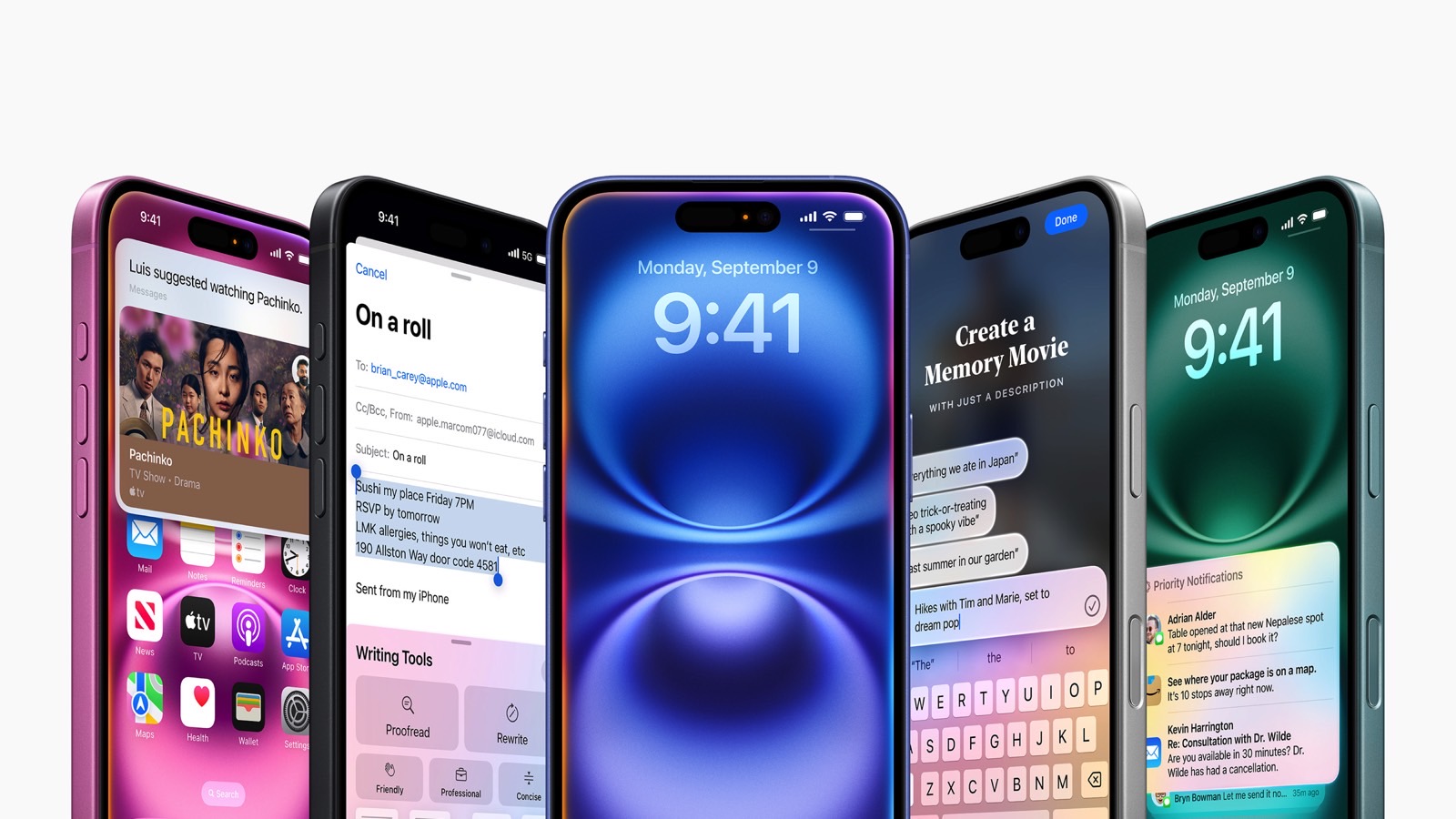
Apple wasn’t spared the hallucination humiliation either, with Apple Intelligence conflating News reports to deliver fake information via the summarization feature for the News app. Apple has decided to pull the feature from the latest iOS 18 beta and deploy the needed fixes.

“With the latest beta software releases of iOS 18.3, iPadOS 18.3, and macOS Sequoia 15.3, Notification summaries for the News & Entertainment category will be temporarily unavailable,” an Apple representative told CNBC.

Tech. Entertainment. Science. Your inbox.

Sign up for the most interesting tech & entertainment news out there.

By signing up, I agree to the Terms of Use and have reviewed the Privacy Notice.

Apple is working on improving the News summarization feature, which will return in a future software update. It’s unclear when the feature will be back, but Apple Intelligence continues to be a top priority for Apple’s software development teams.

As a reminder, iOS 18.4 will bring another set of AI features to iPhone, iPad, and Mac, including the smarter Siri that can control some apps and access more user data on the device to provide more helpful assistance.

Apple Intelligence’s hallucination problems went viral in December when the AI summarized several BBC reports into a single notification that started with “Luigi Mangione shoots himself.” Mangione is the alleged Brian Thompson assassin who did not shoot himself.

Other hallucinations date back to November when the AI might have shown some users The New York Times summaries that claimed Israeli Prime Minister Benjamin Netanyahu had been arrested. That wasn’t the case.

Hallucinating news is a big problem for any AI product, whether Apple Intelligence or ChatGPT. After all, we’ve been worried about AI misleading users with fake information and the manipulation risks that might come from AI products controlled by nefarious actors. Companies like Apple must get any news-related AI features right, especially summarization. Either that or not do it at all.

In addition to disabling Notification Summaries for the News and Entertainment category in iOS 18.3 beta 3, Apple has added a label to the feature noting that summaries can contain errors, as the app is in beta.

Apple made another change to how summaries appear in notifications so you can tell them apart from regular notifications. Starting with iOS 18.3 beta 3, they’ll be italicized.

Finally, Apple Intelligence users who install the latest beta can decide whether to enable or disable summaries for an iPhone app directly from the Lock Screen. Swipe to the left on a Notification Summary to get an options menu that will let you disable them for specific apps. The alternative is going into the Settings app, where you’d have customized the AI summarizations before the new beta.

As an iPhone user in the EU, I still can’t get Apple Intelligence. I couldn’t test it or experience any of the hallucination issues that US iOS 18 beta testers have encountered. Hopefully, the hallucination problem will go away by the time I get my hands on Apple Intelligence on the iPhone.

However, it’s great to see Apple admit the errors and pull the AI summarization feature entirely rather than proceeding with it without a proper fix.

Source

Posted on

Nvidia CES 2025 Keynote live blog: all the latest on the RTX 5000 reveal and more

Refresh

2025-01-07T02:19:22.946Z

OK folks, we’re coming up on the 15 minutes from the start of Nvidia’s CES 2025 keynote, where CEO Jensen Huang will take the state at Madalay Bay’s Michelob arena. We’re expecting some major news tonight, so for those who’ve been waiting to hear about Nvidia’s next-gen consumer graphics cards, you don’t much longer to wait.

And if you really want to hear all about data center AI and Omniverse stuff, I’m sure Jensen will get around to those as well.

2025-01-07T02:29:54.366Z

The biggest thing I’m expecting tonight is Nvidia’s GeForce RTX 5090, RTX 5080, and possibly the RTX 5070 Ti.

Following up Nvidia’s Lovelace GPUs, the Blackwell-based RTX 5000 series is expected to be substantially more powerful, with the rumor mill putting the RTX 5080 around 10% faster than the RTX 4090, currently the best graphics card on the consumer market.

That, of course, would put the RTX 5090 in a class entirely on its own, and there’s no telling where its performance will ultimately end up. That said, if speculation is on the mark, it should feature 32GB GDDR7 VRAM with a memory bandwidth of 1.52TB/s on a 512-bit memory bus, making it truly the world’s first 8K gaming graphics card.

2025-01-07T02:34:51.483Z

OK, here we go.

2025-01-07T02:35:41.129Z

OK, I DO want an exoskeleton. Those things look cool as hell.

2025-01-07T02:40:19.662Z

Gary Shapiro at Nvidia's CES 2025 keynote

(Image credit: Nvidia)

CTA President Gary Shapiro is introducing Jensen Huang.

2025-01-07T02:40:57.948Z

OK, I unironically love ‘Never gonna give you up.’ I used to rollerskate to that song as a kid.

2025-01-07T02:42:45.386Z

OK, the Nvidia segment of the keynote is about to begin, but it sure is taking a while. Nvidia is normally quicker to launch than this.

2025-01-07T02:43:44.651Z

OK, NOW we’re kicking things off.

2025-01-07T02:46:00.230Z

Tokens, tokens, tokens. It’s no surprise that we’re just jumping right into AI, but yeah, it’s remarkable how much Nvidia has transformed almost overnight.

2025-01-07T02:47:17.648Z

Nvidia CEO Jensen Huang

(Image credit: Nvidia)

LOL, Jensen’s jacket is bedazzled.

2025-01-07T02:50:02.565Z

That was a very short Virtua Fighter demo.

2025-01-07T02:53:25.839Z

OK, the first mention of GeForce, so here we go.

2025-01-07T02:57:25.216Z

That was a pretty impressive demo.

2025-01-07T02:59:37.544Z

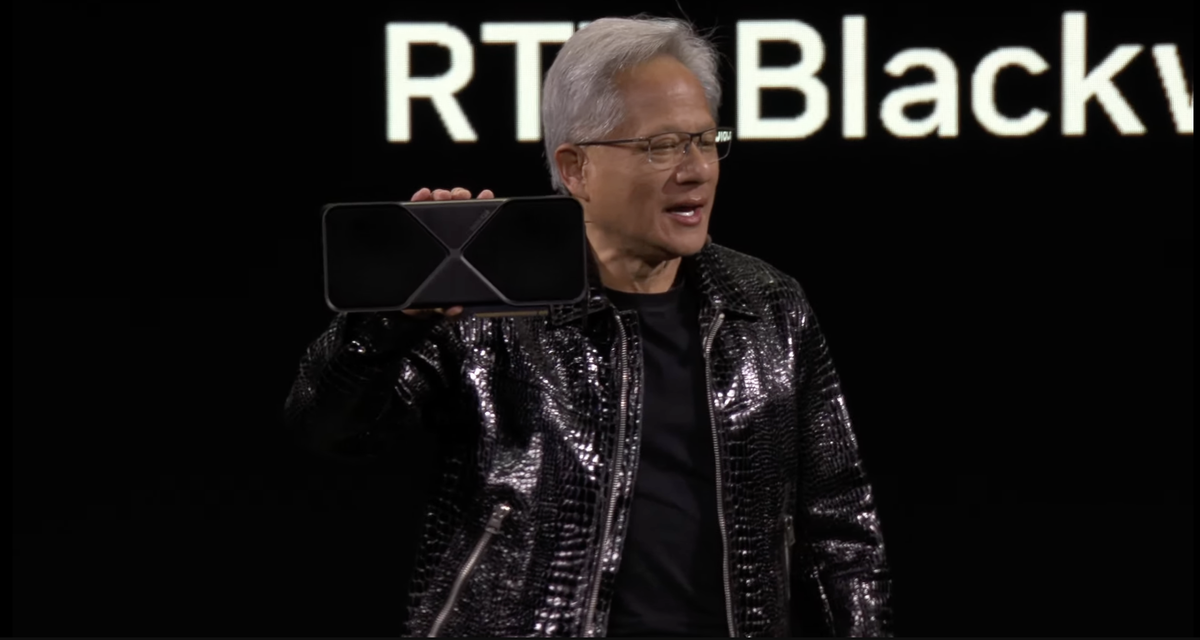
Nvidia CEO Jensen Huang holding the RTX 5090 at CES 2025

(Image credit: Nvidia)

Nvidia RTX Blackwell is official, and that is a very pretty looking graphics card.

2025-01-07T03:01:09.811Z

OK, so Jensen is holding the RTX 5090.

2025-01-07T03:02:45.916Z

OK, RTX 5070 at $549, RTX 4090 performance. Whoa.

2025-01-07T03:04:03.641Z

A slide showing the prices of the Nvidia RTX Blackwell line of GPUs

(Image credit: Nvidia)

OK, RTX 5090 starting at $1,999. RTX 5080 for $999. RTX 5070 Ti for $749. Yes, absolutely. This is what I want to see.

Don’t get me wrong, these are still expensive graphics cards, but given the fears of a $1600 RTX 5080, this is a very pleasant surprise.

2025-01-07T03:05:31.979Z

OK, so very little on specs, but I want to know about this AI management processor.

2025-01-07T03:06:54.298Z

If the shader cores can also carry the weight of AI workloads, as Jensen stated, then we’re getting way better DLSS on these cards.

2025-01-07T03:07:56.329Z

Also, the RTX 5000 series will be available starting in January, though we don’t know which will be coming first.

2025-01-07T03:09:07.844Z

Nvidia GeForce RTX 5000 series mobile GPUs are also coming, with the RTX 5070 mobile featuring RTX 4090 performance, though I’m guessing Jensen means RTX 4090 mobile performance.

2025-01-07T03:13:40.118Z

So we have fully entered into the data center segment of the keynote. While GeForce graphics cards got at least a bit more time and attention than Lovelace got, it’s clear that these cards aren’t as important to Nvidia as the data center business.

And yeah, that shield bit was a bit…well, it was something.

2025-01-07T03:20:30.975Z

I want to say, I find all of this AI discussion interesting from an academic perspective, but I think there’s a lot of expectations for these data centers, and no one is mentioning that the power requirements for these are pretty much going to put a cap on what they can do, since we only have so much electrical power available on a grid at any one time.

2025-01-07T03:23:53.532Z

Oh man, I just had a dark thought. Can you imagine training the AI agent that’s taking your job? That’s grim.

2025-01-07T03:28:11.071Z

Coding assistants are the death knell for the junior software developer. So much for ‘learn to code’.

2025-01-07T03:29:37.059Z

OK, the virtual human thing is still giving major uncanny valley, but it’s less severe than it used to be.

2025-01-07T03:38:02.365Z

OK, sorry about that folks, we were dealing with some technical difficulties, but we’re back to the action, and that action is all about tokens. It’s tokens all the way down.

2025-01-07T03:42:20.776Z

OK, so the end of data for training models is another major bottleneck for AI, and what Jensen is talking about here with Cosmos is generating new data that subsequent models can be trained on (synthetic data), since these models have already consumed all the existing data it could be trained on.

However.

I wonder how Cosmos will avoid model collapse.

2025-01-07T03:46:53.410Z

The worry with synthetic data is that you’ll end up with a Habsburg AI, one that’s effectively inbred on its own data to the point where it becomes a useless abomination. Google the Habsburg monarchs of Europe if you want to see why this is such an apt description of the problem.

2025-01-07T03:49:26.497Z

An Nvidia RTX 5000 series graphics card against a green and black background

(Image credit: Nvidia)

OK, we just got word on the Blackwell GPU availability.

The RTX 5090 and RTX 5080 will go on sale on January 30, 2025, for $1,999 and $999, respectively.

The RTX 5070 Ti and RTX 5070 will be available in February for $749 and $549 respectively. UK and Australia pricing wasn’t given, but we’ve reached out to Nvidia for clarification.

2025-01-07T03:53:36.423Z

Nvidia RTX 5090, RTX 5080, and RTX 5070 Ti laptops will be available starting in March, while the RTX 5070 laptops will be available starting in April.

2025-01-07T03:55:08.915Z

Nvidia’s autonomous vehicle chip would get annihilated in NYC traffic, I can guarantee that, though it might work in a lot of other cities.

2025-01-07T03:58:05.893Z

Hmmm. Sythetic input data has been shown to quickly degrade the quality of the model you’re training (model collapse) which i haven’t heard mentioned once. I wonder how nvidia plans on tackling that problem.

2025-01-07T03:59:31.506Z

I do have to say, if I have to deal with AI model collapse in the product I’m using, I’d really rather not have to deal with that at highway speeds.

2025-01-07T04:16:41.375Z

And that’s a wrap on Nvidia’s CES 2025 keynote. Now, if you’ll excuse me, I have to go bother Nvidia PR to try and track down some spec sheets. Stay tuned for more from CES 2025 thoughout the week, including more details on the Nvidia Blackwell GPUs.

Source

Posted on

Galaxy S25 price leak sparks concern about imminent hikes

Now that CES 2025 has come and gone, the next big event in the tech world is Samsung’s Galaxy Unpacked event on January 22nd. Samsung will unveil the Galaxy S25 lineup at the show, including a Galaxy S25 Slim variant.

The ultra-thin phone might hit stores in just a few months, but that’s hopefully not the only surprise Samsung has prepared for fans. Rumors say Samsung will unveil its Android XR-based AI-infused smart glasses at the show. We certainly expect to see the Vision Pro rival, Project Moohan, unveiled officially. Samsung might also announce a new Galaxy Ring 2 model.

But Unpacked might also bring some unexpectedly bad news: Price hikes for the three (well, four) Galaxy S25 models, the show’s stars.

We saw warnings a few weeks ago that at least one of the three main Galaxy S25 versions could cost more than last year’s model. Now, a new report from Europe suggests price hikes might be in order for all three models, which will be available in stores by February.

Tech. Entertainment. Science. Your inbox.

Sign up for the most interesting tech & entertainment news out there.

By signing up, I agree to the Terms of Use and have reviewed the Privacy Notice.

Reports from Korea detailed in mid-December the two factors that might force Samsung to raise prices for the Galaxy S25 models. First, there was the political turmoil in Korea that impacted the dollar-won exchange. Then there’s the Snapdragon 8 Elite processor, the high-end chip that will power all Galaxy S25 models, that’s significantly more expensive than its predecessor.

The report singled out the Galaxy S25 Ultra as the likely model to get a higher price tag than the Galaxy S24 Ultra.

A month later, Italian blog SmartWorld says that a local store in Italy has already set up placeholder pages for the Galaxy S25 phones that will go on sale after Unpacked.

The store listed prices for all three Galaxy S25 versions and their respective memory options, indicating that price hikes will be in order. According to this information, the Galaxy S25, S25 Plus, and S25 Ultra will cost at least €50 more than their predecessors.

While that might seem troubling, I’ll say there’s nothing official about these prices. That’s a point the Italian blog makes. Maybe it’s just placeholder information waiting to be edited once Unpacked drops. SmartWorld also says that well-known inside Roland Quandt said in December that the Galaxy S25 European prices would match last year’s models.

If the price hikes are real, they might not reflect Samsung’s plans worldwide. It’s unclear in which markets Samsung will raise prices for the Galaxy S25. After all, a €50 hike isn’t as big as expected. If it translates to a $50 price hike in the US, you can offset it by simply registering to preorder a Galaxy S25 flavor. Registration will give you $50 in Samsung credit.

On the other hand, European prices also factor in VAT. The actual price hike might be lower when you remove the tax.

I’ll also remind you that Samsung and its carrier partners will run plenty of promos during the preorder period to make the Galaxy S25 price more palatable. One already leaked: free Gemini Advanced access for up to a year. That’s a subscription that usually costs $20/month. It offers plenty of cloud storage in addition to Google’s best AI model.

Finally, a recent rumor says that Samsung wants to launch a hardware subscription plan soon for devices like the Galaxy S25. While it will be available only in certain markets initially, a hardware subscription plan might make the Galaxy S25 a lot easier on the wallet.

As for the Galaxy S25 Slim, the handset doesn’t have a predecessor, so we can’t predict how much it’ll cost. But I don’t expect it to be more affordable than the base Galaxy S25 model. The ultra-thin phone will still run on the same high-end Snapdragon chip as the rest of them.

Source

Posted on

Meta is about to ruin WhatsApp with AI bots no one wants

Of all the generative AI assistants out there, Meta AI must be the most annoying for the simple fact that Meta is shoving it down our throats. No app is safe, from Facebook to Messenger to WhatsApp to Instagram. Meta AI is there whether you want it or not, and there’s no way to deactivate it.

Meanwhile, ChatGPT is entirely optional, not that OpenAI can really force it on anyone. Apple’s Apple Intelligence is also optional; you don’t have to use it even if you have access to it. Then there’s Google Gemini, which is baked into many Google products but doesn’t feel as intrusive as Meta AI. The same goes for Microsoft’s Copilot.

The worst part about Meta AI is that Meta isn’t done ruining its apps with overdoing the AI presence. We’ve just learned of AI profiles coming to Facebook and Instagram, which is extremely annoying. It gets worse; Meta will now give AI bots prime plans inside WhatsApp, a feature that nobody really asked for from the one Meta app that’s actually useful.

WhatsApp is the world’s largest chat app. It works on iPhone and Android and supports end-to-end encryption across platforms. That’s the only reason I’m still using it. That, and the fact that Meta relented on its annoying WhatsApp policy change a few years ago.

Tech. Entertainment. Science. Your inbox.

Sign up for the most interesting tech & entertainment news out there.

By signing up, I agree to the Terms of Use and have reviewed the Privacy Notice.

Come to think of it, the only reason WhatsApp is so good and still encrypted, is that the app was built this way well before Meta bought it for a small fortune.

The last thing I want in WhatsApp is support for AI chatbots. Yes, it’s great that you can save a ChatGPT number to chat with the chatbot from WhatsApp, but that’s optional.

Say that Meta feels like it has to put AI bots in WhatsApp to expose more people to Meta AI and potentially make some money in the process. I still hate the idea of WhatsApp getting a dedicated AI menu. That’s wasted screen real estate right there. It’s a feature I’ll never use, and I’m sure others will be equally uninterested.

The new AI bots menu in a WhatsApp beta release for Android.The new AI bots menu in a WhatsApp beta release for Android. Image source: WABetaInfo

Meta is testing the new interface in an Android beta version of WhatsApp. Always reliable WABetaInfo surfaced the image above that shows the new AI tab replacing the Communities tab. That menu, which might actually be useful, is merging with the Chats tab.

The new AI tab will include all sorts of AI chatbots to talk to, including third-party models that can talk to you about specific topics.

I don’t doubt that some WhatsApp users will want to use these services. I say that as a longtime ChatGPT user who chats with OpenAI’s chatbot about all sorts of things daily. But I absolutely hate the idea of any AI product being forced on me the way Meta is doing with Meta AI.

WhatsApp is especially important to me as I use it to talk to many people. It’s not just Android users in my family or friends group that like WhatsApp; plenty of iPhone owners prefer the platform over iMessage. AI isn’t needed. Or if it is, it should be hidden somewhere and accessible on demand.

It might get even worse than that. WABetaInfo found evidence in a different WhatsApp beta version that Meta wants to let users create custom AI chatbots right inside the app. The process might be similar to what’s already available on Instagram.

Support for custom AI bot creation in a WhatsApp beta release for Android.Support for custom AI bot creation in a WhatsApp beta release for Android. Image source: WABetaInfo

The feature resembles the custom chatbots available in ChatGPT and Gemini, so it’s not entirely surprising. But, again, it’s not something I want to clutter a key app like WhatsApp.

I don’t see any value in adding AI bots to WhatsApp or supporting the creation of custom ones.

Remember that if left unchecked, some custom AI chatbots might be harmful, especially when certain types of users are exposed to them. And it’s not like Meta is improving its content moderation policies, so we have no idea how it’ll police this universe of AIs it’s bringing to apps like WhatsApp and Instagram.

I can only hope that Meta will not bring these features out of beta, but that’s just wishful thinking. If anything, I take some solace in knowing that it’ll take longer for Meta to deploy the AI changes to WhatsApp in Europe.

Source

Posted on

Samsung just hallucinated that it will become the global AI leader in 2025

Samsung was the first big smartphone vendor to launch a flagship phone with AI at the core of its marketing efforts. Last year’s Galaxy S24 series introduced the Galaxy AI suite of features. Samsung followed with the Galaxy Z Fold 6 and Flip 6, which got additional AI capabilities. Samsung then extended Galaxy AI support to older flagship devices. And in a few weeks, Samsung will launch the Galaxy S25 series, which should introduce even more Galaxy AI novelties.

But Samsung leadership is hallucinating worse than an AI program ever could about Samsung’s global role in genAI. In a New Year’s address, Samsung Electronics CEO and Vice Chairman Han Jong-hee and DS Division Vice Chairman Jeon Young-hyun addressed Galaxy AI, saying that Samsung should become the undisputed leader of device AI this year.

“Now is the time for bold innovation that goes beyond the existing success methods as we face an inflection point in AI technology,” the execs said, according to a machine-translated Samsung release. “Let’s establish ourselves as a clear device AI leader this year through advanced intelligence.”

The goal of becoming the undisputed AI leader is noble. It’s what you’d expect key execs to say ahead of a busy year when AI will continue to dominate the tech world. It’s also something officials at other leading tech companies could say, considering AI is the main priority right now.

Tech. Entertainment. Science. Your inbox.

Sign up for the most interesting tech & entertainment news out there.

By signing up, I agree to the Terms of Use and have reviewed the Privacy Notice.

But Samsung is nowhere close to being a leader in AI, and I don’t see it happening in 2025 either. The main problem with Samsung’s Galaxy AI approach is that it doesn’t have a meaningful model of its own to power the genAI tech on phones like the Galaxy S24 and S25.

Using Google's Circle to Search AI feature on the Galaxy S24 Ultra.Using Google’s Circle to Search AI feature on the Galaxy S24 Ultra. Image source: Samsung

Galaxy AI is a mix of AI technologies. Google’s Circle to Search is a good example. Also, Galaxy S25 phones are rumored to come with free Google Gemini Advanced, Google’s best version of Gemini AI.

I’ll also point out that Samsung’s upcoming XR devices, Project Moohan and unnamed AR smart glasses, will work on Google’s Android XR platform, with Gemini playing a key role. I expect Galaxy AI to be part of the picture for both types of products because Samsung can’t AI on its own.

Samsung doesn’t have an alternative to ChatGPT or Gemini. If it is working on Bixby upgrades and Gauss upgrades, matching these AI models will take a long time.

Also, Samsung doesn’t have a desktop presence. ChatGPT is my primary AI tool right now, and I use it across devices. Most of the time, I access it on my Mac rather than a mobile phone.

OpenAI and Google have better models. Meta, Claude, and Microsoft also have AI tools that are more advanced than Samsung’s. Apple is working on a Siri LLM that will behave like ChatGPT and has incorporated ChatGPT into Apple Intelligence on the iPhone.

As for on-device AI, Samsung might have been the first to push AI on mobile devices with Galaxy AI, but it’s not the only one. Google is doing it with Pixel phones and Android in general. Apple laid out an even better vision of on-device AI with Apple Intelligence this year, which Samsung doesn’t appear to be able to match.

Samsung's Project Moohan Android XR headset.Samsung’s Project Moohan Android XR headset. Image source: Samsung

Apple Intelligence might be behind Galaxy AI and other rivals, but Apple has something rivals can’t match: a massive base of devices that can use Apple Intelligence, and the list is growing rapidly. Once Apple Intelligence matures, Apple could very well become the undisputed device AI leader.

Speaking of Apple’s AI vision, Samsung has yet to match what Apple wants to do with iPhones. It’s not just about text and notification summaries, text generation, wallpaper generation, photo editing, and translation. It’s about Siri becoming a more useful assistant by accessing on-device contextual information about the user.

Apple has a plan, at least; one that Samsung might follow. Samsung’s Galaxy AI teasers during the Fold 6 and Flip 6 launch event revealed the company is working on a similar vision. But Samsung waited for Apple’s Apple Intelligence reveal before it unveiled its own plans.

I’ll also point out that Apple Intelligence is designed to offer more on-device AI features and better privacy for cloud-based AI than Galaxy AI can. Turn off Galaxy AI on your phone right now, and you’ll lose many of its useful features. Samsung has yet to match Apple’s Private Cloud Compute, a private cloud-based AI system.

What I’m getting at is that it’ll take years for any company to become the undisputed leader in device AI. If that ever happens. And it’s way too early for Samsung to call for that title, especially considering its massive reliance on partners like Google.

Also, suppose the Samsung execs only want the company to sell as many products that can run third-party AI programs within Galaxy AI. In that case, that still doesn’t qualify as being the undisputed leader of device AI.

Source

Posted on

Top 10 AI and storage stories of 2024

Artificial intelligence (AI) has hit the headlines and the datacentres, but with it comes a range of performance and operating considerations that impact storage as much as any other IT discipline.

In this review, we look at the key demands of AI processing on data storage, the type of storage AI requires, and the suitability of cloud storage for AI workloads.

We drill down into the data needs of AI and storage, such as the demands of high-dimension vector data and checkpointing during AI training, plus the compliance considerations that use of AI brings with it.

We also look at the responses of storage suppliers to the rapid rise of AI use cases in the datacentre, in terms of link-ups with leading players like Nvidia, as well as in their storage offer aimed at AI workloads. 

In this guide, we examine the data storage needs of artificial intelligence, the demands it places on data storage, the suitability of cloud and object storage for AI, and key AI storage products.

We look at the use of vector data in AI and how vector databases work, plus vector embedding, the challenges for storage of vector data and the key suppliers of vector database products.

We talk to Charlie Boyle of Nvidia about data challenges in artificial intelligence, key practical tips for AI projects, and demands on storage of training, inferencing, RAG and checkpointing.

Storage supplier announcements at Nvdia conference centre on infrastructure integration, tackling the GPU I/O bottleneck and AI hallucinations by running Nvidia NeMo and NIM microservices.

We spoke to Pure Storage CEO Charlie Giancarlo about why write speed is key for artificial intelligence workloads, accessible storage for AI data, and his prediction of the death of spinning disk.

We talk to NetApp’s Grant Caley about AI and data storage, the need for scale, performance and hybrid cloud, and to move, copy and clone data for wrangling for inference runs.

AI checkpointing operations targeted by Vast Data as it touts QLC-based storage for AI workloads.

Start looking at artificial intelligence compliance. That’s the advice of Mathieu Gorge of Vigitrust, who says AI governance is still immature, but firms should recognise the limits and still act.

AI consultancy Crater Labs spent vast amounts of time managing server-attached drives to ensure GPUs were saturated. A shift to all-flash Pure Storage slashed that to almost zero.

Originally driven by Intel’s now-defunct Optane storage class memory, Parallelstore offers massive parallel file storage targeted at artificial intelligence training use cases on Google Cloud.

Source

Posted on

Top 10 data and ethics stories of 2024

In 2024, Computer Weekly’s data and ethics coverage continued to focus on the various ethical issues associated with the development and deployment of data-driven systems, particularly artificial intelligence (AI).

This included reports on the copyright issues associated with generative AI (GenAI) tools, the environmental impacts of AI, the invasive tracking tools in place across the internet, and the ways in which autonomous weapons undermine human moral agency.

Other stories focused on the wider social implications of data-driven technologies, including the ways they are used to inflict violence on migrants, and how our use of technology prefigures certain political or social outcomes.

In an analysis published 14 January 2024, the IMF examined the potential impact of AI on the global labour market, noting that while it has the potential to “jumpstart productivity, boost global growth and raise incomes around the world”, it could just as easily “replace jobs and deepen inequality”; and will “likely worsen overall inequality” if policymakers do not proactively work to prevent the technology from stoking social tensions.

The IMF said that, unlike labour income inequality, which can decrease in certain scenarios where AI’s displacing effect lowers everyone’s incomes, capital income and wealth inequality “always increase” with greater AI adoption, both nationally and globally.

“The main reason for the increase in capital income and wealth inequality is that AI leads to labour displacement and an increase in the demand for AI capital, increasing capital returns and asset holdings’ value,” it said.

“Since in the model, as in the data, high income workers hold a large share of assets, they benefit more from the rise in capital returns. As a result, in all scenarios, independent of the impact on labour income, the total income of top earners increases because of capital income gains.”

In January, GenAI company Anthropic claimed to a US court that using copyrighted content in large language model (LLM) training data counts as “fair use”, and that “today’s general-purpose AI tools simply could not exist” if AI companies had to pay licences for the material.

Anthropic made the claim after, a host of music publishers including Concord, Universal Music Group and ABKCO initiated legal action against the Amazon- and Google-backed firm in October 2023, demanding potentially millions in damages for the allegedly “systematic and widespread infringement of their copyrighted song lyrics”.

However, in a submission to the US Copyright Office on 30 October (which was completely separate from the case), Anthropic said that the training of its AI model Claude “qualifies as a quintessentially lawful use of materials”, arguing that, “to the extent copyrighted works are used in training  data, it is for analysis (of statistical relationships between words and concepts) that is unrelated  to any expressive purpose of the work”.

On the potential of a licensing regime for LLM’s ingestion of copyrighted content, Anthropic argued that always requiring licences would be inappropriate, as it would lock up access to the vast majority of works and benefit “only the most highly resourced entities” that are able to pay their way into compliance.

In a 40-page document submitted to the court on 16 January 2024 (responding specifically to a “preliminary injunction request” filed by the music publishers), Anthropic took the same argument further, claiming “it would not be possible to amass sufficient content to train an LLM like Claude in arm’s-length licensing transactions, at any price”.

It added that Anthropic is not alone in using data “broadly assembled from the publicly available internet”, and that “in practice, there is no other way to amass a training corpus with the scale and diversity necessary to train a complex LLM with a broad understanding of human language and the world in general”. 

Anthropic further claimed that the scale of the datasets required to train LLMs is simply too large to for an effective licensing regime to operate: “One could not enter licensing transactions with enough rights owners to cover the billions of texts necessary to yield the trillions of tokens that general-purpose LLMs require for proper training. If licences were required to train LLMs on copyrighted content, today’s general-purpose AI tools simply could not exist.”

Computer Weekly spoke to members of the Migrants Rights Network (MRN) and Anti-Raids Network (ARN) about how the data sharing between public and private bodies for the purposes of carrying out immigration raids helps to prop up the UK’s hostile environment by instilling an atmosphere of fear and deterring migrants from accessing public services.

Published in the wake of the new Labour government announcing a “major surge in immigration enforcement and returns activity”, including increased detentions and deportations, a report by the MRN details how UK Immigration Enforcement uses data from the public, police, government departments, local authorities and others to facilitate raids.

Julia Tinsley-Kent, head of policy and communications at the MRN and one of the report’s authors, said the data sharing in place – coupled with government rhetoric about strong enforcement – essentially leads to people “self-policing because they’re so scared of all the ways that you can get tripped up” within the hostile environment.

She added this is particularly “insidious” in the context of data sharing from institutions that are supposedly there to help people, such as education or healthcare bodies.

As part of the hostile environment policies, the MRN, the ARN and others have long argued that the function of raids goes much deeper than mere social exclusion, and also works to disrupt the lives of migrants, their families, businesses and communities, as well as to impose a form of terror that produces heightened fear, insecurity and isolation.

At the very end of April, military technology experts gathered in Vienna for a conference on the development and use of autonomous weapons systems (AWS), where they warned about the detrimental psychological effects of AI-powered weapons.

Specific concerns raised by experts throughout the conference included the potential for dehumanisation when people on the receiving end of lethal force are reduced to data points and numbers on a screen; the risk of discrimination during target selection due to biases in the programming or criteria used; as well as the emotional and psychological detachment of operators from the human consequences of their actions.

Speakers also touched on whether there can ever be meaningful human control over AWS, due to the combination of automation bias and how such weapons increase the velocity of warfare beyond human cognition.

The second global AI summit in Seoul, South Korea saw dozens of governments and companies double down on their commitments to safely and inclusively develop the technology, but questions remained about who exactly is being included and which risks are given priority. 

The attendees and experts Computer Weekly spoke with said while the summit ended with some concrete outcomes that can be taken forward before the AI Action Summit due to take place in France in early 2025, there are still a number of areas where further movement is urgently needed.

In particular, they stressed the need for mandatory AI safety commitments from companies; socio-technical evaluations of systems that take into account how they interact with people and institutions in real-world situations; and wider participation from the public, workers and others affected by AI-powered systems.

However, they also said it is “early days yet” and highlighted the importance of the AI Safety Summit events in creating open dialogue between countries and setting the foundation for catalysing future action.

Over the course of the two-day AI Seoul Summit, a number of agreements and pledges were signed by the governments and companies in attendance.

For governments, this includes the European Union (EU) and a group of 10 countries signing the Seoul Declaration, which builds on the Bletchley Deceleration signed six months ago by 28 governments and the EU at the UK’s inaugural AI Safety Summit. It also includes the Seoul Statement of Intent Toward International Cooperation on AI Safety Science, which will see publicly backed research institutes come together to ensure “complementarity and interoperability” between their technical work and general approaches to AI safety.

The Seoul Declaration in particular affirmed “the importance of active multi-stakeholder collaboration” in this area and committed the governments involved to “actively” include a wide range of stakeholders in AI-related discussions.

A larger group of more than two dozen governments also committed to developing shared risk thresholds for frontier AI models to limit their harmful impacts in the Seoul Ministerial Statement, which highlighted the need for effective safeguards and interoperable AI safety testing regimes between countries.

The agreements and pledges made by companies include 16 AI global firms signing the Frontier AI Safety Commitments, which is a specific voluntary set of measures for how they will safely develop the technology, and 14 firms signing the Seoul AI Business Pledge, which is a similar set of commitments made by a mixture of South Korean and international tech firms to approach AI development responsibly.

One of the key voluntary commitments made by the AI companies was not to develop or deploy AI systems if the risks cannot be sufficiently mitigated. However, in the wake of the summit, a group of current and former workers from OpenAI, Anthropic and DeepMind – the first two of which signed the safety commitments in Seoul – said these firms cannot be trusted to voluntarily share information about their systems capabilities and risks with governments or civil society.

 Dozens of university, charity and policing websites designed to help people get support for serious issues such as sexual abuse, addiction or mental health are inadvertently collecting and sharing site visitors’ sensitive data with advertisers.  

A variety of tracking tools embedded on these sites – including Meta Pixel and Google Analytics – mean that when a person visits them seeking help, their sensitive data is collected and shared with companies like Google and Meta, which may become aware that a person is looking to use support services before those services can even offer help.

According to privacy experts attempting to raise awareness of the issue, the use of such tracking tools means people’s information is being shared inadvertently with these advertisers, as soon as they enter the sites in many cases because analytics tags begin collecting personal data before users have interacted with the cookie banner.

Depending on the configuration of the analytics in place, the data collected could include information about the site visitor’s age, location, browser, device, operating system and behaviours online.

While even more data is shared with advertisers if users consent to cookies, experts told Computer Weekly the sites do not provide an adequate explanation of how their information will be stored and used by programmatic advertisers.

They further warned the issue is “endemic” due a widespread lack of awareness about how tracking technologies like cookies work, as well as the potential harms associated with allowing advertisers inadvertent access to such sensitive information.

Computer Weekly spoke to author and documentary director Thomas Dekeyser about Clodo, a clandestine group of French IT workers who spent the early 1980s sabotaging technological infrastructure, which was used as the jumping off point for a wider conversation about the politics of techno-refusal.

Dekeyser says a major motivation for writing his upcoming book on the subject is that people refusing technology – whether that be the Luddites, Clodo or any other radical formation – are “all too often reduced to the figure of the primitivist, the romantic, or the person who wants to go back in time, and it’s seen as a kind of anti-modernist position to take”.

Noting that ‘technophobe’ or ‘Luddite’ have long been used as pejorative insults for those who oppose the use and control of technology by narrow capitalist interests, Dekeyser outlined the diverse range of historical subjects and their heterogenous motivations for refusal: “I want to push against these terms and what they imply.”

For Dekeyser, the history of technology is necessarily the history of its refusal. From the Ancient Greek inventor Archimedes – who Dekeyser says can be described as the first “machine breaker” due to his tendency to destroy his own inventions – to the early mercantilist states of Europe backing their guild members’ acts of sabotage against new labour devices, the social-technical nature of technology means it has always been a terrain of political struggle.

Hundreds of workers on Amazon’s Mechanical Turk (MTurk) platform were left unable to work after mass account suspensions caused by a suspected glitch in the e-commerce giant’s payments system.

Beginning on 16 May 2024, a number of US-based Mechanical Turk workers began receiving account suspension forms from Amazon, locking them out of their accounts and preventing them from completing more work on the crowdsourcing platform.

Owned and operated by Amazon, Mechanical Turk allows businesses, or “requesters”, to outsource various processes to a “distributed workforce”, who then complete tasks virtually from wherever they are based in the world, including data annotation, surveys, content moderation and AI training.

According to those Computer Weekly spoke with, the suspensions were purportedly tied to issues with the workers’ Amazon Payment accounts, an online payments processing service that allows them to both receive wages and make purchases from Amazon. The issue affected hundreds of workers.

MTurk workers from advocacy organisation Turkopticon outlined how such situations are an on-going issue that workers have to deal with, and detailed Amazon’s poor track record on the issue.

Refugee lawyer and author Petra Molnar spoke to Computer Weekly about the extreme violence people on the move face at borders across the world, and how increasingly hostile anti-immigrant politics is being enabled and reinforced by a ‘lucrative panopticon’ of surveillance technologies.

She noted how – because of the vast array of surveillance technologies now deployed against people on the move – entire border-crossing regions have been transformed into literal graveyards, while people are resorting to burning off their fingertips to avoid invasive biometric surveillance; hiding in dangerous terrain to evade pushbacks or being placed in refugee camps with dire living conditions; and living homeless because algorithms shielded from public scrutiny are refusing them immigration status in the countries they’ve sought safety in.

Molnar described how lethal border situations are enabled by a mixture of increasingly hostile anti-immigrant politics and sophisticated surveillance technologies, which combine to create a deadly feedback loop for those simply seeking a better life.

She also discussed the “inherently racist and discriminatory” nature of borders, and how the technologies deployed in border spaces are extremely difficult, if not impossible, to divorce from the underlying logic of exclusion that defines them.

The potential of AI to help companies measure and optimise their sustainability efforts could be outweighed by the huge environmental impacts of the technology itself.

On the positive side, speakers at the AI Summit London outlined, for example, how the data analysis capabilities of AI can assist companies with decarbonisation and other environmental initiatives by capturing, connecting and mapping currently disparate data sets; automatically pin point harmful emissions to specific sites in supply chains; as well as predict and manage the demand and supply of energy in specific areas.

They also said it could help companies better manage their Scope 3 emissions (which refers to indirect greenhouse gas emissions that occur outside of a company’s operations, but that are still a result of their activities) by linking up data sources and making them more legible.

However, despite the potential sustainability benefits of AI, speakers were clear that the technology itself is having huge environmental impacts around the world, and that AI itself will come to be a major part of many organisations Scope 3 emissions.

One speaker noted that if the rate of AI usage continues on its current trajectory without any form of intervention, then half of the world’s total energy supply will be used on AI by 2040; while another pointed out that, at a time when billions of people are struggling with access to water, AI-providing companies are using huge amounts of water to cool their datacentres.

They added AI in this context could help build in circularity to the operation, and that it was also key for people in the tech sector to “internalise” thinking about the socio-economic and environmental impacts of AI, so that it is thought about from a much earlier stage in a system’s lifecycle.

Source

Posted on

Mysterious ChatGPT hardware must be smart glasses, given what OpenAI just unveiled

After months of speculation, Jony Ive confirmed in mid-September that he and a team of former Apple designers are working on hardware that will have ChatGPT at the core. While Ive said his LoveFrom design company will be involved in creating the product (or products?), he didn’t reveal what form factor(s) we should expect.

I labeled the product an iPhone competitor because the iPhone is an AI device, just like the Pixel and any other smartphone that can run native or third-party AI apps. The ChatGPT hardware will compete against the iPhone no matter what it looks like. The only thing we know about the gadget is that it “uses AI to create a computing experience that is less socially disruptive than the iPhone.”

Nearly three months later, I believe the ChatGPT device has to feature a key component, a pair of smart glasses that will truly let the user make the most of OpenAI’s AI models. It’s all thanks to what we witnessed on December 12th, a few short hours apart.

First, Samsung and Google unveiled the Android XR experience and teased the first devices with AI at the center. Project Moohan is Samsung’s obvious Vision Pro alternative, and yes, it looks too much like the latter. Project Moohan will be a spatial computer that supports VR, AR, and AI.

Tech. Entertainment. Science. Your inbox.

Sign up for the most interesting tech & entertainment news out there.

By signing up, I agree to the Terms of Use and have reviewed the Privacy Notice.

All the acronyms are there, with AI giving Samsung a theoretical advantage over the Vision Pro. That will be Galaxy AI and Gemini AI, in case you were wondering.

Samsung's Project Moohan Android XR headset.Samsung’s Project Moohan Android XR headset. Image source: Samsung


More interesting than Moohan is Google’s unannounced pair of smart glasses. Samsung is probably working on its own smart glasses, but the company didn’t feel compelled to announce them on Thursday. 

Google demoed the smart glasses during its Gemini 2.0 announcement, showing how Project Astra can work on them. The wearable device is paired with a Pixel phone, which will handle the processing, including Gemini. The glasses give the AI eyes and ears so it can see everything around you and communicate information as you seek help while on the go.

Add the Android XR platform, and you get augmented reality features. Think AI notification summaries, Google Maps navigation, and real-time translation. According to Google’s demo, these are all part of Android XR.

All of that further reinforces my belief that standalone AR glasses are the future of mobile computing. They’ll complement the iPhone first and then replace it.

Google Maps AR navigation on smart glasses.Google Maps AR navigation on smart glasses. Image source: Google

Seeing Samsung and Google’s announcements was enough to make me realize OpenAI will need similar abilities from ChatGPT. And the only way to deliver them is by making smart glasses of its own.

Little did I know that OpenAI’s “12 Days” live stream, which followed Samsung and Google’s surprise announcement, would further drive that point home.

OpenAI on Thursday announced that ChatGPT Advanced Voice Mode is finally getting support for real-time video streaming and screen sharing. We saw these features demoed for GPT-4o back in May, but OpenAI needed time to bring them to all users.

The ChatGPT mobile app will let you use the camera of your iPhone or Android device to see the world and hold a conversation about it with the user.

The demos OpenAI offered showed that the AI can recognize people and remember details about them. Also, the AI can recognize objects and provide tips and tutorials related to them if asked.

When I first tried Advanced Voice Mode, I wanted to use ChatGPT as a museum voice guide. However, the experience lacked a key feature: the live video stream support that OpenAI just made available to ChatGPT users. Instead, I had to upload photos whenever I had questions about something.

Back to Thursday’s OpenAI updates, the ChatGPT demos showed that you can share your phone screen with the AI and ask questions about the content. It’s another way of giving the AI the ability to see what you’re doing.

This settled it for me. Any multimodal AI is a great tool to enhance your productivity, but it can get miles better if the AI gets eyes. Smart glasses are the best way to wear the AI’s eyes. The glasses don’t even have to support augmented reality features. AR would be just the cherry on top. 

It turns out Meta was right all along with the Ray-Ban AI project. As such, I think OpenAI and LoveFrom have to bundle a pair of smart glasses with whatever ChatGPT hardware product they end up making. I don’t think they can make standalone smart glasses. The technology isn’t ready for that.

Solos AirGo Vision ChatGPT smart glasses: Front look.Solos AirGo Vision ChatGPT smart glasses: Front look. Image source: Solos


They could always create only ChatGPT smart glasses that could then connect to the iPhone, Mac, or any smart device. But in such a case, they won’t control the underlying platform. On that note, I did show you a pair of smart glasses earlier this week (above) which put ChatGPT front and center. They might not be a first-party device, but they’re available for preorder.

This is all speculation from this ChatGPT enthusiast. I have no way of knowing what Ive & Co. are actually designing. But smart glasses seem like a key piece of the puzzle. And no, placing a camera on clothing will not work. Humane tried that and failed miserably. Eyewear is a whole different ball game.

Source