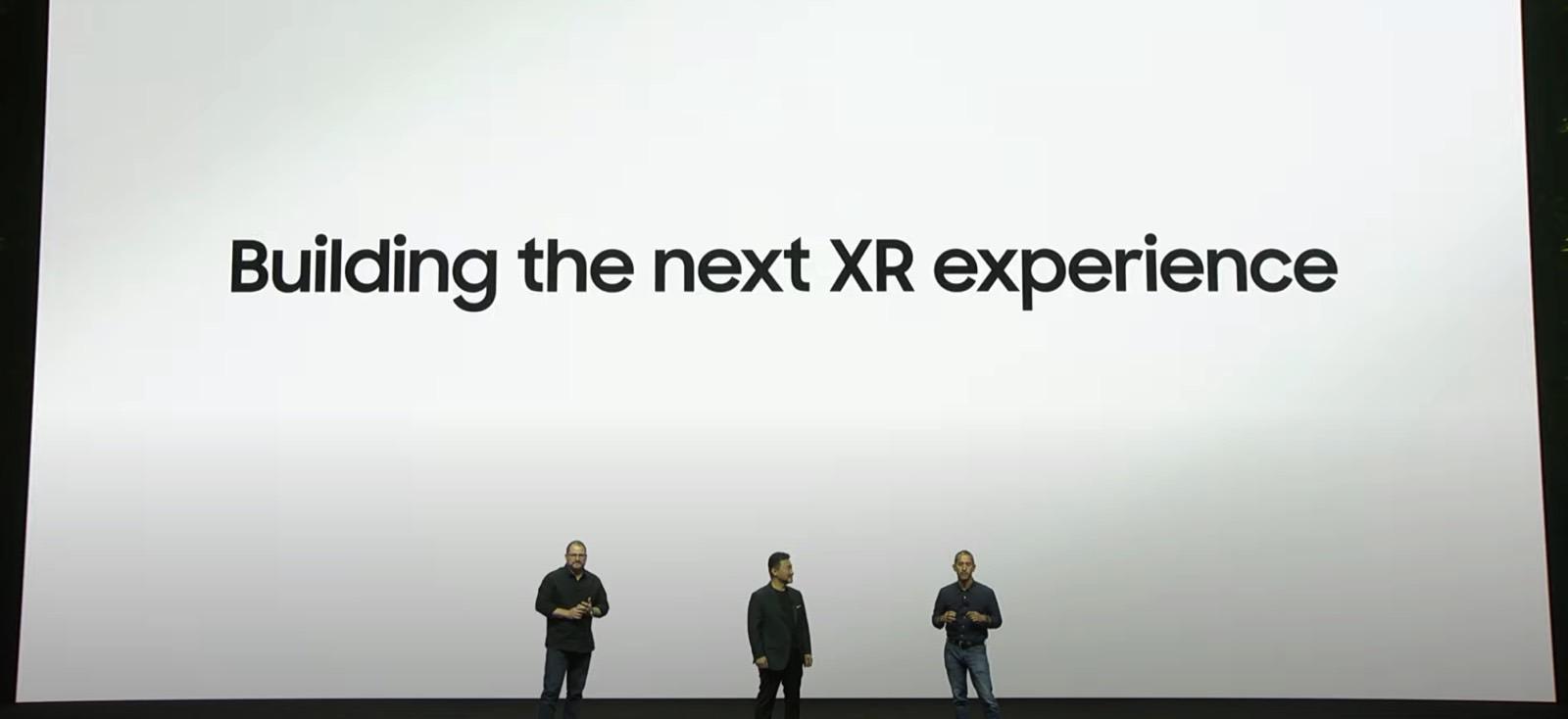
Remember when Samsung invited Google and Qualcomm to announce the “next XR experience“? I know I do because it happened in early February 2023, during the Galaxy S23 event. At the time, the web was filled with rumors about Apple’s mixed reality device, which would launch as the Vision Pro. Apple’s spatial computer dropped a few months after that teaser from Samsung, Google, and Qualcomm. It was immediately clear that the Vision Pro was so sophisticated that Samsung couldn’t possibly launch a rival anytime soon.
Nearly two years later, that Samsung XR headset still doesn’t exist. But Samsung has been teasing it again recently, saying the device should be unveiled at some point next year.
While Samsung never detailed the specs and features of the XR device, a new leak may give us an idea of what Samsung is working on. Unsurprisingly, Samsung isn’t building a Vision Pro rival. Instead, it’s doing something that might be more useful to most people. The first Samsung XR device will apparently be a pair of glasses with Gemini AI at the core. And it turns out that we might have seen it already during Google’s Project Astra demo at I/O 2024.
Samsung had this to say about the unnamed XR headset a few weeks ago during its most recent quarterly earnings report:
Tech. Entertainment. Science. Your inbox.
Sign up for the most interesting tech & entertainment news out there.
By signing up, I agree to the Terms of Use and have reviewed the Privacy Notice.
We plan to contribute to the expansion of the Samsung Health ecosystem through the Galaxy Ring launched this year and to strengthen the connectivity experience between our products, such as the XR (eXtended Reality) device scheduled to be launched in the future.
I wouldn’t be surprised if Samsung brought the XR headset to the Galaxy S25 Unpacked launch event that’s supposed to happen in mid-January. Samsung could then keep teasing the XR glasses before giving them a summer 2025 launch. That’s what Samsung did with the Galaxy Ring last year.
A report from the Korean site Maeil Business Newspaper said a few days ago that Samsung will release smart glasses with built-in AI in the third quarter of 2025. Google and Qualcomm are named as Samsung’s partners. That means this is the “next XR experience” that Samsung teased nearly two years ago.
 Ray-Ban Meta smart glasses. Image source: Jonathan S. Geller
Samsung will manufacture some 500,000 units, according to a report from Chinese research company Wellsen XR.
In terms of specs, the Samsung XR headset will rely on Qualcomm’s AR1 chip as the main CPU and an auxiliary NXP chip. The headset will feature a 12-megapixel camera sporting a Sony IMX681 CMOS image sensor. The wearable will feature a 155 mAh battery and weigh 50 grams.
Gemini will be preinstalled, which is hardly a surprise. If Google is involved, that’s what Google can bring to the table. We’ve already seen Meta make great use of smart glasses for Meta AI features. Apple is also looking into creating smart glasses of its own.
The Samsung product will also support mobile payments via a QR code scanning feature. It’ll also recognize hand gestures.
As 9to5Google points out, the Samsung XR glasses feature an almost identical battery to the Ray-Ban Meta glasses, and they are almost similar in weight. This suggests that the Samsung XR device can’t possibly incorporate a screen. The reports from Asia make no mention of one.
All this suggests Samsung’s “next XR experience” device is more of a Ray-Ban Meta clone than a Vision Pro rival. That’s enough to give you an idea of what the glasses would look like. But I’ll also remind you of Google’s impressive Project Astra demo from I/O 2024.
OpenAI hosted an unexpected ChatGPT event in early May to introduce GPT-4o and Advanced Voice Mode. OpenAI’s demos showed the chatbot’s ability to handle multimodal inputs, including a new conversational voice mode that sounded like a real conversation between people.
 Google used the smart glasses on the right to demo Project Astra (Gemini Live) at I/O 2024. Image source: Google
OpenAI stole Google’s thunder by a few days. Google’s Project Astra showed the same AI abilities for Gemini that OpenAI had just demoed for ChatGPT. Google used two devices to demo Project Astra: an unnamed Pixel device and an unnamed XR headset. The person talking to Gemini switched between them halfway through the demo.
The glasses are visible above, by the red apple. The clip at the end of this post will give you an even better look.
There’s no way to prove those are Samsung XR smart glasses. But I’d speculate that’s what it is. We’re looking at a prototype unit with Gemini preloaded.
Part of Project Astra became a reality rather quickly. That’s the Gemini Live conversational AI experience available on Pixel phones and other places. That’s all the more reason to indicate the smart glasses by the red apple are happening. Samsung is the likely partner in this endeavor.