Posted on

Inside Amazon’s robot-powered warehouse

Thank you for joining!

Access your Pro+ Content below.

1 April 2025

Inside Amazon’s robot-powered warehouse

  • Share this item with your network:

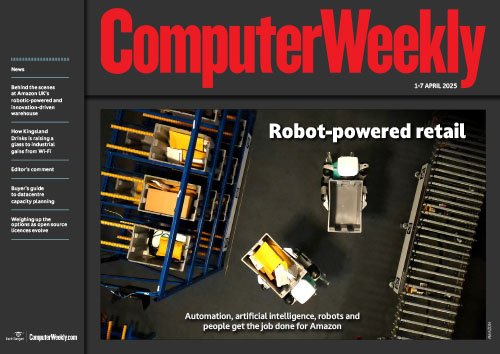
In this week’s Computer Weekly, we go behind the scenes at Amazon’s robot-powered Swindon warehouse to see how AI and humans are working together. We examine the state of open source licensing and find out how it’s affecting datacentre operators. And we visit a 130-year-old wine and drinks company to find out how technology has brought operations into the modern age. Read the issue now.

Source

Posted on

iPhone, iPad update fixes critical WebKit flaw

Apple has released updated versions of its iOS and iPadOS mobile operating system (OS) that address a potentially dangerous vulnerability that appears to have been exploited in the wild.

The two releases, iOS 18.3.2 and iPadOS 18.3.2, are available for iPhone XS and later, iPad Pro 13-inch, iPad Pro 12.9-inch 3rd generation and later, iPad Pro 11-inch 1st generation and later, iPad Air 3rd generation and later, iPad 7th generation and later, and iPad mini 5th generation and later.

Collectively, the update addresses a single vulnerability tracked as CVE-2025-24201. Apple customarily releases very sparse details of the vulnerabilities it addresses to avoid giving too much away to threat actors, and the flaw in question is no exception.

Apple revealed that the flaw is an out-of-bounds write issue affecting the WebKit open source web browser engine that powers Safari, Mail, App Store and many other Apple and Linux ecosystem applications.

Cupertino said: “Maliciously crafted web content may be able to break out of Web Content sandbox. This is a supplementary fix for an attack that was blocked in iOS 17.2.”

Version 17.2 of the two OSes dates back just over a year to December 2023, and besides security fixes brought a large number of new features to Apple’s mobile estate, including the launch of a diary feature called Journal, and enhancements to its Weather app, among other things.

Nation-state adversary?

In its update notes, Apple indicated that it took steps to address the issue after it became aware of exploitation of CVE-2025-24201 in the wild. The firm said: “Apple is aware of a report that this issue may have been exploited in an extremely sophisticated attack against specific targeted individuals on versions of iOS before iOS 17.2.”

The fact that this attack is being described as sophisticated and targeted likely indicates that the vulnerability was used by a nation-state threat actor, possibly against individuals of interest to the intelligence services in that country. To Western ears, this could indicate exploitation by actors linked to China, Iran, North Korea or Russia.

However, given Apple mobile devices are so widely used, other countries and even private companies are known to seek out and leverage vulnerabilities in its device estate for similar purposes.

Notably, disgraced Israeli spyware manufacturer NSO Group – the organisation behind the Pegasus malware that was famously used by the Saudi Arabian regime against murdered journalist Jamal Khashoggi – exploited multiple Apple vulnerabilities in the service of its mercenary activities.

Even though this might indicate the risk to everyday members of the public might be limited, Sylvain Cortes, vice-president of strategy at Hackuity, told Computer Weekly that all users should take steps to protect themselves.

“The flaw poses a significant risk to users of older versions of the operating system, particularly those released before iOS 17.2,” said Cortes. “We highly encourage users to update their devices to iOS 18.3.2 as soon as possible to maintain the security and privacy of their data.”

Besides the fix, the update also brings new customisation options for Apple users, a redesigned Photos application, “new ways to express yourself” in Messages, a hiking feature in Maps, and updates to Wallet.

Source

Posted on

Salesforce execs at TDX 25: Agentforce a whole system AI play

At the TDX 2025 developer conference in San Francisco, Salesforce executives presented its Agentforce agentic AI technology as a “whole system” approach, where large language models (LLMs) are less significant than a “trinity” of data, applications and agents. Relatedly, they consistently disparage “DIY” artificial intelligence (AI) programmes.

Paula Goldman, the supplier’s chief ethical and humane use officer, said: “I think a lot of the public discourse about AI has been about [large language] models. But if you think about Agentforce, it’s a whole system. There’s a foundation model, and then there’s a series of smaller models that go into our Atlas system, and there are workflows that are automated that people can draw on. We’ve got used to talking about AI as models over the past few years, but I think we need to be talking about systems.”

David Schmaier, president and chief product officer at Salesforce, said the supplier’s entire technology stack, including Slack and Tableau, comes into play with Agentforce. He also pointed to its Data Cloud platform as central to its AI offer.

“You couldn’t have a computer without a microprocessor; you need storage and RAM and a display and an operating system around it. That’s what we’ve done. We have our data cloud, which harmonises hundreds of thousands of systems. It gives you the data, the metadata and the semantics. That’s why we can outperform an LLM by itself. LLMs have hallucinations, they have bias, toxicity. An LLM is necessary but insufficient. We add to the LLM. Our view is the data powers the AI and then the AI powers the customer experience of the future,” he said.

An LLM is necessary but insufficient. We add to the LLM. Our view is the data powers the AI and then the AI powers the customer experience of the future David Schmaier, Salesforce

“We call it the ‘holy trinity’. We have the Data Cloud, then we have our Sales Cloud, Service Cloud and Marketing Cloud apps – which is how we got the name Salesforce – as well as Slack, Mulesoft and Tableau. And now we have Agentforce on top of all that. That’s how we can turn on 10,600 customers over three days with agents. It’s because we are using the same platform as we have for 25 years. So, with a healthcare company, for example, that has workflows it has bult in its Salesforce deployment, it can make all those available for [virtual] agents,” Schmaier added.

He believes too many organisations are doing DIY AI. “Most people are just trying to take whatever apps they have, whether it’s Salesforce or SAP or Workday, and just buying ChatGPT and trying to plug it in. No other competitor has what we have, in terms of agents. We think we have a real lead in this agentic field. We’ve sold to 5,200 customers since launching at Dreamforce [in September 2024]. Now, we have 200,000 customers, and most don’t use Agentforce today,” he said.

Rahul Auradkar, executive vice-president and general manager of Unified Data Services and Einstein at Salesforce, made a similar argument about what the provider calls DIY AI.

“What we are doing with agents is an entire system. We’re not shipping a model, an app or a copilot. We’re shipping an AI system on a deeply unified platform. What that system allows our enterprise customers, who don’t want to do the DIY, to do is surface customer-centric analytics and workflows, and listen to the customers to feed back to the system so the agents get better. Copilots are a narrow sliver of what AI can be,” he said.

“The difference between a DIY AI and an enterprise using [our] system is that the enterprise can focus on things that they are good at, which is plenty of things. They have their data. The have their transactions. They have their engagement data. They have their AI policies, their workflows, their automations. We bring all that together within a deeply unified platform and drive value for our customers,” added Auradkar.

DIY AI programmes strongly in evidence among users

And yet, analyst research from Informa TechTarget’s Enterprise Strategy Group (ESG) offers a contrast with Salesforce’s disparagement of DIY AI – a complicating contrast rather than a confutation, but a contrast nevertheless.

Towards the end of 2024, ESG surveyed 832 professionals at organisations across the globe involved in the strategy, decision-making, selection, deployment and management of generative AI (GenAI) initiatives and projects at their organisations and familiar with their organisation’s use of third parties to support GenAI initiatives.

The resulting report, The state of the generative AI market: Widespread transformation continues – authored by Mark Beccue, principal analyst, Mike Leone, practice director and principal analyst, and Emily Marsh, associate research director – does find support for an agentic AI philosophy: “Respondents most often said that they see AI agents, virtual assistants, and intelligent chatbots powered by AI as valuable productivity tools, though they also often said they view them with cautious optimism (41%). Over two-thirds of organisations are planning for or considering AI agents, which represents a significant opportunity for AI vendors to target these requirements with capabilities and services.”

They also note, however: “The AI agent market is extremely nascent and loaded with challenges, including managing single-task agents, interoperability problems, the potential emergence of multitask agents and security.”

But the authors also remark, similarly to Salesforce’s Auradkar, that: “A wide majority (84%) of respondents agreed it is important to incorporate their own enterprise data into models that support generative AI. GenAI models themselves are not a competitive differentiator. Rather, effectively identifying, organising and vetting internal data for use with GenAI models is the key to creating unique and highly actionable insights.”

The research also found user organisations to be embracing a variety of LLMs – open source and proprietary. The largest percentage of respondent organisations (43%) are both proprietary and open source models.

Alongside this enthusiasm for using large language models, the study found that organisations are placing “their bets on internal resources, planning to reskill or upskill employees (58%) and provide education and awareness training to employees (43%)”. This suggests a growing cadre of employees who will want to do DIY AI.

The authors comment: “Employee enthusiasm for these technologies is likely at a high point as GenAI excitement pervades many facets of society, so this internal investment will likely be a win-win situation whereby personnel receive welcome development opportunities and the business gains valuable GenAI expertise.”

At Dreamforce in September 2024, Marc Benioff, co-founder, chairman and CEO of Salesforce, was in combative mood in respect of Agentforce, positioning it as a wholescale alternative to generative AI copilot usage, associated with Microsoft and Google, but with other vendors too.

“There’s a lot of narratives out there from vendors, and a lot of it is not true,” he said at the time. “You need to sit with those customers [at the Dreamforce event], look at the code and break the hypnosis coming from all the vendors. There’s plenty of real customers here who are really deploying real AI. But there are billions being invested in copilots, delivering how much productivity increase? Is there a better way to do it? And so, that’s our gambit.”

The game is still being played. The middle game lies ahead.

Source

Posted on

DeepSeek-R1: Budgeting challenges for on-premise deployments

Until now, IT leaders have needed to consider the cyber security risks posed by allowing users to access large language models (LLMs) like ChatGPT directly via the cloud. The alternative has been to use open source LLMs that can be hosted on-premise or accessed via a private cloud. 

The artificial intelligence (AI) model needs to run in-memory and, when using graphics processing units (GPUs) for AI acceleration, this means IT leaders need to consider the costs associated with purchasing banks of GPUs to build up enough memory to hold the entire model.

Nvidia’s high-end AI acceleration GPU, the H100, is configured with 80Gbytes of random-access memory (RAM), and its specification shows it’s rated at 350w in terms of energy use.

China’s DeepSeek has been able to demonstrate that its R1 LLM can rival US artificial intelligence without the need to resort to the latest GPU hardware. It does, however, benefit from GPU-based AI acceleration.

Nevertheless, deploying a private version of DeepSeek still requires significant hardware investment. To run the entire DeepSeek-R1 model, which has 671 billion parameters in-memory, requires 768Gbytes of memory. With Nvidia H100 GPUs, which are configured with 80GBytes of video memory card each, 10 would be required to ensure the entire DeepSeek-R1 model can run in-memory. 

IT leaders may well be able to negotiate volume discounts, but the cost of just the AI acceleration hardware to run DeepSeek is around $250,000.

Less powerful GPUs can be used, which may help to reduce this figure. But given current GPU prices, a server capable of running the complete 670 billion-parameter DeepSeek-R1 model in-memory is going to cost over $100,000.

The server could be run on public cloud infrastructure. Azure, for instance, offers access to the Nvidia H100 with 900 GBytes of memory for $27.167 per hour, which, on paper, should easily be able to run the 671 billion-parameter DeepSeek-R1 model entirely in-memory.

If this model is used every working day, and assuming a 35-hour week and four weeks a year of holidays and downtime, the annual Azure bill would be almost $46,000 a year. Again, this figure could be reduced significantly to $16.63 per hour ($23,000) per year if there is a three-year commitment.

Less powerful GPUs will clearly cost less, but it’s the memory costs that make these prohibitive. For instance, looking at current Google Cloud pricing, the Nvidia T4 GPU is priced at $0.35 per GPU per hour, and is available with up to four GPUs, giving a total of 64 Gbytes of memory for $1.40 per hour, and 12 would be needed to fit the DeepSeek-R1 671 billion-parameter model entirely-in memory, which works out at $16.80 per hour. With a three-year commitment, this figure comes down to $7.68, which works out at just under $13,000 per year.

A cheaper approach

IT leaders can reduce costs further by avoiding expensive GPUs altogether and relying entirely on general-purpose central processing units (CPUs). This setup is really only suitable when DeepSeek-R1 is used purely for AI inference.

A recent tweet from Matthew Carrigan, machine learning engineer at Hugging Face, suggests such a system could be built using two AMD Epyc server processors and 768 Gbytes of fast memory. The system he presented in a series of tweets could be put together for about $6,000.

Responding to comments on the setup, Carrigan said he is able to achieve a processing rate of six to eight tokens per second, depending on the specific processor and memory speed that is installed. It also depends on the length of the natural language query, but his tweet includes a video showing near-real-time querying of DeepSeek-R1 on the hardware he built based on the dual AMD Epyc setup and 768Gbytes of memory.

Carrigan acknowledges that GPUs will win on speed, but they are expensive. In his series of tweets, he points out that the amount of memory installed has a direct impact on performance. This is due to the way DeepSeek “remembers” previous queries to get to answers quicker. The technique is called Key-Value (KV) caching.

“In testing with longer contexts, the KV cache is actually bigger than I realised,” he said, and suggested that the hardware configuration would require 1TBytes of memory instead of 76Gbytes, when huge volumes of text or context is pasted into the DeepSeek-R1 query prompt.

Buying a prebuilt Dell, HPE or Lenovo server to do something similar is likely to be considerably more expensive, depending on the processor and memory configurations specified.

A different way to address memory costs

Among the approaches that can be taken to reduce memory costs is using multiple tiers of memory controlled by a custom chip. This is what California startup SambaNova has done using its SN40L Reconfigurable Dataflow Unit (RDU) and a proprietary dataflow architecture for three-tier memory.

“DeepSeek-R1 is one of the most advanced frontier AI models available, but its full potential has been limited by the inefficiency of GPUs,” said Rodrigo Liang, CEO of SambaNova.

The company, which was founded in 2017 by a group of ex-Sun/Oracle engineers and has an ongoing collaboration with Stanford University’s electrical engineering department, claims the RDU chip collapses the hardware requirements to run DeepSeek-R1 efficiently from 40 racks down to one rack configured with 16 RDUs.

Earlier this month at the Leap 2025 conference in Riyadh, SambaNova signed a deal to introduce Saudi Arabia’s first sovereign LLM-as-a-service cloud platform. Saud AlSheraihi, vice-president of digital solutions at Saudi Telecom Company, said: “This collaboration with SambaNova marks a significant milestone in our journey to empower Saudi enterprises with sovereign AI capabilities. By offering a secure and scalable inferencing-as-a-service platform, we are enabling organisations to unlock the full potential of their data while maintaining complete control.”

This deal with the Saudi Arabian telco provider illustrates how governments need to consider all options when building out sovereign AI capacity. DeepSeek demonstrated that there are alternative approaches that can be just as effective as the tried and tested method of deploying immense and costly arrays of GPUs.

And while it does indeed run better, when GPU-accelerated AI hardware is present, what SambaNova is claiming is that there is also an alternative way to achieve the same performance for running models like DeepSeek-R1 on-premise, in-memory, without the costs of having to acquire GPUs fitted with the memory the model needs.

Source

Posted on

VMware backup: Key decision points if you migrate away from VMware

Broadcom’s 2023 acquisition of VMware for US$69bn led to disruptive changes in the virtualisation provider’s pricing.

Key here is a move from perpetual licences to a subscription model. This has left some enterprises facing higher costs, with some considering a move to alternative virtualisation environments.

For those considering that, the challenge is to ensure any migration provides adequate backup and recovery measures for new hypervisors. This is as well as protecting remaining VMware workloads.

VMware: Twist or stick?

The main reason CIOs cite for moving away from VMware is cost, with worries over increasing overheads from the new subscription model prominent. VMware also discontinued its free edition of VMware vSphere ESXi, which was popular with smaller firms.

For enterprises looking to move, VMware alternatives include competing virtualisation technologies, such as Nutanix, Microsoft Hyper-V and Oracle Linux Virtualization. There are also open source options that include Red Hat OpenShift Virtualization, Linux Kernel-level Virtual Machines (KVM) and Proxmox Virtual Environment.

As yet, there are few signs of a mass exodus, however. One survey, carried out by backup provider Nakivo, suggested a third of its customers planned to move away from VMware to Proxmox. The supplier points to a smaller number of customers moving to Nutanix and Hyper-V.

This suggests a larger percentage of VMware users have either decided to stay with the technology and the new commercial terms, some of which – including simpler storage licensing – can favour some workloads.

“Naturally, the first reaction is to say, ‘Right, I’m going to go somewhere else, I’m going to use somebody else’s technology’,” says Patrick Smith, field chief technology officer for EMEA at Pure Storage.

“And some organisations have fairly rapidly moved off VMware onto other platforms, but they are either small or very agile to be able to do that.”

Other enterprises might be biding their time, not least because moving between hypervisor platforms is complex and carries risk. Nor do the alternatives offer all VMware’s features and functionality – or not in one place, at least.

Backup, recovery and VMware alternatives

If moving workloads from one hypervisor to another is difficult, then ensuring those workloads and data are backed up adds another layer of complexity.

Much will depend on how an enterprise currently protects its systems, including VMware, alternative hypervisors it is considering, and the backup and recovery tools it uses.

For the majority of organisations, it is probable the data protection systems they use will work if they choose to stay with VMware as a major platform or migrate to alternatives Tony Lock, Freeform Dynamics

The good news is the larger backup and disaster recovery suppliers already have support for competing virtualisation platforms. Hyper-V, in particular, is well supported for businesses that also run on Microsoft infrastructure.

At the same time, providers such as Veeam, Rubrik and Nakivo have strengthened support for open source platforms, especially Proxmox.

This raises the prospect of firms being able to continue with their current backup and recovery provider, even if they move to a mixed approach to virtualisation. Alternatively, if their current disaster recovery supplier falls short, there is the chance to move to a toolset that does support a multi-supplier approach.

“For the majority of organisations, it is probable the data protection systems they use will work if they choose to stay with VMware as a major platform or migrate to alternatives,” suggests Tony Lock, principal analyst at Freeform Dynamics. “This is especially likely to be the case if they have a data protection solution that protects a mixed environment.”

Out of the box?

However, even if a data protection or backup and recovery tool supports alternatives to VMware, IT teams should anticipate carrying out configuration and testing before their alternatives go live.

If they do not, there is a risk that by attempting to save money on licensing, they expose the business to risk and additional costs down the line.

Backup is turning out to be a quite a polarising aspect of moving away from VMware Bruce Kornfeld, StorMagic

VMware’s maturity and market share means products such as ESXi and vSAN are well-understood and well-supported by independent software suppliers, integrators and in-house teams. Not all hypervisors enjoy that industry support.

One area where this is apparent is where backup and recovery providers offer “agentless” integration directly with hypervisors. This is not – yet – on offer for all the alternatives, and CIOs might need to consider agent-based backup.

“Backup is turning out to be a quite a polarising aspect of moving away from VMware,” says Bruce Kornfeld, chief product officer at StorMagic, a supplier of hyper-converged storage.

“The leaders in virtualisation have had the attention of the backup software industry over the last 20-plus years, and tight agentless integration directly with their hypervisors is something that many users have come to expect. However, the backup software industry hasn’t had the research and development capacity to work with every hypervisor on the market – there just hasn’t been the return on investment in the past.”

“VMware customers that have made the decision to move away from VMware need to re-address their backup strategy,” he says. “They need to look at using an agent-based approach. This is the way backup has been done for decades and will work with any hypervisor.” This should not, Kornfeld says, come with extra costs.

Firms also need to consider the time and resources they need to set aside for backup and disaster recovery testing, once they have decided to move workloads away from VMware. This includes testing file and virtual machine-based backup routines.

In fact, changing hypervisors can present a good opportunity to review the strength of disaster recovery and backup arrangements across the business. These might not be as robust as CIOs expect.

“It is fair to say that some organisations are not totally happy with their data protection solutions and processes,” says Tony Lock.

“In such circumstances, it is certainly something they will need to look at, but the issue is do they have the resources and budgets to potentially modify two important systems at once? And even if they do, would they be happy that they can manage the risk of change, since any major platform change carries some element of risk?”

It is here where careful supplier evaluation and selection, and potentially bringing in additional supplier or third-party engineering support, should pay for itself.

Source

Posted on

DeepSeek: Welcome to US artificial intelligence’s Sputnik moment

Following last weekend’s introduction of the latest large language model (LLM) from DeepSeek, ChatGPT’s new artificial intelligence (AI) rival has topped the Apple App Store for iPhone downloads.

The DeepSeek R1 LLM is open source and uses reasoning combined with what the company calls “cold start data”, which means that rather than trawling the internet and social media sites to amass vast quantities of machine learning data, it relies instead on reinforced learning to improve accuracy.

On its GitHub page, the developers of DeepSeek describe R1 as a large-scale reinforcement learning on the base model. “We directly apply reinforcement learning to the base model without relying on supervised fine-tuning as a preliminary step,” it says. “This approach allows the model to explore chain-of-thought for solving complex problems.”

An estimated 2.1 million searches for DeepSeek were recorded over the weekend, with at least 1.6 million of these on Sunday 26 January alone. This is 12.3% of ChatGPT’s 13 million searches in the same timeframe.

Along with taking a different approach to ChatGPT, the interest in DeepSeek is also being driven by competitive pricing and the fact that the code is open source.

While OpenAI, the maker of ChatGPT, charges $2.50 per million input tokens for its GPT-4o model, DeepSeek is priced at $0.14 per million input tokens in situations where the AI engine is able to draw on previously cached information. Non-cached inputs are priced at $0.55 per million tokens.

The extent of interest in the AI from the Chinese firm resulted in turmoil in the valuation of tech stocks in the US. Reuters reported that Nvidia saw its share price drop 17%, which effectively wiped $593bn off its market valuation.

Wake-up call

In a speech on Monday, US president Donald Trump described DeepSeek as a wake-up call for the US tech sector.

Among the numerous subjects Trump spoke about in his speech to Republican party members of Congress were the executive orders revoking the AI regulations introduced under former president Joe Biden. “We don’t want to have any future president ever sabotage our economy with out-of-control regulations,” he said. “Last week I signed an order revoking Joe Biden’s destructive artificial intelligence regulations so that AI companies can once again focus on being the best, not just being the most woke.”

He then referenced DeepSeek as he continued talking about why deregulation is important for AI in the US. “Today and over the last couple of days I’ve been reading about China and [one Chinese company] in particular coming up with a faster method of AI and a much less expensive method. Hopefully the release of DeepSeek AI from a Chinese company should be a wake-up call for our industries that we need to be laser-focused on competing to win.”

DeepSeek’s developers have been able to combine cutting-edge algorithms to slash the energy demands of AI training and deployment. In his speech, Trump described what DeepSeek had achieved as “good”, since companies aiming to develop AI applications that use DeepSeek do not have to spend as much money compared with rival LLMs. “I view that as a positive, as an asset,” he added.
 
Commenting on what the rise of DeepSeek has meant to financial markets, Charu Chanana, chief investment strategist at investment platform Saxo, pointed out that DeepSeek took only two months to develop and less than $6m to build, using reduced-capability chips from Nvidia. This is significant given that the Biden administration banned the export of high-end Nvidia graphics processors (GPUs) to China in 2023.

“US tech companies are trading at premium valuations, with major AI players like Nvidia, Microsoft and Alphabet commanding forward P/E [price to earnings] multiples far above historical averages,” she said. “With these stocks priced for perfection, even minor disruptions, such as DeepSeek proving advanced AI can be built without top-tier chips, could weigh heavily on share prices. For Nvidia, in particular, its role as a key supplier of AI chips makes it vulnerable if demand for its high-end products wanes.”

The idea of lower-cost and more energy-efficient AI coming from DeepSeek appears to have an immediate impact both on the US tech giants and the energy sector, which has been banking on the growth of AI-fuelled power consumption.

“DeepSeek’s breakthrough signals a shift toward efficiency in AI, which will redefine both energy and AI markets,” said Nigel Green, the CEO of global financial advisory giant DeVere Group. “The opportunities for investors willing to act now are enormous.

“This challenges the assumption that AI’s growth is tied to ever-increasing energy consumption. While the market is reacting to short-term uncertainty, efficiency-driven AI models will expand adoption into new markets and industries. This means more widespread use, deeper integration and, ultimately, sustained demand for energy solutions.”

Arguably, it’s the fact that DeepSeek has been able to achieve results using inferior hardware and offer its LLM at a highly competitive price that is set to change every organisation’s approach to AI: it doesn’t necessarily require throwing vast amounts of costly GPUs at the hardware and having to recoup these costs by charging end users a premium.

“By developing cutting-edge generative AI models without relying on the latest, most expensive hardware, DeepSeek has demonstrated that agility and strategy can outpace raw computational power,” said Kjell Carlsson, head of AI strategy at Domino Data Lab. “Their achievements also highlight the vulnerability of incumbents in the generative AI space – proving that open-source innovation continues to be a powerful equaliser, enabling challengers to match and even surpass established players years into the revolution.”

What all this means is that DeepSeek signifies Chinese competition to Silicon Valley’s existing AI models and is a demonstration of how the pace of AI development is pushing boundaries and lowering costs. 

Source

Posted on

Top 10 cyber security stories of 2024

The year 2024 threw up another diverse crop of stories in the world of cyber security, with much to pay attention to, particularly in the realm of artificial intelligence (AI), which continued to dominate the headlines.

This year, we steer away from AI fear, uncertainty and doubt to focus on some of the other big issues, such as data privacy and protection, large scale breaches, and the tricky issues surrounding the security of widely used open source components.

There was also trouble at the mill for cyber security companies themselves, which often found themselves in the headlines, often after the privileged access afforded by their products and services was abused to attack their customers. Ivanti, Microsoft and Okta all make our top 10 this year – and we would be remiss not to mention CrowdStrike.

Here are Computer Weekly’s top 10 cyber security stories of 2024.

1. Leak of 26 billion records may prove to be ‘mother of all breaches’

At the end of January 2024, a data dump comprising 26 billion records and totalling more than 25GB in size was discovered by researchers. Dubbed the largest leak in history, and the “mother of all breaches”, the majority of the data related to Chinese social media platforms, but the likes of Adobe, Dropbox, LinkedIn, MyFitnessPal, Telegram and X were also included.

Much of the data appeared to have been compiled from various smaller leaks, likely a broker who intended to sell it on to others for use in identity theft, phishing attacks and account takeovers.

2. Okta doubles down on cyber in wake of high-profile breaches

In February, identity and access management (IAM) provider Okta announced plans to double its investment in security over the next 12 months and launched a Secure Identity Commitment. This came in the wake of the exploitation of its products and services during a series of cyber attacks during 2023, and earlier.

The company’s leadership said that as a security leader it recognised it needed to work a lot harder to stop ne’er-do-wells from taking advantage of the identity data its customers entrust to it.

3. Widespread Ivanti vulnerabilities make waves

Another cyber company was in the news at the start of 2024, Ivanti, a specialist in asset, identity and supply chain management found a series of vulnerabilities in its Policy Secure network access control (NAC), Ivanti Connect Secure secure socket layer virtual private network (SSL VPN), and Ivanti Neurons for zero-trust access (ZTA) products caused concern at organisations worldwide after being exploited by a threat actor.

The three vulnerabilities in question enabled attackers to access privileged data and obtain elevated access rights on their victims’ systems.

4. Open source alert over intentionally placed backdoor

In April, users of the open source XZ Utils data compression library narrowly avoided falling victim to a major supply chain attack, after evidence of an apparently intentionally placed backdoor in the code was revealed. The malicious code, embedded in versions 5.6.0 and 5.6.1 of the library, enabled unauthorised access to affected Linux distributions.

It later emerged that the dodgy code was placed there by a malicious actor who intentionally worked hard over a long period to gain the trust of the projects’ developers. The security of widely used open source components was to be one of the big themes of the year.

5. Microsoft beefs up cyber initiative after hard-hitting US report

In May, Microsoft doubled down on its Secure Future Initiative (SFI), expanding the programme – which set out to address the software and vulnerability issues frequently exploited by threat actors – in the wake of a damning US government Cyber Safety Review Board (CSRB) report.

Redmond said the rapid evolution of the threat landscape underscored the severity of the threats that face both its own operations and those of its customers, and admitted that given its central role in the world’s IT ecosystem, it had a “critical responsibility” to earn and maintain trust.

6. CrowdStrike update causes worldwide chaos

The biggest IT story of 2024 – arguably – was not strictly speaking a security incident, but appears here since it originated at a security company. On 19 July, IT pros all over the UK and beyond awoke to a fast spreading IT outage downing key systems, originating at cyber firm CrowdStrike after it pushed a flawed rapid response update to key threat detection sensors that caused Windows computers to enter a so-called boot loop.

The extensive disruption caused no major security incidents at the time, but the ramifications continue to this day, with CrowdStrike execs facing legal repercussions and even being called to account for the incident in front of politicians. As with the XZ Utils scare a couple of months previously, the CrowdStrike incident shows again the importance of paying close attention to one’s code.

7. Campaigners call for evidence to reform UK cyber laws

Those who have been following the CyberUp campaign for legal reform over the past few years will know well the difficulties the group has had in convincing Britain’s politicians that the time has come to reform the outdated Computer Misuse Act of 1990, which – thanks to archaic wording in regard to the offence of “unauthorised” access to a computer – puts security professionals in the UK at risk of prosecution simply for doing their jobs.

With Keir Starmer moving into 10 Downing Street, the campaign team seized the opportunity to launch a fresh call for evidence and views during the summer, saying that about a third of UK security firms had experienced monetary losses due to the law, putting at risk £3bn of the sector’s £10.5bn annual contribution to the economy.

8. NCSC celebrates eight years as Horne blows in

In eighth place on the Computer Weekly list, the National Cyber Security Centre celebrated its eighth birthday this year, although its new leader, Richard Horne, who took up the post in October, is only the organisation’s third official CEO.

Eight years may not be a particularly long time – the Brexit referendum was eight years ago – but the cyber security landscape has changed radically in that time, and looking ahead, as the interdependency between security and intelligence would become more critical, and the risks and opportunities of new technologies and more sophisticated threats increase, the NCSC’s work to get better at addressing the security of those technologies and how to use them to the UK’s advantage continues.

 9. Zero-day exploits increasingly sought out by attackers

In November, the NCSC and its US equivalent, CISA, published new annual data revealing that of the 15 most exploited vulnerabilities of 2023, the majority were zero-days compared with less than half in 2022. The trend has continued through 2024, and the NCSC warned that defenders need to dramatically up their game when it comes to vulnerability management and patching.

Among some of the most heavily exploited CVEs were some that are now widely known, including infamous issues in Progress Software’s MOVEit Transfer, Log4Shell and Citrix, many of them dating back years.

10. US TikTok ban imminent after appeal fails

At the end of 2024 came the news that TikTok is likely to be banned in the US in mere weeks after a Washington DC appeal court rejected representations from the China-owned social media platform, which claimed its First Amendment rights were being violated.

Legitimate concerns about the firm’s data protection and privacy practices – and the possibility that the data TikTok holds may be exploited by the Chinese government – lie at the core of the potential ban which would have global ramifications and impact millions of users, influencers and businesses alike.

Somewhat ironically, given he once tried to ban it himself, the platform’s best hope for a reprieve may now lie with president-elect Donald Trump, who will undoubtedly be an impactful force in the cyber security world in 2025.

Source

Posted on

Computer Weekly announces the Most Influential Women in UK Tech 2024

Sheridan Ash, founder and co-CEO of Tech She Can, has become the 13th person to be named Computer Weekly’s Most Influential Woman in UK Tech.

Launched in 2012, the Computer Weekly list of the 50 Most Influential Women in UK Tech started as a list of 25, expanding to 50 in 2015, and now seeing hundreds of nominations each year.

The list was originally created to showcase the amazing women in the technology industry, shining a light on the sector’s role models who may inspire the next generation of women in tech.

As well as the 2024 longlist of more than 700 nominated women, and our list of Rising Stars, there are also new entrants to our Hall of Fame, launched to acknowledge those who have made a lifetime contribution to the UK’s technology sector.

This year’s winner, Sheridan Ash, launched Tech She Can to teach girls and young women about technology careers and subjects to inspire them to choose this path in the future.

Until 2023, Ash led technology innovation at PwC UK, and is currently co-CEO and founder of the charity Tech She Can. She was a board member of the Institute of Coding for four years and, in 2020, received an MBE for services to young girls and women through technology.

Tech She Can is an award-winning charity with more than 240 member organisations, which together work with industry, government and schools to improve the ratio of women in technology roles. It provides initiatives and pathways into tech careers across all the different stages of girls’ and women’s lives.

At PwC, Ash led change in the technology workforce, pioneering initiatives that saw the percentage of women in tech more than double to reach 32%.

Timperley is a freelance consultant and co-founder of Tech North Advocates, a private sector-led collection of tech experts who champion the technology sector in the north of England.

In 2021, she co-founded advisory firm Growth Strategy Innovation, which helps to grow startup and scaleup organisations. She is now innovation director for Oxford Innovation, which helps organisations develop ecosystems for entrepreneurs and innovators, in turn boosting local areas.

Timperley was named a Computer Weekly Women in Tech Rising Star in 2017 when, until 2021, she was a board member of FutureEverything. She previously co-founded Enterprise Lab.

Turner founded Angel Academe, a pro-women and pro-diversity angel investment group focused on technology, and is currently CEO of the group.

Until 2023, Turner was also an advisory board member of tech recruiter Spinks, and in 2007 co-founded consultancy Turner Hopkins, which helps businesses create digital strategies.

Previously, Turner was an external board member and chair of the investment committee for venture capital fund the Low Carbon Innovation Fund and a board member of the UK Business Angels Association, the trade association for early-stage investment.

Hunter founded Coding Black Females in 2017 to help black female software developers meet each other and network. Alongside her work at Coding Black Females, Hunter is a software developer.

She is an advisory board industry representative in the University of Essex Online’s computing department, technical director at SAM Software Solutions, and technical director at full-stack and front-end training organisation Black CodHer Bootcamp.

Previously, Hunter was lead software engineer at Made Tech, and held roles such as senior software developer, lead Java developer, app developer and technical consultant at various firms. She was named a Computer Weekly Women in UK Tech Rising Star in 2020.

Before her time as an MP, Niblett had a long career in technology, having roles such as industry sales leader at DXC Technology and head of alliances, channel and ecosystem in EMEA at 1E.

Now, alongside her role as an MP, she’s founder of the Labour: Women in Tech group, which campaigns to reach equal gender opportunities in the technology industry. She’s also the co-chair of the All-Party Parliamentary Group on FinTech and the Parliamentary Internet, Communications and Technology Forum (PICTFOR), as well as the chair for the Interparliamentary Forum on Emerging Technologies and a member of the Women and Equalities Select Committee.

An entrepreneur and co-founder, Brailsford joined Code First Girls as CEO in 2019, where she works to encourage more women into the tech sector by providing software development skills and education.

Prior to her work at Code First Girls, she co-founded and was CEO of performance management firm Frisbee, which was part of venture capital fund Founders Factory. Until summer 2024, she was was a board member for the Institute of Coding, where she focused specifically on diversity and inclusion. She is also a self-employed commercial and strategy consultant.

As part of her role as partner and head of digital for Europe at Oliver Wyman, O’Neill leads digital transformation and new proposition launches at companies all over the world.

Alongside this, she is also a strategic partner at FutureDotNow, a board trustee for Girlguiding and special adviser to the founder at The Youth Group.

Sillem worked for the Royal Academy of Engineering for 12 years before being appointed its CEO in 2018. Previous roles at the academy include deputy CEO and director of strategy, director of programmes and fellowship, and head of international activities.

As well as her work for the academy, Sillem is a trustee of EngineeringUK and the Foundation for Science and Technology, and CEO of the Queen Elizabeth Prize for Engineering.

Lakhani founded Century Tech as a teaching and learning platform focused on subjects such as artificial intelligence (AI), cognitive neuroscience, big data analytics and blockchain, where she is also CEO.

A frequent public speaker, she has previously been a member of the UK’s AI Council, a board member for the Foundation for Education Development, a board member for Unboxed 2022, and a non-executive director for the Department for Digital, Culture, Media and Sport (DCMS).

She is a digital patron for Cottesmore School, and has appeared on the BBC’s AI Decoded news segment. She was awarded an OBE in 2014.

Mary McKenna is a huge supporter of entrepreneurship and startups, holding several roles as an adviser and investor. Her social enterprise, AwakenHub, where she is co-founder, is focused on building a community of female founders in Ireland.

As well as being an expert adviser for the European Commission, she is an entrepreneurship expert with the Entrepreneurship Centre at the University of Oxford’s Said Business School, and a trustee for CAST, among many other board memberships and non-executive directorships.

Thorne is co-CEO of Tech She Can, a charity aimed at increasing the number of women in the technology sector, as well as a venture partner at Deep Science Ventures and a diversity and inclusion advisory board member for the Institute of Coding.

She has a background in the education sector, previously holding roles as director of innovation strategy for the University of Surrey and executive officer to the vice-president (innovation) at Imperial College London.

Williams is CEO of inclusion campaign FutureDotNow, which aims to ensure people are not left behind by the growing skills gap caused by digital adoption. She is a member of the UK government’s Digital Skills Council, and chair of the Good Things Foundation.

Prior to her current work, Williams spent more than 20 years at BT in a number of different roles, including programme director for sustainable business, director of tech literacy and education programmes, and director of digital society. Until 2024, she was a member of the board of trustees for Transport for London.

With a background in law surrounding telecoms, the internet and media, Wright now uses her expertise as director of not-for-profit The Institute of AI, as well as partner at Harbottle & Lewis, heading up the tech, data and digital group.

She has worked in the tech sector for over 20 years. Her team at Harbottle & Lewis is comprised of 66% female and 66% ethnic minority members.

During 2023, she worked with the OECD, WEF and the ITU to build a reputation in relation to the regulation of AI. She is also working with the Ditchley Foundation, considering whether the collaborative approach in relation to telecoms can work for AI regulation.

In her 30 years at KPMG, Mehta has had many responsibilities, including building the firm’s focus on trade and investment, and helping scaleup clients to access financial support.

She is now chair of the organisation, and in 2022 was awarded an MBE for services to UK trade and investment and supporting female entrepreneurs.

An expert in diversity, inclusion and community building, Farooq co-founded Muslamic Makers in 2016 as a networking group for Muslims in tech, design and development.

As well as a freelance diversity and inclusion consultant, Farooq is a scout for Ada Ventures with special interest in edtech, healthtech and fintech, and until March 2024 was a community manager for Big Society Capital.

She has an extensive background in digital and AI in both the private and public sectors.

Taylor co-founded TechReturners, where she is currently CEO, to give skilled individuals who have had a career break the opportunity to connect with firms and help them back into mid-level to senior-level tech roles.

She is also co-founder of The Confidence Community, which aims to provide resources, training information and events to give people more career confidence. Taylor is co-founder of community WIT North and co-founder of ReframeWIT.

She recently founded community platform Voices in Tech to help connect speakers with event opportunities.

Dawes has headed up Ofcom since 2020 following her previous role as permanent secretary at the Ministry of Housing, Communities and Local Government, as well as many other roles across the Civil Service.

She has previously been a trustee at Patchwork Foundation, which aims to encourage under-represented young people to participate in democracy, and a non-executive director of consumer group Which?.

Award-winning entrepreneur Avril Chester is currently the CTO of the Royal Pharmaceutical Society, her most recent in a series of roles heading up technology in organisations. In 2018, she founded technology charity platform Cancer Central to help support people with cancer.

Martin has a history of working as a test consultant at firms such as Barclays, Sony, the UK Home Office, Shazam and Sky, and is currently a startup adviser and founder of her own coaching and consultancy firm.

Prior to this, she was head of quality at Adarga and is currently chair for the BCS Special Interest Group in Software Testing, and until January 2023 was the vice-chair of the BCS LGBTQIA+ tech specialist group.

Amanda Brock’s role at OpenUK sees her leading the sustainable and ethical development of open technologies in the UK, including technology such as open source software, hardware and data.

She also sits on the boards of both the Cabinet Office Open Standards Board and US cyber security firm Mimoto, is an advisory board member of several firms, as well as acting as a judge for the CIO 100 Awards.

Moore has been at Apps for Good since 2019, originally as director of education, products and events, then as chief operating officer (COO), before becoming CEO in 2021.

Her career background has been heavily weighted towards education, having been international education programme coordinator for London 2012, and volunteering as governor at the Harris Academy Ockendon and Sixth Form.

Tanaka is currently part of the programme team for All4Health&Care, a community launched during the pandemic to connect digital healthcare providers with the public sector. She is also the head of the CMO Office for NHS Black Country ICB, and is on the community support committee for BCS.

Previously, she has been a fellow, independent audit for AI systems for ForHumanity, and BCS Women membership secretary.

Calista has a history in both technology and the public sector.

Alongside her role at Labour Digital, she is head of policy and public affairs at UK scaleup Vorboss, and she co-founded network Women in Tech Policy.

She volunteers as an adviser for digital citizenship charity Glitch, and is a policy board member for OpenUK.

With experience in cloud at companies such as Salesforce and IBM, Kelisky started her role at Google in 2022 well-equipped with the skills needed to run its cloud division.

Alongside this, Kelisky is on the board of directors for Calnex Solutions, and is a member of the board of directors for the Women in Telecoms and Technology networking group.

Lila Ibrahim became Google DeepMind’s first COO in 2018, looking after teams in disciplines such as engineering, virtual environments, programme management and operations.

Prior to this role, she was COO of online skills platform Coursera, and has also acted at general manager for emerging markets platforms in China at Intel.

Philpot has a background in both sales, and learning and development, which she uses in her role as the vice-president of global sales enablement at Getty Images. She has held various roles both in and outside of sales at many notable firms, such as Shell, Mars and GSK.

As well as being a board member for the TLA Black Women in Tech group, she is a member and speaker for the Sales Enablement Directive.

Hodson has an extensive background in the technology sector, and has had roles such as managing consultant at EY and general manager at Siemens Business Services responsible for public sector, healthcare, financial services and manufacturing.

More recently, she was vice-president for global sales, marketing and operations – field transformation at Microsoft, before becoming chief executive of IBM in UK and Ireland at the beginning of 2023.

She’s also a board member and deputy president of TechUK, and holds several non-executive directorships.

As managing director of Jomas Associates (Engineering & Environmental), Savage specialises in geotechnical and environmental engineering.

She is also passionate about topics such as women in engineering and social mobility, and is on the UK government’s SME Business Council.

With a long history of CEO positions, Kirkby has experience in running companies with a background in telecoms, and in February this year took over as CEO of BT Group. Her past CEO roles have included TDC group, Tele2 and Telia, and she is also a non-executive director of Brookfield asset management.

Barclay has been with Microsoft for more than 10 years, holding several roles including director of SMB, general manager of small and mid-market solutions and partners, COO, and CEO in the UK.

In November 2024, she became president of enterprise and industry for Microsoft in the UK. She is chair of the industrial strategy advisory council for the Department for Business and Trade, volunteers as a board member for the British Heart Foundation and, until recently, was a non-executive director at CBI.

Oniwinde Agoro founded BYP Network in 2016 to help black professionals network and have easier access to jobs, after a trip abroad confirmed the challenges young black people face in getting jobs both in and outside the UK.

Until 2024, she was board trustee for volunteer organisation Getting On Board, and has received several awards and accolades, including Forbes 30 Under 30 and Financial Times Top 100 BAME Leaders in Technology.

Wallace heads up diversity and inclusion, partnerships and people change at Sky, and one of her focuses in this role is designing and delivering the people strategy for technology within the firm.

Outside of this, Wallace was a member of the advisory board for recently disbanded Tech Talent Charter, and volunteers as a cub and scout assistant.

Scullion is a serial founder, having founded dressCode, a not-for-profit that encourages young women in Scotland to consider a career in computer science, and co-founded the Ada Scotland Festival, which aims to use collaboration to close the gender gap in computer science education in Scotland.

These endeavours stem from her being a computer science teacher passionate about encouraging more children to take the subject. Alongside this work, she is a volunteer for the Scottish Tech Army, a not-for-profit aimed at using tech for good.

Earlier this year, Tulip took on the role of chief growth officer at software engineering consultancy Conquer Technology. In 2018, she co-founded community-led initiative Women In Leeds Digital, which encourages and helps minority groups to consider a career in technology.

Tulip is also chair of the regional productivity forum in Yorkshire, Humberside and the North East for the Productivity Institute, ambassador for Leeds as a digital city at Leeds City Council, and managing director at &Then Consulting.

Moore co-founded data analytics and AI firm Panintelligence in 2010 with the aim of helping firms properly organise their data to more easily adopt AI. She became CEO in 2018.

Alongside this, Moore also founded low-code tech community No Code Lab and gender equality community Lean In Leeds. As well as a position as chair for Lifted Ventures, Moore is an Ada Angel for inclusive venture firm Ada Ventures.

As global director of identity at Sky, Moore is responsible for leading the firm’s identity management projects. Prior to this, she held several roles as a project manager, and was previously the head of infotainment group technology for Vodafone.

As well as being a member of the board for Tech Talent Charter, she is the co-founder of female tech leaders community Lift as we Climb.

Maria Axente is the head of AI public policy and ethics at PwC in the UK, where she combines her skills in analytics and ethical AI policy development to ensure AI is developed with humans in mind.

Previously, she was the artificial intelligence and AI-for-good lead at the firm, responsible for advising clients on responsible use of AI, and ensuring ethical development of PwC AI operations, products and services.

She’s a vice-chair for the data, analytics and AI leadership committee at TechUK, and in the past she has been an advisory board member for the APPG for AI, and adviser for the PHI for Augmented Intelligence.

As CEO of Nash Squared, White heads up the global firm which provides IT recruitment, technology solutions and leadership services out of 36 offices across the world.

White has a long background in the tech sector, having previously held roles as CIO and director of IT, as well as completing a degree in computer science.

Bentinck was named a Computer Weekly Rising Star in 2014, and has co-founded several organisations, including Entrepreneur First, a firm that supports European technology startups, and not-for-profit coding training programme Code First Girls.

She is on the Computer Science Department Industrial Liaison Board for Imperial College London, is a board trustee for Generation and is the author of startup business book How to be a founder.

Hirt joined Innovate Finance in 2015 as the industry body’s head of community, before eventually becoming its CEO six years later. She now heads up the organisation, aiming to drive innovation and transformation in the fintech sector to make it more inclusive.

She has worked around the world in a variety of roles, including acting head of corporate relations for Chatham House in the UK, head of membership for the Brazilian-American Chamber of Commerce in New York, and head new hire trainer for an English language training programme in Japan.

Davis is the co-founder of diversity career platform Diversifying, and founder and CEO of recruitment organisation BAME Recruitment and Consulting.

She is chair of the board of directors for Pop Up Projects and a board trustee for charity Over the Wall, both aimed at changing young people’s lives for the better.

Davis has previously held roles in talent acquisition in the STEM sector, at telecoms firm BT, and as part of a short-term project at an aerospace, aviation, F1 and motorsport organisation.

The first female to head up GCHQ, Keast-Butler moved into the director role last year after serving as deputy director general of MI5. With a long career in security and defence, her previous roles have included overseeing the upkeep of functions that support MI5’s operational activities and the launch of the UK’s National Cyber Security Programme.

As well as her work as senior EUC engineer, infrastructure and cloud engineering at the London Stock Exchange Group, Opong is a freelancer and STEM adviser and a board trustee for The Blair Project Foundation.

Until recently, she was part of the City of London Corporation volunteer advisory group for equality, diversity and inclusion, and was previously an advisory board member for Neurodiversity in Business, and a mentor at the TechUp mentor programme for Durham University.

Opong was a contributor for Voices in the shadows, the book of black female role models created by the 2022 Computer Weekly Most Influential Woman in UK Tech, Flavilla Fongang.

Munby has a long history of working in government, and became permanent secretary leading the Department for Science, Innovation and Technology in February 2023.

She has also been partner, leader of strategy and corporate finance practice in UK and Ireland at McKinsey & Company, where she led the firm’s work on productivity across the UK economy.

Crosswell is managing director of consulting firm Exadin, as well as chair for the Centre for Finance, Innovation and Technology. She holds several other non-executive directorships in firms such as Freemarket and the Centre for Policy Studies. In 2021, she received an OBE for services to the financial services sector.

Graham has been the CEO of not-for-profit the ScaleUp Institute since 2015, and has an OBE for services to UK business and economy.

As well as being a visiting professor of entrepreneurship at Strathclyde University, Graham holds various non-executive and advisory roles.

As CEO of Salesforce in the UK and Ireland, Bahrololoumi is responsible for the workforce in these regions across all industries and functions, and is particularly focused on ensuring its customers are ready for digital transformation.

She sits on several boards, including for Seeing Is Believing Coventry Place, Movement to Work and Cancer Research UK Corporate Partnerships, and is an independent non-executive director on the TSB board.

In 2023, she was awarded a CBE for services to the information technology sector.

Naming the technology sector her “familiar territory”, Gardner has an extensive background in the technology sector, having held roles such as first line support at Fujitsu, senior supply chain administrator at Technicolor and project manager at the BBC as a member of the BBC’s Design and Technology Business Management Unit HQ Team.

Now, she’s a business operations analyst as part of the technology arm of News UK, and is a board trustee of food and hygiene bank Necessities UK.

Cardell has been at the Competition and Markets Authority since 2013, first as general counsel, then as interim CEO, and now as CEO.

Prior to her time at the Competition and Markets Authority, she was a legal partner for the markets division of energy markets authority Ofgem, and in her early career spent 11 years at law firm Slaughter and May, working her way from trainee solicitor to partner.

Sinel founded Teens in AI and Acorn Aspirations to help young people who want to solve real-world problems using technology such as AI, virtual, augmented and mixed reality.

She has won awards for her work, including CogX 2017 Award in Using AI for Social Good Projects, and is currently an education taskforce committee member for the All Parliamentary Group on Artificial Intelligence, and a business mentor at Microsoft for Startups.

Before working on Acorn Associates and Teens in AI, Sinel was a consultant for several firms, including the British Council, NGOs, Chittagong Hill Tracts and the Ethiopian Cultural Heritage Project. 

Source

Posted on

Nakivo aims at VMware refugees tempted by Proxmox

Backup software vendor Nakivo has added Microsoft 365 cloud-to-cloud backup, support for backups of Proxmox virtualisation environments, and cloud as a target for NAS backups in the latest version – v11 – of its Backup & Replication product.

Support for data protection of Microsoft 365 environments brings Nakivo into line with numerous backup suppliers that protect data in the main cloud services. Here, they are capitalising on the fact that the hyperscaler cloud providers do no more than rudimentary protection of customer data.

Sergei Serdyuk, product management vice-president at Nakivo, said: “Microsoft’s business model is that you are responsible for your data and they are responsible for their infrastructure. So, if you accidentally delete something, you are responsible. What we have launched allows customers to put their data somewhere it can be recovered from and they can set up a repository where they want.”

This extends Nakivo’s cloud backup capabilities from its existing EC2 support. Serdyuk said other cloud platforms would be added, but would not say when.

Meanwhile, Nakivo added support for agentless backups in the open source Proxmox virtualisation environment. According to Serdyuk, around one third (33%) of its customers – mostly small to medium-sized enterprises (SMEs) – who responded to an internal survey said that they planned to migrate to Proxmox and away from VMware.

The background to this is the Broadcom purchase of VMware and subsequent licensing changes and reported cost rises, said Serdyuk.

“Broadcom acquired VMware and changed the licensing model from perpetual to subscription,” said Serdyuk. “Customers have reported increased costs as a result and so many are looking elsewhere. Proxmox is free, or comes with inexpensive support, and is suited to SMEs. As a virtualisation platform, it can displace VMware. We also see a smaller percentage migrate to Nutanix and Hyper-V.”

Prominent backup product maker Veeam – which made its name providing backup for VMware – started to offer Proxmox during the summer, in a move seen as a key moment for those considering moving away from VMware. That move is seen as potentially unlocking migration to Proxmox because it removes the barrier to protecting those environments.

Nakivo has also added backup of NAS devices to cloud targets. According to Serdyuk, this necessitated the company developing a way to make file data suitable for S3 storage.

“Most cloud vendors claim S3 compatibility [for file data], but there have needed to be some tweaks to work with the API,” he said. “So, there has been some fine-tuning to work with file data – block data is easier – because when we copy file data to S3, the whole file needs to be transformed to work in the cloud.”

Version 11 also saw the addition of backup from NetApp Storage Snapshots for FAS and AFF arrays to allow customers to backup VMware VMs on these devices from storage snapshots. Federated repository capability allows customers to create a scalable storage pool from multiple locations, with failover to useable capacity elsewhere should first choice storage in the pool fail.

Nakivo now offers a tenant overview dashboard for service provider customers that allows them to manage tenant activity, performance and resource metrics from a single screen.

Nakivo was founded in 2012 and started out by specialising in VM backup. Its version 1.0 offered VMware support and installation on Windows.

It now supports workloads in VMware, Microsoft Hyper-V, Nutanix, Windows and Linux, and in the cloud in Amazon EC2 and Microsoft 365.

It supports use cases that range from SMEs, to large enterprises and managed service providers (MSPs), with deployment possible on NAS, Windows and Linux, as well as in a virtual appliance or from an Amazon instance in the cloud. It can restore with granularity that ranges from single files to entire sites.

Version 10.9 of Backup & Replication software added ransomware malware scanning, as well as bare metal recovery and recovery from tape directly to virtual machine (VM).

Source